Nintex offers a platform that helps companies discover, automate, and optimize business processes.
$480
Minimum 1,000 users per user
SnapLogic
Score 8.6 out of 10
N/A
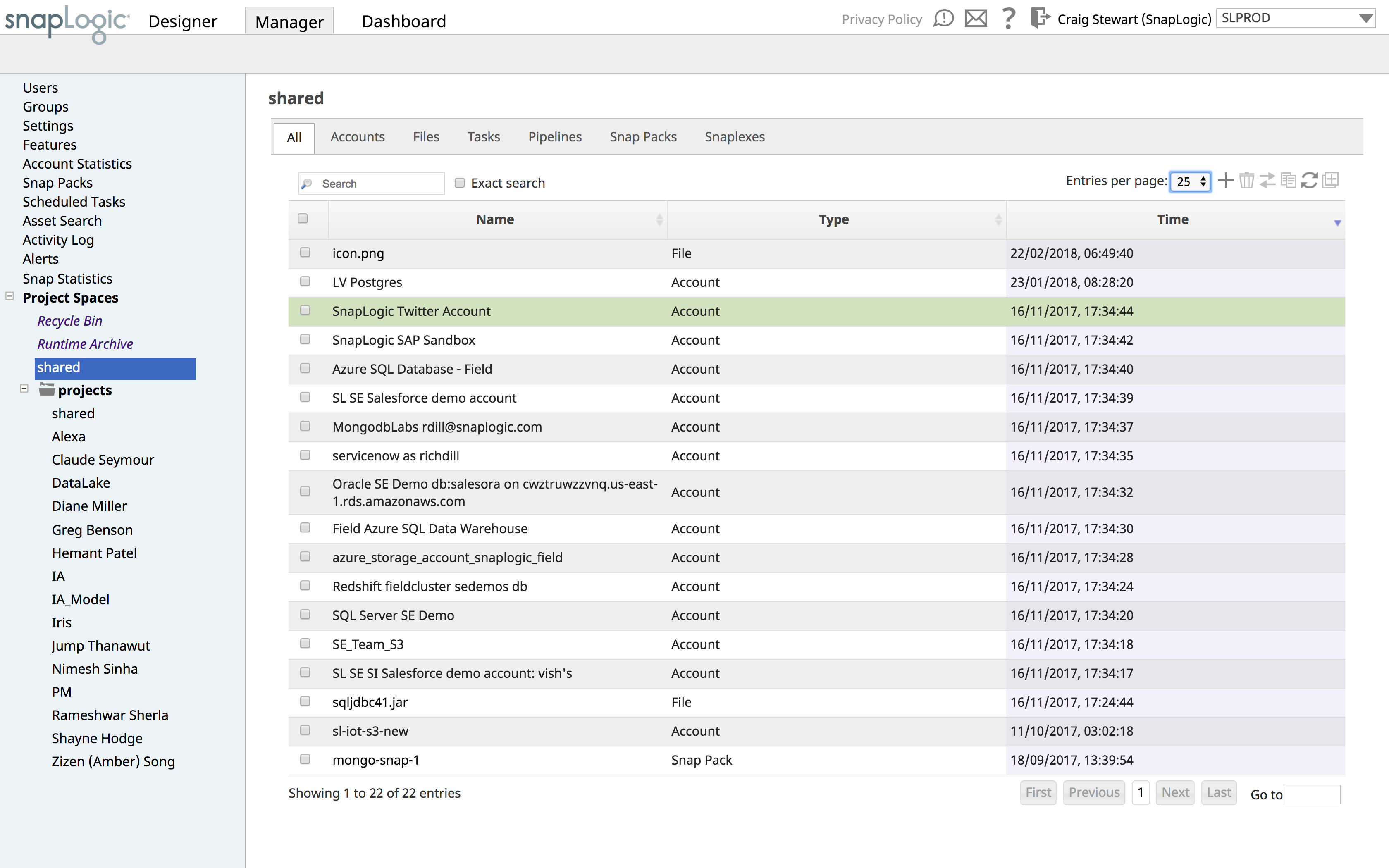
SnapLogic is a cloud integration platform with a self-service capacity supported by over 450 prebuilt modifiable connectors. SnapLogic also offers real-time and batch integration processes for interfacing with external data sources, a drag-and-drop interface, and use of the vendors’ Iris AI.
N/A
Workato
Score 9.1 out of 10
N/A
Workato is a cloud or on-premise automation and integration platform with enterprise-grade
capabilities and no coding required. Workato provides pre-built connectors to integrate with over 300
business applications and enables task automation across apps.
Nintex Process Platform commercial terms are the lowest compared to other BPM tools. The other plus point is it allows the building of API or webhooks to link up with other systems. The RPA license is also included in the bundle, which is not offered by other products on the …
Both products were much more complicated to configure and get started with. With Workato, we had simple integrations set up and running without a couple of hours. With Jitterbit and SnapLogic it required some training just to evaluate it, and also required a lot of …
We use Nintex to automate fundraising outreach at scale. It helps us send personalized emails to a large contact list, and we’d also like to automate follow-ups when there’s no reply. If you need highly customized solutions or clean, fully controllable code, I wouldn’t recommend Nintex. It has many features, but it’s not the same as building your own system from scratch. That said, it can save a lot of time for standard automation workflows.
Snaplogic is unique from other IPASS tools if you're very sensitive about data security as they have an on-premise option where your data never needs to leave your data center. And data pipelines can be quickly created if Snaplogic has the requisite connector to your data sources. On the downside, if you're transforming a large amount of data for example in training machine learning models, a tool with elastic compute capability is more appropriate.
Workato is brilliant to make separate applications work together without much effort or specialists being needed. When specific events on software A should trigger actions on B (or more) and you want that to happen without any development or big budgets, that's where Workato comes into play. It's a great help if you want tasks automated, communications flowing and data synced between different applications.
Integrations with other services using various secure authentication methods, along with the seamless integration with SharePoint, are the icing on the cake. This makes it superior to other BPM tools available in the market.
Flexibility in application development - The diverse configurable properties offer multiple ways to utilise the controls and events, affording the flexibility to expand your scope and enabling the creation and use of processes in a myriad of ways.
The streamlined and efficient deployment process significantly accelerates release management, allowing for faster and smoother implementation of updates and new features.
The user interface of the pages offers a more refined and appealing look and feel compared to most other BPM tools.
The Workato product interface is brilliantly thought through and designed. The learning curve for first timers is easy enough to get started and build useful things, and Workato really shines in their ability to handle complex triggers and interactions. Workato allows people to build software apps so much faster than by coding each functionality.
Workato has fantastic documentation, making things accessible without any holes in the product. The product just works, never has any bugs, never lags, and just generally allows us to see and change exactly what we need to.
Workato has an absolutely amazing support team. We tried the free version for a while, then realized it was the single most important software tool we have, and we upgraded. The support at the paid tier is A+, seriously the best from any company we've worked with. Feels more like a good friend then a support rep.
If you are creating a process with parallel subprocesses, there's no way to see, in a single view in Nintex, all the steps for the subprocesses. You have to view each sub-process in its own view, so it's hard to see what's going on at a high level.
There isn't an easy way to filter the processes by another user (not yourself) in Nintex. There is a report that shows processes and objects by user, but that's not as convenient. This is something that I've seen in other tools (OpenPages by IBM) so I am surprised that it is missing.
Nintex doesn't really have a way to capture iterative processes (which we have a lot of). It's designed for linear processes.
Customer support - responsive, but often not equipped to help efficiently identify root cause of issue. Need to improve escalation to technical resources and turnaround time
Recipe organization and sharing. Can be challenging to copy recipes, or grab recipes from publicly available site. There are often dependencies and errors that have vague descriptions.
We are currently investigating which collaboration platform best suits our needs. Chances are that we move to SharePoint Online and then we're going to also consider the microsoft power platform (power automate and power apps) to develop forms and workflows. Aspecially the pricing model for the cloud is currently a blocking factor to go for the Nintex solution in the Cloud.
This has been hands down the BEST software company I have ever used and dealt with. I am a 25 year IT veteran at this college. They go above and beyond in soliciting our feedback/input and proactively follow up about bugs, issues, etc. I have given multiple potential clients my thoughts and after seeing the SL demo they all sign up. I appreciate their support model, it's REFRESHING!
Based on the on-prem experience with this tool, I believe that they have a lot of potential to help the online version catch up to where the on-prem left off. Nintex developed their online version and it is not as fully formed or capable compared to the on-prem version, and the licensing model scales back what we would have liked to be an expansion or at least continuous improvement of existing flows. It is also not near as user friendly specifically to non-developers and has an uncanny similarity to Microsoft Flow in the online instance. Consistent with my reviews of the tool - I believe they have some good approaches to design thinking that, if translated well from on-prem to online, could make this a clear winner again.
The sheer work Workato eliminates from people's daily jobs is simply a great contribution to people's productivity and a boost to capability. It actually strikes the balance between business and tech teams. It also reduces dependency on developers, and speeds up their delivery too. The only reason it's not a full 10/10 is for the price - it's a bit expensive for what we'd like, and their batch or high data volume processing can be improved.
The Nintex Process Platform has never crashed or had any availability issues during my usage. However there was an issue that was of my own making that caused a slowdown of the system. I had set up a process to run once a day and check for employees on a list that had certain parameters selected, and for some reason that I had to troubleshoot, the process instead ran constantly, which filled the cache quickly. I ended up having to dismantle that process so the system didn't crash.
Unlike any other process automation product out there. Not only is it a low-code, easy to use tool for building processes in environments like SharePoint or Salesforce, they have really started to expand their tool-set by offering tools to manage other things like process mapping, RPA, mobile,etc.
The support team works as fast as they can and they are usually fast to solver the issues. Sometimes they need more time to solve one of them because our workflows and so on are more complex than usual clients.
They can be prompt but they have not been as useful as I've wanted. We had a bug that affected many of our customers through an API connection between SnapLogic and our platform. Eventually they were able to figure it out, but it took a long time of negotiating between our engineering team and theirs. Additionally, we installed the SnapLogic groundplex for our customers and we've run into a bunch of problems of connectivity. If SnapLogic offered to be on those calls with our clients to troubleshoot how to fix these problems, I would give them a better grade here.
They employ an extremely knowledgeable team of problem solvers. I've never had a disappointing interaction or one that has left me still searching for answers. I know that when I ask for help, they'll partner with me until we find a solution together
I used the Nintex training software, it was easy to watch and follow along. It didn't go too fast and was descriptive enough to understand what the steps needed were in order to produce efficient workflows and user friendly forms.
1.Start with Simple Workflows: Begin with basic workflows to gain user confidence before tackling complex processes. 2.Involve Stakeholders Early: Engage business users and IT early to align workflows with real business needs. 3.Comprehensive Training: Invest in user training to ensure smooth adoption and reduce resistance. 4.Leverage Prebuilt Templates: Use Nintex’s templates to speed up implementation and maintain consistency. 5.Iterate and Optimize: Continuously improve workflows based on user feedback and performance metrics.
We discovered that we could not use Workato for our more complex, large enterprise integrations. It was useful for simple workflows that matched the prebuilt recipes.
Microsoft environment does not have the scalability of Nintex; it is perfect for small and medium-sized companies, especially in environments where Microsoft environment is almost entirely used. Although Microsoft offers options to connect to other applications, its platform lacks the development and robustness that Nintex provides. Nintex not only covers Microsoft environments but also Google and other important platforms.
We opted for SnapLogic due its ease of use and the flexibility it offers, it was the platform that was strongest in both application integration and data integration and both were use cases we wanted to be able to cover.
We already used Zapier, but since it doesn't support NetSuite we had to choose another automation platform. Now that we've been using Workato for a few months, we have plans to move the stuff we're going through Zapier to Workato. We set up a trial account with all the other platforms, and they were all more expensive and A LOT more complicated than Workato.
The scalability is really bottlenecked by the imagination of the user. I was able to make processes for my own personal usage, making my daily tasks easier. I was also able to make processes that affected hundreds of employees, making large standardization and efficiency gains. So either way, the system is used the same way, and I was the limiting factor.
People have woken up to the amount of overlap after mapping their processes.
People can be resistant to process changes. You need to have the support from above or support from the 'business' that you are process changing to be able to see the positive impacts.
Numbers talk. if you can get a general salary figure from your HR dept to show savings for 'employee bands', then when you present reports, they will be all the richer in data.
As business consultants, Workato has greatly improved our offerings to our clients as well as improved the time frame to implement automated workflows and integrations.
For our clients, the return on investment is almost immediate. Once a Workato recipe is up and running (which can be done very fast), data is integrating, duplicate data entry and user errors are eliminated, and cross-company KPI metrics are easier to report than ever.