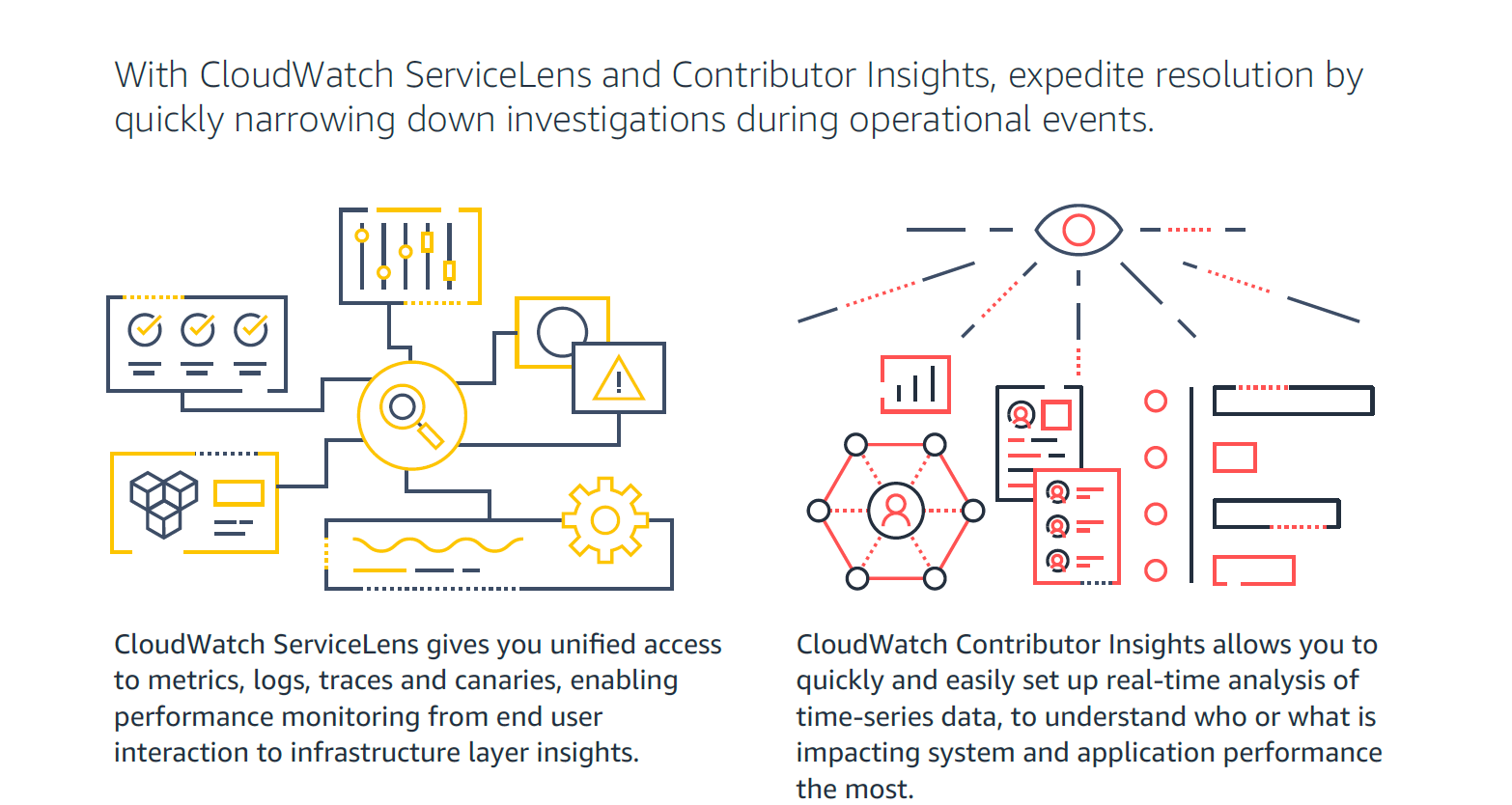
Amazon CloudWatch is a native AWS monitoring tool for AWS programs. It provides data collection and resource monitoring capabilities.
$0
per canary run
CA Unicenter NSM (Discontinued)
Score 3.1 out of 10
N/A
Unicenter Network and Systems Management (Unicenter NSM) from CA Technologies reached end of life (EOL) in 2015.
N/A
Pricing
Amazon CloudWatch
CA Unicenter Network and Systems Management (Discontinued)
Editions & Modules
Canaries
$0.0012
per canary run
Logs - Analyze (Logs Insights queries)
$0.005
per GB of data scanned
Over 1,000,000 Metrics
$0.02
per month
Contributor Insights - Matched Log Events
$0.02
per month per one million log events that match the rule
Logs - Store (Archival)
$0.03
per GB
Next 750,000 Metrics
$0.05
per month
Next 240,000 Metrics
$0.10
per month
Alarm - Standard Resolution (60 Sec)
$0.10
per month per alarm metric
First 10,000 Metrics
$0.30
per month
Alarm - High Resolution (10 Sec)
$0.30
per month per alarm metric
Alarm - Composite
$0.50
per month per alarm
Logs - Collect (Data Ingestion)
$0.50
per GB
Contributor Insights
$0.50
per month per rule
Events - Custom
$1.00
per million events
Events - Cross-account
$1.00
per million events
CloudWatch RUM
$1
per 100k events
Dashboard
$3.00
per month per dashboard
CloudWatch Evidently - Events
$5
per 1 million events
CloudWatch Evidently - Analysis Units
$7.50
per 1 million analysis units
No answers on this topic
Offerings
Pricing Offerings
Amazon CloudWatch
CA Unicenter NSM (Discontinued)
Free Trial
Yes
No
Free/Freemium Version
Yes
No
Premium Consulting/Integration Services
Yes
No
Entry-level Setup Fee
No setup fee
No setup fee
Additional Details
With Amazon CloudWatch, there is no up-front commitment or minimum fee; you simply pay for what you use. You will be charged at the end of the month for your usage.
—
More Pricing Information
Community Pulse
Amazon CloudWatch
CA Unicenter Network and Systems Management (Discontinued)
Features
Amazon CloudWatch
CA Unicenter Network and Systems Management (Discontinued)
Monitoring Tasks
Comparison of Monitoring Tasks features of Product A and Product B
Amazon CloudWatch
-
Ratings
CA Unicenter Network and Systems Management (Discontinued)
6.0
1 Ratings
28% below category average
Automated alerts and notifications
00 Ratings
6.01 Ratings
Management Tasks
Comparison of Management Tasks features of Product A and Product B
Amazon CloudWatch
-
Ratings
CA Unicenter Network and Systems Management (Discontinued)
6.0
1 Ratings
22% below category average
Patch Management
00 Ratings
5.01 Ratings
Service configuration management
00 Ratings
8.01 Ratings
Software and hardware inventory
00 Ratings
5.01 Ratings
Reporting
Comparison of Reporting features of Product A and Product B
Amazon CloudWatch
-
Ratings
CA Unicenter Network and Systems Management (Discontinued)
5.5
1 Ratings
34% below category average
Performance data reports
00 Ratings
5.01 Ratings
Customizable reporting
00 Ratings
7.01 Ratings
Data visualization
00 Ratings
5.01 Ratings
Risk analysis
00 Ratings
5.01 Ratings
Security
Comparison of Security features of Product A and Product B
Amazon CloudWatch
-
Ratings
CA Unicenter Network and Systems Management (Discontinued)
2.0
1 Ratings
108% below category average
Antivirus and malware management
00 Ratings
2.01 Ratings
Best Alternatives
Amazon CloudWatch
CA Unicenter Network and Systems Management (Discontinued)
CA Unicenter Network and Systems Management (Discontinued)
Likelihood to Recommend
Amazon AWS
For out business we find that AWS Cloudwatch is good at providing real-time metrics for monitoring and analysing the performance and usage of our platform by customers. It is possible to create custom metrics from log events, such people adding items to a basket, checking out or abandoning their orders.
It's a decent system if you're a pure IT shop and want to become ITIL-aligned. It forces everyone into an ITIL mentality - service level agreements, change management, and asset tracking. It's very rote, for better and for worse. It's not appropriate at all as a customer-facing or non-IT facing self-service tool. You will never get your end users to really understand how to use the interface.
It provides lot many out of the box dashboard to observe the health and usage of your cloud deployments. Few examples are CPU usage, Disk read/write, Network in/out etc.
It is possible to stream CloudWatch log data to Amazon Elasticsearch to process them almost real time.
If you have setup your code pipeline and wants to see the status, CloudWatch really helps. It can trigger lambda function when certain cloudWatch event happens and lambda can store the data to S3 or Athena which Quicksight can represent.
Memory metrics on EC2 are not available on CloudWatch. Depending on workloads if we need visibility on memory metrics we use Solarwinds Orion with the agent installed. For scalable workloads, this involves customization of images being used.
Visualization out of the box. But this can easily be addressed with other solutions such as Grafana.
By design, this is only used for AWS workloads so depending on your environment cannot be used as an all in one solution for your monitoring.
It's excellent at collecting logs. It's easy to set up. The viewing & querying part could be much better, though. The query syntax takes some time to get used to, & the examples are not helpful. Also, while being great, Log Insights requires manual picking of log streams to query across every time.
Support is effective, and we were able to get any problems that we couldn't get solved through community discussion forums solved for us by the AWS support team. For example, we were assisted in one instance where we were not sure about the best metrics to use in order to optimize an auto-scaling group on EC2. The support team was able to look at our metrics and give a useful recommendation on which metrics to use.
We have to hire 2 full-time 3rd-party consultants to run this application. That tells me it's not a very IT-friendly, vendor-supported application. Compare that with, say, SolarWinds, which is much easier for regular IT staff to customize without sacrificing features and capability. Sure, we have to bring in Loop1 to consult for us when we need to do a major SolarWinds config change or need a really unusual custom query built, but we never need more than 10 hours of consulting per month.
Grafana is definitely a lot better and flexible in comparison with Amazon CloudWatch for visualisation, as it offers much more options and is versatile. VictoriaMetrics and Prometheus are time-series databases which can do almost everything cloudwatch can do in a better and cheaper way. Integrating Grafana with them will make it more capable Elasticsearch for log retention and querying will surpass cloudwatch log monitoring in both performance and speed
I did not select CA. If it were up to me, I would migrate us to ServiceNow. The user interface on ServiceNow is 100% more modern and 200% more user friendly. With ServiceNow, the front page for end users makes it clear: one button that says "Ask for something" and one button that says "Report a problem". That's what our end users need. The biggest problem we have in our organization is that our end users don't report issues to the Help Desk often enough and rarely ask for things through the Help Desk. A clean, simple self-service option like this would open up a world of new information for our customer service team.
It was integral during our large IT consolidation 10 years ago in merging 10 different IT departments into one by converging on one ticketing system for all IT issues.
Its lack of user-friendliness has gated us from being able to deploy a true self-service IT help desk.