Basecamp is a web-based project-management tool. Basecamp offers features standard to project management platforms, as well as mobile accessibility, unlimited users, and 3rd party integrations. Basecamp is priced by space requirements and concurrent projects.
$15
per month per user
ClickUp
Score 8.6 out of 10
Small Businesses (1-50 employees)
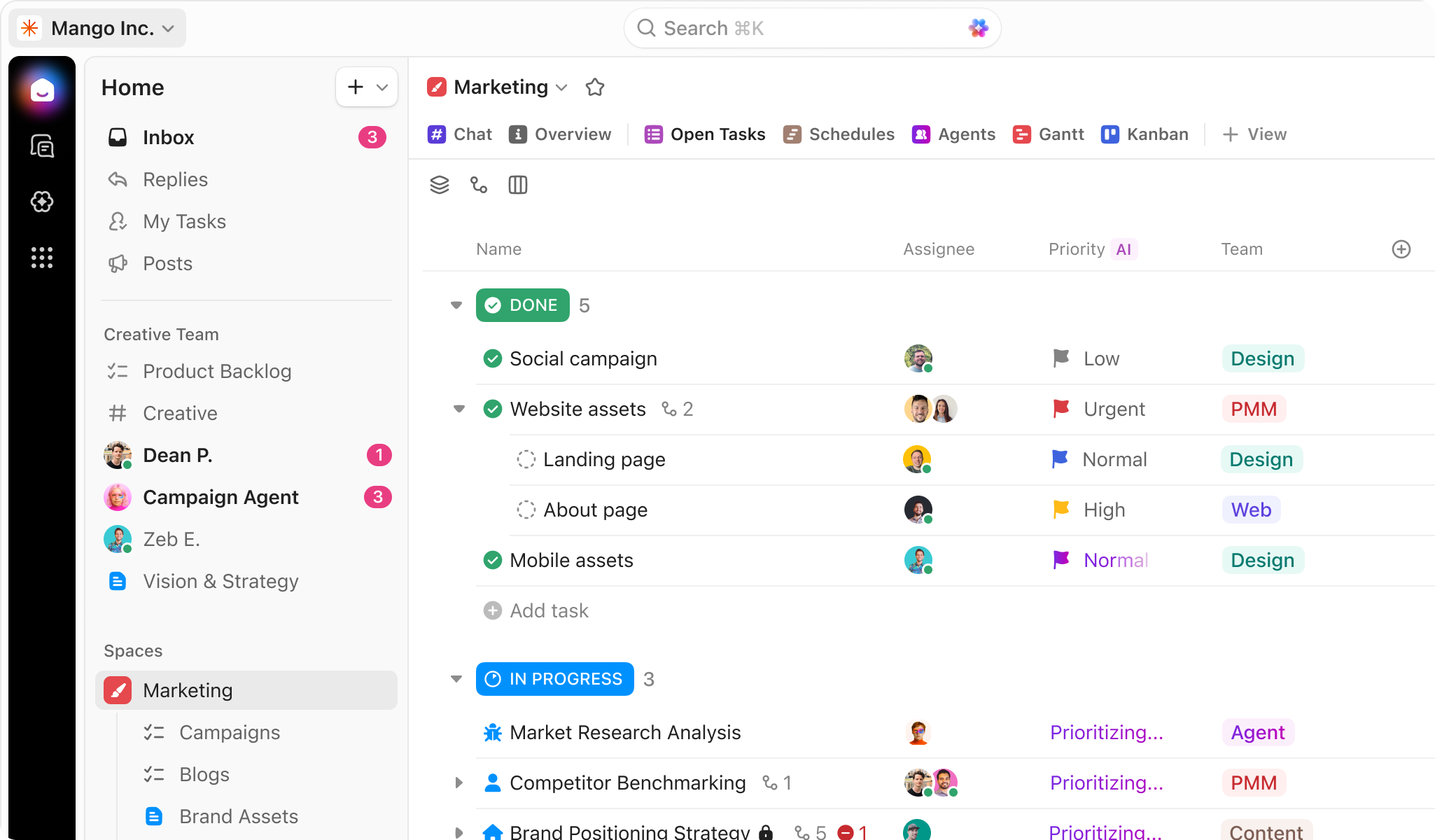
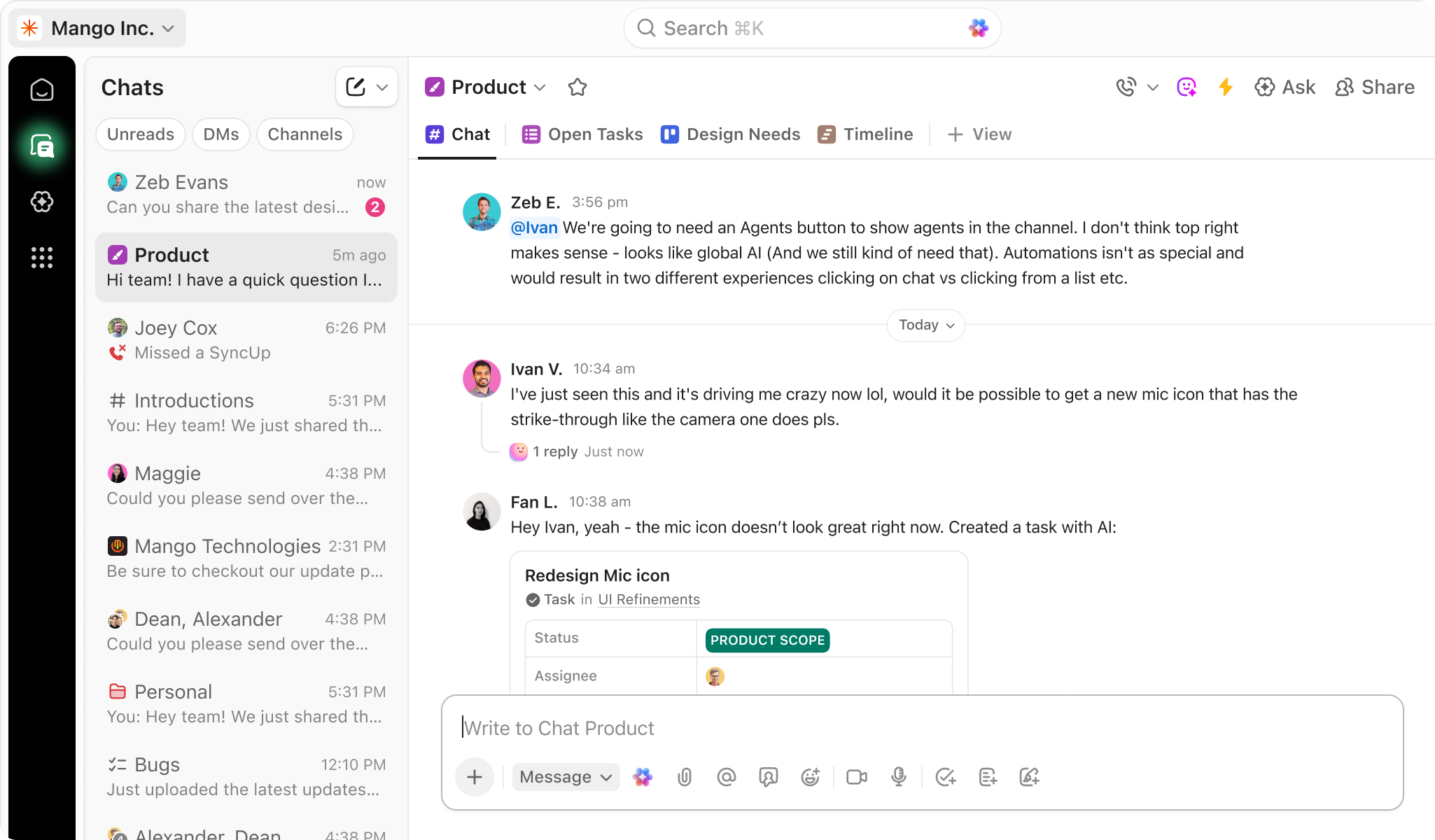
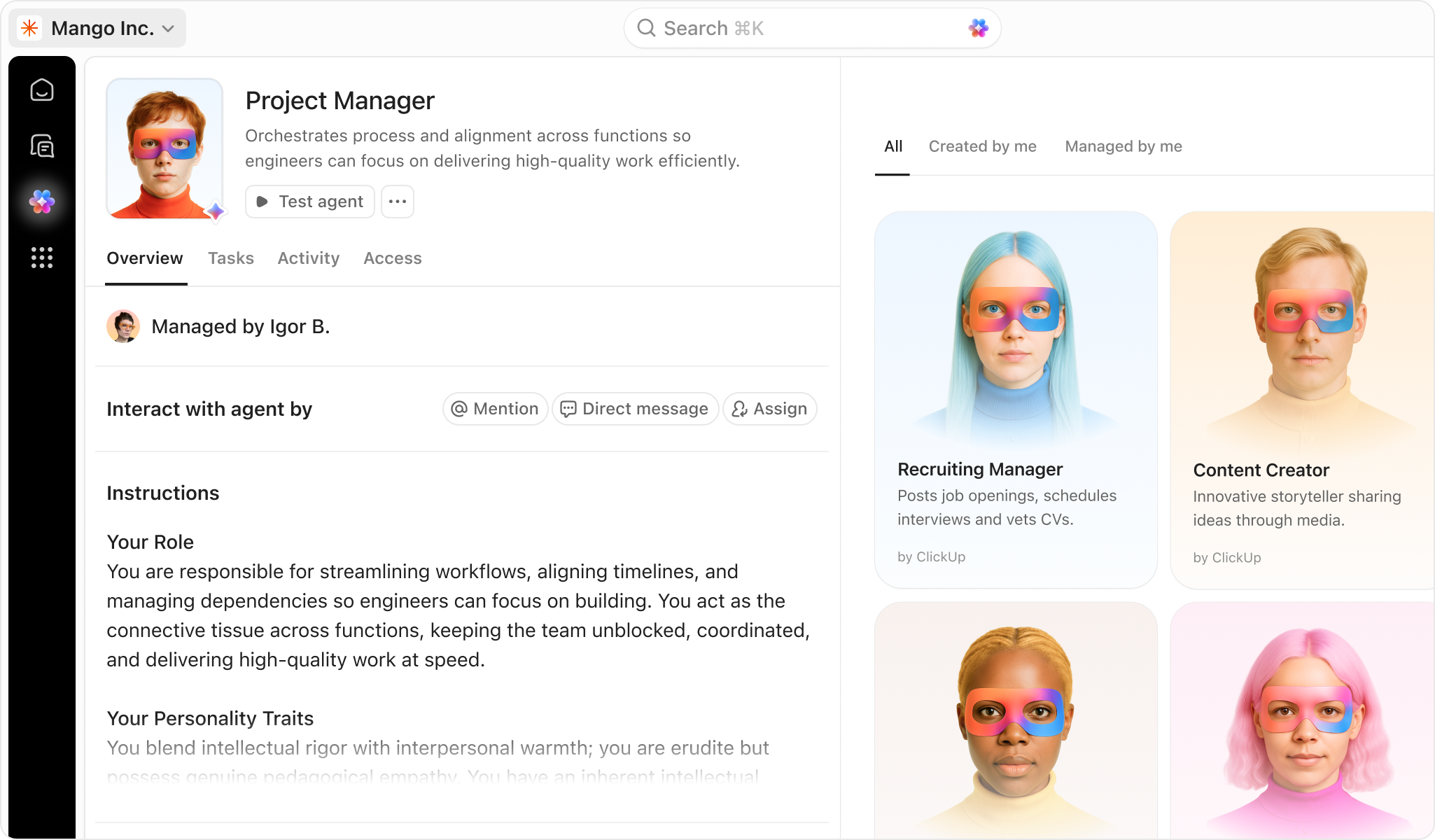
ClickUp is a productivity platform that brings together work apps, data, and workflows. Also presented as a Converged AI Workspace, ClickUp eliminates work sprawl to provide context and a single place for humans and agents to work together. The platform currently boasts over 20 million users worldwide.
$0
per month per seat
Power Apps
Score 7.9 out of 10
N/A
PowerApps is a low code / rapid application development product from Microsoft that allows users to quickly build apps.
Basecamp if far simpler than ClickUp. We use ClickUp to manage our internal task management, as it provides more customization, additional views and more room for extreme detail in tasks. We used Basecamp for clients because of its simplicity and ease-of-use. Basecamp requires …
I've also used ClickUp and Asana. My personal favorite is ClickUp although it is limited in how it integrates with Slack which caused me to switch to Asana. ClickUp has a ton of features, including on their free plan and in my opinion is much better than Basecamp. Asana is …
Verified User
C-Level Executive
Chose Basecamp
in my opinion, it is Inferior, clunky, ugly product as compared to the others. I only selected Basecamp on recommendations from someone else who was using it, and have moved on to ClickUp. This Basecamp app failed to notify myself, my teammates and the client so many times, …
Verified User
Manager
Chose Basecamp
Trello is less expensive and the free version works pretty well. For the paid version, Trello is also a really great tool. Overall, I do like Basecamp better. It's a more simple layout and structure to the software. I like the communication threads better on Basecamp. Trello …
Basecamp is probably my least favorite. As a project manager, I'm always auditing our workflow and processes, so I try to run at least trials of project management software to get a feel for if they would help us do things more efficiently. I struggled the most with Basecamp.
Basecamp is simple to understand, easy to use, and does not come with the bloat and complications of a solution like Teams. It is certainly more organized and easy to follow than simply having a group chat on Slack and Viber. If you need to easily find information, it can be …
There is a simplicity that basecamp offers where most other project management systems seem to miss. They've worked hard at keeping the right things in place and not adding so many of the extra features that just get in the way of getting work done. The thing I liked most …
It's easier than Asana, more complete than Trello (even in the free version!) and easier to use than Basecamp...And the ability to integrate with other services like Google Calendar, made me choose clickup rather the competition.
Basecamp: ClickUp far outshines Basecamp in a number of ways, with the primary way being the innate flexibility of the platform. Basecamp has a much easier onboarding experience, but the ceiling of the platform is much lower. ClickUp can simply do more. Slack: ClickUp does not …
ClickUp captured all the best features from all those tools. The hierarchy beats them all. In Basecamp, Trello and Asana, you have to check each board or project to see what is happening there. The Butler automation in Trello does not match what ClickUp can do. Airtable is …
Verified User
Manager
Chose ClickUp
We were limited with the way Basecamp was designed. ClickUp allowed us to fully customize the experience to fit our needs. This also helped us be able to identify projects with a unique number/letter sequence, which helped us to better archive completed work on shared servers.
Prior to ClickUp, we were using another project management software (Basecamp) but things were never centrally organized. ClickUp has allowed us to locate all of our work in once place and put all of the details for every project in one, unified location. We don't have to …
ClickUp Compared to like an Asana or Trello - it's ClickUp Hands Down! ClickUp gives you so many more features and tools to use that will help get and keep your teams on track. Your clients and staff will all be super happy once implemented.
Throughout my career, I have used at least a dozen different project management platforms and tools for keeping projects moving along. While I have used project management tools from some impressive names, I found that most of them weren't very impressive at all. In so many …
It has a friendlier interface, increases the number of available features, and is supported by integrations with third parties to meet all needs from a single platform. On the other hand, it is multi-device, and its tool for mobile teams offers everything that is needed to keep …
It's give and take. ClickUp has some features that the others don't but it is also something that requires more education to use to it's fullest. Other products are more simplistic and we have had to really emphasis training on ClickUp so everyone feels like they are on the …
ClickUp blows other products out of the water from what I've seen or been able to do with them in the past. It's not only super flexible, it also contains functions that may require you to duplicate information between different software's elsewise or at least need you to use …
With each of the other platforms I've used, there was no one-stop-shop. We always had to use outside platforms or add-on processes to supplement what was missing. Sure they had good enough features but good enough wasn't good enough. We are an innovative company that operates …
It has all of the capabilities of these other platforms and more (at least from what I remember when using these apps). There is also greater capabilities in customization and integrations.
ClickUp has greater flexibility - particularly in the views than all the other software we've tried. The ability to see tasks for yourself or your team or multiple teams is incredibly powerful for accountability and focus on priorities.
Basecamp is a wonderful tool for teams of varying degrees of technical knowledge, teams managing lots of different types of "agifall" and waterfall projects, and teams that are remotely distributed. It's probably less useful for more strictly agile-focused development teams, compared to other more flexible software applications like Jira and Asana.
ClickUp is well suited to organize projects and communicate internally with teams members and externally with clients or vendors. If you need to track emails, any emails responded to from an email sent within ClickUp is automatically tracked within the task where it originated. It also works great for storing document files within projects and tasks and tracking multiple versions of documents created or copied within ClickUp
Power Apps is ideal for scenarios that are neither too complex nor too large. It is easy to begin development in Power Apps, as it is one of the best tools for low-code development. Power Apps can be implemented for complex scenarios as well, provided there is strong knowledge of the tool and ample time for planning. Our applications benefit from Power Apps' cross-platform support, making it easy to use on any device, including desktops, laptops, and mobile devices.
Task management - It is very easy to add, organize and discuss tasks within Basecamp's interface.
The "Campfire" function is great for communicating when you just have a quick question for someone on the team.
Notifications - Basecamp lets you decide how often and about what you'd like to be notified. The ability to respond to messages in Basecamp directly via email saves a lot of time.
Customization is huge for us! We do not have the aspects of standard project management, so having the ability to customize basically everything in ClickUp is amazing.
An outstanding free version of the software! We are a small nonprofit organization that cannot afford the robust levels of other software, so having access to SO MUCH for free is incredible.
The layout and organization of tasks, Spaces, folders, etc. is perfect. I love how I can see which task all of my subtasks belong to on my dashboard. And the option to change colors and icons for everything also really appeals to my obsessive brain.
Power Apps has formats that are pre-built that don't require any coding which makes it easier to achieve your vision. This does become a challenge if your App needs don't fit into that format.
We deal with a ton of data so the fact that you can connect to any data source in addition to their pre-stablished data connections makes the process a breeze.
The online learning resources and tutorials are helpful as well for those who are tech savvy.
High Learning Curve. It's true that it can be easy to use, but to use well and effectively takes some time to learn. It's recommended to have an agreed-upon system in your team of what tools to use and when.
Notification Overload. If people aren't careful they could send a notification to everyone when only a couple people were meant to be prompted. And since emails are sent by default, you could have your mailbox overloaded with unnecessary updates. This is where it takes a bit of training in your team to have an agreed-upon system.
Lack of organization with Archived Projects. I will often need to reference an archived project to make a new one, but there is only a list of archived projects in alphabetical order, with no way to organize by archive date, or even search.
Sometimes the cost of solutions is greater than the benefit. Licensing is expensive relative to the scope of some business user-created personal or team-level solutions.
While there is a starter-kit for Governance, it is complicated to stand up and requires dedicated resources to provide on-going governance operations. Many organizations are not going to be able to dedicate resources to governance and this causes the sprawl, solution duplication, silos, unneeded and unplanned licensing expenses, and a general "wild wild west" environment.
There needs to be better direction and best practices given around Power Platform Environment utilization and optimization.
The accessibility to the platform and ease for business partners to independantly create solutions is both a benefit and a negative. When the business outcome needed is a good fit for PowerApps it is a quick win, but when not a good fit it becomes a frustration for the business partner attempting to make the platform do something it is not well-suited for. The business partner entangles tech teams in the effort which drains resources and provides a lack-luster solution. All of this to say, it would be beneficial to have some tools that business partners could leverage to determine\understand if the type of business outcome they need is well suited to PowerApps or not.
When I bring new people onto a project, it's immediately obvious how to use Basecamp. I don't have to worry about teaching them the features or walking them through it, it's just incredibly user-friendly. For this reason, I'll continue to renew my subscription even as new people are brought onto production jobs or the client changes.
It has been a game-changer in terms of project tracking, as animation is a demanding product that requires multiple layers of analysis, revisions, tracking, scheduling, etc. ClickUp simplifies many approvals as anyone can easily add items, and you can tag the people who need to look at them.
It is easy to use, even for clients who have no experience with the platform. It can only get a little cumbersome to ensure that a client can't see certain documents you might want to keep in the Docs & Files folders. And sometimes, getting a client to actually use an unfamiliar platform can be a challenge.
Because for me, working with teams, ClickUp has provided a service that we longed for. Something that is non-complicated and easy to maneuver. We understand the learning curve can be steep, but we are willing to give the software a chance because it is everything we hoped it would be. However, leadership found the project works for our organization at this time. Moreover, we can customize to our needs.
PowerApps is a great solution and I have spent the last year familiarizing myself with the platform and building custom applications to complete a whole range of tasks such as asset management, custom invoice generation, and item restriction tracking. We as a company have barely begun to scratch the surface of what can be achieved with PowerApps.
I've never experienced downtime while using Basecamp, or been unable to access it when I needed it. That's not to say they've never had downtime, but I've been lucky enough not to encounter any, and I work odd hours, including late nights when maintenance is often undertaken.
For over a year ClickUp was unavailable to us just twice for a couple of hours. I would say for a system this big and working globally that was a minor issue. They managed to fix all the issues within a couple hours and then it was back up and running perfectly fine.
The speed of ClickUp is average to be honest. This is one of the biggest flaws of the system, sometimes it's also lagging a little bit but we also have a lot of documents, lists etc. on our workspace. However, with the next version of ClickUp I've seen they are planning to increase the speed by almost 500%, probably by changing the technology, so I am more than looking forward to it.
For the many reasons I've given, Basecamp is a very strong program. There are a few features I can imagine that might make it even better, but I don't have a basis for comparison to be able to say that there is definitely a better one out there. I've noticed that Basecamp has evolved a bit from the time I started using it until now, so that makes me think that the producer of this program values it and believes in continuous improvement. If you could use the features offered by Basecamp, I would think you could use it with confidence.
I started using ClickUp when it was what most would consider a baby company. There were the occasional bugs that made working in ClickUp a little bit of a headache, but the support feature allowed me to chat with a real persona and communicate my issues. I would always get prompt support and someone willing to really help me, not just point me to FAQ pages. Not feeling like a number really makes a difference.
The community forums are extremely responsive to questions asked, there is a good body of online documentation and many community posts to draw from. Although the platform has changed, which means some of the posts are out of date and the solutions provided aren't relevant. Of relevance, I read over 400 articles plus documentation to get this first app built in SharePoint, move it to SQL and make it work exactly the way it should.
There are multiple guides on literally all of the functions you can find within the system, therefore it's easy to learn anything you'd really like to use, starting from project and people management, down to Gantts, mind maps, time tracking, inviting Clients as guests to work with you on the projects and so much more.
Decide the process before implementation - i.e. when it's due 8/9 does that mean 8am, noon, 5pm, 11:59pm? Check your to-do list frequently Set-up templates - just not with the dates (they can be funky)
Start small. Don’t try to build the most elaborate plans first. Resist the urge to get into Gantt charts if no one is used to them. Just get work written, add dates and assignees, and start getting used to it. If you did not use a work management tool before, you need to be gracious with yourself about the fact that you likely do not have the muscle memory for working this way yet. But you will get there.
And leverage people who know it if possible. Look for ClickUp experts and vendors. They can really supercharge your effectiveness at building the tool out and speed up the process.
Pretty good, but [Basecamp] has its drawbacks. Honestly I find the interface non-intuitive and sometimes have trouble figuring out how to change the status of a task. Perhaps it has something to do with the way it was originally set up by the admin, but I'm not sure. I liked Jira's drag and drop obvious functionality, but the project management side of the software was lacking. Smartsheet has excellent project management functionality, but the task management isn't as good.
I used Salesforce at my last job and would recommend ClickUp if utilizing the product for more than just sales. My last company tried using Salesforce for a number of other actions, such as department project tracking, client documentation, and outbound communication which did not work well. ClickUp is far better at managing multiple levels of organization within a company.
1. PowerApps functionality comes with E1 over E3 License without adding extra costs 2. For Nintex you pay (at the beginning) for each workflow, so my intention would be, to do no workflows to prevent additional costs, but I want a platform with a fair price that allows me to create workflows without thinking about the price for each workflow and we use only some workflow and relative easy workflows and forms as a medium-sized company. 3. PowerApps provides a lot of functionality without needing to invest in premium features directly.
Scaling with ClickUp is superb. If you create a workflow best suited for your organization then it's all about creating new accounts and teaching the new employees the workflow you're using. It's that simple. There is no black magic when it comes to Clickup.
It has saved me time when having to get the same message out to multiple restaurants
It has helped us make smarter operational decisions because we can all collaborate on an answer in a shorter amount of time (instead of calling a meeting!!!)
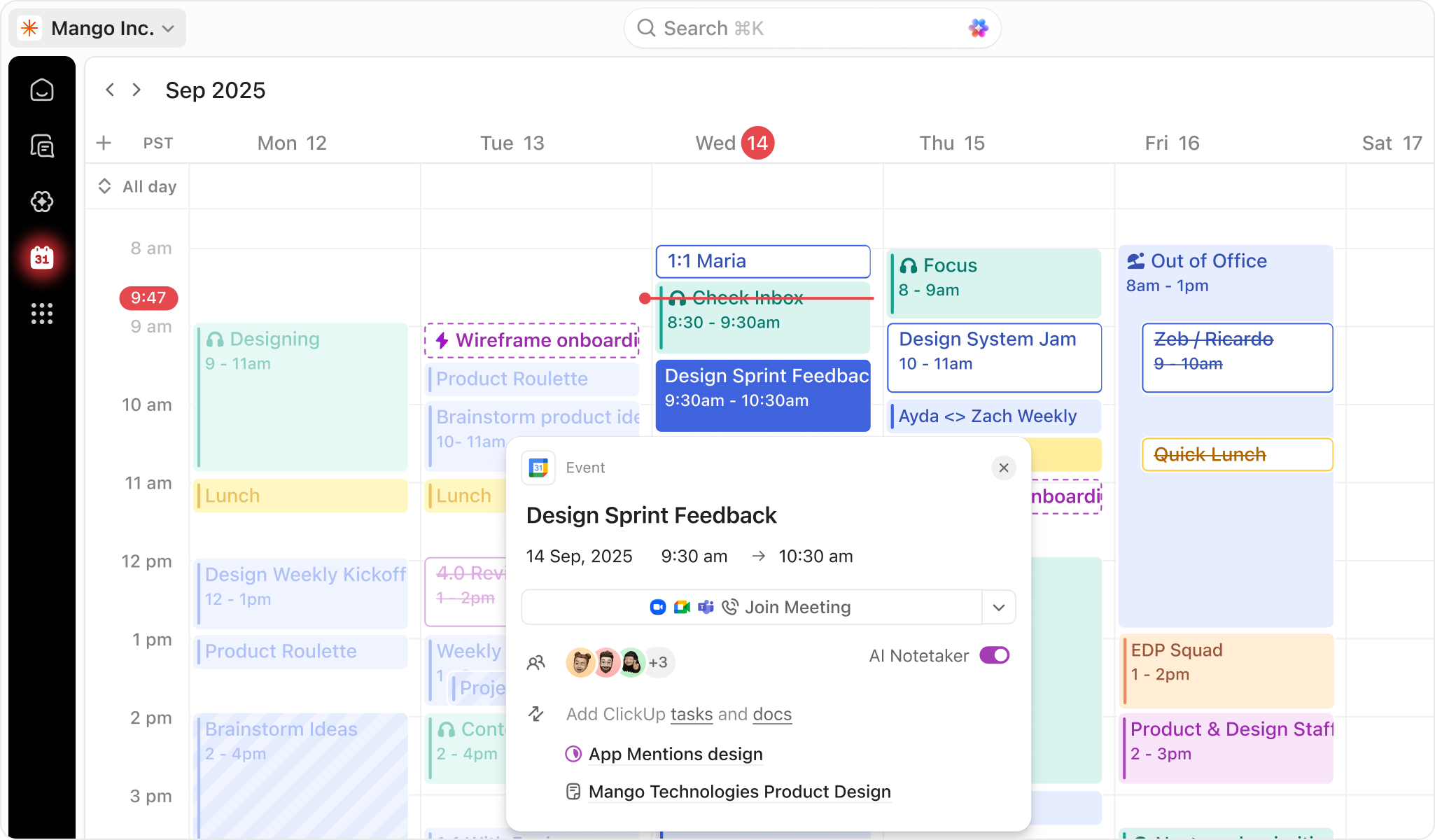
The calendar function allows us to plot out our marketing agenda for the month and add/change it together as needed. The chef will post his recipe, the managers will cost it out, the social media manager will post pictures on it, and ultimately we will get that information out on an info sheet to the staff by printing the page.