Basecamp is a web-based project-management tool. Basecamp offers features standard to project management platforms, as well as mobile accessibility, unlimited users, and 3rd party integrations. Basecamp is priced by space requirements and concurrent projects.
$15
per month per user
Kintone
Score 9.4 out of 10
N/A
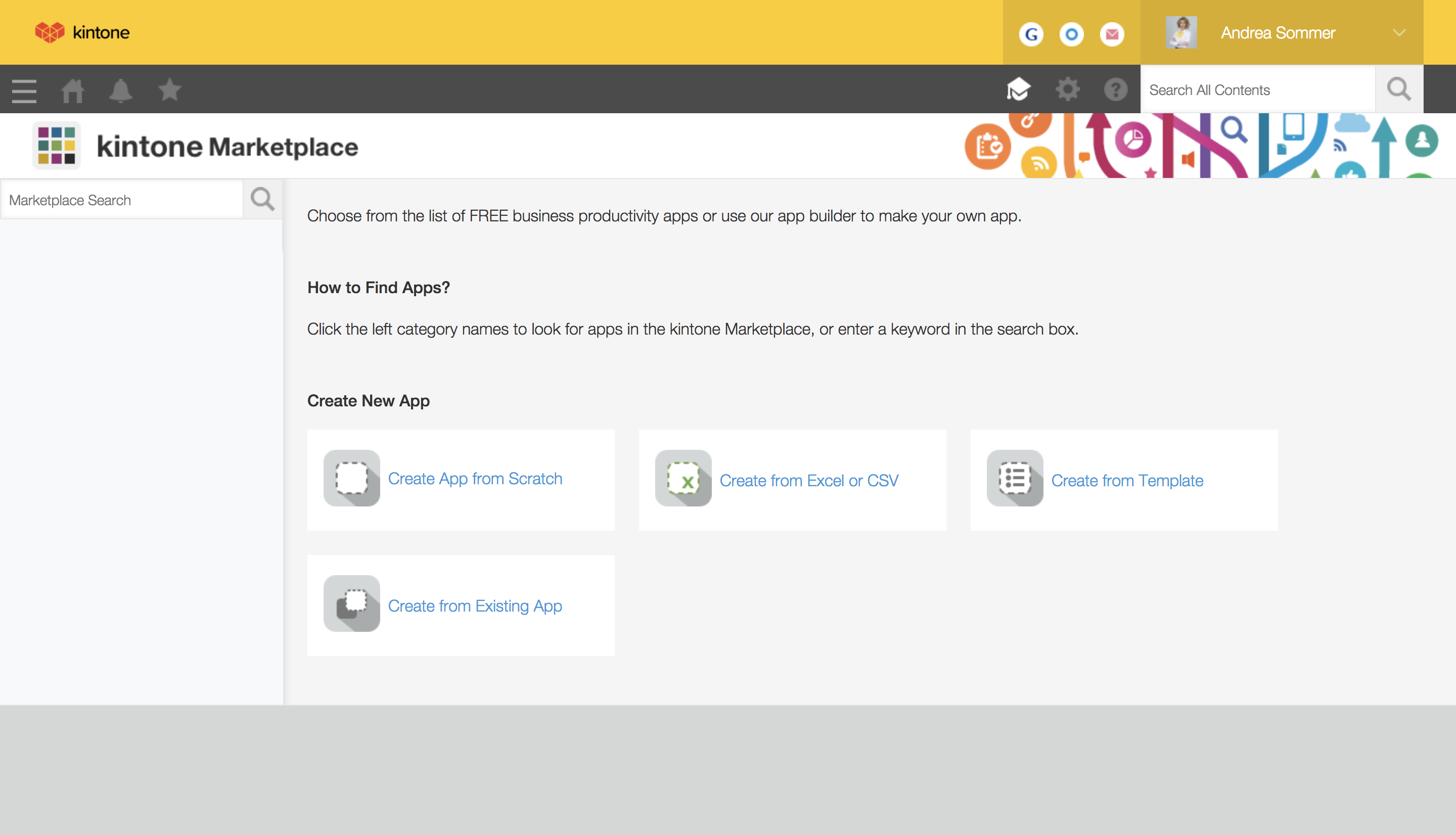
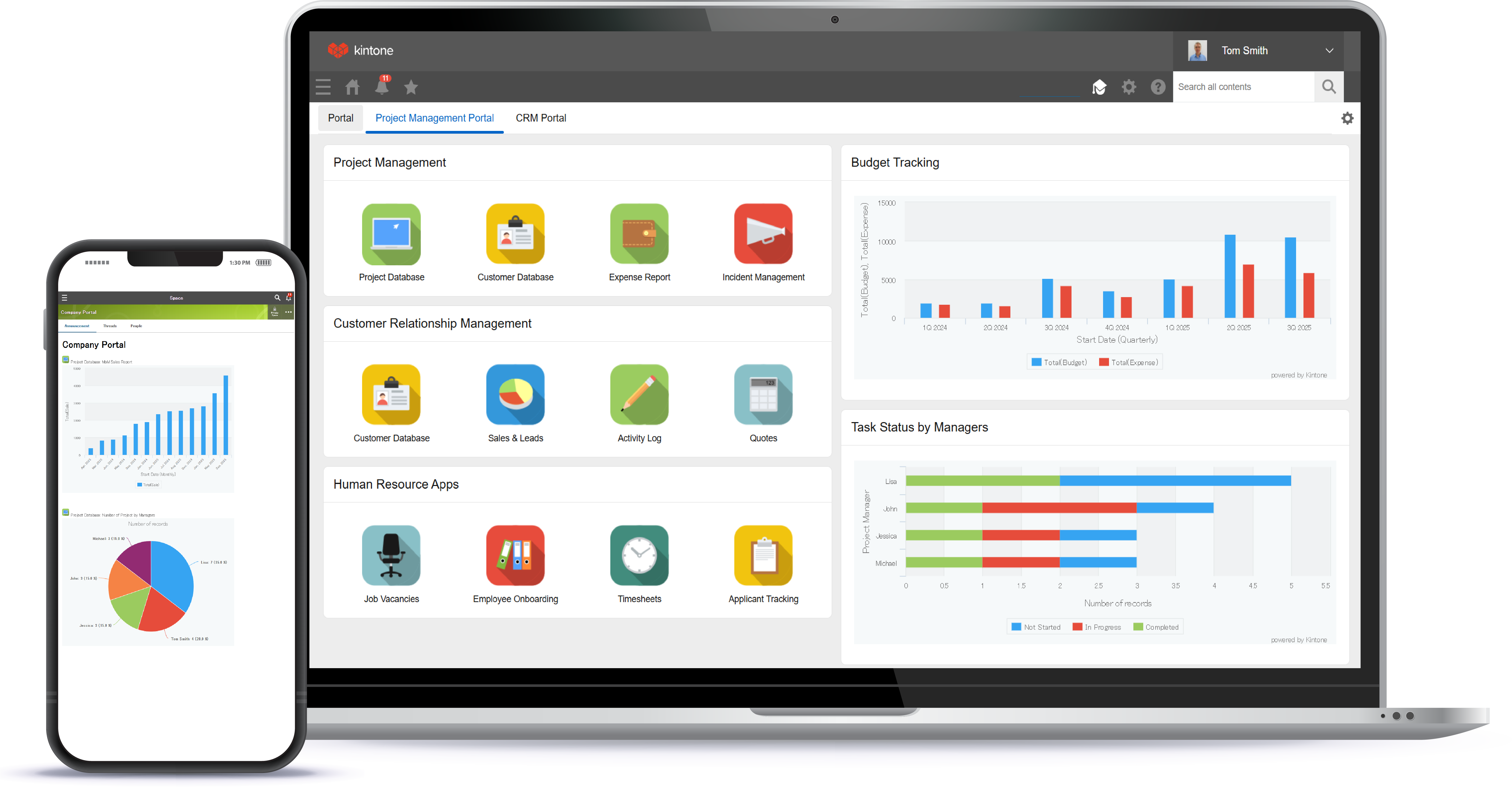
Kintone is a customizable digital workplace platform used to manage data, tasks, and communication. The no-code drag-and-drop interface can be used to create custom applications.
$120
per month for 5 users (minimum)
Teamwork.com
Score 8.5 out of 10
N/A
Teamwork.com is a project management platform built specifically for client work. The platform helps users deliver work on time and on budget, eliminate client chaos, and understand profitability. Teamwork.com’s customers track and manage their projects with a suite of integrated solutions such as helpdesk, collaboration, knowledge sharing and customer relationship management add-ons, enabling Teamwork.com to be the ‘one-stop shop’ solution for business owners. Headquartered in Cork,…
$13.99
per month per user
Pricing
Basecamp
Kintone
Teamwork.com
Editions & Modules
Basecamp Plus
$15
per month per user
Basecamp Pro Unlimited
$299
per month (billed annually)
Basecamp Free
Free
Limited Capabilities
Professional Subscription
$24
per month per user
Deliver
$13.99
per month per user
Grow
$25.99
per month per user
Free Forever
Free
Up to 5 users
Scale
Contact sales team
Offerings
Pricing Offerings
Basecamp
Kintone
Teamwork.com
Free Trial
Yes
Yes
Yes
Free/Freemium Version
Yes
No
Yes
Premium Consulting/Integration Services
No
Yes
No
Entry-level Setup Fee
No setup fee
Optional
Optional
Additional Details
—
Minimum requirement of 5 users. Kintone offers a free prototype to build with using existing process.
There is a simplicity that basecamp offers where most other project management systems seem to miss. They've worked hard at keeping the right things in place and not adding so many of the extra features that just get in the way of getting work done. The thing I liked most …
Comparatively, Basecamp has been found to be the easiest to use and onboard new users. Additionally the cost model for our organisation is much lower on Basecamp compared to the competition.
Other products are more aligned with Agile practices but for most of our operational …
Basecamp links all of the functionalities of a messenger feature (thanks to Pings) with task delegating and managing the project. Marketer's life became much easier with Basecamp.
I'd say Teamwork is a very robust platform, more than Basecamp but that was actually what threw me off. Basecamp wins in its simplicity and interface. Trello is easy to use but limited and in some ways hard to follow. Basecamp wins in its features. Asana however presents the …
We started with Basecamp and switched to Teamwork Projects because of it's greater flexibility with tasks especially. After using both I do prefer Teamwork Projects because of the many features. However, we aren't completely happy with it and are looking into other software …
Teamwork Projects was a better fit for us. With Basecamp, we had to set up tasks as milestones to assign due dates. At the time we reviewed it, you could assign tasks to milestones but would not have a date associated with it; we lost the ability to see if we were on target …
Teamwork Projects is better organized than other online tools. It is well though out and organized. Having the ability to set priorities and order on lists is a big deal for us. The best part was being able to toggle from lists to cards and get a visual indication of what is …
We used Basecamp extensively and really dislike that tool. Teamwork Projects is so much better. We evaluated Wrike and Asana before ultimately deciding on Teamwork Projects. We felt it was a better option over those two for our use case.
We used Basecamp for many years until about 2017. When Basecamp was getting upgraded from 2.0 to 3.0, I believe we found that we couldn't migrate our projects easily. So we started to look for new solutions and found that Teamwork Projects had much more customizability than Base…
Teamwork is way better than ProWorkflow in every way, especially design (UI). PWF was hard to use and that resulted in people not using it and logging time--which caused a whole bunch of business problems. Compared to Basecamp, TW Proejcts is way more organized and easy to …
Teamwork is definitely an upgrade when compared to Basecamp or Trello. It has more customizing capabilities, time tracking, file sharing, messaging and much more. The nifty feature is being able to give your clients selective access, so they can follow the progress without …
Teamwork Projects has a better feature set than Basecamp and we also found the pricing to be more attractive since we only needed a handful of users. The pricing structure of Basecamp with unlimited users would be more attractive for larger teams and for future-proofing growth. …
I prefer Teamwork over monday.com and Google Drive, but it could still use more functionality. We primarily use the Gantt chart, but I wish there was more functionality. There aren't as many features as I would like and I wish we didn't need to pay per user. I like things like B…
Basecamp's user interface isn't as friendly, and it's much harder to find your way around. As web developers ourselves, if we can find our way around a web-based tool, we can't recommend it to our clients, so we tried Teamwork, found it was very easy to use, and have since …
Every application has its own Pros &Cons but Basecamp pricing is not much flexible either they had flat per month rate for businesses. Teamwork Graphical user interface is better and their free version is also a plus point. Basecamp only offers 30 days free trial.
I spoke about this quite a bit before, but as far as usability goes, Microsoft Projects is totally useless for me, so I avoid it at all costs. Basecamp was just a task management app and had very small feature set beyond that. We had to rig it to do other things for us, but it …
Teamwork was the choice for us during the first few years, as it was accessible and affordable. Later on, Asana and monday.com delivered superior features and functionality.
For my purposes, Teamwork blows all other project management systems out of the water. They are providing more frequent updates as well so the software is always improving. Teamwork's mobile app isn't as good as some other's, but that is not my main device, so that doesn't …
Our team overwhelmingly preferred Teamwork Projects to other project management tools. It is reasonably priced while still offering an equal or better product.
Teamwork has not only a Kanban view and Gantt chart view, but it also shows a calendar view, board view, and list view. It's very comprehensive and gives its users freedom to customize the viewing experience where several other competitor platforms only show one or two views.
We have tried a lot of different tools, but settled on the robust solution that Teamwork Projects provided. The others just seemed to lack in what we needed.
The size of our organization (75 employees) and the type of projects we manage, we selected the least robust platform that could still allow us to perform project management well. We are really proud of what we have accomplished with Teamwork and we can recommend it to anyone …
We chose to migrate to Teamwork Projects after a recommendation to try it. We believe the platforms are very similar but that Teamwork Projects is potentially better suited for us as we continue to scale and grow out team.
On the whole Teamwork Projects comes across as the preferred solution due to cost, speed of adoption, support for multiple devices, licensing models, support for internal/external users, email services, integration capability and the support services. Furthermore, the …
Teamwork Projects stacks up against them with one feature and it is tracking time. It is intuitive, but you need to give it some time - at first it may be a bit of an overwhelming tool, simply too difficult to use and enjoy.
Basecamp is a wonderful tool for teams of varying degrees of technical knowledge, teams managing lots of different types of "agifall" and waterfall projects, and teams that are remotely distributed. It's probably less useful for more strictly agile-focused development teams, compared to other more flexible software applications like Jira and Asana.
Kintone is great if you want a software that will help you in managing your data, and keep track of which tasks are assigned to whom. It also helps to streamline communication and information in one central place. However, it is not for you if you are looking for something complex that has to manage a lot of data.
Teamwork is awesome for teams who need a flexible tool that supports all types of projects. Since it supports kanban it makes visualizing the work to be done and the work in progress very easy. The Gantt chart support is decent and helps to understand how a team is doing when it comes to getting work done in a given time frame. Teamwork isn't a great option for companies that have a bunch of projects going simultaneously due to the way Teamwork structures their billing based on a number of active projects.
Task management - It is very easy to add, organize and discuss tasks within Basecamp's interface.
The "Campfire" function is great for communicating when you just have a quick question for someone on the team.
Notifications - Basecamp lets you decide how often and about what you'd like to be notified. The ability to respond to messages in Basecamp directly via email saves a lot of time.
High Learning Curve. It's true that it can be easy to use, but to use well and effectively takes some time to learn. It's recommended to have an agreed-upon system in your team of what tools to use and when.
Notification Overload. If people aren't careful they could send a notification to everyone when only a couple people were meant to be prompted. And since emails are sent by default, you could have your mailbox overloaded with unnecessary updates. This is where it takes a bit of training in your team to have an agreed-upon system.
Lack of organization with Archived Projects. I will often need to reference an archived project to make a new one, but there is only a list of archived projects in alphabetical order, with no way to organize by archive date, or even search.
I feel that Kintone is not well enough known yet. This means that other apps/APIs are not necessarily easy to connect with Kintone. Yes, you can use Zapier though for interfacing with other apps.
It would be great if it could give more customized options to change the look and format of certain things. You can make price quote apps, for example, but have to rely on 3rd party apps or programming skills to customize the look and fields.
If you make a table as an input field, it cannot connect to other internal Kintone apps for lookups and such.
I think there is more potential to make more customized data graphs.
Visualization needs to be improved, charts graphs are limited
Value stream mapping should be available to determine and prioritize the work.
Documentation should be available stepwise with export and printable facility.
It should be configurable like ERP with cross functionalities of different users, where users login, assign and approve the work, job or project details, where it should be collectively effected on a project.
Add many examples, little more AI, Machine learning required for suggestion and recommendation. It would be a plus point
When I bring new people onto a project, it's immediately obvious how to use Basecamp. I don't have to worry about teaching them the features or walking them through it, it's just incredibly user-friendly. For this reason, I'll continue to renew my subscription even as new people are brought onto production jobs or the client changes.
I still think that there's a room for Kintone's future, and high expectations for them in additional features and innovative tools and supports. Truly hope that they will support email features, and standardized supports for various plug-ins with the 3rd party software and apps. In the meantime, we will have to consider our ways of doing our work in all aspects
We are already at an annual contract, and have been for the past 5 years; so far the system has delivered, and our personal is already trained in it. A major overhaul of our entire infrastructure (as in moving everything to a single, unified platform) might change the current continuity of Teamwork Projects on our organization, but that's not feasible in the near future.
It is easy to use, even for clients who have no experience with the platform. It can only get a little cumbersome to ensure that a client can't see certain documents you might want to keep in the Docs & Files folders. And sometimes, getting a client to actually use an unfamiliar platform can be a challenge.
While, we have been quite happy with out choice to use Kintone, there are a couple of things (mentioned previously) that would make the experience better. Overall, it has been the best fit for our organisation. We are still in the process of building out a needed API and integrating that, so we have yet to reach full functionality with one of our apps in Kintone. Once we have that completed, I think we'll have a better idea of how well it truly works for us
I give it a 9 out of 10, because there is a bit of a learning curve when you first start using Teamwork Projects because there is a lot to learn & recognize where to find it. They do offer a good range of tools that can be applied to every project - So say you're working on an internal project and don't need Milestones or Billing, you can shut those modules off. This can help simplify the interface for beginners. Once you've had a few days in Teamwork Projects, I think it's a 10/10 usability. It's very easy to accomplish your tasks and keep track of what you're managing.
I've never experienced downtime while using Basecamp, or been unable to access it when I needed it. That's not to say they've never had downtime, but I've been lucky enough not to encounter any, and I work odd hours, including late nights when maintenance is often undertaken.
For the many reasons I've given, Basecamp is a very strong program. There are a few features I can imagine that might make it even better, but I don't have a basis for comparison to be able to say that there is definitely a better one out there. I've noticed that Basecamp has evolved a bit from the time I started using it until now, so that makes me think that the producer of this program values it and believes in continuous improvement. If you could use the features offered by Basecamp, I would think you could use it with confidence.
I have had very specific questions about different aspects of the software, and I have always been able to get a hold of someone who could help. If my sales rep didn’t know the answer, he would get me in touch with someone who did know the answer. The whole team is very ready to help. It definitely feels like they view my success as their success, which is so important with this type of software.
We've been able to meet with the customer success team on multiple occasions to discuss the roadmap and learn about the company culture. Being based in Ireland, we occasionally have to wait until they wake up to get support requests handled in the states and larger conversations about big enhancement requests were politely collected but not followed up on
Decide the process before implementation - i.e. when it's due 8/9 does that mean 8am, noon, 5pm, 11:59pm? Check your to-do list frequently Set-up templates - just not with the dates (they can be funky)
Everyone has their own tastes of things and way they want to work. Asking them to adapt to the changes with the new tools or apps is always difficult. We would want to start with a very small but best example within the organization, which in our case was that the employees will not be bothered by the bosses by being asked to find the documents, status of the progresses, or major things/requests/projects.
Pretty good, but [Basecamp] has its drawbacks. Honestly I find the interface non-intuitive and sometimes have trouble figuring out how to change the status of a task. Perhaps it has something to do with the way it was originally set up by the admin, but I'm not sure. I liked Jira's drag and drop obvious functionality, but the project management side of the software was lacking. Smartsheet has excellent project management functionality, but the task management isn't as good.
Kintone is the easiest product to create from and the cost is the lowest I believe. In addition, reconfigurability and extendability are great. If you look for a low code tool, you can try Kintone. But as same as another low code tool, don't expect too much.
I spoke about this quite a bit before, but as far as usability goes, Microsoft Projects is totally useless for me, so I avoid it at all costs. Basecamp was just a task management app and had very small feature set beyond that. We had to rig it to do other things for us, but it failed at that. Asana was a very nice app to trial, but it lacked many of the features that we were looking for.
It has saved me time when having to get the same message out to multiple restaurants
It has helped us make smarter operational decisions because we can all collaborate on an answer in a shorter amount of time (instead of calling a meeting!!!)
The calendar function allows us to plot out our marketing agenda for the month and add/change it together as needed. The chef will post his recipe, the managers will cost it out, the social media manager will post pictures on it, and ultimately we will get that information out on an info sheet to the staff by printing the page.
Teamwork was a great starter into project management software. We were WAY more organized and efficient than we ever were with Trello boards and the PM software included with our accounting system.
Clients were mostly pleased with interacting with Teamwork, and appreciated the ability to track their comments and requests in one place.
Ultimately, we stopped using Teamwork after about 6 months because we need something more focused on web development projects specifically