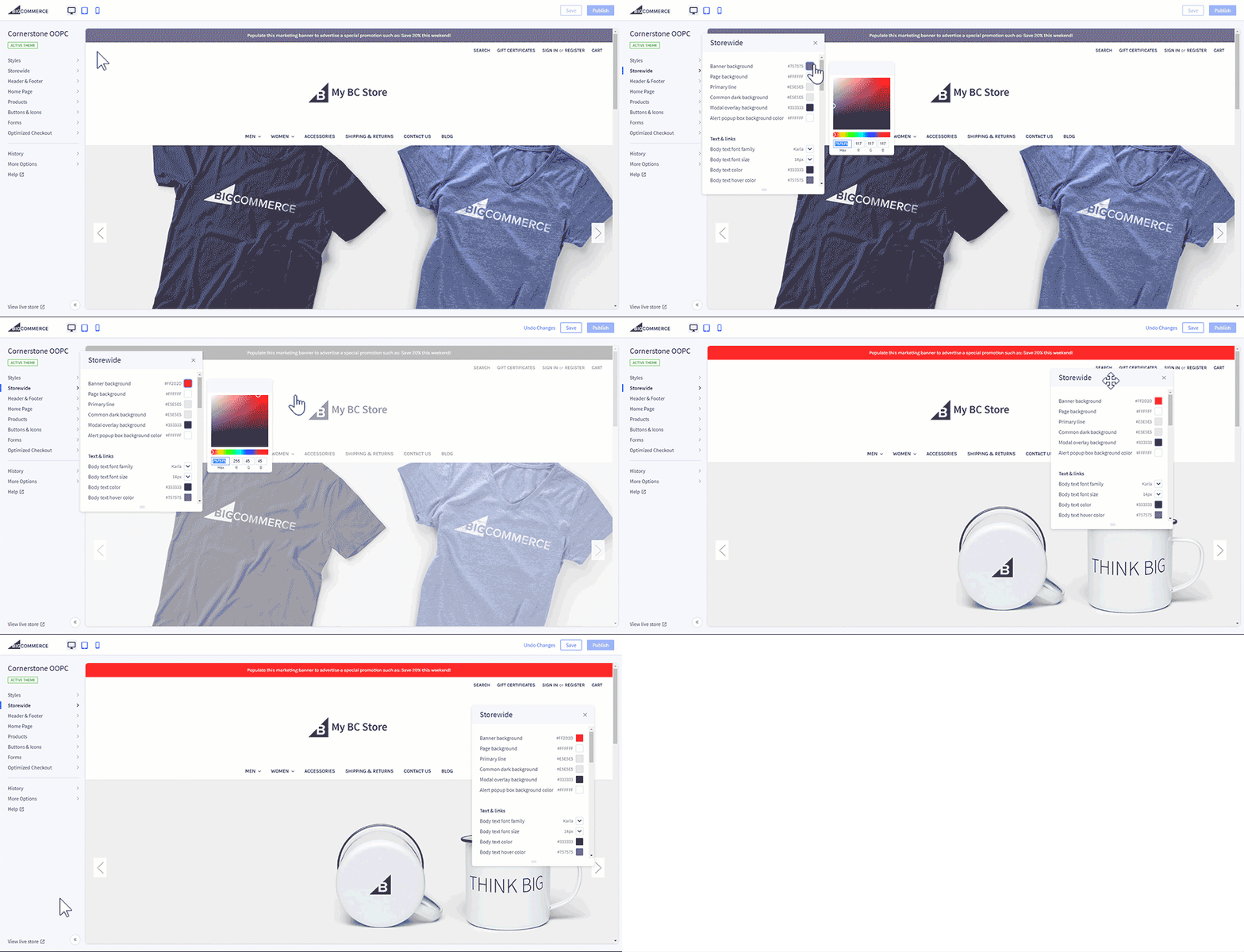
BigCommerce is a SaaS platform that allows SMBs to develop eCommerce sites. Features include the capabilities to design the storefront, configure products, manage payments, generate traffic, and optimize conversion.
$39
per month
Shopify
Score 8.6 out of 10
N/A
Shopify is a commerce platform designed for both online stores and retail locations. Shopify offers a professional online storefront, a payment solution to accept credit cards, and the Shopify POS application to power retail sales.
$39
per month
Shopify Plus
Score 9.0 out of 10
N/A
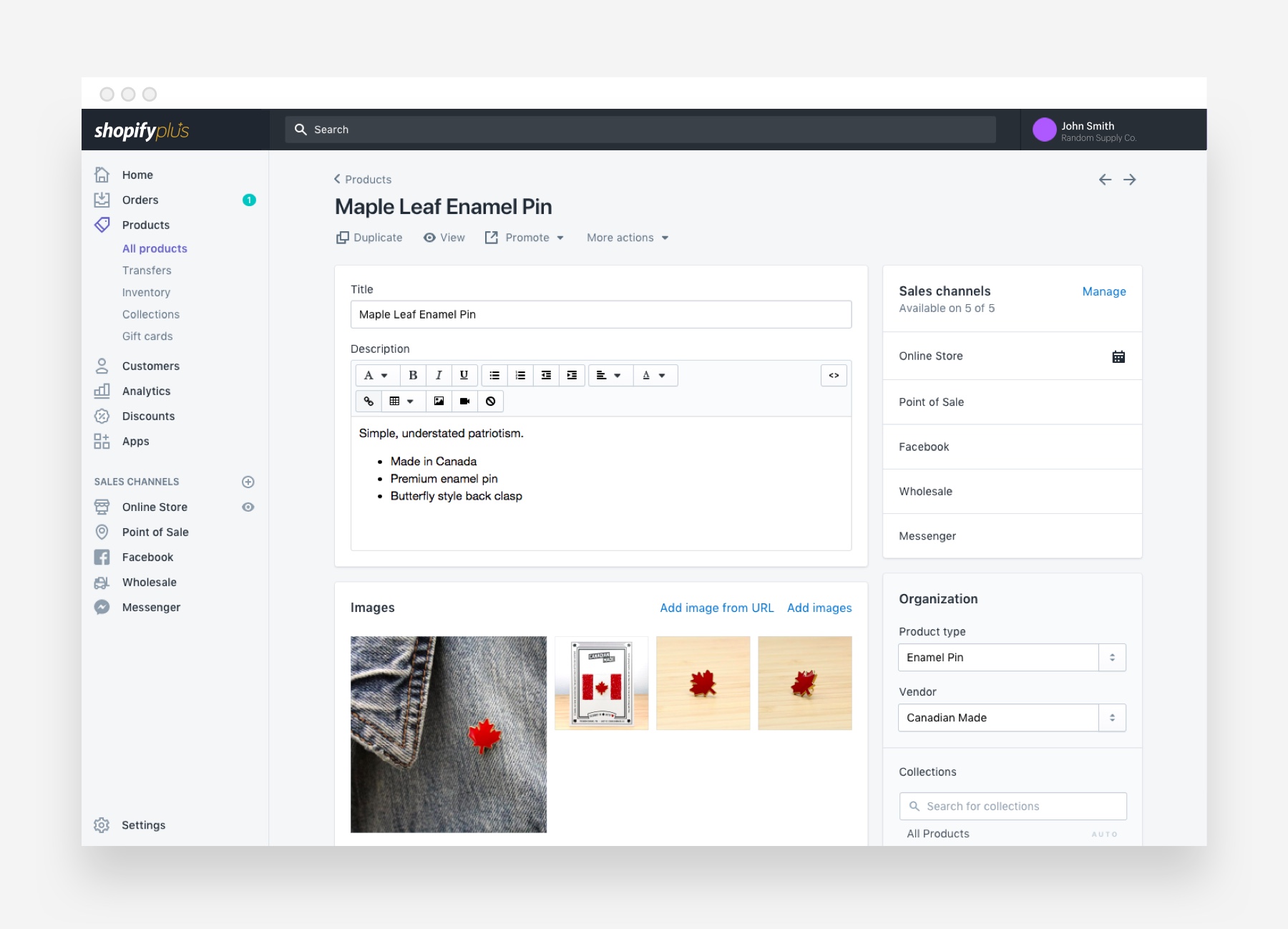
Shopify Plus is an eCommerce solution built for enterprise-level companies that enables them to sell online and offline across social channels like Facebook , Pinterest, and marketplaces like Amazon and eBay.
I chose BigCommerce over Shopify because I felt there were more built-in apps in BigCommerce. Other than that, I felt that both solutions are very similar.
We deal in firearms. I tried Shopify first back in 2016 and that was a miserable mistake, very firearm NOT friendly there. Then we went to Volusion the next month and we were quite happy there for 7-1/2 years and several million $ in sales. The issue is Volusion was losing …
BigCommerce combines the ease-of-use that you get form Shopify, with the ability to handle large numbers of Sku's like a custom Magento site might have.
But unlike a custom site like Magento, you don't need a coder or developer for every little change you want to make to the …
BigCommerce has more built in options than Shopify. While Shopify has lots more apps that are available and a lower initial price. The use of third party apps is good to have lots of options but each option needs to be vetted and dealt with independently. They greater number of …
I personally prefer BigCommerce over Shopify. Shopify is more confusing to use and takes longer to get a site up and running. Shopify also seemed to heavily lack some needed bulk editing tools that bigcommerce has. The only thing I preferred about Shopify was that it had more …
Although k-eCommerce may be a good fit for businesses who's ERP is Microsoft NAV Dynamics, we found the application to be cumbersome and lacking user friendly functionality as compared with BigCommerce. The k-eCommerce support was poor, impersonal and lacked situational …
BigCommerce is way better than 3dcart, it was comparable to Shopify but with the new product promotions available it is better than Shopify now. It is better than Magento in that you do not need dedicated programmers to make simple changes to your store!!! The best part about …
When we compared BigCommerce to Shopify Plus, we found that BigCommerce had better SEO benefits available without needing an additional paid app to control it. We were also able to manage listings and orders more efficiently with better value for money. Shopify Plus offered …
BigCommerce is much better than Squarespace in terms of providing more powerful e-commerce tools and allows more integrations especially payment processors. Shopify although a great product is just simply much more expensive than BigCommerce.
When you look at the landscape of e-commerce platforms, BigCommerce really sets itself apart by being built for serious growth from day one. While Wix is great for simple drag-and-drop projects and Shopify excels at getting a basic shop live in an hour, they both often hit a …
I didn't select BigCommerce. I did use Shopify in a previous role, and they are very similar. Shopify might be a half a step ahead, but BigCommerce is cheaper.
BigCommerce is fully hosted SaaS product which handles the security, performance and upgrades whereas others need my intervention. It has strong built in B2B features that may be lacked in other platforms such as WooCommerce. It has strong APIs and ecosystem of integration …
Ability to handle Large catalog is a big advantage BigCommerce provides strong Headless Commerce Support to the merchant. Faster Implementation time with lower total cost of ownership.
Each platform has its pros and cons. However, overall, BigCommerce is the most challenging to work with from a developer's perspective. Simply finding files and locating the code in the theme editor takes too much time.
- Ease of Use: With guided onboarding, BigCommerce enables us to manage stores independently within days, reducing the need for extensive technical support.
-Comprehensive Built-In Features: BigCommerce provides a wide array of native features, minimizing reliance on …
I find BigCommerce easy to use from a non computer person stand point. It was easy to quickly get adjusted to and what they charge for building and running a website far surpassed there competitors.
While all of these platforms have their advantages, they couldn't provide the level of international shipping and the multiple shipping options needed by my clients with advanced e-commerce stores. Those two major features were the reason we went with BigCommerce in the first …
BigCommerce gave me a better looking website. It also integrated with Square, which was a huge factor. They also allowed my business, which includes CBD products, which other platforms did not allow.
We chose BigCommerce over competitors due to customization and cost. We're able to have the site we're looking for, easily managed within our marketing team without hours of tedious revisions.
Magento - we had a negative experience with the complexity involved in maintaining the site backend and product catalog with a previous client and decided it wasn't suitable for the …
We left BigCommerce and immediately were thrilled. BigCommerce worked fine but we saw immediate savings of several thousand dollars per month. The site speeds and page load times were way better and the app store is very comparable. Many of the features are similar between the …
Shopify is great for the quick deployment of eCommerce websites and scaling them to test for feasibility. It's very affordable and easy to use. BigCommerce provides more function and customization but it takes coding experience to execute so it may not be best for some teams, …
Shopify stacks up well with BigCommerce in terms of SEO. We've found WooCommerce to be even more SEO friendly because of the plugins that can be leverage in WordPress.
Shopify is the most accessible website management tool to make custom edits to and is the quickest to learn. The file structure is easy to understand, but on Magento, it is very complicated. BigCommerce offers more default options than Shopify, but Shopify has more apps. 3D …
With Wix and Squarespace, we really like the extended customization options for our store, but they both lacked the "commerce theme." Shopify, like BigCommerce is essentially designed to cater right to ecommerce and thus has more tools and features to support that effort. BigCom…
Shopify and BigCommerce are similar to each other in the sense that they have a very similar back end to the website. The ability to upload products is very similar and able to control settings. However, Shopify does seem to be easier to understand and has some added features …
I have tried (and currently use and love) BigCommerce. GoDaddy was also decent and very easy to use. Volusion, Ecwid, Weebly, Wix, SquareSpace - all were colossal wastes of time.
Shopify is so much easier to use, and much more user-friendly than both BigCommerce and Magento. The reporting, product management, and app marketplace are much better as well. Shopify also integrates with other systems very easily with apps and sales channels, so it saves a …
I have been in e-commerce for over 15 years now, and Shopify is overall the best website platform that I have used. I have used AmeriCommerce, StoresOnline/Crexendo, BigCommerce, Weebly/Square, Wix, Wordpress, GoDaddy and others - Shopify is the best in most …
Shopify out of the box had more features and did what we were looking to do that BigCommerce could not do without extensive customizations using a third-party vendor. That made it a very easy choice to switch to Shopify. Most of the customizations needed in Shopify we were able …
Shopify is the best tool in the ecosystem because with all the apps in its sphere, you can do almost anything. It also has the best checkout experience one can ask for in the Ecommerce / website space. I think when it comes to shipping inventory and theme management it’s the …
They have more analytics, better designs, more apps to create a more robust system to run a business on. Their system is very intuitive, and they are heavily investing in constantly making their platform better. The biggest selling point years ago was the ability to track with …
You can build an e-commerce site very quickly and easily. Bulk upload of products is a very convenient feature. There are regular features and roadmap updates on Shopify as compared to others in the market. The quality of customer support is also good. Shopify meets all the …
Shopify performs a great marketing influence by having ads and different kinds of branding on various social media. Also, their utilities promotion creates a great impact on the people's mind, and after executing action on the platform, in my experience I liked it how …
Shopify as a business is one of the fastest-growing e-commerce solutions in the world. And for good reason, because it's core functionality is set up in such a way that you can literally start an online business in a couple of hours. They have a massive suite of applications …
We selected Shopify because of the competitor reviews as one of the top 3 eCommerce platforms globally, but Shopify Basic performs poorly for the new and non-tech capable users compared to other top-ranked eCommerce platforms. The reviews and dominating brand exposure of …
Shopify is much easier to use and able to grow better with our company. It has fewer glitches which affect productivity, and more features to prevent needing many different programs.
Shopify, to us, had more of a customization opportunity. We also felt that the plans offered by Shopify were more in gear with what we were looking to do with our company.
Shopify Plus integrates so well with other services, and keeps all levels of the online shopping experience in one place. It really saves a developer or manager a lot of headache that can arise with other e-commerce platforms.
We found BigCommerce to be almost identical to Shopify in many ways, but Shopify had more apps in their marketplace and we couldn't find another significant difference at the time.
We selected Shopify over Magento due to development, hosting and payment processing costs. And BigCommerce was a decent choice, but this let us start small and grow quickly.
Shopify Plus is WAYYYYYY better than anything else that we have used, and it's not even close. The websites are faster and more reliable, both of which are critical to running an online business. The cost to run is way less. We are running five websites on Shopify Plus for less …
Shopify had the quickest go-to-market and most robust API among the products we compared. CommerceCloud required a VERY LONG integration phase that we just didn't have time for. BigCommerce fell short on the number of features and API coverage that we needed. Overall Shopify …
Shopify is a much easier and more intuitive platform to use.
The mobile focus is outstanding from the other competitors and the capability to modify the store without previous code or experience makes them the best e-commerce platform.
Shopify Plus is the most advanced and most widely accepted "DIY" website tool. While WordPress has some capabilities and is certainly cheaper, it is still a blogging platform with e-commerce capabilities added later, and you can tell that's what it is when you use it. BigCommerc…
Shopify Plus is the best choice for DTC-oriented brands, especially if you are a leaner team and want more hands-on customization vs relying on an agency to manage your website backend.
Shopify is more robust and has more functionalities than its competitors like BigCommerce and Kibo. It offers the best UI in the business and the most exhaustive app marketplace ecosystem. It is more cost effective than big system and doe snot require large teams of developers …
Verified User
Strategist
Chose Shopify Plus
There are all good for business who are just starting but as the business grows the platform has to be able to scale with it
A far more professional approach to e-commerce in general. Servers and the core SSL are taken care of and you're left with a whole host of tools to sell, sell and sell.
Shopify Plus offers a more robust solution than Woo commerce and is easier to train on than Big Commerce. Woo commerce is freeware with no support. Big Commerce offers more SEO features and is a more powerful solution, but harder to remote train users on - lots more …
Shopify Plus is way ahead of the pack in terms of features, automated and worry free maintenance / security / scaling / infrastructure, customer support, and speed. We've been building eCommerce sites for over a decade and it seems almost every positive trend in eCommerce is …
Squarespace is a platform meant for creating websites/blogs that also has an eCommerce component layered on top. Conversely, Shopify Plus was build from day one with eCommerce in mind. This is evident throughout the experience, especially with regards to order management, and …
BigCommerce is really well suited for someone who wants to get selling quickly, but may not have endless developer experience, or even web design experience for that matter. Their templates, even the free ones, are very attractive and supported by tons of third party apps. I think the only times it is not a slam dunk recommendation would be if someone is dead set on using another solution like Shopify, or if they are not looking for an ecommerce site and more of a flat website, this would be overkill.
Shopify allowed us to handle matrix items and combined listings. Both of which we could not do on our previous platform. There was some customization involved but overall, it did what we needed it to. The one downside was that if we want to change anything we would have to reload the entire set of matrix items manually.
Shopify Plus makes order management simple and less error prone. Connecting our ERP allows us to seamlessly manage our product listings, fulfill orders, and sync customer data. Limitations to the number of product variants requires attention from our staff to make sure our products sync without issue. Other than being arbitrary, there's really no need to limit the number of product variants.
It's base security and integration with trusted security partners (such as NoFraud) is a game-changer when it comes to reliability and a "hands off approach" for our IT department. The up-time is also very good.
It offers a wide range of verified plugins that are (for the most part) easy to install and use for any specific scenario you're looking for.
It's Analytics area in the admin is actually nice and offers a wide variety of reports that you can run.
In my experience, customer support FAILS terribly in knowledge of getting a BC site live
In my experience, the back side/ dashboard is very archaic compared to Volusion, will add hours of work to your week.
In my experience, pretty much anything you NEED is done with an "app" at additional cost. I think we have a few hundred dollars in apps already on top of cost of BigCommerce.
I feel coming from Volusion to BigCommerce was so depressing but we do feel secure that the company will remain in business. We are looking for something else already.
I would love it if Shopify built an in house app which helped us post UGCs and social proof from platforms such as Instagram, Youtube etc. more seamlessly on our website. Right now, we are able to do it through third party apps but the look and feel is just okay.
When linking to our communication service some customers have several emails with orders and only one email generates orders. It would be nice if we could combine all of this information into one account.
If a customer has multiple accounts you are also unable to edit the email address as it is already used, another reason merging accounts would be helpful.
Some of the processes in Shopify are too easy to complete. I’m certain scenarios a peony of “are you sure you would like to complete(this action)” would be extremely helpful and avoid mistakes that are not reversible.
I personally would not even consider another e-commerce website platform.
Bigcommerce may have the same (or close to the same) functionality and integrations as other SaaS platforms but they excel at customer service and tech support. At the end of the day you need a company that will answer the phone in less than a minute especially if you're having a 5 alarm issue. That said, we hardly ever have any issues. The site was down for a few minutes one time 5 years ago. Sometimes we have issues with coding or apps and they help me with that too. They even walked me through installing our new theme when the contracted developers told me that wasn't included in the development of our new website.
Bigcommerce comes out with new innovations every year, not including apps that other people write for the platform, and there are a lot of those and new ones all the time. And there are a LOT of awesome themes to choose from (Halothemes are the best).
And the price is reasonable!
I'd give Bigcommerce my business any time and recommend them to anyone looking to run an e-commerce website. You could even use them for a non-shopping site, we have one of those too!
Nothing we have used in the past or have seen thus far even comes close to offering what we get with Shopify Plus, especially for the price. You cannot even come close to getting what we are getting at the price we pay. We are beyond thrilled and Shopify Plus meets and exceeds all of our needs and expectations. We love it!
I think that overall it has a great front end for the customer. On the back end, it takes a little spin-up time, but in just a couple of hours you can really have your head wrapped around everything you're going to need 99% of the time. It takes me about 5 minutes to train a new user on how to interact with customer orders.
It is fairly easy to use Shopify regardless of what task you are attempting to perform. Most things are customizable to a degree without requiring coding ability. I have very limited coding experience and have still been able to navigate my way around changing features of the website that require edits to the code with the use of AI and trial-and-error. This previously wasn't possible with the WooCommerce platform.
It is extremely easy for merchants to get to know how Shopify Plus works. Comparitive to other platforms such as Magento and WooCommerce it is extremely lean and easy to operate, meaning clients who migrate over to it find it very intuitive to use. There is also a lot of guides and up to date information online
So far in my time with BigCommerce I have not had any down time when it comes to my webstore or accessing it at any time I need to. Knowing that they have such a good uptime, it makes me feel comfortable that my customers can access things anytime, but also keep sales going 24/7
I have not had any issues with pages loading slow or any real other issues, not that I have encountered so far. Speed of the site and images loading are fantastic and everything just seems to work nicely, which may seem like a simple thing to say about things, but when something just WORKS! Its rather nice vs fighting with things to work right.
Because they are always there no matter how simple or complex the question is, if they don't know the answer they don't fake it and just make you go away feeling frustrated.. they get you to someone that does know the answer. I always appreciate their help and their honesty!
In terms of support I give Shopify a 9 out of 10 because they're always very friendly and thorough, and they personally can't solve my problem for me they always point me in the proper direction with the proper information I need to move forward
They have a comprehensive online help file system that makes it easy to do almost anything. They cover just about everything you'd want to do with your online store with images, clear descriptions and in some cases video. I will, however, say the videos should be a little more professorially done and not sound like the employees are doing it in their cubical.
Shopify offered us several trainings to setup a Shopify store, how to build a brand, SEO, product photography etc. All this content have been super helpful in our journey.
A certified BigCommerce design and solution partner will usually comprise a team of highly experienced designers, developers and marketers. It is our view that in the vast majority of cases, this will pay dividends in the long-term - especially for those teams that could use the extra support.
BigCommerce even with add-ons such as a PIM and B2B functionality wins for small businesses on affordability and ease of use. No servers or updates to worry about and no expensive agencies to pay. This being said, if the budget were no issue, for larger organisations Magento is perhaps a better option.
Big Commerce and SAP Hybris are two other platforms we've investigated and Shopify is by far easiest to use and customize. While it doesn't do everything out of the box, the apps do fill in many gaps. The cost however, is probably the biggest selling point against these other two options.
Shopify had the quickest go-to-market and most robust API among the products we compared. CommerceCloud required a VERY LONG integration phase that we just didn't have time for. BigCommerce fell short on the number of features and API coverage that we needed. Overall Shopify gave us the most bang for the buck.
I believe after seeing all of the parts of this platform, one is able to develop the business and keep adding on select features for the business. There are multiple options for purchase with the various platforms once the business grows more. The different features being offered by the platform can lead us to scalability.
Provides a robust platform to sell a high-risk product.
Page Builder saves you time and money by negating the need to buy a template.
Includes robust promotion settings that allow for codes and automatic discounts, bulk discounts, and customer groups (i.e. military discount), all native options.
It got the store up quickly so the client could start selling. She was previously selling products on Etsy and Facebook and wanted to consolidate everything onto one website, so the main thing Shopify solved was to reduce the store owner's time in managing all her products on multiple sites. Also, we had previously built a website on Wix with all the custom functionality and branding she needed - a truly great, high-end website - but it performed so slowly that it was unusable. So the speed at which Shopify can be set up and then works on the page is appreciable.
The website was manageable by the client - she could figure the system out herself after a while so she saved money on costs for hiring developers. She did have to hire developers to customize some of the plug-ins but costs are all relative; it wasn't a high investment compared to building a full e-commerce website. With the complexity and size of her product base and the functionality and branding she wanted to have in a website, and the potential of her business, she would have needed to invest well over $10,000 to get to where she really needs to be. In the end she kept the budget under $5000.00.
Costs kept climbing with plug-ins having to be added with everything. My client became more involved in building the website and began to try multiple plugins, and she did not have the skill base to evaluate the plugins functionalities so she chose plugins that did not do everything she needed, and then ended up paying the plugin developers to customize the plugins. So on one hand, it's pretty amazing to be able to bring up an e-commerce website as quickly as a week or so, but on the other hand if you need anything customized or deeper functionality in regards to product searching and filtering on the web page, and management on the backend, it quickly goes beyond the skills of the average person to manage, and above their expected budget as well. In the end my client really did not get anything close to the functionality for the website we had originally envisioned.
Shopify was the easiest way we could find to bring the client's products to a global market. We evaluated several other platforms and the functionality simple did not seem to be adequate, so Shopify seemed like the only solution that could do enough of what we needed and still stay within this client's budget. Really the problem in this project was not platform per se but that the budget wasn't large enough. Shopify managed to provide a solution for an ecommerce store with thousands of products on a tiny budget, so in the sense of pure functionality it provided the best value of all the platforms we evaluated. The solution still isn't big enough for this client's business though so, without having insights into this client's post-build sales results, my guess is that because her new website did not make her products easier to sort through, and she likely didn't have much more budget left to invest in SEO and other marketing of the website, her sales probably didn't increase substantially as a result of having built the website. So I think this project all in all did not likely have a high ROI.
The pricing of Shopify Plus over the regular Shopify Account solution is about 10x if not 20x the cost. But with this cost comes the increased reliability and trust you have in your eCommerce Software solution/website. We still have a great ROI with the Shopify Plus Pricing.
With Shopify Plus, we have been able to drill deeper into a more robust eCommerce experience for our customers
With Shopify Plus, we have been able to customize our Website further with recommended apps, features, and customizations based on our Dedicated Account Reps expertise.