Coremetrics / IBM Digital Analytics (discontinued)
Score 8.9 out of 10
N/A
Based on the former Coremetrics, IBM Digital Analytics is a discontinued analytics product. IBM acquired Coremetrics in 2010, and re-branded the platform to the IBM Digital Marketing Optimization Solution. Product support was ultimately provided by Acoustic, but the product is not a part of the company's plans going forward.
N/A
Google Analytics
Score 8.2 out of 10
N/A
Google Analytics is perhaps the best-known web analytics product and, as a free product, it has massive adoption. Although it lacks some enterprise-level features compared to its competitors in the space, the launch of the paid Google Analytics Premium edition seems likely to close the gap.
$0
per month
Looker
Score 8.4 out of 10
N/A
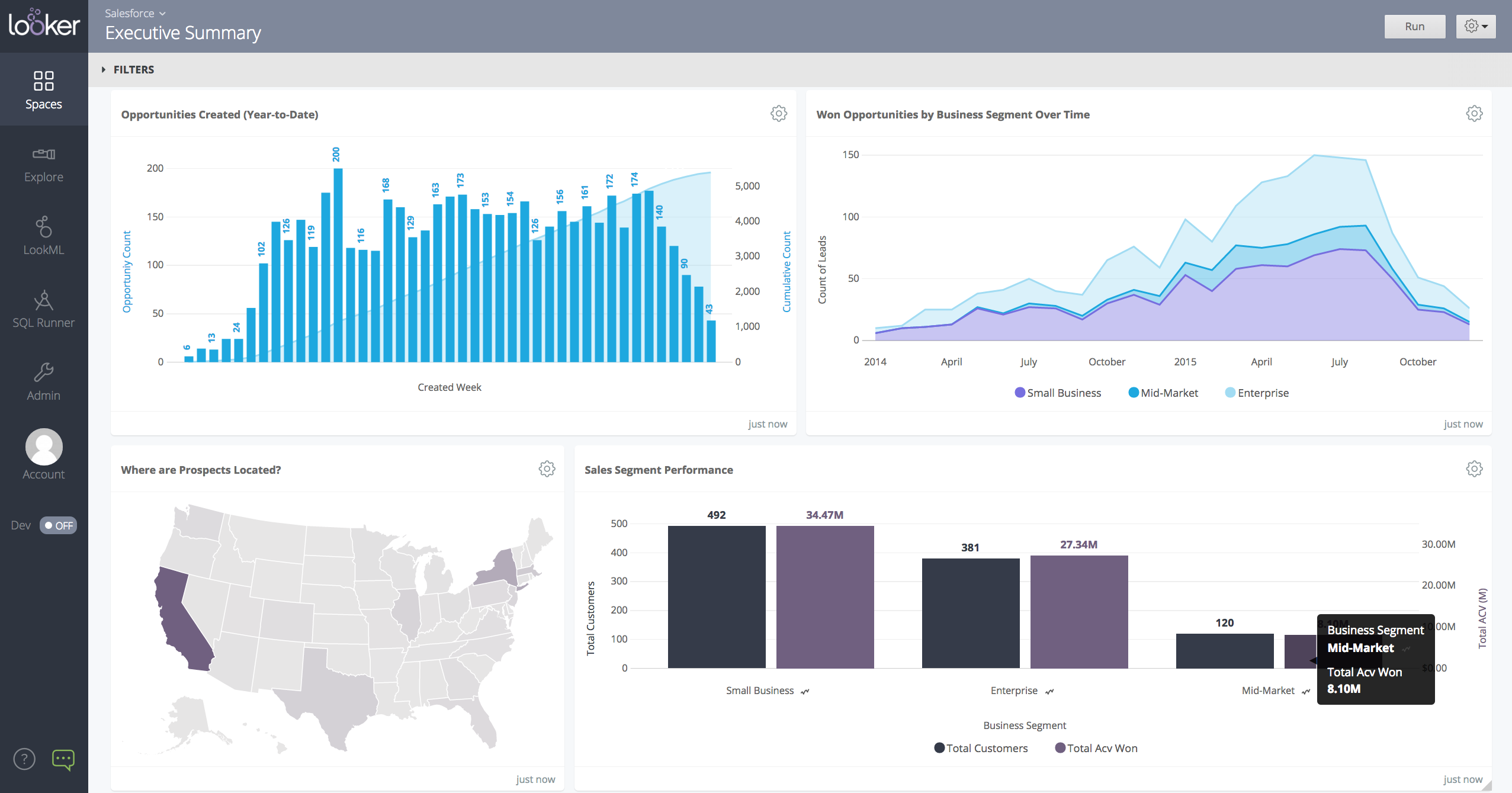
Looker is a BI application with an analytics-oriented application server that sits on top of relational data stores. It includes an end-user interface for exploring data, a reusable development paradigm for data discovery, and an API for supporting data in other systems.
N/A
Pricing
Coremetrics / IBM Digital Analytics (discontinued)
Google Analytics
Looker
Editions & Modules
No answers on this topic
Google Analytics 360
150,000
per year
Google Analytics
Free
No answers on this topic
Offerings
Pricing Offerings
Coremetrics / IBM Digital Analytics (discontinued)
Google Analytics
Looker
Free Trial
No
No
Yes
Free/Freemium Version
No
Yes
No
Premium Consulting/Integration Services
No
No
Yes
Entry-level Setup Fee
No setup fee
No setup fee
Required
Additional Details
—
—
Must contact sales team for pricing.
More Pricing Information
Community Pulse
Coremetrics / IBM Digital Analytics (discontinued)
Google Analytics
Looker
Considered Multiple Products
Coremetrics / IBM Digital Analytics (discontinued)
Chose Coremetrics / IBM Digital Analytics (discontinued)
I feel that Google Analytics give you what you really need, without the hefty price tag. Along with giving you what you need, it is extremely more user friendly than IBM DA and can be easily learned by a multitude of people while still giving very significant information that …
Chose Coremetrics / IBM Digital Analytics (discontinued)
Google Analytics is great low cost alternative to IBM Digital Analytics for smaller, low traffic sites but does not offer the in depth product performance reports we require for our retail clients. IBM can add notes on Google's user interface but Google should really add …
Verified User
Analyst
Chose Coremetrics / IBM Digital Analytics (discontinued)
Much of the work we did in IBM Digital Analytics could have been answered through Google Analytics, a much simpler, agile and FREE solution set. Not mention, given the vast number of Google Analytics USERS, free and actionable support is simply a click away ... this compared to …
Verified User
Employee
Chose Coremetrics / IBM Digital Analytics (discontinued)
IBM Analytics is a great tool for measuring and analyzing web traffic along with consumer behavior to a degree. When compared to other solutions and tools available in the market today, I'd suggest checking out Kissmetrics or even Google Analytics over this tool. Ultimately, it …
Chose Coremetrics / IBM Digital Analytics (discontinued)
In comparison to Adobe, I believe IBM Digital Analytics and Adobe Analytics are fairly similar in terms of features. When it comes to the marketing attribution approach, IBM is what sets it apart. Additionally, pre-integrated technologies with great ROI, like LIVEmail or IBM …
Chose Coremetrics / IBM Digital Analytics (discontinued)
IBM Digital Analytics was already in place when our team was brought on. None of us are fans. IBM does not seem to care from a customer service level whether or not we are satisfied or getting what we need out of their offering.
Chose Coremetrics / IBM Digital Analytics (discontinued)
I think that Google Analytics does everything just a little bit better than IBM. I was brought in with IBM being so deeply integrated with existing systems that changing to another tool isn't viable at this time.
Chose Coremetrics / IBM Digital Analytics (discontinued)
IBM Analytics typically goes up against Adobe Analytics in the enterprise web analytics product selection process. When we determine a client isn't after the big guns, we'll usually refer them to Google Analytics, but when individual user conversion tracking is a must, we will …
Chose Coremetrics / IBM Digital Analytics (discontinued)
We have used Adobe Analytics and Google Analytics in similar instances. IBM Digital Analytics is between the 2 products, slightly better than Google Analytics but far behind the flexibility offered in Adobe.
Chose Coremetrics / IBM Digital Analytics (discontinued)
Google Analytics - Compared to IBM, not as strong on the product reporting (product views, abandoned carts etc.). The end results can be achieved through custom variables, but that does require custom coding. While Google does at least have a reporting API, it is not nearly as …
Verified User
Analyst
Chose Coremetrics / IBM Digital Analytics (discontinued)
As a consulting company, we tailor the analytics solution to our clients. Usually they start with a free solution like Google Analytics, but they rapidly end up with a paying solution because it offers a deeper analysis and less restrictions on the data.
Chose Coremetrics / IBM Digital Analytics (discontinued)
Have extensive use of Omniture and Google Analytics, but I find Digital Analytics the best for retailers. It's is an easy to use solution that highlights the merchandising and marketing issues related to your website.
Chose Coremetrics / IBM Digital Analytics (discontinued)
I mentioned Adobe and Google and made some comparisons in prior questions. I believe that any of these packages can be made quite powerful with a good implementation, which includes a good tagging strategy. I like Coremetrics best because I believe it is easier to get a solid …
Verified User
Consultant
Chose Coremetrics / IBM Digital Analytics (discontinued)
Omniture and Webtrends were also considered. When business needs are met by both Coremetrics and Omniture, the latter tends to be more expensive. Webtrends is often a good choice when server logs are also used with page tags. Server logs is an older technology which tends to …
Chose Coremetrics / IBM Digital Analytics (discontinued)
Webtrends and Omniture were on the shortlist. Webtrends tagging implementation seemed a little less flexible than Omniture and Coremetrics. When it finally came down to pricing and desired features, Omniture and Coremetrics were not significantly different, so we based the …
Google Analytics is for me the default one to implement especially for business starting in analytics. The time (aka cost) of implementation is very low and it provides results in a matter of hours. The integration with the Google ecosystem is also a plus especially when …
Wix and other website platforms have a built-in analytic tool, but it is not as sufficient as Google Analytics, so I always use GA as the main source of information about sales. Most of the analytic tools on web platforms can't visualize user flows, which is very important when …
Ease of use: Google Analytics is known for its user-friendly interface and straightforward setup process, making it accessible for beginners. Adobe Analytics has a steeper learning curve and requires more technical expertise. Features: Adobe Analytics offers a more comprehensive …
Verified User
Manager
Chose Google Analytics
Coremetrics offered better support to the admins, but the data was unclear and often misleading. Site catalyst is difficult to use and has a high barrier to entry. Google analytics is a better data platform, with a better user interface, but they are lacking in the support like …
If it was my choice I would have used IBM Digital Analytics (DA) for everything. DA has it quirks but it really gives some deep analysis on the data and with a bit of development work you can really get all the data you could possibly want. If every website and newsletter was …
I haven't used a very similar software to Looker. However, for the same means, I have extensively used Google Analytics. While Google Analytics is great for e-commerce, it has some issues for businesses where you need to input conversion from different sources, and that is …
Looker is a lot less overwhelming and lets you take the data that you have in Google Analytics to make it understandable, focused and specific to the audience that is viewing the content. I haven’t used any other tools, but feel because of the ease of accessibility and cost, …
Tableau was significantly more expensive than Looker, more detailed, and required more set-up. Overall, Tabluea is great; we just didn't need something that robust. Plus, our client budgets can't afford a multi-year contract. Perhaps once they scale more, we'll need something …
Tableau provides additional visual functionality and is great for more in-depth visuals or further data exploration, but it is costly and an extremely robust solution for simple data reporting. Looker can't be beat when it comes to integrating with other G-Suite tools. All in …
Looker Studio is not as robust as Tableau or Microsoft BI. So it does not provide quite as much insight or depth and it has more limitations overall then the other major reporting products. However, it is also free and connects perfectly with other Google products. Plus, all of …
Technically, Power BI is much more complete and powerful, but it's like an ocean liner. I didn't need all that equipment. In my case, I needed to move more quickly, like on a speedboat, to build a page with several data sources in a single source of truth that could be easily …
We use both Looker and Tableau. It depends on the specific team. However, there is a clear correlation that we use Tableau more often when there are more data sources, including financial data.
Looker is an off-the-shelf, free tool for Google business users. Other than the internal cost of time to build, we had no costs to set up what we needed to do. Knowledge sharing internally and using templates greatly reduced this cost, making the overall cost very low.
Tableau- Not web based which makes it more difficult to use and share templates etc. Seems more dated. ChartIO - Looker's LookML layer that predefined joins was appealing to us vs a tool like ChartIO which requires more raw SQL comprehension.
I considered Looker along with RJ Metrics and Domo. The other platforms seemed to be offering much more of a service-focused offering, with fees that would likely scale quite high without certainty. Looker is focused on more of a product-driven approach and would be a good fit …
Coremetrics / IBM Digital Analytics (discontinued)
Google Analytics
Looker
Likelihood to Recommend
Discontinued Products
IBM analytics has continued to improve upon the days of being the original core metrics. After using the updated version for quite some time, it has been great at providing the needed analytics to measure ROI and goal performance for our quarterly KPI's. It has resulted in a great increase in web engagements although we are a midsize company, smaller outfits may not need such an expensive option.
Google Analytics is particularly well suited for tracking and analyzing customer behavior on a grocery e-commerce platform. It provides a wealth of information about customer behavior, including what products are most popular, what pages are visited the most, and where customers are coming from. This information can help the platform optimize its website for better customer engagement and conversion rates. However, Google Analytics may not be the best tool for more advanced, granular analysis of customer behavior, such as tracking individual customer journeys or understanding customer motivations. In these cases, it may be more appropriate to use additional tools or solutions that provide deeper insights into customer behavior.
When data drives potential for new orders, Looker earns its place in our tech stack. If, on the other hand, we are hoping for pipeline generation, Looker is useful if you are willing to repeatedly go check customer utilizations .... it is not appropriate if you are hoping to automate data analysis for this purpose.
IBM CXA comprises an acquisition called Tealeaf. This tool has deep heritage and this is evident in its present-day capabilities.
The Universal Behaviour Exchange or UBX puts the concept of personalisation at the forefront. The ability to combine physical (analog) and digital transactions to create the complete picture of a customer journey, is a stand out benefit.
The solution does not have to involve the purchase of software. IBM CXA can be sold as a service bundled with analytics as a service. This not only lowers the cost of ownership, it gets around one of the principal issues. Strong staff with design and analytical capability to drive the solution and deliver tangible benefits.
The seamless integration of Watson AI services to help with the heavy lifiting. Watson reinforces the analytical focus this solution has and can learn to recognise situations specific to a company.
Show visited pages - sessions, pageviews - which programs are viewed the most.
Displays session source/medium views to see where users are coming from.
It shows the video titles, URLs, and event counts so we can monitor the performance of our videos.
It gives a graphic face to the numbers, such as using bar charts, pie graphs, and other charts to show user trends or which channels are driving engagement.
Our clients like to see the top pages visited for a month.
I like the drop-and-drag approach, and building charts is a little easier than it was before.
The user interface is in Flash, which can be very frustrating and slow at times. Apparently, this is to be transitioned in a future release.
Can only segment the last 93 days of data. Any historical segmentation beyond the 93 days must be run in Explore (which is credit based, and has its own limitations with the number of credits per month, based on the initial contract with IBM).
Reports can only display 93 days of data at a given time for custom date ranges. There are pre-programmed date ranges setup with IBM during implementation (last week, last month, last quarter etc.), but are not flexible enough to answer more specific questions.
Certain reports cannot have segments applied, making answering some simple questions a bit more tricky. For example, I can create a segment around mobile devices and apply it to the marketing channels report, but I can't create a marketing channel segment and apply it to the mobile reports.
Built in API calls allows for nice report design and automation.
IBM Digital Analytics is a great solution for our clients and I believe they offer the best solution for the retail space. We have access to IBM support via email or live chat and they can answer many of the reporting questions that come up. IBM is receptive to our feedback of the product so I am confident they will continue making improvements
We will continue to use Google Analytics for several reasons. It is free, which is a huge selling point. It houses all of our ecommerce stores' data, and though it can't account for refunds or fraud orders, gives us and our clients directional, real time information on individual and group store performance.
I give it this rating because it deems as effective, I am able to complete majority of my tasks using this app. It is very helpful when analyzing the data provided and shown in the app and it's just overall a great app for Operational use, despite the small hiccups it has (live data).
Google Analytics provides a wealth of data, down to minute levels. That is it's greatest detriment: find the right information when you need it can be a cumbersome task. You are able to create shortcuts, however, so it can mitigate some of this problem. Google is continually refining Analytics, so I do not doubt there will be improvements
Looker is relatively easy to use, even as it is set up. The customers for the front-end only have issues with the initial setup for looker ml creations. Other "looks" are relatively easy to set up, depending on the ETL and the data which is coming into Looker on a regular basis.
We all know Google is at top when it comes to availability. We have never faced any such instances where I can suggest otherwise. All you need is a Google account, a device and internet connection to use this super powerful tool for reporting and visualising your site data, traffic, events, etc. that too in real time.
As reports are templated, the system is pretty quick. Sometimes you have to wait a bit for a report to render. Or you might have to re-load the page. But there is no real issue here and the system is on par with other similar systems.
This has been a catalyst for improving our site's traffic handling capabilities. We were able to identify exit% from our sites through it and we used recommendations to handle and implement the same in our sites. We have been increasing the usage of Google Analytics in our sites and never had any performance related issues if we used Analytics
Somehow resources heavy, both on server and client. I recommned at least 50Mbs data rate and high performance desktop comouter to be abke to run comolex tasks and configure larger amount of data. On the other hand, the client does not need to worry when viewing, the performance is usually ok
Overall, the level of support is very good and I would say it is a strong asset of the solution. However, you can sometimes feel that there is a difference of level among the support team.
The Google reps respond very quickly. However, sometimes they can overly call you to set up an apportionment. I'm very proficient and sometimes when I talk to reps, they give beginner tutorials and insights that are a waste of time. I wish Google would understand my level of expertise and assign me to a rep (long-term) that doesn't have to walk me through the basics.
Never had to work with support for issues. Any questions we had, they would respond promptly and clearly. The one-time setup was easy, by reading documentation. If the feature is not supported, they will add a feature request. In this case, LDAP support was requested over OKTA. They are looking into it.
Online training is really great. One of the best assets that they have. Lots of great videos, pop quizzes at the end of each module. Fantastic. Other tools have similar features, but not as good.
love the product and training they provide for businesses of all sizes. The following list of links will help you get started with Google Analytics from setup to understanding what data is being presented by Google Analytics.
I think my biggest take away from the Google Analytics implementation was that there needs to be a clear understanding of what you want to achieve and how you want to achieve it before you start. Originally the analytics were added to track visitors, but as we became more savvy with the product, we began adding more and more functionality, and defining guidelines as we went along. While not detrimental to our success, this lack of an overarching goal resulted in some minor setbacks in implementation and the collection of some messy data that is unusable.
Much of the work we did in IBM Digital Analytics could have been answered through Google Analytics, a much simpler, agile and FREE solution set. Not mention, given the vast number of Google Analytics USERS, free and actionable support is simply a click away ... this compared to IBM Digital Analytics fractured and often absent support service.
I have not used Adobe Analytics as much, but I know they offer something called customer journey analytics, which we are evaluating now. I have used Semrush, and I find them much better than Google Analytics. I feel a fairly nontechnical person could learn Semrush in about a month. They also offer features like competitive analysis (on content, keywords, traffic, etc.), which is very useful. If you have to choose one among Semrush and Google Analytics, I would say go for Semrush.
Looker Studio, you can easily report on data from various sources without programming. Looker Studio is available at no charge for creators and report viewers. Enterprise customers who upgrade to Looker Studio Pro will receive support and expanded administrative features, including team content management. So it's good.
This solution can support large amount of data and transaction. The way that user management features are built, it shows it is meant for large organizations.
Google Analytics is currently handling the reporting and tracking of near about 80 sites in our project. And I am not talking about the sites from different projects. They may have way more accounts than that. Never ever felt a performance issue from Google's end while generating or customising reports or tracking custom events or creating custom dimensions
We spend too much time trying to work around bugs on the new UI.
We spend too much time trying to figure out how to make certain segments work because support and the knowledge center are lackluster.
Our sales rep is very unresponsive and leaves us searching for a lot of answers on our own, including what other products we may benefit from that IBM offers.
Looker has a poignant impact on our business's ROI objectives. As an advertising exchange we have specific goals for daily requests and fill, and having premade Looks to monitor this is an integral piece of our operational capability
To facilitate an efficient monthly billing cycle in our organization, Looker is essential to track estimated revenue and impression delivery by publisher. Without the Looks we have set up, we would spend considerably more time and effort segmenting revenue by vertical.
Looker's unique value proposition is making analytical tools more digestible to people without conventional analytical experience. Other competing tools like Tableau require considerably more training and context to successfully use, and the ability to easily plot different visualizations is one of its greatest selling points.