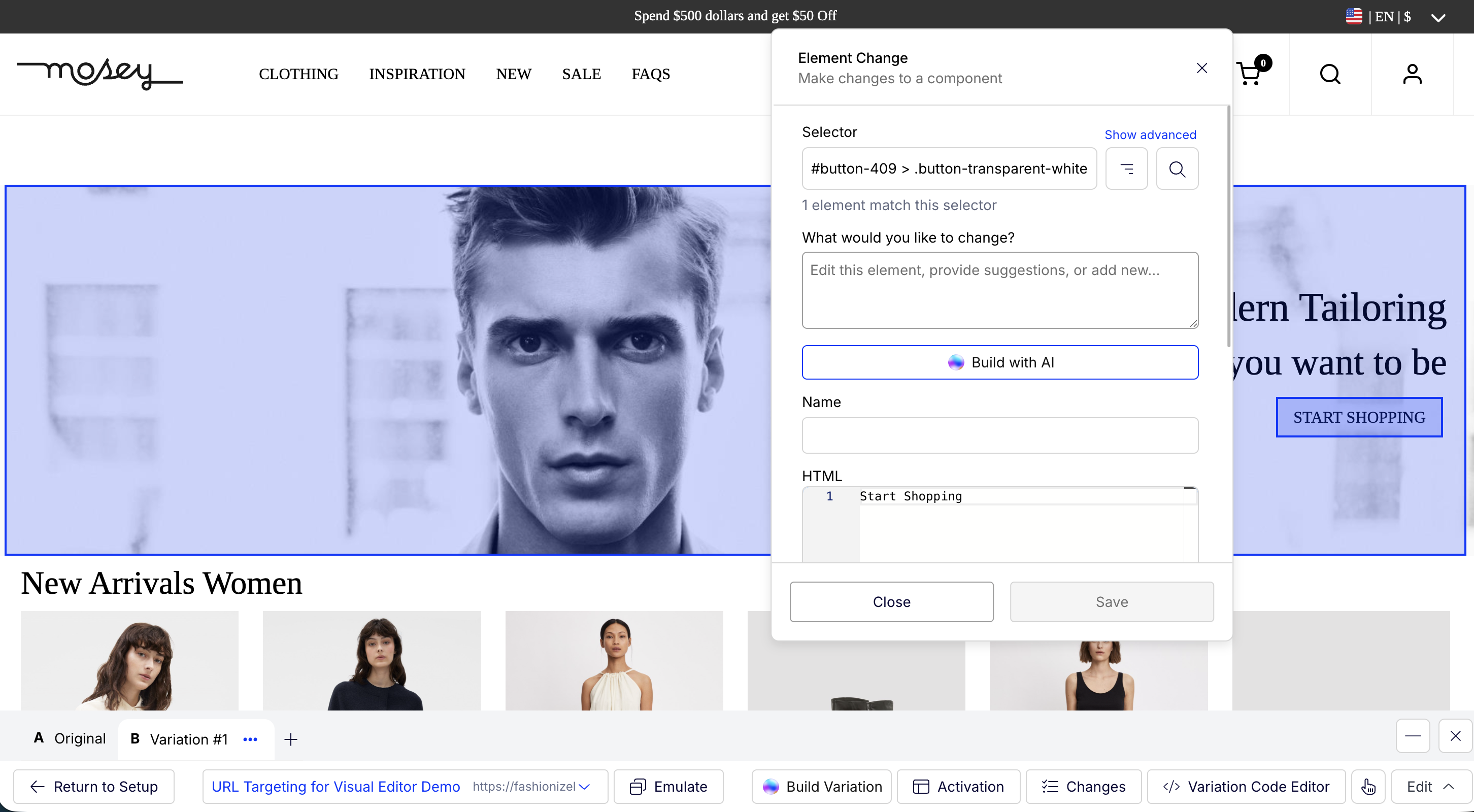
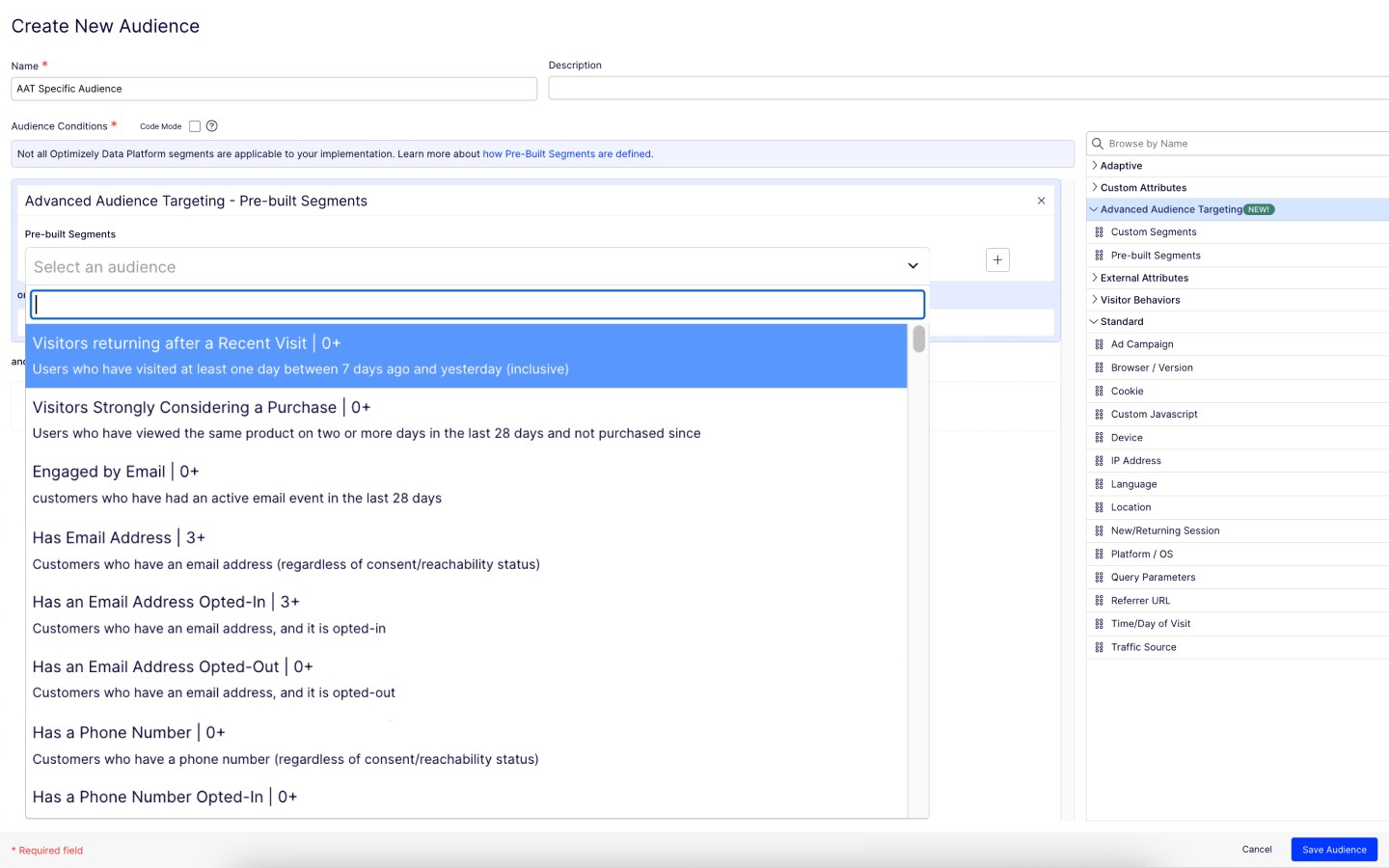
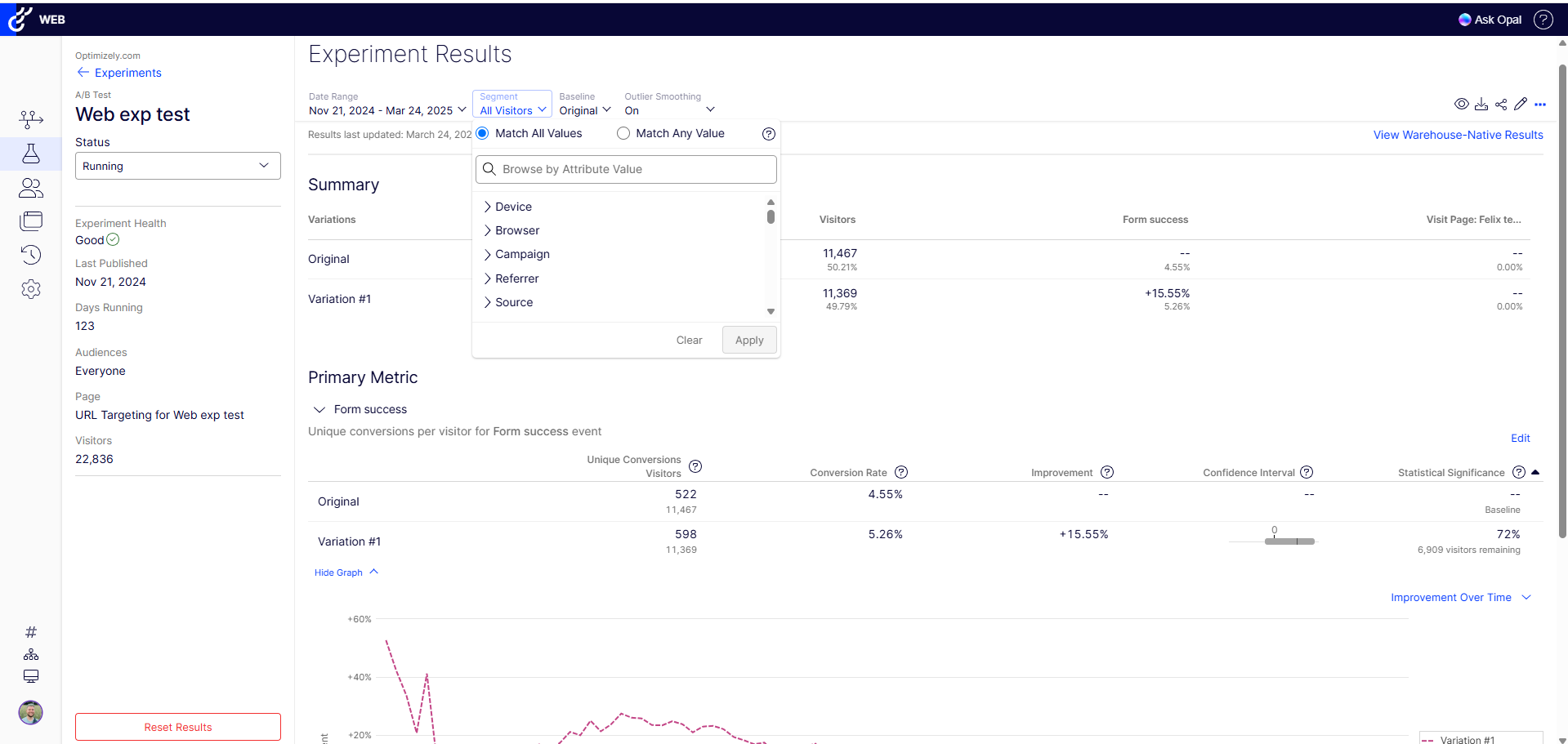
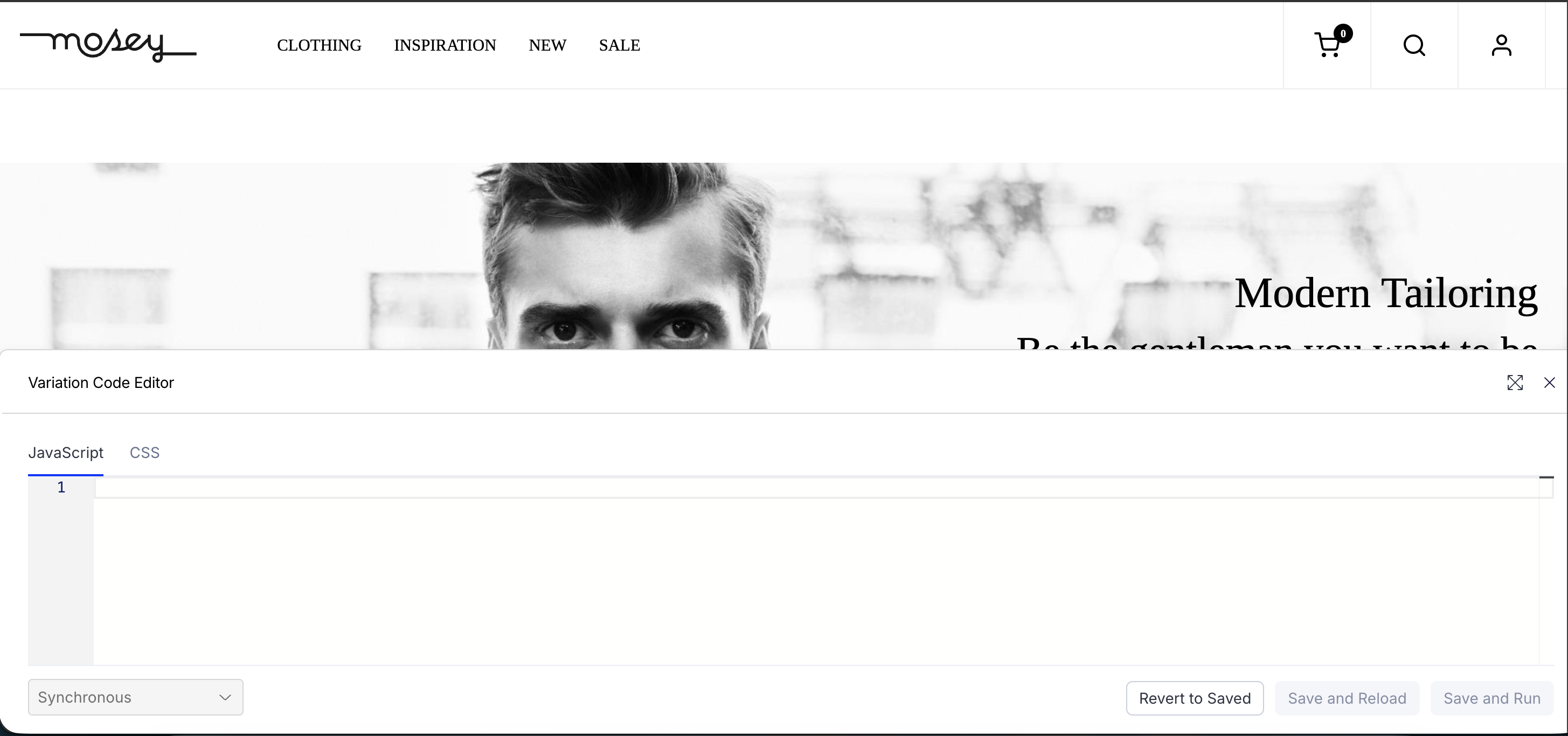
Whether launching a first test or scaling a sophisticated experimentation program, Optimizely Web Experimentation aims to deliver the insights needed to craft high-performing digital experiences that drive engagement, increase conversions, and accelerate growth.
N/A
VWO
Score 8.2 out of 10
N/A
VWO is an A/B testing and conversion optimization platform that enables growing businesses to conduct qualitative and quantitative visitor research, build an experimentation roadmap and run continuous experiments on their digital properties. With its 5 capabilities Plan, Track, Test, Analyze, and Target, it brings the entire CRO (conversion rate optimization) process at one place. VWO helps online businesses follow the process- and data-driven conversion…
$49
per month
Pricing
Optimizely Web Experimentation
VWO
Editions & Modules
No answers on this topic
Subscription
$99.00
per month
TESTING
Get a Demo
The classic VWO A/B testing solution
CONVERSION OPTIMIZATION
Get a Demo
The all-in-one platform for all your optimization needs
ENTERPRISE
Get a Demo
Customized solution with advanced AB testing and conversion optimization capabilities
> Adobe's pretty cool for its recomentation / AI / ML engine > VWO's wysiwyg is pretty solid and the heatmapping is nice > abtasty's consent features are pretty cool to launch patch and AB Test Consent Rate > Monetate & Dynamic Yield's pre-built personalization features help …
Optimizely Web Experimentation was more robust and able to handle the broad array of sites we run than VWO. It has been a great platform to easily add additional sites onto, but still providing a universal overview of all of them, making management a simple task.
Optimizely Web Experimentation is perfect for medium or advance use but not for basic use. For basic use or new users VWO would be a better fit, or for users who would do a test once per month with low traffic. Optimizely is more for users or companies who use cro or do …
Best-in-Class Experiment Design compared to platforms like VWO and Convert. Optimizely offers a more polished and intuitive UI for setting up experiments. It feels purpose-built with lots of concurrent tests. Features like traffic allocation, audience targeting, and variation …
Honestly, Optimizely Web Experimentation has its pros and cons just like any other tool. We use Optimizely because we have resources here in the country that can help us when e have issues. The support team being local helps a lot so we don't have long wait times to get things …
None of them have a best in class stats engine and live within an ecosystem of marketing technology products the way that Optimizely does, so the scalability of using any one of those tools is limited as compared to using Optimizely Web Experimentation.
Optimizely is my favorite due to its ease of use and exceptional testing capabilities. It is not the cheapest tool, but the other tools that could be compared are not cheap—you get what you pay for. Some of the smaller tools are making gains, though!
The largest thing is that we've had an excellent experience working with Optimizely Web Experimentation's team of people. While competitors may have a novel solution that leverages the hottest in LLM/AI/or what have you, Optimizely Web Experimentation's approach has been tried …
Overall, the tools we compared against were great, but we went with Optimizely because it has all the features we needed and has the market leadership that gave us trust we would be successful in our experimentation efforts.
Analytics are vastly superior, platform UI is by far the easiest to use, and capabilities are best in class. If your organization has any budget for a web experimentation tool, it should be using Optimizely Web Experimentation.
We wanted one tool, that was easy for marketers and developers to use and would allow us to remain organized. Neither Of the other products allowed for this as seamlessly as Optimizely.
Whilst Optimizely is more expensive (for us at least) we found it was far technically superior and easier to use. We have not run into the technical constraints that we have with other tools. In addition when we went to market to evaluate different suppliers optimizely won …
In some ways, when we did a demo with other products, some things were built in like scroll tracking. But in many ways, Optimizely just was easier to use.
As I mentioned, VWO is a great all-in-one tool that lets clients research & test all within one tool. It's a little on the expensive side so it might not deliver the desired ROI for smaller clients and can also encourage the small clients to run small, insignificant A/B tests …
VWO is by far the easiest tool to use among all experimentation tools. It is like the experimentation tool for dummies and works as well as the others. A highlight would be the reports on every test because compared to the others, in VWO is way much easier to understand the …
While there are many free or cheap options for A/B and multivariate testing out there (and we have tried several), VWO provides the right balance between cost and capability for our agency. That, and the level of customer service provided when we need it makes VWO our choice …
There are significant differences in each platform when it comes to Optimizely and vwo. From a functionality and performance perspective they each have their pros and cons. It is important to go through the feature sets of each and ensure the solution you select will work …
VWO has worse usability and isn't as flexible as the other platforms. Also, the insight that Qubit and Optimizely generates is actually accurate and can be used compared to the reports that VWO provide.
I was not involved in Optimizely, nor did we implement it outside a free trial I believe, but VWO seemed to do generally the same things with a lower cost, though I could be mistaken.
I have used Qualtrics in the past. It is very good for survey creation and logic. I know some …
We enquired and looked into using Optimizely and Qubit before deciding on VWO. All appear to be great tools that would have done the job required, however, when compared, we didn't hit the level of traffic for Qubit to consider a partnership, and Optimizely was a lot more …
VWO is better in price for sure, and I would say it has much better functionality than Crazy Egg. Optimizely is more expensive than the two and I think its UI is much better than VWO. However, I think you get the same with VWO that you do with Optimizely. Once VWO catches up in …
VWO does seem to be as good as, or better, than Optimizely. And VWO is certainly not as expensive. But I must say that we have not really used Optimizely - we have only compared it with VWO when doing research before choosing for VWO as our tool of choice.
The user experience was quite similar at least on that level we were and are using these kind of products. We decided to stick with VWO because of a more attractive pricing, the ease of use of the WYSIWYG editor and the user segmentation.
The way VWO is priced makes more sense for mid market users (don't have to pay by impression). I had used Optimizely, but when my company had some content go viral we used up all our impressions on a test with data that was irrelevant (viral visitors aren't target audience).
VWO was our ultimate choice because we of the affordability. It also fell more in line with our use case of testing and not necessary for full personalization.
We've used Optimizely for a year then switched to VWO (using it for 2 years now). Optimizely is too expensive for what it provides. The cost is double the VWO cost and it has less features and lower visitor quota.
We chose VWO after deciding that Optimizely is absurdly expensive. We stopped using VWO months ago due to a number of problems and switched to Convert, which has been fantastic. We highly recommend Convert to other companies now and wished we had found it prior to going with VWO.
I think it can serve the whole spectrum of experiences from people who are just getting used to web experimentation. It's really easy to pick up and use. If you're more experienced then it works well because it just gets out of the way and lets you really focus on the experimentation side of things. So yeah, strongly recommend. I think it is well suited both to small businesses and large enterprises as well. I think it's got a really low barrier to entry. It's very easy to integrate on your website and get results quickly. Likewise, if you are a big business, it's incrementally adoptable, so you can start out with one component of optimizing and you can build there and start to build in things like data CMS to augment experimentation as well. So it's got a really strong a pathway to grow your MarTech platform if you're a small company or a big company.
It works better for either small or big companies because small companies can start with the free plan which is very decent and has everything they need. Also for big companies who get the best paid plans they get a lot of premium functionalities, the insight module, outstanding reports. But for medium size companies who can only afford the basic paid plan, it may not be the best tool as it is very limited. For example, they cannot analize a/b tests for new and ruturning visitors, neither based on the users device category.
The Platform contains drag-and-drop editor options for creating variations, which ease the A/B tests process, as it does not require any coding or development resources.
Establishing it is so simple that even a non-technical person can do it perfectly.
It provides real-time results and analytics with robust dashboard access through which you can quickly analyze how different variations perform. With this, your team can easily make data-driven decisions Fastly.
VWO is pretty easy to implement on websites and doesn't require a heavy technology lift
The VWO interface is pretty intuitive and let's non-technical users make variants for testing
The VWO reporting dashboard is excellent for determining statistical significance and understanding whether differences in conversion rates are meaningful or not
The user interface within VWO does take a bit of time to get used to, especially as it pertains to switching back and forth between tests. When running multiple experiments on a site at a time, a clear and succinct dashboard for everything in one place would be helpful (as opposed to needing to switch between A/B, multivariate, etc).
I rated this question because at this stage, Optimizely does most everything we need so I don't foresee a need to migrate to a new tool. We have the infrastructure already in place and it is a sizeable lift to pivot to another tool with no guarantee that it will work as good or even better than Optimizely
It's great value and we think we've ironed out all the major teething troubles. However, if we experience any more bugs or problems that significantly slow us down then we're seriously considering switching to Optimizely, which I haven't personally tested but have heard great things about from my CRO peers
Optimizely Web Experimentation's visual editor is handy for non-technical or quick iterative testing. When it comes to content changes it's as easy as going into wordpress, clicking around, and then seeing your changes live--what you see is what you get. The preview and approval process for sharing built experiments is also handy for sharing experiments across teams for QA purposes or otherwise.
I gave Visual Website Optimizer a rating of 8 because it is overall a great product to use. Setting up and keeping track of various tests is easy and straight forward. The only reason why this product is not rated higher is because the support documents online leave a lot of room for improvement.
I would rate Optimizely Web Experimentation's availability as a 10 out of 10. The software is reliable and does not experience any application errors or unplanned outages. Additionally, the customer service and technical support teams are always available to help with any issues or questions.
I would rate Optimizely Web Experimentation's performance as a 9 out of 10. Pages load quickly, reports are complete in a reasonable time frame, and the software does not slow down any other software or systems that it integrates with. Additionally, the customer service and technical support teams are always available to help with any issues or questions.
VWO doesn't appear to slow down our website at all, though some customers with adblockers like UBlock Origin have been known to not see entire pages if VWO is making changes to the page at a macro level (background, font, etc). This is rare though.
They always are quick to respond, and are so friendly and helpful. They always answer the phone right away. And [they are] always willing to not only help you with your problem, but if you need ideas they have suggestions as well.
While their online document support is lacking a simple email to their support team will almost always get responded to the next day. It has however taken more than one email to explain the problem to the support team till they understood the problem. The solution I was given also only half fixed the problem the rest I figured out on my own.
The tool itself is not very difficult to use so training was not very useful in my opinion. It did not also account for success events more complex than a click (which my company being ecommerce is looking to examine more than a mere click).
Training was good, just limited to the onboarding process. They walked through all of the steps it takes to get started in VWO and each of the modules, along with giving us ideas for starting our first test. I feel like it could be better if there was a guided process within the VWO program to continue to educate you along the way, and a way to turn that off for experienced users.
In retrospect: - I think I should have stressed more demo's / workshopping with the Optimizely team at the start. I felt too confident during demo stages, and when came time to actually start, I was a bit lost. (The answer is likely I should have had them on-hand for our first install.. they offered but I thought I was OK.) - Really getting an understanding / asking them prior to install of how to make it really work for checkout pages / one that uses dynamic content or user interaction to determine what the UI does. Could have saved some time by addressing this at the beginning, as some things we needed to create on our site for Optimizely to "use" as a trigger for the variation test. - Having a number of planned/hoped-for tests already in-hand before working with Optimizely team. Sharing those thoughts with them would likely have started conversations on additional things we needed to do to make them work (rather than figuring that out during the actual builds). Since I had development time available, I could have added more things to the baseline installation since my developers were already "looking under the hood" of the site.
Overall, the implementation of VWO is straightforward. If you've got a straightforward way of deploying code to all of your test pages, either a good CMS or a TMS, then implementation should be a breeze. There is no tweaking to be done to the code itself, and once deployed it has the flexibility to cope with different VWO modules (tracking, conversion analysis, session analysis) without modification.
The ability to do A/B testing in Optimizely along with the associated statistical modelling and audience segmentation means it is a much better solution than using something like Google Analytics were a lot more effort is required to identify and isolate the specific data you need to confidently make changes
There are significant differences in each platform when it comes to Optimizely and vwo. From a functionality and performance perspective they each have their pros and cons. It is important to go through the feature sets of each and ensure the solution you select will work specifically with your business objectives and conversion rate optimization goals
We can use it flexibly across lines of business and have it in use across two departments. We have different use cases and slightly different outcomes, but can unify our results based on impact to the bottom line. Finally, we can generate value from anywhere in the org for any stakeholders as needed.
The product seems infinitely scalable for our needs (small business) and we've never had any issue with loading VWO-edited elements. I will say, though, that online customers with ad blockers have been known to not see certain VWO elements as their third-party scripts are disabled.
We're able to share definitive annualized revenue projections with our team, showing what would happen if we put a test into Production
Showing the results of a test on a new page or feature prior to full implementation on a site saves developer time (if a test proves the new element doesn't deliver a significant improvement.
Making a change via the WYSIWYG interface allows us to see multiple changes without developer intervention.