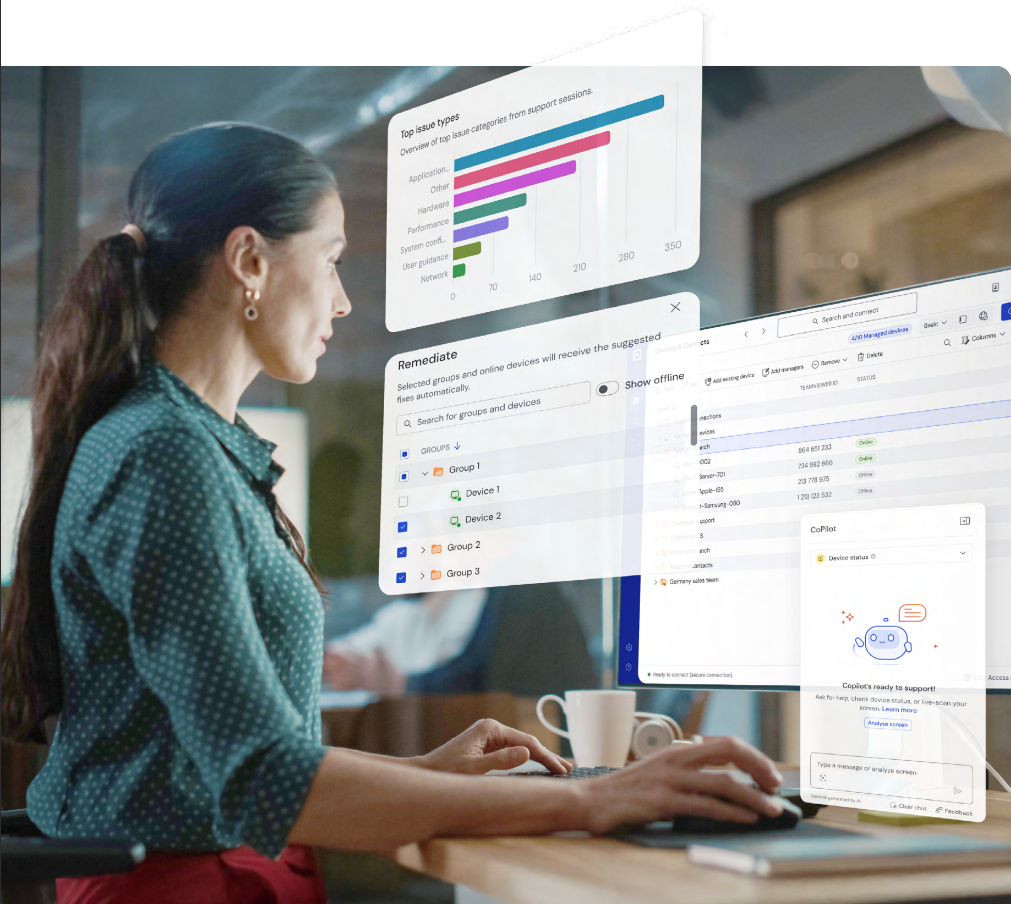


TeamViewer Remote Desktop and TeamViewer Host.

Use Cases and Deployment Scope
The IT admin uses remote access to provide help desk services and to occasionally copy files to remote workstations. In addition, we have 15 Remote Workers that access on-premise desktops for secure remote work.
Pros
- Secure connections.
- Easy file transfer.
- Handles multiple remote monitors well.
- Assigning multiple managers to a device.
Cons
- MFA could be a lot better when connecting to the remote device. If a phone is added to security for the remote worker, then the admin cannot use Easy Access to access the device without interaction with the remote worker. Admins should have access to remote devices via other MFA methods.
- App updates sometimes cause unstable status and computer must be restarted.
- OS updates often require additional user interaction before completing the sign-in process, leaving TeamViewer in an incomplete startup state and preventing the Remote Worker from accessing the device. An admin then has to remote into the device using another remote desktop access tool (Apple Remote Desktop, for instance) and bypass the user interaction screens, which allows the login process to complete and TeamViewer to start up fully. It would be best if the TeamViewer Host could connect even when the OS is prompting for user interaction (e.g., clicking OK on modal dialog boxes post-update).
Return on Investment
- Post-COVID, we moved to a hybrid environment, and TeamViewer allows me, as an IT admin, to access our devices remotely very easily (with some caveats) and to support staff who are also working from home.
- A negative would be the TV Host agent not allowing access (hangs on authorizing or connecting) after an OS update restart.
- Another negative would be the need to log in to an admin local account to assign a manager to a device. Should be able to do it on the standard user side as long as the person trying to set managers is a TeamViewer manager and has the proper access and authentication. It could be an issue with our deployment, but the master admin manager is not being set automatically as it should.
Alternatives Considered
Apple Remote Desktop, ScreenConnect and Datto RMM
Other Software Used
Claris FileMaker, Microsoft Office 2016 (discontinued), Google Chrome, Freshservice, iMIS, Microsoft SharePoint, macOS, Microsoft Windows, Google Workspace, Arctic Wolf Managed Risk, Cisco Meraki MX