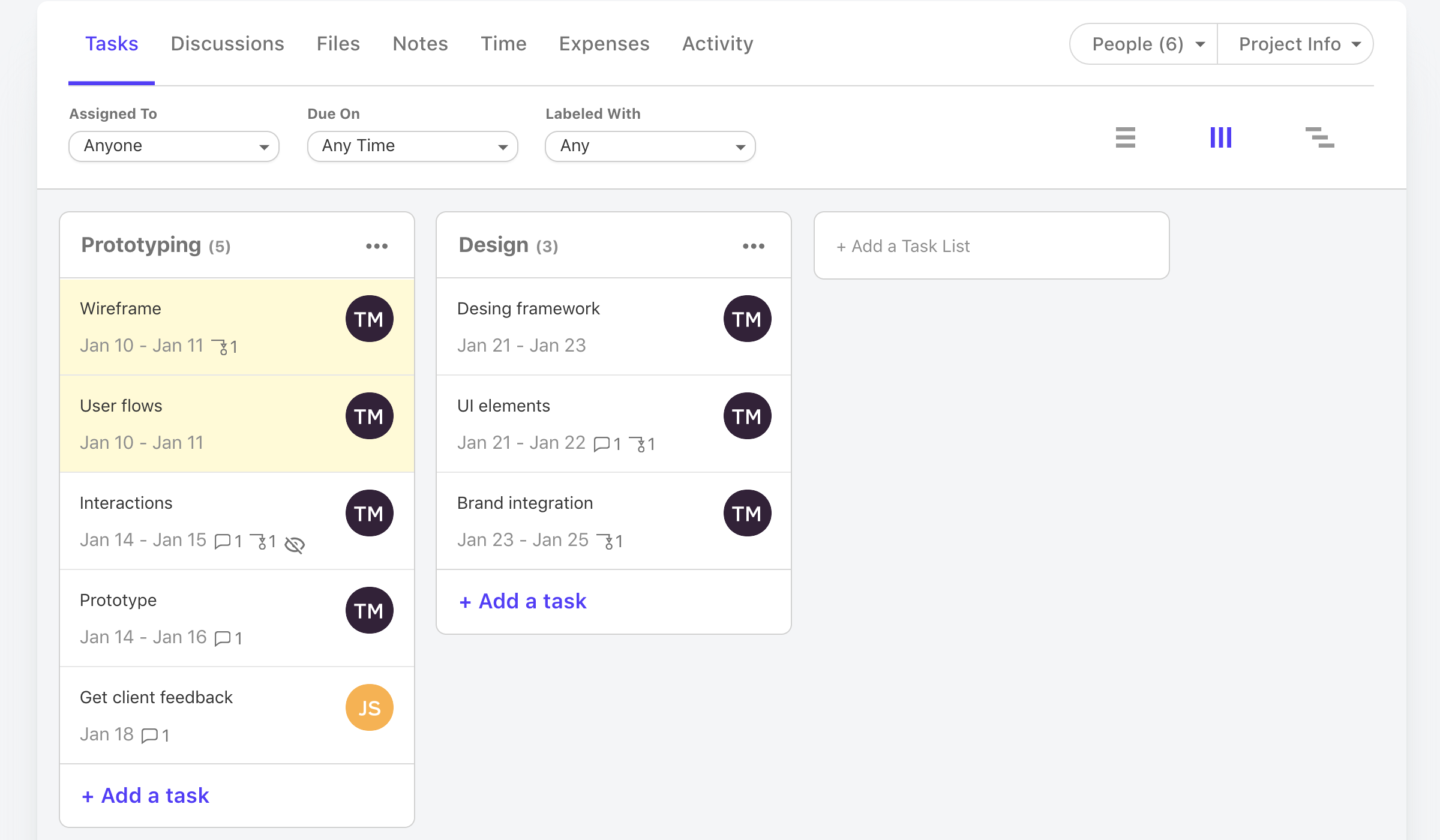
Active Collab is a project management solution built around features such as task management, collaboration, time tracking, and invoicing.
$8
per member/per month
Basecamp
Score 8.7 out of 10
N/A
Basecamp is a web-based project-management tool. Basecamp offers features standard to project management platforms, as well as mobile accessibility, unlimited users, and 3rd party integrations. Basecamp is priced by space requirements and concurrent projects.
$15
per month per user
Dayforce
Score 8.0 out of 10
Enterprise companies (1,001+ employees)
Dayforce is a people platform that simplifies HR operations. As a unified HCMS, it delivers HR, payroll, benefits, workforce management, talent, and analytics—helping organizations boost productivity, stay compliant, and make smarter decisions with embedded intelligence and personalized experiences.
We chose Active Collab overall because we liked its easy to use user interface, project management suite and agency/vendor/client interaction capabilities. We also chose it primarily because it was offered as a web-based platform that offered very clean and easy mobile access …
ActiveCollab has similar features to Basecamp for both project management and communication purposes. However, Basecamp has a better interface for organization of projects within clients and allows for linking to specific comments. However, ActiveCollab is more affordable than B…
ActiveCollab is easier to use and simpler in its setup. It has the right mix of features and simplicity. It's also project-oriented which is important for our workflow. Other tools are often too task-oriented, making it hard to track projects. Overall, ActiveCollab has a great …
Scenarios where ActiveCollab works well 1) ActiveCollab works well for small teams specifically T&M teams.Its invoicing feature is unique & can make your life easy. 2) It is very easy to use & posses good range of filters like on the task list, we can drag/drop tasks, Filter by assignee's, tasks lists, due dates, or completed tasks. 3) It has some simple but awesome features like when you're in the middle of writing something i.e a comment on story and get interrupted, it retains what you wrote. 4) It allows you to tag team members in threads of comments to grab their attention, its really needed when teams are distributed. Thus helping team members to collaborate easily & stay on same page. 5) It integrates pretty well with other web apps like quickbooks , Slack, Trello, HubSpot, Zapier etc Scenarios where ActiveCollab did not work well 1) Tasks can not have multiple assignee's here so if two members are working on same task it did not allow you to reflect that. 2) Sorting capability is not their under invoicing 3) It did not work well for larger teams 4) Search option is not very detailed & you may end up wasting lot of time searching one particular bug or issue.
Basecamp is a wonderful tool for teams of varying degrees of technical knowledge, teams managing lots of different types of "agifall" and waterfall projects, and teams that are remotely distributed. It's probably less useful for more strictly agile-focused development teams, compared to other more flexible software applications like Jira and Asana.
I think Dayforce is a great option for a large and/or Global organization. I do not think it would be the best fit for a very small company or business. It really shines for enterprise organizations with multi-locations. While a small business could use it, I would say it has too many bells and whistles that might feel overwhelming to a smaller organization.
Task management - It is very easy to add, organize and discuss tasks within Basecamp's interface.
The "Campfire" function is great for communicating when you just have a quick question for someone on the team.
Notifications - Basecamp lets you decide how often and about what you'd like to be notified. The ability to respond to messages in Basecamp directly via email saves a lot of time.
It isn't possible to set members of staff as part time, so if someone is unavailable on certain days you must manually enter them as OOO every single day that they are not in, that other teammates work. Hours also can't be edited individually - everyone is treated as working the same hours in a day, rendering capacity planner useless for flexi working teams
Subtasks cannot be assigned their own hours and deadlines, meaning the To Do list view can't be seen in actual date order and capacity planner does not reflect all time allocated to an individual's schedule unless every task is set up as a separate task rather than subtask
There is no way to see all tasks of a certain type across multiple campaigns (e.g all copywriting tasks vs all technical tasks) - support team suggested exporting data and making spreadsheets
Kanban view isn't available for people's own task lists ('board' view here shows a list)
Not possible to have one task be assigned to more than one person
Notifications are not sent when tasks are updated, so you have to leave comments and tag people each time
High Learning Curve. It's true that it can be easy to use, but to use well and effectively takes some time to learn. It's recommended to have an agreed-upon system in your team of what tools to use and when.
Notification Overload. If people aren't careful they could send a notification to everyone when only a couple people were meant to be prompted. And since emails are sent by default, you could have your mailbox overloaded with unnecessary updates. This is where it takes a bit of training in your team to have an agreed-upon system.
Lack of organization with Archived Projects. I will often need to reference an archived project to make a new one, but there is only a list of archived projects in alphabetical order, with no way to organize by archive date, or even search.
There have been a few instances of users being locked out of Ceridian due to recent upgrades. Not ideal when an employee wants to see their paystub and is suddenly have login issues.
Not the best for when an employee is transferred to another country as their employee number is locked to their SIN or SSN. And, we are required to create a new user record with a new employee number for the new country.
When I bring new people onto a project, it's immediately obvious how to use Basecamp. I don't have to worry about teaching them the features or walking them through it, it's just incredibly user-friendly. For this reason, I'll continue to renew my subscription even as new people are brought onto production jobs or the client changes.
We are highly invested in Ceridian's Dayforce product. It give us the flexibility and scaling that our growing company needs. Its potential reaches beyond the basic HR functions to the decision making that our Management Team needs. Ceridian is always innovating the employee and employee experiences to offer cutting edge options.
It is easy to use, even for clients who have no experience with the platform. It can only get a little cumbersome to ensure that a client can't see certain documents you might want to keep in the Docs & Files folders. And sometimes, getting a client to actually use an unfamiliar platform can be a challenge.
I think it's very usable for the employee. I don't think it is as easy for the HR/PR admins - especially if there is an issue. There are so many setup screens that need to be looked at to try to figure out why payroll isn't calculating properly, hours aren't feeding over correctly, or benefits are not calculating properly. For the most part, they can't do their own troubleshooting. The same is true for the managers. Our managers find it cumbersome to go into make any schedule changes after the schedules have been generated.
I've never experienced downtime while using Basecamp, or been unable to access it when I needed it. That's not to say they've never had downtime, but I've been lucky enough not to encounter any, and I work odd hours, including late nights when maintenance is often undertaken.
Dayforce's high availability ensures that our HR processes are supported around the clock, which is critical for a global organization like ours. The platform is cloud-based, offering reliable access from any location at any time, allowing our employees, managers, and HR teams to stay connected regardless of time zones or geographic locations. This level of availability ensures that payroll processing, employee self-service, and real-time data access continue uninterrupted, even during peak periods or unforeseen disruptions. The system’s robust infrastructure minimizes downtime, which is vital for operations that span multiple regions. Additionally, having a centralized platform that’s always available helps keep our teams aligned, ensures compliance, and facilitates timely decision-making across all our locations.
We haven't noticed any slow-down due to the integration of Dayforce WFM with our Ceridian HPL products (HRIS and Payroll). The new HTML view of the timesheets don't load as quickly as the old Silverlight view - however, we have gotten used to the change.
We have not required support for ActiveCollab as it works pretty seamlessly. We didn't have any issues with using the platform or with any billing issues. The self-service aspect of the platform is robust and easy to navigate so we have not encountered any errors that required assistance from the support team.
For the many reasons I've given, Basecamp is a very strong program. There are a few features I can imagine that might make it even better, but I don't have a basis for comparison to be able to say that there is definitely a better one out there. I've noticed that Basecamp has evolved a bit from the time I started using it until now, so that makes me think that the producer of this program values it and believes in continuous improvement. If you could use the features offered by Basecamp, I would think you could use it with confidence.
Most of the time the support is great; it's not always super efficient but I always get the help I need. Occasionally it takes a lot longer than we had hoped or get conflicting responses. We had one ticket recently where we were told we would have to pay the service team to support us on the project and then another person called the next day with the solution to our query and was able to find a solution easily. Generally, though, the response is great and they either walk me though how to do something via a Zoom Meeting or they email step-by-step instructions on how to do it and say if I have questions we can set up a meeting to discuss further.
The courses are very interactive and informative. There are classes for every topic, which allows you to make the most of the system. There are also some "go at your own pace" course which is a great option for a busy schedule.
Decide the process before implementation - i.e. when it's due 8/9 does that mean 8am, noon, 5pm, 11:59pm? Check your to-do list frequently Set-up templates - just not with the dates (they can be funky)
Have a strong internal team. Communicate with your implementation team - they are there to make it work for you. Take the time to really think about how you want the system to work for you - in some cases, you may need to rethink your own business practices to see if you are working harder when the system could do it for you
ActiveCollab is easier to use and simpler in its setup. It has the right mix of features and simplicity. It's also project-oriented which is important for our workflow. Other tools are often too task-oriented, making it hard to track projects. Overall, ActiveCollab has a great mix of simplicity with good features.
Pretty good, but [Basecamp] has its drawbacks. Honestly I find the interface non-intuitive and sometimes have trouble figuring out how to change the status of a task. Perhaps it has something to do with the way it was originally set up by the admin, but I'm not sure. I liked Jira's drag and drop obvious functionality, but the project management side of the software was lacking. Smartsheet has excellent project management functionality, but the task management isn't as good.
I can't speak much to how it would be if we had all of these features separately since I started with Dayforce all being integrated and have no other experience, but having it all in one place has made the completion of all of these HR tasks seamless. We can direct all of our energies into the same system, and it makes it easier to field employee inquiries and to troubleshoot when we need to
Overall, we are extremely happy with the Dayforce WFM module. Our biggest pain point is concerning the twice annual software upgrades - which is the only reason I haven't rated them as a '10'. Because every customer is configured differently, the upgrades can sometimes have adverse effects on our current configured policies/rules. And although they roll-out the upgraded version in a test environment several weeks before go-live, not all testing is accurate in that environment. Some issues do not present themselves until you are working with live punches.
It has saved me time when having to get the same message out to multiple restaurants
It has helped us make smarter operational decisions because we can all collaborate on an answer in a shorter amount of time (instead of calling a meeting!!!)
The calendar function allows us to plot out our marketing agenda for the month and add/change it together as needed. The chef will post his recipe, the managers will cost it out, the social media manager will post pictures on it, and ultimately we will get that information out on an info sheet to the staff by printing the page.
Performance Reviews/Comp used to be handled via paper and tracking/reporting was a nightmare - having all of that in the system is so much more efficient and provides huge ROI
Our organization used to have big problems with hiring managers going rogue and hiring positions that aren't approved by Finance - we built an approval workflow in the system that triggers before any req is approved which has completely solved this problem
Dayforce Wallet has been a huge perk for our employees - it's heavily used and our crew love it