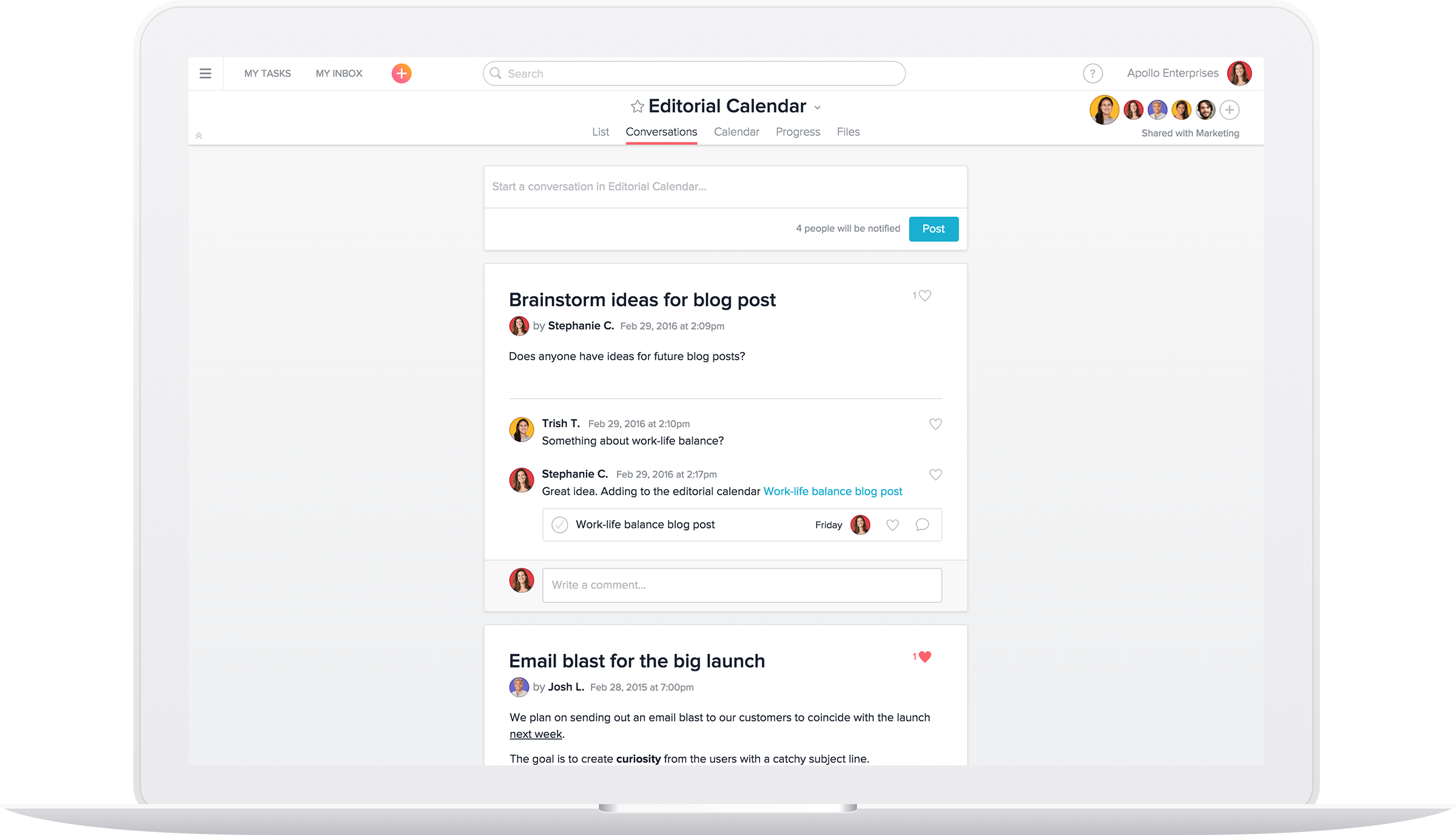
Asana is a web and mobile project management app. With tasks, projects, conversations, and dashboards, Asana lets an entire team know who's doing what by when, enabling workload balancing. Users can also add integrations for GANTT charts, time tracking and more.
$13.49
per month per user
Harvest
Score 8.8 out of 10
N/A
Harvest is used to track time, gain insights from past projects, and get paid for work. Dedicated apps and integrations with popular tools like Asana and Slack allow Harvest to fit into a team’s workflow.
A selection of visual reports are offered to keep projects running smoothly and an organization's team supported. Harvest also helps to turn a team’s tracked time and expenses into professional nvoices and collect payment quickly with integrated online payments.
$13.75
per month per seat
Wrike
Score 8.5 out of 10
Mid-Size Companies (51-1,000 employees)
Wrike is a project management and collaboration software. This solution connects tasks, discussions, and emails to the user’s project plan. Wrike is optimized for agile workflows and aims to help resolve data silos, poor visibility into work status, and missed deadlines and project failures.
$240
per year 2 users (minimum)
Pricing
Asana
Harvest
Wrike
Editions & Modules
Starter
$13.49
per month per user
Advanced
$30.49
per month per user
Enterprise
Contact Sales
Personal
Free
Harvest Pro
$13.75
per month per seat
Harvest Premium
$17.50
per month per seat
Wrike Free
$0
per month per user
Wrike Team
$10
per month (billed annually) per user (2-15 users)
Wrike Business
$25
per month (billed annually) per user (5-200 users)
Apex
Request a quote
per month per user
Pinnacle
Request a quote
per month per user
Offerings
Pricing Offerings
Asana
Harvest
Wrike
Free Trial
Yes
Yes
Yes
Free/Freemium Version
Yes
Yes
Yes
Premium Consulting/Integration Services
Yes
No
Yes
Entry-level Setup Fee
Optional
No setup fee
No setup fee
Additional Details
A discount is offered for annual billing.
20% discount for annual billing on Pro and Premium plans.
Every premium plan begins with a 14-day trial period.
Asana is a great balance of simplicity and robustness. JIRA is simply too robust for my team's needs - it is more appropriate for a software team. We did not need the capabilities to customize automated workflows. Our development process is waterfall, so a PM software centered …
Verified User
Contributor
Chose Asana
Asana is extremely easy to use and gives us all the functionality we need in order to stay on task and meet deadlines. Trello seemed a little elementary compared to Asana, and Wrike seemed a little more complicated than our team needed. Asana is a good balance and has been …
Asana is so much better than Wrike. Wrike has a lot more customizability, but it's too much. Asana keeps things very simple and can include a litany of integrations to help me get the most out of my needs. Wrike, from what I remember, also uses more resources from my computer. …
Asana is simpler and easier to manage than Teamwork Projects and Wrike for smaller teams, but still offers more features than Basecamp and requires a lot less customization than monday.com.
Wrike is similar but JUST a bit more cumbersome in every way. So if something takes 1-2 clicks in Asana it will take 3-4 in Wrike. Just enough of a lift that it makes it hard for people to just get started working. Instead, you must change your employees to think the way …
I used Wrike a few years ago. It was just okey, less configurable, harder to navigate than Asana. Maybe they improved their user experience over the years. I have also used Jira Software (not being on a development team) to structure projects and work sprints. This tool was …
Overall for the money Asana brings a lot of value for organizations who want to do more with less and need a task and project management solution as a small company is growing and scaling to get to the next level. In the space when we evaluated didn't find a lot of other …
Verified User
Analyst
Chose Asana
We tried it as one my developers swore up and down how good it was at the startup... well it crashed in our office, since we didn't end up working the way they did. We are more of a dev ops company than a social media or open source
Asana hit our sweet spot of easy to try, appropriate pricing for our mid size non-profit team, flexibility, and features. Lots of other platforms have very similar features organized in other ways, but Asana made sense and was fun to work with right off the bat. there were …
We are evaluating Forecast as another project management option. The benefit of Asana is that is it usable on mobile whereas Forecast is not. Asana is also more affordable, making it easy to add teammates and clients. Since Asana does not manage resources/time allocation like …
Both software are very similar to each other, even in the economic factor, the reason we choose Asana over the others is because of its usability, the software is very easy to use which helps to get the most out of it, in addition to the integrations that provide Asana with …
We “beta” tested several softwares across our company. Asana was a great fit for our small corporate team. But when we rolled it out company wide, it didn’t stick. We eventually ended up using Airtable - which has worked out well for us.
I like how easy it was to set things up. It was fairly intuitive to setup. Its main features are pretty good. And the main thing is, they are listening to the customer's needs and have built new features that add further value.
Keyboard control. The ability to view and change the task without opening a new page.
Harvest
Verified User
Executive
Chose Harvest
We have used multiple products that are similar. The main one we were using previously is called DeskTime. However, our team felt like DeskTime was a little bit creepy and didn't feel like we fully trusted them and their time. Thankfully Asana was able to integrate with …
Like Asana, Harvest is great for project management, though it definitely skews more toward the time tracking rather than the step by step process. Some of our team members write out their to-do list as project tasks in Havest and start the tracker when they're ready to get to …
The Harvest UI was much simpler. The others felt like they had too much going on and setting up and maintaining was confusing. Harvest's interface is very straightforward and easy enough for a non-techie to set up for their business. Toggl was the closest competitor and looked …
I honestly cannot remember the name of the last time tracking system I used, but I personally prefer Harvest. The tracking software I used before forced users to schedule their services with a timestamp and felt that it was very difficult to maintain this system honestly. I …
Basecamp, we used to have Basecamp. But Harvest+Asana made our decision making easier. We tried with Wrike but the user interface is not aseasy as is looks. Harvest has our problems resolved by now with simple steps that make this tool work for us. Other tools that could help …
After using Harvest for some time, I thought I would try Toggl. It might have been a lack of experience with the interface, but it didn't seem as intuitive to understand billing, and at the time they didn't have a companion desktop app.
Harvest is better than the other time tracking software we have used, primarily, Timeneye. It allows better reporting with less effort. It is also easier to use the larger our agency gets. The plug ins and integrations that Harvest has (Asana primarily) make it even better …
I like Wrike best. I liked Asana, but I think it got too pricey for the features that we wanted out of it. Notion was fine, but I think its ability to integrate with the rest of our tech stack proved difficult. Trello was fine, it was early in my career and I remember its ease …
There is a time and place for any project management tool, and it largely depends on what your team has historically used and where they feel comfortable. Many of the tools are so similar in their features that feel becomes such a significant factor in how teams handle work …
monday.com and Asana both offer more straightforward customization and, therefore, simplicity that make them much easier to use for teams like mine who do not typically manage large projects, but instead maintain smaller task lists that are frequently updated.
Wrike is great for large corporate teams, on par with Asana. I did not have the choice in Wrike, and was initially skeptical after coming from an Asana company but I have been pleasantly surprised in my year+ of using the platform. Wrike is better for cross team projects where …
My previous organization used Asana and the features and interface lacked the buy in from the team. It was not set up the same easy to maneuver way that Wrike is.
Trello was enjoyable and visual yet simply could not withstand the burden of extensive data analysis tasks. Asana is beautiful and simple to work with, yet I thought it was lacking in the customization of reporting that I required. I have selected Wrike since it is in that …
The features and automations in Wrike definitely overshadow the previous tools I've used. I think Asana has a slightly better visual appeal to it and I found navigation simpler vs Wrike but how detailed you can get with a tool like Wrike is unparalleled. Basecamp was actually …
Asana is easier to use compared to Wrike having a steeper learning curve. However, be not afraid, you will be getting that value in a couple of months.
Its scope is more focused and its implementation with email tools is what really puts it above the others. Sometimes softwares are too big for their own good and Wrike covered our main need of keeping track of tasks and having visibility across stakeholders much better than the …
Although they all seem similar upon first view, Wrike is a bit more advanced and allows for more customizations and can get way more complicated (in a good way)
I find Wrike far more robust, especially for multi-step processes and team collaboration. It’s more flexible and suits our operational needs better than Monday.
Wrike has better options for in-task review and approval than anything I've used in the past. The available customization for dashboards and reports is powerful and useful. It's easy to use Wrike at a low level—taking the time to learn its specialized and more powerful features …
Wrike is a stronger platform, faster, easier to use, and better suited for our needs. it checks almost all the boxes where as almost every other platform has significant holes in the product.
Wrike is way more robust than other platforms I have used. I also really enjoy the customer service and having a dedicated account person to reach out to if we need and provide training. It has more features and is more customizable and 'smart.'
I think Wrike is comparable against these competitors - it reminds me of Trello the most in terms of interface. I did not personally select Wrike, I am a user, not the purchase decision maker.
Wrike provides multiple use cases on managing workflow through the various range of functionalities provided. Trello more so provides a straight forward way to obtain a full scope view of projects, but Wrike is more comprehensive in managing all stages.
Great for large project and/or complex projects. However there can be a learning curve. I would possibly choose a different platform if I am working with non-techy team members.
I think the ease of use and cross collaboration is really useful here against other platforms. Also one of the biggest differences is actually really helpful how the app stores files and images which makes them useful to look for previous images (especially when you upload a …
The usability of Asana is broad since it's available in a variety of platforms that are widely used nowadays. I think that it would be great for people who are constantly on the move and switching devices, since it has allowed me to work from my phone, too. I also think that Asana has proven itself to handle a large quantity of work
Harvest is ideally suited for a variety of scenarios, particularly in the realms of freelance or consulting work, where accurate hour tracking for billing is crucial. It excels in small to medium businesses managing team projects, allowing for effective resource allocation and time management across multiple concurrent projects. For budgeting and forecasting, Harvest provides valuable data, aiding in accurately estimating the duration and cost of future projects based on past data. It's also highly beneficial for remote or distributed teams, thanks to its cloud-based platform that facilitates seamless coordination. Additionally, its detailed reporting features enhance client transparency, fostering trust through clear communication of time spent on projects. However, Harvest may be less suitable for larger enterprises with complex integration needs or specialized industries requiring more niche features. Small startups or individuals on tight budgets might find the cost challenging, especially if they don't fully utilize all its features. Lastly, for those needing only basic time tracking, simpler or free tools might be more appropriate, making Harvest an unnecessary expenditure for basic needs.
I think that Wrike is customizable enough to fit most needs, so I would generally recommend it as a starting point to anyone that is looking for a project management tool. Some people on my team don't like it, but I think that is moreso due to lack of exposure than any flaws in the tool itself. I predominately taught myself many of the features, and I found it to be straightforward. There is lots of great documentation out there, plus the community forums are incredible helpful as well. Wrike might not be THE perfect tool for every single need, but I think that there would be very few situations where it would ultimately be incompatible with a team's workflow needs.
Through it, we were able to communicate and cooperate with the rest of the team to complete the work in the required manner and at the appropriate time.
Offers several options on using the tool, for example, you can use the app on your phone, the app for desktop, or simply have the website open.
The timer integrates with other platforms. For example, our team uses Asana as our project management tool. Now, in real-time, I can know which projects my team is working on and whether we're implementing good time management strategies to meet our goals.
The summary break downs are wonderful! You can view an individual's hours as well as project hours. There are even notifications you could receive when your team is getting close to reaching the allotted time for a client's project.
I’m still trying to figure out how tasks best associate to a specific project. There’s a couple different places to edit that and I’m a little confused as to best practice.
Does not integrate into basecamp which is our project management system
I wish that Wrike had more drag and drop functionality that would be connected to assignee and also I wish that the finish date of a task would update to the date where you checked completed. It does not do that. Also finishing a task doesn't move the start date of the next task it "protects your time in that way", but our management team wants us to quickly see what we have down the pipeline rather than having to scroll down the list of upcoming tasks.
It is very user-friendly. Takes a new employee an hour to start figuring out how the system works. That's an important factor. You don't want to encounter the issue where employees need a week to understand how the system works. For example, JIRA, I tried using it for a week and I still don't understand the complicated layout. Asana has a simple interface. Once you see it, you get it type of program.
Again, just a minor compatibility issues using with other platforms such as Basecamp, but it does do everything promised. The only downfall we have found is having to create a job in both platforms and then connecting them later vs being able to create a project once and having them automatically connect.
It's easy as pie to use. I don't have any issues and only the oldest, most un-tech savvy of coworkers on my team seems to have issues with it. It's quick to pick up, intuitive, and effective. I have no criticism for it.
Over two years of (almost) daily usage without outages. Don't remember any errors. I give it 9 only because some Wrike plugins (for online document edit) are based on NPAPI architecture. These types of plugins are being phased out in new browsers, and NPAPI plugins are disabled by default in recent versions of Chrome so you have to do some browser adjustments when you switch browsers or move to another computer.
Wrike tasks loads fine, but I hate clicking files and wait for a bit of time since it is powerpoint or word, Wrike assumes I want to open those on Wrike. My suggestion is to link it to office 365 so we do not need Wrike based decoder for PPTX and DOCX
I haven't had to use their support so I can't rate it. The fact that I haven't needed them reflects the ease of use of the product. I would recommend that any new users schedule a complete demo of the product to ensure that they are using it to it's fullest (there's a lot of useful features).
They're very responsive and do their best to answer whatever questions we've had. Sometimes, the question or request we've made is for a feature that doesn't yet exist, however in most cases those features have been built later and did eventually address our need.
During my learning phase with Wrike, I initially struggled with setting up automation rules and request forms. However, Wrike support was always my go-to, resolving issues within seconds or minutes. Their assistance made the learning process much easier. My best experience was receiving step-by-step screenshots to follow, with the support team on standby until I was completely satisfied.
I love the Wrike training options. Wrike Discover has tons of courses, learning plans, certifications, etc. This is an area where Wrike definitely shines! I wish these resources were more in your face for new people, because it seems like a lot of coworkers didn't know all of this training was available to them.
There are a lot of bells and whistles in Wrike, and not all of it is easy or intuitive to understand once it's plopped in your lap. It's easier when there are a few choice people who understand Wrike as a platform and articulate it in such a way where it makes it easy to pass it along to others in the group
Asana is a top-tier project management software that helps us organize and track projects from start to finish. It allows us to apply tasks/to-dos to multiple projects without duplication, divide complex projects into smaller tasks, and track project progress. It also helps us organize work on Kanban boards or linear lists. It stands out from the crowd in a big way compared to the competition.
Harvest is significantly better than Jira. I think Jira's is not originally intended to be used as a time logging/management system, but we had been previously using it as that. It was much clunkier, and many employees had a difficult time using it as a user interface goes. Harvest is much more user friendly and has simplified the daily time-logging process for everyone in our office
We use both monday.com and Wrike. While Monday does have a better user interface, Wrike allows us to have more visibility into tasks where multiple people are collaborating. And also to receive project brief-ins and requests for new projects. We use both differently and I would say for us Wrike is more the collaboration tool than the day to day individual task management tool - and it works great.
The sky is the limit for what can be done in Wrike. We started with 1 use case and within 5 months we migrated several key business practices over to Wrike because they were easier to manage. Use cases so far: process improvement, management review, corrective actions, maintenance requests, month-end financial closing, and document management. As we grow, it's easy to imagine putting even more into Wrike where it becomes a cornerstone for how we do business
Different teams (e.g., contracting, compliance, provider relations) can view updates in real time, comment directly on tasks, and escalate items when needed.
Wrike allows us to template the contracting process (from intake to signature) to ensure consistency across payers and reduce administrative overhead.
Leadership can see the status of negotiations at a glance, identify bottlenecks, and prioritize resources accordingly.