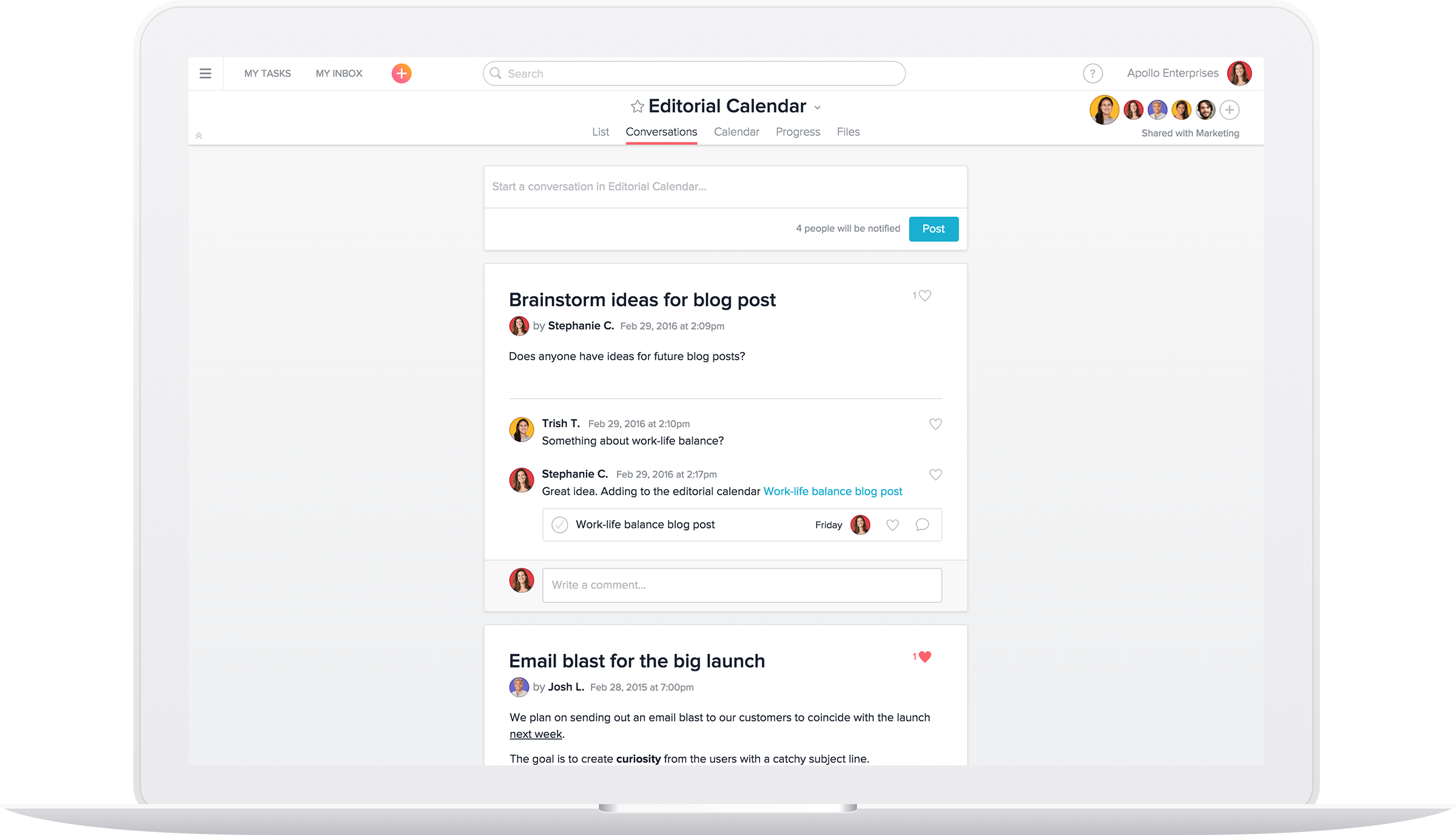
Asana is a web and mobile project management app. With tasks, projects, conversations, and dashboards, Asana lets an entire team know who's doing what by when, enabling workload balancing. Users can also add integrations for GANTT charts, time tracking and more.
$13.49
per month per user
Oracle Sales
Score 8.0 out of 10
N/A
Oracle Sales guides sellers with intelligent recommendations to help them focus on the most valuable prospects at the right time. These machine learning-based CRM selling tools center around clean, complete customer data from internal and external sources.
$65
Per User Per Month
Wrike
Score 8.5 out of 10
Mid-Size Companies (51-1,000 employees)
Wrike is a project management and collaboration software. This solution connects tasks, discussions, and emails to the user’s project plan. Wrike is optimized for agile workflows and aims to help resolve data silos, poor visibility into work status, and missed deadlines and project failures.
$240
per year 2 users (minimum)
Pricing
Asana
Oracle Sales
Wrike
Editions & Modules
Starter
$13.49
per month per user
Advanced
$30.49
per month per user
Enterprise
Contact Sales
Personal
Free
Professional
$65.00
Per User Per Month
Standard
$100.00
Per User Per Month
Enterprise
$200.00
Per User Per Month
Premium
$300.00
Per User Per Month
Wrike Free
$0
per month per user
Wrike Team
$10
per month (billed annually) per user (2-15 users)
Wrike Business
$25
per month (billed annually) per user (5-200 users)
Apex
Request a quote
per month per user
Pinnacle
Request a quote
per month per user
Offerings
Pricing Offerings
Asana
Oracle Sales
Wrike
Free Trial
Yes
Yes
Yes
Free/Freemium Version
Yes
No
Yes
Premium Consulting/Integration Services
Yes
Yes
Yes
Entry-level Setup Fee
Optional
No setup fee
No setup fee
Additional Details
A discount is offered for annual billing.
—
Every premium plan begins with a 14-day trial period.
Asana is a great balance of simplicity and robustness. JIRA is simply too robust for my team's needs - it is more appropriate for a software team. We did not need the capabilities to customize automated workflows. Our development process is waterfall, so a PM software centered …
Verified User
Contributor
Chose Asana
Asana is extremely easy to use and gives us all the functionality we need in order to stay on task and meet deadlines. Trello seemed a little elementary compared to Asana, and Wrike seemed a little more complicated than our team needed. Asana is a good balance and has been …
Asana is so much better than Wrike. Wrike has a lot more customizability, but it's too much. Asana keeps things very simple and can include a litany of integrations to help me get the most out of my needs. Wrike, from what I remember, also uses more resources from my computer. …
Asana is simpler and easier to manage than Teamwork Projects and Wrike for smaller teams, but still offers more features than Basecamp and requires a lot less customization than monday.com.
Wrike is similar but JUST a bit more cumbersome in every way. So if something takes 1-2 clicks in Asana it will take 3-4 in Wrike. Just enough of a lift that it makes it hard for people to just get started working. Instead, you must change your employees to think the way …
I used Wrike a few years ago. It was just okey, less configurable, harder to navigate than Asana. Maybe they improved their user experience over the years. I have also used Jira Software (not being on a development team) to structure projects and work sprints. This tool was …
We tried it as one my developers swore up and down how good it was at the startup... well it crashed in our office, since we didn't end up working the way they did. We are more of a dev ops company than a social media or open source
Asana hit our sweet spot of easy to try, appropriate pricing for our mid size non-profit team, flexibility, and features. Lots of other platforms have very similar features organized in other ways, but Asana made sense and was fun to work with right off the bat. there were …
Both software are very similar to each other, even in the economic factor, the reason we choose Asana over the others is because of its usability, the software is very easy to use which helps to get the most out of it, in addition to the integrations that provide Asana with …
We “beta” tested several softwares across our company. Asana was a great fit for our small corporate team. But when we rolled it out company wide, it didn’t stick. We eventually ended up using Airtable - which has worked out well for us.
I like how easy it was to set things up. It was fairly intuitive to setup. Its main features are pretty good. And the main thing is, they are listening to the customer's needs and have built new features that add further value.
I like Wrike best. I liked Asana, but I think it got too pricey for the features that we wanted out of it. Notion was fine, but I think its ability to integrate with the rest of our tech stack proved difficult. Trello was fine, it was early in my career and I remember its ease …
There is a time and place for any project management tool, and it largely depends on what your team has historically used and where they feel comfortable. Many of the tools are so similar in their features that feel becomes such a significant factor in how teams handle work …
monday.com and Asana both offer more straightforward customization and, therefore, simplicity that make them much easier to use for teams like mine who do not typically manage large projects, but instead maintain smaller task lists that are frequently updated.
Wrike is great for large corporate teams, on par with Asana. I did not have the choice in Wrike, and was initially skeptical after coming from an Asana company but I have been pleasantly surprised in my year+ of using the platform. Wrike is better for cross team projects where …
My previous organization used Asana and the features and interface lacked the buy in from the team. It was not set up the same easy to maneuver way that Wrike is.
Trello was enjoyable and visual yet simply could not withstand the burden of extensive data analysis tasks. Asana is beautiful and simple to work with, yet I thought it was lacking in the customization of reporting that I required. I have selected Wrike since it is in that …
The features and automations in Wrike definitely overshadow the previous tools I've used. I think Asana has a slightly better visual appeal to it and I found navigation simpler vs Wrike but how detailed you can get with a tool like Wrike is unparalleled. Basecamp was actually …
Asana is easier to use compared to Wrike having a steeper learning curve. However, be not afraid, you will be getting that value in a couple of months.
Its scope is more focused and its implementation with email tools is what really puts it above the others. Sometimes softwares are too big for their own good and Wrike covered our main need of keeping track of tasks and having visibility across stakeholders much better than the …
Although they all seem similar upon first view, Wrike is a bit more advanced and allows for more customizations and can get way more complicated (in a good way)
I find Wrike far more robust, especially for multi-step processes and team collaboration. It’s more flexible and suits our operational needs better than Monday.
Wrike has better options for in-task review and approval than anything I've used in the past. The available customization for dashboards and reports is powerful and useful. It's easy to use Wrike at a low level—taking the time to learn its specialized and more powerful features …
Wrike is a stronger platform, faster, easier to use, and better suited for our needs. it checks almost all the boxes where as almost every other platform has significant holes in the product.
Wrike is way more robust than other platforms I have used. I also really enjoy the customer service and having a dedicated account person to reach out to if we need and provide training. It has more features and is more customizable and 'smart.'
I think Wrike is comparable against these competitors - it reminds me of Trello the most in terms of interface. I did not personally select Wrike, I am a user, not the purchase decision maker.
Wrike provides multiple use cases on managing workflow through the various range of functionalities provided. Trello more so provides a straight forward way to obtain a full scope view of projects, but Wrike is more comprehensive in managing all stages.
Great for large project and/or complex projects. However there can be a learning curve. I would possibly choose a different platform if I am working with non-techy team members.
I think the ease of use and cross collaboration is really useful here against other platforms. Also one of the biggest differences is actually really helpful how the app stores files and images which makes them useful to look for previous images (especially when you upload a …
The usability of Asana is broad since it's available in a variety of platforms that are widely used nowadays. I think that it would be great for people who are constantly on the move and switching devices, since it has allowed me to work from my phone, too. I also think that Asana has proven itself to handle a large quantity of work
Excellent as a customer relationship management tool, sales forecasting, building better sales plan for the entire deal lifecycle using critical and complex data, a 360-degree comprehensive view of vendors, partners, customers. Ensuring high standards and consistency is maintained in pricing so that quotes are competitive for prospective customers. At the end of the day, this is an excellent tool for selling and closing deals while being able to access needed information in one place.
I think that Wrike is customizable enough to fit most needs, so I would generally recommend it as a starting point to anyone that is looking for a project management tool. Some people on my team don't like it, but I think that is moreso due to lack of exposure than any flaws in the tool itself. I predominately taught myself many of the features, and I found it to be straightforward. There is lots of great documentation out there, plus the community forums are incredible helpful as well. Wrike might not be THE perfect tool for every single need, but I think that there would be very few situations where it would ultimately be incompatible with a team's workflow needs.
Through it, we were able to communicate and cooperate with the rest of the team to complete the work in the required manner and at the appropriate time.
I would like to see more integration with other CRMs such as Salesforce.
We have each business unit built into Salesforce and it can track the amount of gross profit that flows through our Oracle database. It then further it trickles to each sales rep and what they've closed during their time at the company. These figures are not always accurate.
It be difficult navigating to accounts and drilling down into each specific customer to understand details.
I wish that Wrike had more drag and drop functionality that would be connected to assignee and also I wish that the finish date of a task would update to the date where you checked completed. It does not do that. Also finishing a task doesn't move the start date of the next task it "protects your time in that way", but our management team wants us to quickly see what we have down the pipeline rather than having to scroll down the list of upcoming tasks.
It is very user-friendly. Takes a new employee an hour to start figuring out how the system works. That's an important factor. You don't want to encounter the issue where employees need a week to understand how the system works. For example, JIRA, I tried using it for a week and I still don't understand the complicated layout. Asana has a simple interface. Once you see it, you get it type of program.
Overall our organization has completely moved to Oracle CX Sales and now is able to utilize the latest technology backed by AI to provide a much better experience to customers and saving money at the same time. So it's a Win-Win situation. I believe there is a slight learning curve to derive [the] full value out of this but once you are there, you can delight your customers.
It's easy as pie to use. I don't have any issues and only the oldest, most un-tech savvy of coworkers on my team seems to have issues with it. It's quick to pick up, intuitive, and effective. I have no criticism for it.
Over two years of (almost) daily usage without outages. Don't remember any errors. I give it 9 only because some Wrike plugins (for online document edit) are based on NPAPI architecture. These types of plugins are being phased out in new browsers, and NPAPI plugins are disabled by default in recent versions of Chrome so you have to do some browser adjustments when you switch browsers or move to another computer.
Wrike tasks loads fine, but I hate clicking files and wait for a bit of time since it is powerpoint or word, Wrike assumes I want to open those on Wrike. My suggestion is to link it to office 365 so we do not need Wrike based decoder for PPTX and DOCX
I haven't had to use their support so I can't rate it. The fact that I haven't needed them reflects the ease of use of the product. I would recommend that any new users schedule a complete demo of the product to ensure that they are using it to it's fullest (there's a lot of useful features).
The support the Oracle team gives is generally very good. They are patient, willing to help, and their training methods are collaborative and inclusive. They have conducted multiple support sessions and it’s always been a great user experience. The stellar team [is] always on hand to lend support when the right time comes and their helpdesk is always on hand to help.
During my learning phase with Wrike, I initially struggled with setting up automation rules and request forms. However, Wrike support was always my go-to, resolving issues within seconds or minutes. Their assistance made the learning process much easier. My best experience was receiving step-by-step screenshots to follow, with the support team on standby until I was completely satisfied.
Excellent online training material. On-demand always helps to access anytime, anywhere. Also, it is essential that in this day and age, video tutorials with actual product screenshots make the learning more useful and fun at the same time. Certifications help test knowledge gained during these tutorial sessions. This was a blessing for fresh users.
I love the Wrike training options. Wrike Discover has tons of courses, learning plans, certifications, etc. This is an area where Wrike definitely shines! I wish these resources were more in your face for new people, because it seems like a lot of coworkers didn't know all of this training was available to them.
If you have never used a CRM program is is hard to know exactly what you need. We had lots of changes during implementation and even more afterward once the users started working in it everyday. Also the partner we used didn't inform us about Allotments and not being able to Batch delete custom objects (you can now in recent releases). There were so many unknowns, that if I had it to do over, I would educate myself more and ask more questions of the partner that we used for implementation.
There are a lot of bells and whistles in Wrike, and not all of it is easy or intuitive to understand once it's plopped in your lap. It's easier when there are a few choice people who understand Wrike as a platform and articulate it in such a way where it makes it easy to pass it along to others in the group
Asana is a top-tier project management software that helps us organize and track projects from start to finish. It allows us to apply tasks/to-dos to multiple projects without duplication, divide complex projects into smaller tasks, and track project progress. It also helps us organize work on Kanban boards or linear lists. It stands out from the crowd in a big way compared to the competition.
As compared to other CRM, this happens to be one of the best and most affordable as there are some cons, but the pros are great, and I have seen an increase in sales by using this platform. It works great for the sales process from start to end, like lead generation to closure.
We use both monday.com and Wrike. While Monday does have a better user interface, Wrike allows us to have more visibility into tasks where multiple people are collaborating. And also to receive project brief-ins and requests for new projects. We use both differently and I would say for us Wrike is more the collaboration tool than the day to day individual task management tool - and it works great.
When we purchased this system it was one of the more expensive options in the market. However, with an adjustment in service and a relative price structure, this has become a lot more cost-effective over the past few years. It’s now more of a middle-ranking in the pricing structure and I would definitely say this is value for money.
The sky is the limit for what can be done in Wrike. We started with 1 use case and within 5 months we migrated several key business practices over to Wrike because they were easier to manage. Use cases so far: process improvement, management review, corrective actions, maintenance requests, month-end financial closing, and document management. As we grow, it's easy to imagine putting even more into Wrike where it becomes a cornerstone for how we do business
We can very easily pull up a customer's order and provide any detail they need. The time this saves compared to manually tracking customer orders and accounts is incredible.
Knowing exactly who is contacting customer service and what their orders status is before answering the calls makes the customer service reps job much easier than before.
Different teams (e.g., contracting, compliance, provider relations) can view updates in real time, comment directly on tasks, and escalate items when needed.
Wrike allows us to template the contracting process (from intake to signature) to ensure consistency across payers and reduce administrative overhead.
Leadership can see the status of negotiations at a glance, identify bottlenecks, and prioritize resources accordingly.