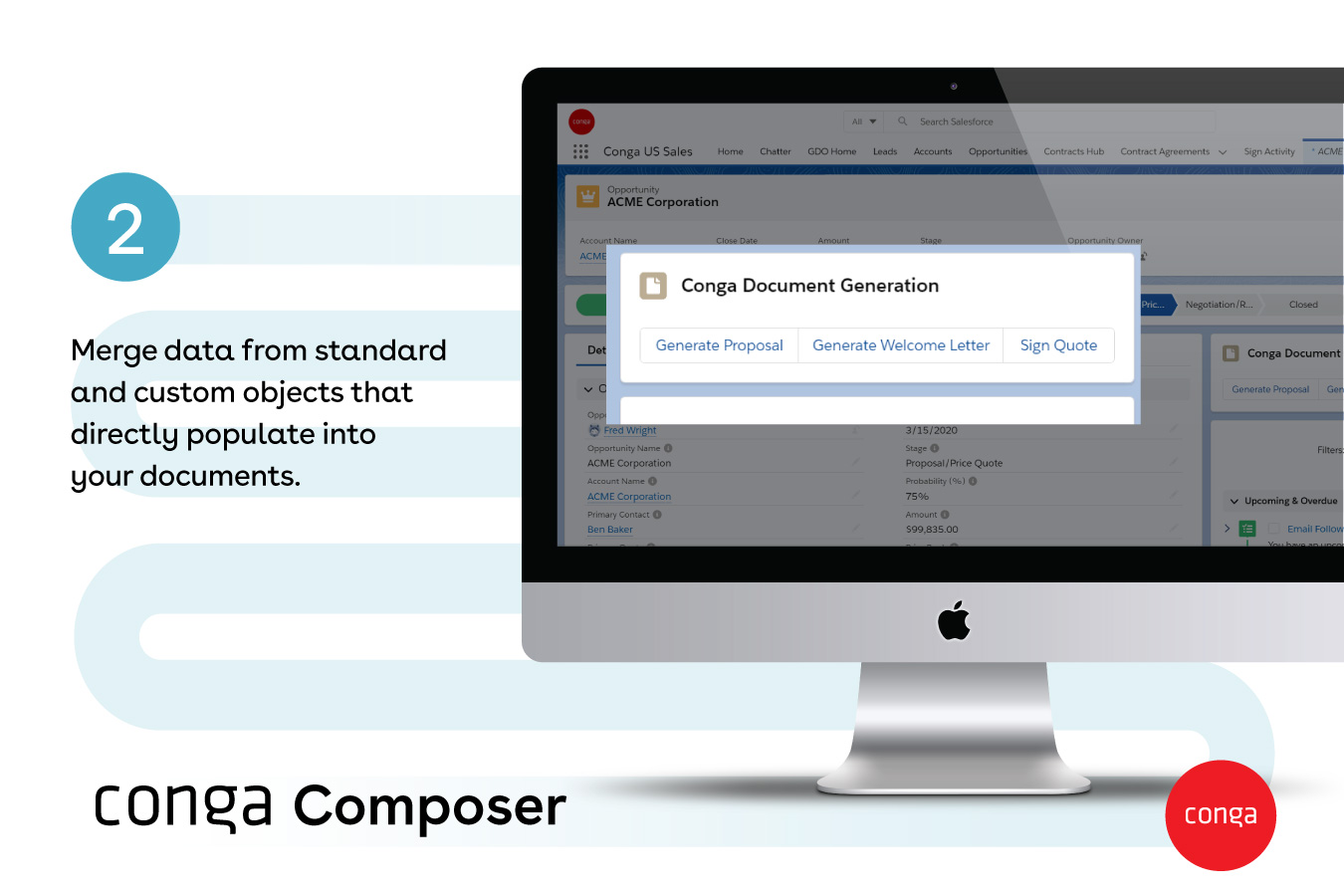
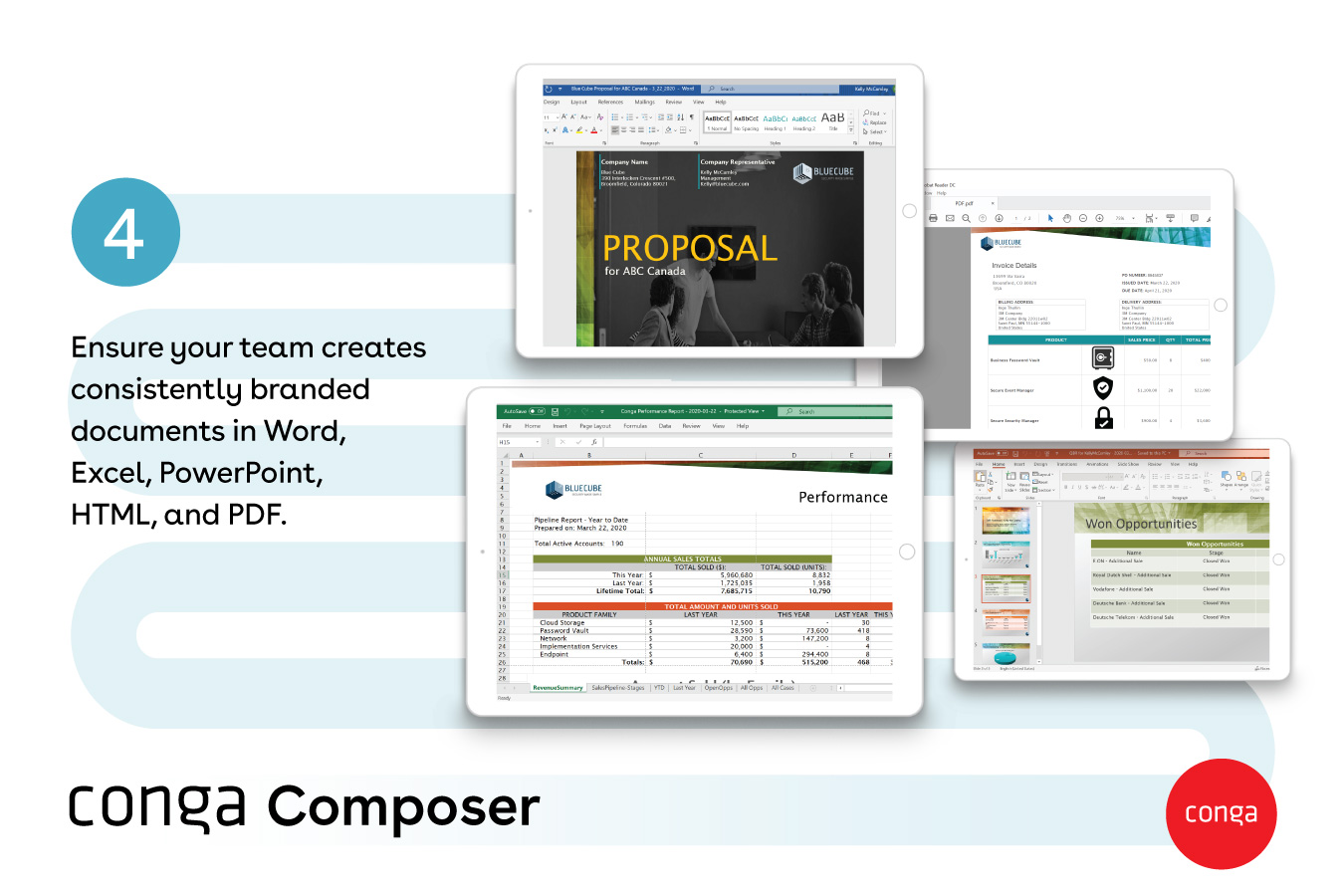
Conga Composer is a document generation and automation tool designed to simplify and streamline the process of creating and distributing customized documents, presentations, and reports.
$30
per month per user
DocuSign
Score 8.7 out of 10
N/A
DocuSign supports transactions with document sharing and electronic signature, as well as automated and guided data collection and entry, record updating across disparate systems and payment collection upon agreement, as well as analytics and reporting.
$15
per month
PandaDoc
Score 8.6 out of 10
N/A
PandaDoc headquartered in San Francisco offers their eponymous electronic signature platform for sales teams, containing sales proposal automation and CPQ (configure, price, quote) features, and integration with CRMs.
$35
per month per seat
Pricing
Conga Composer
DocuSign
PandaDoc
Editions & Modules
No answers on this topic
Personal
$15
per month
Real Starter
$15
per month
DocuSign for Realtors
$35
per month
Standard
$40
per month
Business Pro
$60
per month
Advanced Solutions
Custom Pricing
Starter
$35
per month per seat
Business
$65
per month per seat
Enterprise
Contact Sales
Offerings
Pricing Offerings
Conga Composer
DocuSign
PandaDoc
Free Trial
Yes
Yes
Yes
Free/Freemium Version
No
No
No
Premium Consulting/Integration Services
Yes
No
Yes
Entry-level Setup Fee
Optional
No setup fee
Optional
Additional Details
—
—
PandaDoc offers a free eSign plan and 3 paid packages for eSigning and document automation. All plans include unlimited documents and eSignatures. Evaluations start with a free 14-day trial. Up to a 46% discount for annual pricing.
Conga is more malleable to the documents that you are generating but does not offer the functionality of sending the document directly to the client (such as DocuSign does). Another product we looked into is called Mamba Merge (not found in the list of products above), where we …
I've used PandaDoc before; it is nowhere near as good as Conga Composer in terms of usability and end-user experience. Conga is much more valuable and business-oriented.
Conga Composer helps us in document generation part and once the document has been generated from Conga Composer it can be sent out to the customers. Here we can also use Conga Email Template to send out the message and the attachments. DocuSign here works so well and we can …
We have used PandaDoc and with our personal experience, we can say that Composer is way better as it lets us pull data from multiple Salesforce objects, apply conditional logic, and generate highly customized documents.
Firstly, we used Conga Composer to generate documents and DocuSign as the e-signature tool. However, Conga Sign proved to be much more cost-effective for our user base, as users didn’t need to switch to another system like DocuSign to send contracts to customers. With both …
Conga Composer is highly versatile as this can be easily integrated with Salesforce and other Conga products. Other products either lack integration or lack user experience but Conga Composer has provided both along with great integration which reduces manual tasks which was …
We have not been able to find an offering that allowed for the level of customization or could handle the complexity of the solutions we've built using Conga's products. We selected Conga originally as it was recommended at the time (2012) and there weren't any better …
In my mind, Conga blows away all the competition. The templates are extremely versatile and don't require any additional software (other than MS Office) in order to design. The support that Conga provides is world class and I never had a negative experience with them; all cases …
Vice-President, Business Applications, IT & Facility Operations
Chose DocuSign
Looked at PandaDoc about 18 months ago because of the interesting functionality around tracking redlines in contracts. This is something we are interested in, but PandaDoc was not PCI compliant (we capture billing info on our DocuSign forms). At that time they were pursuing it, …
To be honest, I found out about PandaDoc after we had already signed a contract with DocuSign. I researched PandaDoc, and while they seem fine and are a wonderful up and coming company, we've had such success with DocuSign, and they've been around longer...they have a good …
We currently use Conga Composer for different document generation. They both serve their individual purpose. Conga is used for generating statements of work not necessarily sign able documents in our process. Very happy with both products and feel that they are integral to our …
We didn't really look at other products, but we may be looking into eSign for Salesforce and Conga because there is an existing connector for one of our clients.
DocuSign is like Salesforce for CRM's. It just made sense as we were scaling as an organization and moving and adding new technology to our stacks. We really like Adobe Sign as a close second, but for what we were doing, DocuSign came back as a more professional sales org and …
I think DocuSign is still the leader in this industry as pronounced by their superior customer service and quick development response time to changes in the industry. For simple users, DocuSign is user friendly and easy to navigate while adding significant benefit to small to …
They stack up very well. I was happy with other the other software. They lost us because of how expensive it was for clients to have access to their API. A lot of our clients cannot afford $200/mo. They can afford $50/mo which is what most of our clients pay.
We looked at DocuSign before PandaDocs, and while they are a well-known and good product, we felt their basic content was lacking compared to PandaDoc. We felt we got more bang for our buck, and the navigation seemed better. Plus, we get a dedicated rep with PandaDoc.
PandaDoc and DocuSign are very similar in functionality and design, but I prefer to use PandaDoc's interface. It is so easy to use and I prefer PandaDoc's interface and UI. It feels a little cleaner and a little more professional to me when compared with DocuSign's interface …
PandaDoc is equal to DocuSign in every significant way except for its level of adoption; however, the pricing of PandaDoc is so much better that it's clearly the best choice for our firm.
I think PandaDoc is more modern and has a more user-friendly nature than DocuSign. We preferred Pandadoc because it allowed multiple workspaces, enabling different teams to have varying levels of access. This was incredibly useful, as it meant HR and Legal could only view …
I find it easier to automate and create templates in PandaDoc. Specifically the templates. Also, connecting through API is easier (our IT team says so, I'm not qualified to evaluate that). Pricing is also something important, when we acquired PandaDoc it was cheaper so we were …
PandaDoc is easier to use and creates more professional documents than the other platforms we've evaluated. It also has very handy features such as reminder emails, suggestions, templates that we found were more robust than other platforms. The pricing was also competitive and …
To be able to block certain fields within templates and contracts, so that the commercial team can negotiate the rest and adapt them but cannot change those purely legal clauses that should not be negotiated or changed without the approval of the legal department. I also find …
We chose PandaDoc for its ease of use and tools that allow a professional feel. The convenience for our clients to review and sign agreements also helped us make the decision to go with PandaDoc.
From my experience, Conga Composer is particularly well-suited for generating documents, such as quotes and contracts, directly from Salesforce. It saves us a great deal of time, which is remarkably beneficial for companies with sales teams. Not suitable for companies lacking significant Salesforce expertise or administrative support.
This product is well suited in the use case that I provided before: when it comes to onboarding employees and providing a clear channel for decision making for human resources, this is an excellent tool to accomplish that. I would say the weak points is when you have back and forth communication with users that it might seem a little redundant to have that back and forth communication in that scenario.
Best suited for after demonstrations when requested by the prospect when they are looking for pricing with T&C. The data room is also great that acts like a drop box for opportunities and their contacts. Helps share pertinent information with others in the organization.
Tracking, particularly when collecting signatures through connected applications, such as an ATS, is not always clean or easily traceable.
Formatting documents to handle electronic signature types (signatures, initials, etc.) is not always easy, and highly dependent on the partner's technology.
It is not convenient to have to use DocuSign as a stand alone product if the signatures are required for 3rd party applications. It definitely excels on its own, but the scope of that usage, at least for us, is slim.
Sometimes the fillable fields don't automatically map properly and you have to manually adjust.
Plan tiers and pricing recently changed, so now we get less value and less features (limited templates, no more pricing tables or invoicing/connected payment) for the same price, which is pricy for a small business.
Easier, integrated invoicing as an included feature (so we don't have to use a different software for invoicing/payment collection) would be ideal. You have to upgrade to the Business Plan for this.
Though I love how easily Conga Composer ties into Salesforce and its given analytics, it takes a lot of data entry to get up and running. I don't love that sometimes queries can take a long time to pull. I like keeping our marketing templates consistent via templates in the system. Pulling multiple objects into one report is fantastic too.
I can't imagine doing business without DocuSign now. I would never want to go back to the way we used to do things. The "new way" is "the way" is "the right way." We can honestly be proud of a "one right way" process and not have to suffer through "5 ways for 5 days."
The reason I gave it a rating of 7 is because it's probable, but not for sure. This is because there are a few little things we don't love about pandadoc. Mostly that there is not conditional logic such as: they must either fill this field out OR this one. Also it's a little pricey. But we'll probably stay because it's good enough and a pain to switch to something new
It's a fairly simple tool to integrate into your current business structure. When we've had issues, we were able to resolve them extremely quickly. The users click a button and it can bring in all the quote lines, and our credit application seamlessly into our tool. I'd definitely recommend it to other colleagues
Generally user-friendly once you have command of the basics, but also has a lot of nuances that can make it difficult to train others on. DocuSign University is a helpful tool, but understandably a lot of content to get through to become a well-versed user. A lot of different functionalities but only a few I use on a weekly basis.
Once you get the hang of it, it's very easy to use. There can be a slightly steep learning curve to get fully in on the system. The new editor v2 has really improved usability and allows us to collaborate on documents simultaneously. Once the templates and library items are set up, a new document, whether it be a sales or HR document, takes very little time to complete.
The documents load quickly for the most part but sometimes if there are larger documents with a high number of variables it could take a bit longer to get the document to show up. Most of the time the document comes on the screen relatively quickly allowing for quick access to documents to be edited and sent out.
It's been hit and miss depending on the issue. We use javascript to generate the urls which has confused many techs even though it generates a clean url - they are overwhelmed by the concept of code and can't understand that the url is all that matters.
I'd give them a 10, but there has been 1 or 2 small cases that seemed to fall to the wayside, but I was able to call them up and get them resolved. We were having a bad implementation night (after midnight) and we needed assistance from Docusign. They were able to get an engineer to help us in the early morning hours
Recently I could not upload a pdf to a contract - support was very responsive and easy to work with. They got back to me the next day with an apparent fix - however when I opened the document nothing had changed. I then could not respond to the rep who was helping me because it was a "no-reply address", the problem still has not been solved and we had to make alternate arrangements to get this to the client. Never had it happen before and was only with this one contract.
Docusign is super easy to use, and apart from a few administration details, there was really nothing to train on. Post implementation, there were issues with configuration of auto-filled documents with the integrating 3rd party. That training required some time, because the DocuSign expert took the time to walk me through the 3rd party's configuration (how often does that happen?) so I could see how DocuSign should be best used to overcome weaknesses in the 3rd party platform. 10/10 expert care.
Until you get the hang of it, I recommend doing several internal tests before sending a document to a client. As I mentioned earlier, you have to go through a bit of trial and error at first to verify that the workflow works as expected.
I think Nintex is the primary competitor for Conga Composer, but I have not personally used it. I was not present for the decision to purchase Conga but I would recommend it in future document automation vendor selection processes because I have seen how well it works! We are especially fond of complementary features in Conga Composer, including Conga Email Templates and Conga Global Merge.
There has never been anything that we could really compare to Docusign. We have tried sending documents in a PDF version, but that was not nearly as efficient. DocuSign saves your signature in the system and uses that as it goes through your documents.
We used Dropbox back when it was still HelloSign. At the time, new templates were very hard to create. We had to upload a PDF and then add the fields from there. With PandaDoc, we are able to drag and drop the text, images, logos, and fields we need easily. This has saved our team an immense amount of time.
Could really use better error handling on the product when the document doesn't generate. Zero notifications are provided right now and have no idea where in a 20 page template the error is. Need to keep cutting the template into pieces to find the error.
The report generates 90% of the time so far.
Getting easier to generate templates when knowing how the JSON will be structured to add to merged fields.
Use Work Plan Template Entries and Work Steps to dynamically generate many deliverables.