Adobe Workfront, acquired by Adobe in late 2020, is a web-based project-management tool. It is designed for both IT and marketing teams, but can be implemented for any kind of project. Workfront offers all the features standard to project management platforms, as well as resource allocation, automation, and agile workflow.
N/A
Airtable
Score 8.6 out of 10
N/A
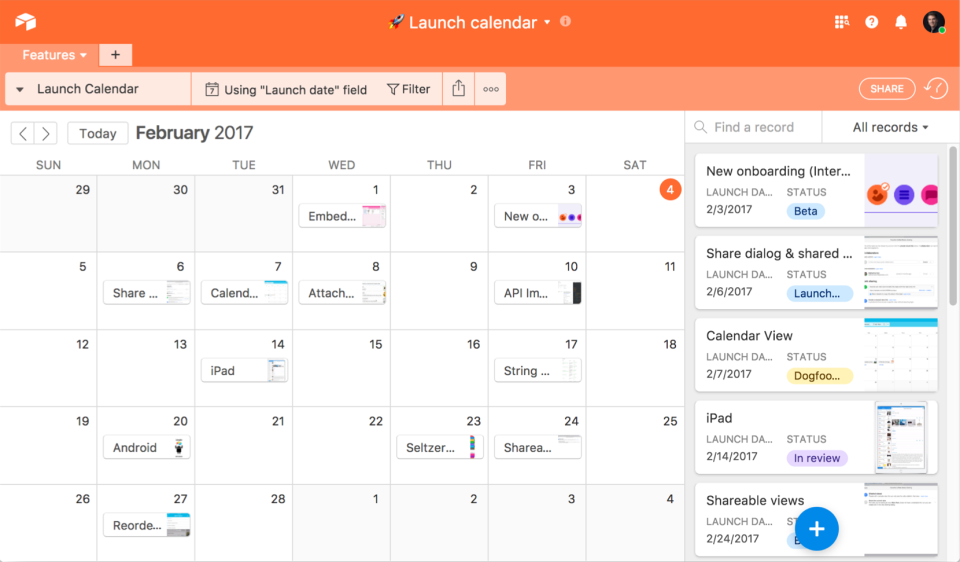
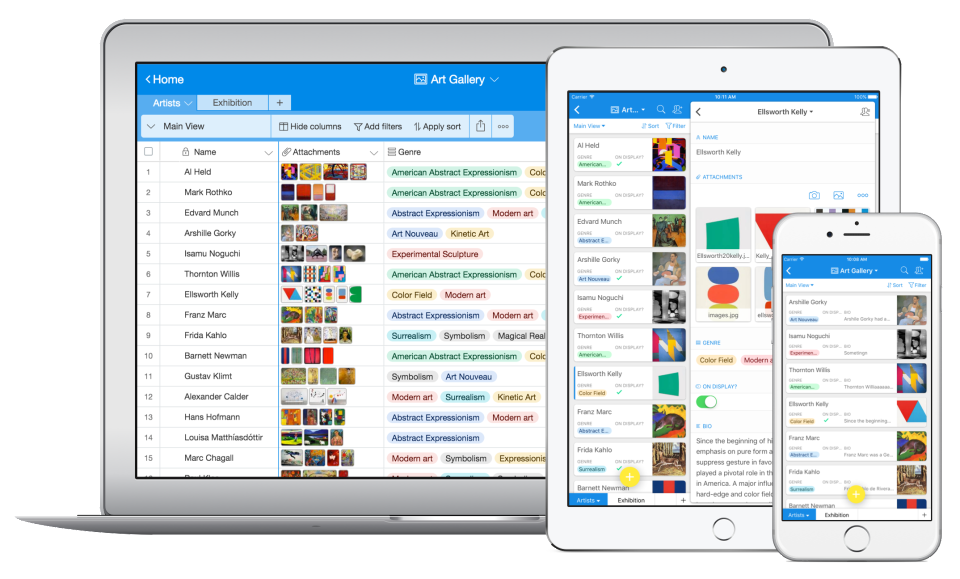
Airtable is a project management and collaboration platform designed to enable content pipelines, product management, events planning, user research, and more. It combines spreadsheet,database, calendar, and kanban functionality within one platform.
$24
per month per seat
Wrike
Score 8.6 out of 10
Mid-Size Companies (51-1,000 employees)
Wrike is a project management and collaboration software. This solution connects tasks, discussions, and emails to the user’s project plan. Wrike is optimized for agile workflows and aims to help resolve data silos, poor visibility into work status, and missed deadlines and project failures.
$240
per year 2 users (minimum)
Pricing
Adobe Workfront
Airtable
Wrike
Editions & Modules
No answers on this topic
Team
$24
per month per user
Business
$54
per month per user
Enterprise
Custom Pricing
Wrike Free
$0
per month per user
Wrike Team
$10
per month (billed annually) per user (2-15 users)
Wrike Business
$25
per month (billed annually) per user (5-200 users)
Apex
Request a quote
per month per user
Pinnacle
Request a quote
per month per user
Offerings
Pricing Offerings
Adobe Workfront
Airtable
Wrike
Free Trial
No
Yes
Yes
Free/Freemium Version
No
Yes
Yes
Premium Consulting/Integration Services
Yes
No
Yes
Entry-level Setup Fee
Optional
No setup fee
No setup fee
Additional Details
—
—
Every premium plan begins with a 14-day trial period.
I have used Jira, Trello, Microsoft Project, Excel, many task list mgmt. apps (Todoist, RTM, etc.), podio, wrike, and paper. I have never found a project management tool that can accomplish bringing corporate people all into the same system as well as workfront (for large …
Workfront beats them all hands down. Asana was too simplistic for our needs, Wrike was very clunky and didn't handle the finances very well. Clarizen didn't have document approvals and collaboration that we needed. Workfront was a great mix of ease of use, complexity, and …
We have used Wrike - when we used it, it was not as advanced, but it may be updated now. We chose Workfront for its robust options - project and task management, resource management, financial and scope management, reporting, workflows, etc. Workfront is flexible in that you …
This is apples and oranges. Wrike is an easy-to-use tool but now feels very basic compared to Workfront. It was too simplified for our needs, and did not allow us to break down large, high-level projects to the steps that we needed. Workfront allows for a lot more details and …
We also use Wrike and Asana. Workfront is way better for in-depth reporting compared to Asana, but lacks the intuitive task management that Asana offers. Asana is just easier to use. Workfront is night and day better than Wrike in almost every aspect. Better reporting, …
Workfront is more robust and versatile than Asana and Smartsheets, which is why we did not go with those tools. It is pretty comparable to Wrike in many ways. We use Workfront over Wrike because we are set up in Workfront already.
Adobe Workfront doesn't stack well with these other tools. monday.com and Airtable have great interfaces and are very easy to set up and use. That is what my team currently uses.
Adobe is very intuitive in its workflow automation and creation of the task workflows that can be used as templates for employees. That is harder to create in Teams unless there is [the] integration of another Microsoft product and more time spent on it by an IT professional. …
I would find that feature-to-feature comparisons and extensive features put Workfront at the same class level as Workamajig. It may come down to preferences and UX of the platform that would make for the ultimate decision on which to go with for project management needs. Asana …
I am a consumer of Workfront for a couple of years now and am a major defender of this venture and the board apparatus for a few reasons. 1) I think that it's exceptionally natural for clients to utilize. 2) It is effectively tweaked dependent on the requirements of your …
Workfront has better integration into the tools we use, like Adobe Creative Suite, Outlook, Salesforce, and our CMS and DAM. We needed a solution that could work well with our MarCOMM Stack and didn't need a whole lot of support. Although we're a small shop (license-wise) …
I haven't really used the other systems. I have only researched them and compared them against each other. I chose Workfront because I felt like the UX/UI and the breadth of what Workfront offers far outweighed the opposition.
When shopping for a project management system, Workfront was the clear winner for our group. The proofing tool, mobile app and product features were far superior to all other products we reviewed and saw demos of.
Assistant Director of Production for Online Learning Video
Chose Airtable
Wrike is robust in its customization, but you are in charge of customizing it yourself. The cool thing about Airtable that they've created a multitude of ways you can immediately launch into a project management solution specific to your industry and needs. It shows that they …
Wrike is a very good platform for project management, however, it focuses more on marketing work which is not negligible, but for us it has worked better to manage with Airtable because it is made to manage projects using the primary information of the company that is none …
Airtable is far more sophisticated than Sheets or Excel in terms of its functions. The interface is also much easier on the eyes. People are less familiar with it and there is a bit of a learning curve, but overall, Airtable empowers us to do more and to better understand our …
Airtable is the most user-friendly and adaptive. It's UX/UI is the most aesthetically pleasing (which matters a lot if its what you're staring at every day), and the customizability of having different views and perspectives of the same record is extremely helpful.
Airtable stack up against major market competitor tools as it provides a unique way of representing data in the form of spreadsheets, which is very easy to understand, and anyone can efficiently work on it. Also, its hybrid cloud provides enough data security. The unique …
Our needs are broad and general. We needed a trued database solution that would take us beyond spreadsheet management, and also a product that could be used for CRM and project management. Airtable was the only solution we found that could meet all our needs at an affordable …
We selected Airtable for the Calendar view and the grid view features. We like being able to link tables to one another, and we appreciate how collaborative the platform is. Airtable is able to display our data in a visually appealing and user-friendly way. We wanted to be able …
I think the usability of Wrike is far better than Airtable. I find Airtable to be intimidating to learn, whereas it was pretty easy for me to pick things up on Wrike.
The advantage compared to MS Project is that Wrike is one tool, while MS Project needs Teams for conversation and is usable for project management, but not for task management and assigning. onepoint PROJECTS and Workfront are similar to Wrike. The decision for Wrike was a …
I think Wrike is better than both because it gives you more fields to clearly explain what is needed. I also like the email automation better on Wrike.
Wrike is a stronger platform, faster, easier to use, and better suited for our needs. it checks almost all the boxes where as almost every other platform has significant holes in the product.
Wrike has been a helpful benchmark of industry standard. Many people who have used other similar platforms have been able to easily transition to Wrike.
Wrike always works - it's always up-to-date, never down, and our one source of truth. I wish the mobile version of Wrike was more usable, but that's the only thing where Wrike may not be the front runner.
For its ease of use, Better project management, Project/task view, Ease of coordination with colleagues, its vertical layout for project updates and comments, and Logical layout.
Wrike has more features than most of the competitors we evaluated, and is a much more flexible tool in terms of being able to mold to any use case. The UI of Wrike is clean and easy to look at and navigate, and it allows each team and each user to customize their experience and …
Verified User
Employee
Chose Wrike
So much better! It's so much easier to manage projects and tasks in Wrike. Input is easier, finding work and documents is easier. Everything about it is better. I would literally walk away from the computer in frustration at times while trying to find or add things to …
Wrike is one of my favorite tools I've used so far because although it has vast reporting capabilities, I also find the interface to be pretty user friendly.
My company already had selected Wrike before I joined. From my experience, it's easier on the eyes, better CX, customisation and automatisation.
Verified User
Employee
Chose Wrike
Wrike offers a lot more features and functionalities compared to the tools we've used previously. The approval process, UI, and integrations available make it a no-brainer. It makes collaboration between remote teams extremely convenient. The experience has been great and after …
Wrike is a great tool across all stages of work. What sets it apart from other platforms is how well it caters to the needs of all types of teams and departments. Being a broader system, it doesn't specialize in any specific area (e.g., finance or design), making it a universal …
wrike gets really granular with tasks and ownership, and allows you to automate particular project mechanics that other software does not do. Wrike is also very collaborative, with the ability to manage your own dashboard or create one for others that allows to easily …
When balancing needs of Roadmap Planning, Program Management, Project Management, Work Management, Queue Management, Ticket Management, I think Wrike hits the perfect balance of usability and configurability with the power to scale effectively while maintaining governance, all …
Features
Adobe Workfront
Airtable
Wrike
Project Management
Comparison of Project Management features of Product A and Product B
Adobe Workfront
7.3
418 Ratings
6% below category average
Airtable
7.8
235 Ratings
1% above category average
Wrike
8.0
914 Ratings
3% above category average
Task Management
8.6417 Ratings
8.9199 Ratings
9.1905 Ratings
Resource Management
7.4375 Ratings
8.0193 Ratings
7.8777 Ratings
Gantt Charts
6.5330 Ratings
8.489 Ratings
7.9635 Ratings
Scheduling
8.0369 Ratings
7.4165 Ratings
8.3791 Ratings
Workflow Automation
7.6376 Ratings
8.0143 Ratings
7.9782 Ratings
Team Collaboration
8.1399 Ratings
8.0218 Ratings
8.6905 Ratings
Support for Agile Methodology
6.8271 Ratings
8.3108 Ratings
7.7503 Ratings
Support for Waterfall Methodology
7.3279 Ratings
8.580 Ratings
8.0452 Ratings
Document Management
7.4377 Ratings
7.5170 Ratings
7.6761 Ratings
Email integration
7.3319 Ratings
7.1115 Ratings
7.7682 Ratings
Mobile Access
5.8309 Ratings
5.9191 Ratings
7.9658 Ratings
Timesheet Tracking
7.7295 Ratings
7.793 Ratings
7.7427 Ratings
Change request and Case Management
7.3297 Ratings
8.1102 Ratings
7.723 Ratings
Budget and Expense Management
7.0255 Ratings
7.2127 Ratings
7.6325 Ratings
Professional Services Automation
Comparison of Professional Services Automation features of Product A and Product B
It works super well for creative brief intake and brand reviews. It took us more time than I'm willing to admit to get it all set up, but for our limited use case, it's working very well now. I'm not sure where it wouldn't be a good fit, honestly. As a newer user, it's still something I'm getting to know and learn.
Airtable is an ideal platform for small and growing businesses to keep track of just about EVERYTHING they need to keep things running smoothly. It's a great way to keep tasks organized, and keep everyone on the same page with progress on all things. Our company finds the kanban particularly useful, as products go through a lifecycle from ideation to retirement, it's good to keep a database of what is in production, what's working, and what we've tried before. I can see the platform being challenging with much larger businesses, but for the small to medium businesses I've used the platform with, it is ideal.
I believe it's well suited if you have multiple jobs/projects that you need to keep organized. We work with multiple job types from print/creative to web, copy and digital ads so it helps us stay organized. I don't think it would be suitable for a company that doesn't have a lot of jobs to manage. We average over 1,200 requests a year.
Airtable has capabilities commonly found in spreadsheet applications, but also has some of the features found in databases.
The ability to filter fields. I set up a filter on the status field, so when a project is marked, complete, on hold, or canceled, that record is hidden from my current projects table view. If it is marked complete, the record is moved to the completed projects table view. In this way I can easily access a record of past projects
Being able to duplicate tables and create alternate views
Collapse and expand records. When I collapse the rows, I can easily scan current projects, next steps, project status, and due dates. When I expand the row, or field, I can see more detailed information about that field or record very easily. I can also expand or open the entire record. This is is helpful, when I am entering a lot of information to multiple fields in that record.
Allow nonusers to add requests, our organization has no need to add all 10,000+ team members to Adobe Workfront, but would like them to be able to send requests to our team
Workfront is sometimes a bit clunky to use, but overall it works well for our teams when it comes to project management and collaboration across multiple, involved teams. It also has flexibility that allows us to adapt it to diverse use cases, some of which aren't necessarily always the first things that one would think of using workfront for.
We will 10/10 renew the use of Airtable because it has brought great value to our team. Not only is Airtable affordable, but it's also user-friendly and helps our team be efficient. We no longer need to rely on Excel spreadsheets being passed from person to person via email. Furthermore, we aren't dealing with corrupt Excel spreadsheets and the need to salvage data when a file is accidentally altered.
I wish that Wrike had more drag and drop functionality that would be connected to assignee and also I wish that the finish date of a task would update to the date where you checked completed. It does not do that. Also finishing a task doesn't move the start date of the next task it "protects your time in that way", but our management team wants us to quickly see what we have down the pipeline rather than having to scroll down the list of upcoming tasks.
Workfront is overly complex, but it is functional as a tool to keep track of projects. It is a shame that sometimes it takes a lot of clicks to find anything. Workfront is slowly modernizing its interface but at the same time, hides certain information away thus making the experience feels worse.
IMO the usability of this product is its greatest asset. The UI is clean and the menus are intuitive to the point where I'd feel confident having a non-spreadsheety colleague take on building an Airtable for the first time with next to no training. I can't say that about every table-like software product that I've used such as Notion.
It does take some time and work to really understand and use it properly, but I think the accessibility to help and documentation make that completely feasible. Once you know how to use it, I find it to be very user-friendly, and have very few complaints.
Maintenance is required, but usually after work hours, Some days the proofing tool function is not operational, but this is a new function of the tool that WF is working out. the kinks on. Chrome is the best browser to use the system in and we find Firefox and Explorer lose some view functionality - Gantt Chart, Resource Grid
I have rarely experience downtime, compared to other tools, and given how much time we spend on the tool. Even if there were to be, their updates on it are very timely, and our support team are able to provide any questions regarding
Over two years of (almost) daily usage without outages. Don't remember any errors. I give it 9 only because some Wrike plugins (for online document edit) are based on NPAPI architecture. These types of plugins are being phased out in new browsers, and NPAPI plugins are disabled by default in recent versions of Chrome so you have to do some browser adjustments when you switch browsers or move to another computer.
I think overall, Adobe Workfront performs well. There have been some times when it doesn't load or run as quickly as our team would like. This is frustrating when it is such a crucial tool that our team utilizes on a daily basis. It can show our workflow when it lags.
I never had any issues with load time, even with the integrations that we use today (google sheets) However, I'm curious if adding additional layers of integrations would slow down performance. We do carry quite a bit of data in Airtable, but, again, no impact on overall performance
Wrike tasks loads fine, but I hate clicking files and wait for a bit of time since it is powerpoint or word, Wrike assumes I want to open those on Wrike. My suggestion is to link it to office 365 so we do not need Wrike based decoder for PPTX and DOCX
I know that this particular company has it's own Adobe Workfront employee that builds out things they need from the software, and meets with them regularly to troubleshoot. I'm not part of this process, but it's refreshing to see Adobe provide this level of customer service to people, and they're expedient.
Airtable has great support. They have a variety of support features to answer any questions. They have great self teaching instructions for templates and product tours. They also have support for teams and project management. They also have a fantastic customer help line. They are able and willing to answer customer questions and never have customers waiting long
During my learning phase with Wrike, I initially struggled with setting up automation rules and request forms. However, Wrike support was always my go-to, resolving issues within seconds or minutes. Their assistance made the learning process much easier. My best experience was receiving step-by-step screenshots to follow, with the support team on standby until I was completely satisfied.
The training is very easy to use and you can simply choose the topics included in the course(s) that are most important to your training needs. After each training course, you are tested on what you have learned. If you need a refresher course, they provide Course Catalogs as well as instructor-led courses & workshops.
Recorded trainings were provided by the Airtable team. Great as an evergreen resources to new team members and for anyone that wants to refresh their Airtable knowledge
I love the Wrike training options. Wrike Discover has tons of courses, learning plans, certifications, etc. This is an area where Wrike definitely shines! I wish these resources were more in your face for new people, because it seems like a lot of coworkers didn't know all of this training was available to them.
Most people learn as you go, a lot of this stuff requires trial and error throughout so my suggestion is to provide as much information in the upfront and keep it as simple as possible. You can add other tools and features as you go but everyone should have the basics down so no bad habits can start to develop. Be persistent with everyone, and don't be afraid to correct and talk through steps again so everyone is on the same page
Training all users was an important part of the implementation, which did take considerable time and effort. At first glance without training, the content calendar can be overwhelming because of the amount of data. The features within Airtable seem to be endless but our team was able to identify the most important to be successful.
There are a lot of bells and whistles in Wrike, and not all of it is easy or intuitive to understand once it's plopped in your lap. It's easier when there are a few choice people who understand Wrike as a platform and articulate it in such a way where it makes it easy to pass it along to others in the group
Adobe Workfront blows the other systems out of the water. It just delivers more - out of the gate, and at every quarterly update. Innovation is top of mind, and meeting customers' needs is key. We have been extremely satisfied with Workfront and look forward to all the new features on the horizon, especially AI.
Airtable was a really good fit for this specific use case as it provided a huge number of collaboration features in an intuitive and pleasant-to-use interface. The free tier worked initially with our work, and the upgrade pathway was fair and made sense for us.
Jira did not at all help us get our work done as content creators. I think that was because Jira wasn't quite right for our uses. Wrike fits our needs so much better. I can't tell you enough the relief I felt when we adopted Wrike and I never had to use Jira again.
As I stated earlier, I didn't have to pay for Workfront myself- I'm a user under a large organization. I know it's not cheap to implement, I don't know how the price scales for a small-business, but I do like the product enough that I'm going to look into it in the future for my own company.
Our organization has thousands of users that use Workfront and it seems to hold up very well. I have not encountered any issues using it and I think it makes it very easy for multiple people to be involved in a project and keep things organized and clear for everyone involved.
There are TONS of opportunity to scale, but I think it's a matter if you have the time and resources to do so because the initial setup can be fairly time consuming and prioritized dedication
The sky is the limit for what can be done in Wrike. We started with 1 use case and within 5 months we migrated several key business practices over to Wrike because they were easier to manage. Use cases so far: process improvement, management review, corrective actions, maintenance requests, month-end financial closing, and document management. As we grow, it's easy to imagine putting even more into Wrike where it becomes a cornerstone for how we do business
Resource Management - Year over year, we were able to validate time and money saved by the implementation of Workfront by more than 2%, saving in non-working dollars and 9% savings in working media dollars.
Organization Restructuring and Automation- We also restructured our teams and implemented automation based on our analysis of how and what we spend our time on and the ROI for our respective business units.
Through this platform, I always have the idea bout which of my team member is working on which particular part of the project, I can easily track their progress, and also I can easily correct them where it is required by adding sticky notes, by sending the attachments and URLs.
Different teams (e.g., contracting, compliance, provider relations) can view updates in real time, comment directly on tasks, and escalate items when needed.
Wrike allows us to template the contracting process (from intake to signature) to ensure consistency across payers and reduce administrative overhead.
Leadership can see the status of negotiations at a glance, identify bottlenecks, and prioritize resources accordingly.