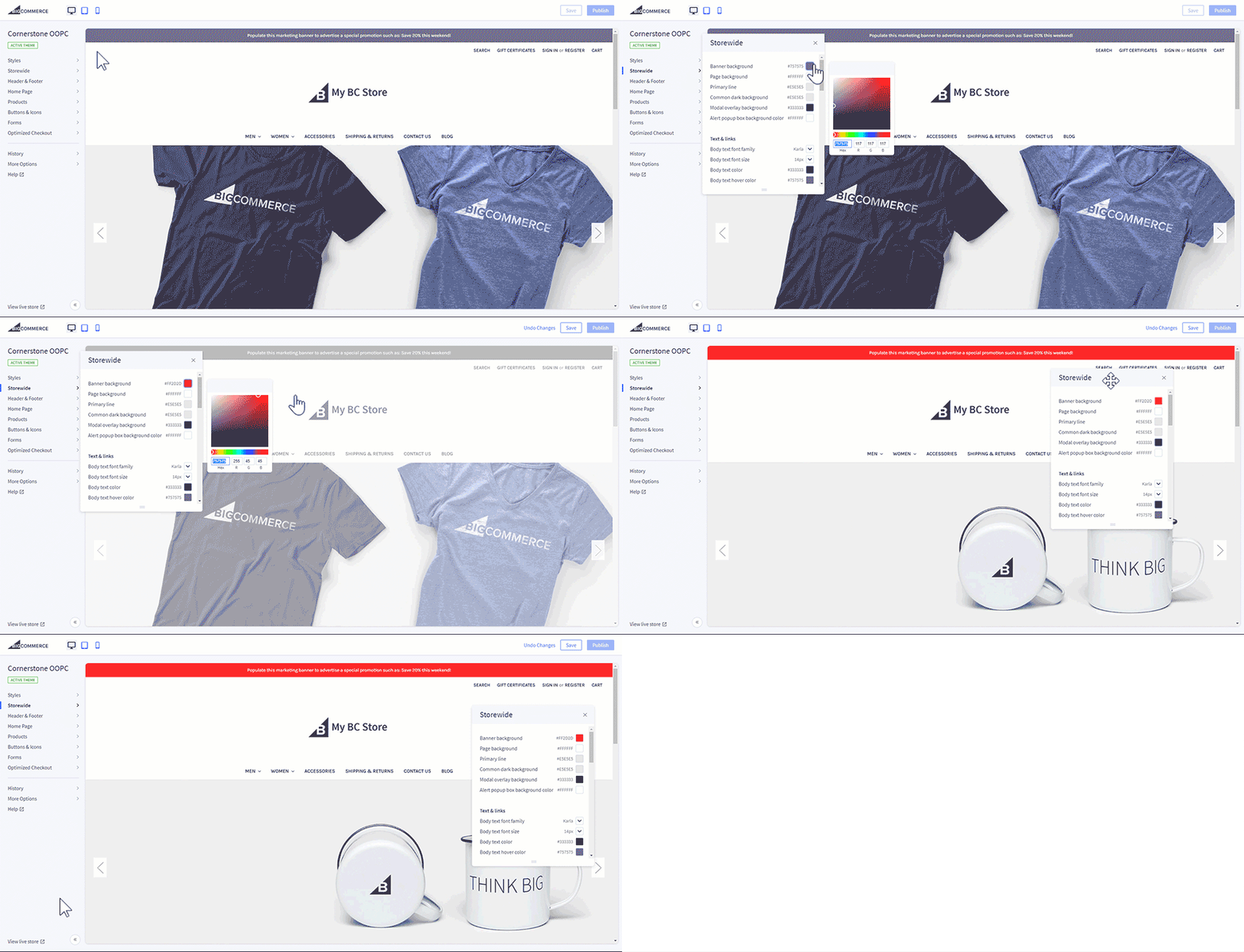
BigCommerce is a SaaS platform that allows SMBs to develop eCommerce sites. Features include the capabilities to design the storefront, configure products, manage payments, generate traffic, and optimize conversion.
$39
per month
Agentforce Commerce
Score 8.1 out of 10
N/A
Salesforce Agentforce Commerce (formerly Commerce Cloud, and Demandware before that) is a cloud-based eCommerce solution for enterprises with merchandising tools, such as sorting, filtering, and image zooming, allowing customers to browse products.
$4
per month
Shopify Plus
Score 9.0 out of 10
N/A
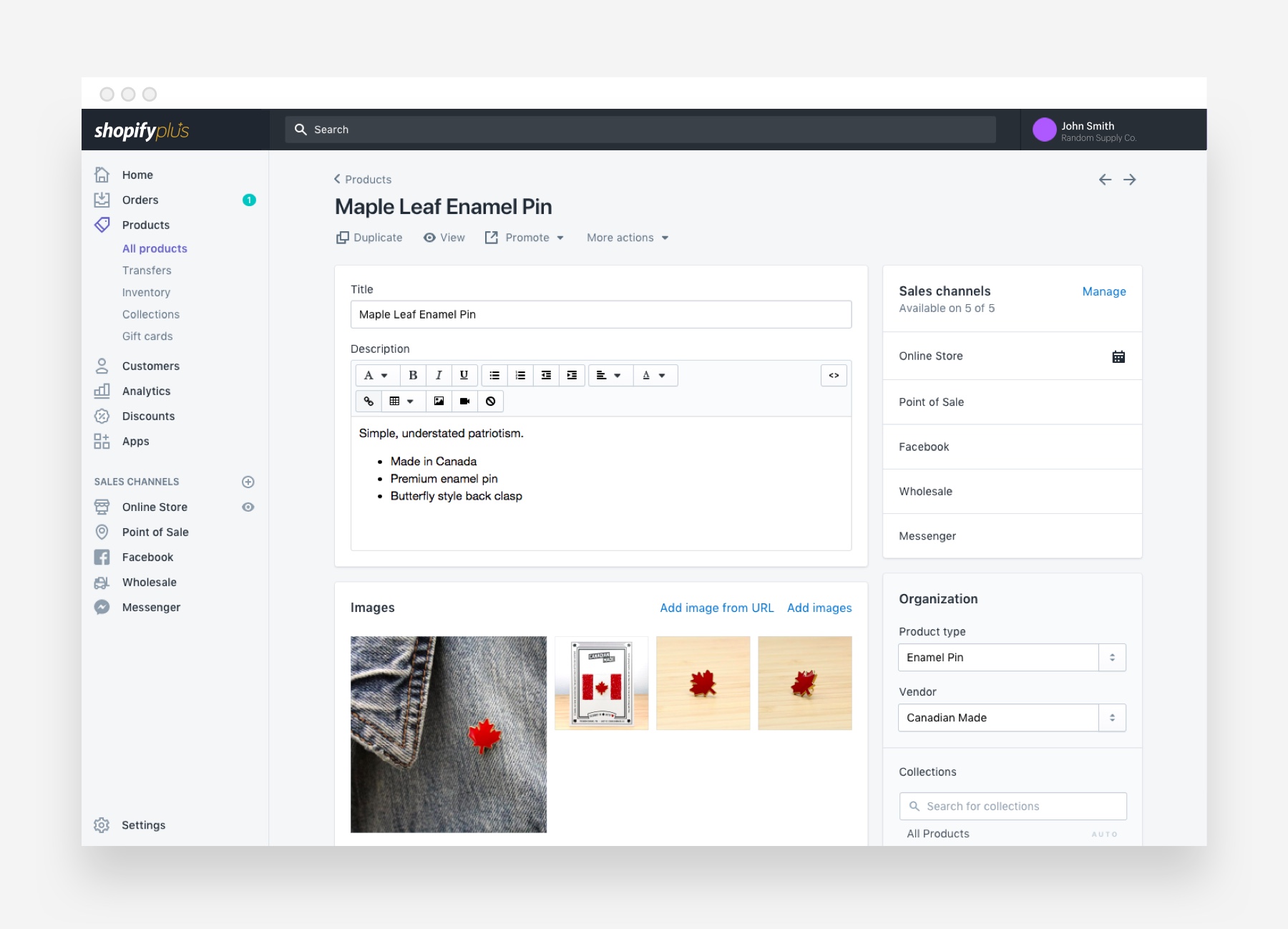
Shopify Plus is an eCommerce solution built for enterprise-level companies that enables them to sell online and offline across social channels like Facebook , Pinterest, and marketplaces like Amazon and eBay.
$2,300
per month with a 3-year commitment
Pricing
BigCommerce
Salesforce Agentforce Commerce
Shopify Plus
Editions & Modules
Standard
$39
per month
Plus
$105
per month
Pro
$399
per month
Enterprise
Custom
per month
No answers on this topic
3-year term
$2300
per month
1-year term
$2500
per month
Offerings
Pricing Offerings
BigCommerce
Agentforce Commerce
Shopify Plus
Free Trial
Yes
No
No
Free/Freemium Version
No
No
No
Premium Consulting/Integration Services
Yes
No
No
Entry-level Setup Fee
No setup fee
No setup fee
No setup fee
Additional Details
A discount is offered for annual billing.
B2B Commerce:
Starter - $4 price/order
Growth - $6 price/order
Plus - $8 price/order
B2C Commerce:
Starter - 1% Gross Merchandise Value
Growth - 2% Gross Merchandise Value
Plus - 3% Gross Merchandise Value
B2B2C Commerce:
1% Gross Merchandise Value
BigCommerce is a great and powerful platform that has lots of upside. We still have a couple basic sites running on BigCommerce, mainly for backing up customer and order data. At this time, we have moved most of our businesses over to Shopify Plus b/c we feel that we get much …
Volusion didn’t have some product presentation features we wanted, Shopify felt small for designs, Shopify Plus was closest but inventory handled differently. In the end it was about recommendations from other 3rd party users that helped make the decision.
We used both Yahoo's ecommerce platform which was awful and very limited, not to mention incredibly difficult to find developers for, to also using Shopify Plus which had a lot going for it too but was surprisingly limited out of the box compared to BigCommerce but has more …
When we compared BigCommerce to Shopify Plus, we found that BigCommerce had better SEO benefits available without needing an additional paid app to control it. We were also able to manage listings and orders more efficiently with better value for money. Shopify Plus offered …
- Ease of Use: With guided onboarding, BigCommerce enables us to manage stores independently within days, reducing the need for extensive technical support.
-Comprehensive Built-In Features: BigCommerce provides a wide array of native features, minimizing reliance on …
We switched from Shopify due to the restrictions they implemented on our industry. While we spent tens of thousands of dollars investing in our Shopify store, we can't have them cutting us off anytime they want. We reviewed WooCommerce, but didn't like the storefront or …
BigCommerce has more modern tools than Yahoo Small Business, is managed unlike WordPress/WooCommerce, and is cheaper than Shopify with better product options management.
Every criterion we evaluated against BigCommerce either won outright or held its own. What got us over the line was the incredible personal support at every step of the way from onboarding and implementation through to BAU. I had a support ticket this morning which I resolved …
Of all the eCommerce platforms we evaluated, only Shopify would compete. Shopify is a better bet with smaller catalogs and less custom business requirements in our experience. While the app store in Shopify is robust, BigCommerce has better native features that were important …
We very much liked BigCommerce because it was the perfect fit or the best of both worlds as far as our business is concerned. It had a really robust shopping cart experience that comes standard and it allows for a Sandbox environment that we can use for future custom build-outs.
We originally started a relationship with Shopify. I spent hundreds of hours working on customized our store. Shopify's customer service and tech support were very frustrating. I finally decided to abandon Shopify since we could never get our store to function exactly as we …
With BigCommerce you have great support (not with the open-source alternatives) without the high order fee that comes with Shopify. You also never have to worry about server settings or up-time. And you still have a lot of freedom with the design and functionality.
BigCommerce was the platform our company already used when I joined - we will likely transition to a new platform. Shopify is faster, OpenCart is more scalable.
BigCommerce offers so much more features and capabilities out-of-the-box than all the other options combined. Sure the other options have a large marketplace of apps and add-ons, but things tends to break when a platform relies on their 3rd party apps to provide basic …
I have managed to build 2 large websites on BigCommerce and it is fast and reliable. Have managed builds on Magento as well as small website projects on Wix, GoDaddy and Shopify and they all have their pros and cons. This is an ever-changing space and it really comes down to …
We evaluated and used numerous platforms before finally landing with BigCommerce. Some of the platforms were cookie-cutter and didn't offer enough freedom to customize certain things. Other platforms required each individual piece of the platform to be manually added.... adding …
If you've been in the eCommerce business for long and don't roll your own solution, odds are you've compared Shopify against BigCommerce. We started on Shopify but decided to switch when Shopify wanted to penalize us 1% of our gross sales for not using their in-house credit …
Other than Shopify all of these solutions require a lot of development and maintenance as they are very custom. Shopify had a good product for direct to consumer but not as good on the B2B facing side of our business. We also don't like the stance they are taking on customer …
BC easily beats Shopify, and since Magento has moved to M2, it easily outpaces Magento as well. Salesforce Commerce Cloud is more powerful and robust but requires a significant investment that is not necessarily desirable for those looking for something more lightweight, which …
WordPress is ridiculously hard to learn, manage, and integrate. It’s not designed to be a one-stop-shop like BigCommerce. I like Shopify, but I would have to pay more to get what I get with BigCommerce, and I would have more apps to manage, sync, and update.
1. The learning curve of Shopify is not too steep, so it does create hinderance for non-technical folks 2. I personally found the AI-powered insights in Shopify to be more accurate than the ones provided in Salesforce Commerce Cloud.
Salesforce Commerce Cloud is as good as the other platforms. On some of my past reviews I pointed out what Magento and Shopify do better than Salesforce Commerce Cloud and what Salesforce Commerce Cloud does better. To quickly recap: -Salesforce Commerce Cloud makes it very …
We selected Salesforce Commerce Cloud due to the options available on the back-office for merchants. The availability to create complex scenarios. The scalability for multiple countries and languages. The integration with other Salesforce solutions already in place to create …
All relative to your organizational size. Shopify works for small to mid, Magento for small to large, commerce tools would be a large-scale plus. Hire a skilled consultant to help you make a decision of this caliber!
All the options and demos were good; we see them all efficient and best suites; the option to choose Salesforce commerce cloud came into the picture when we thought of integrating customer service and promotions as we already use Salesforce service cloud as the support backbone …
We selected Salesforce Commerce Cloud over other vendors in order to enhance customer relationships. Maintaining existing customers is comparatively easy. It thus helps to maintain strong customer focus and also to improve partner and supplier relationships. In addition, in …
Salesforce Commerce Cloud offered more product variables than Shopify. Salesforce was a proper SAAS solution whereas CS-cart wasn't and required more internal dev
Associate Director, Client Leadership for Michelin
Chose Salesforce Agentforce Commerce
Since we are operating within the Salesforce platform such as the DMP and Marketing Cloud, integrating Commerce Cloud was an efficient and consistent way to streamline the processes.
We found BigCommerce to be almost identical to Shopify in many ways, but Shopify had more apps in their marketplace and we couldn't find another significant difference at the time.
We selected Shopify over Magento due to development, hosting and payment processing costs. And BigCommerce was a decent choice, but this let us start small and grow quickly.
Shopify Plus is WAYYYYYY better than anything else that we have used, and it's not even close. The websites are faster and more reliable, both of which are critical to running an online business. The cost to run is way less. We are running five websites on Shopify Plus for less …
Shopify had the quickest go-to-market and most robust API among the products we compared. CommerceCloud required a VERY LONG integration phase that we just didn't have time for. BigCommerce fell short on the number of features and API coverage that we needed. Overall Shopify …
Shopify Plus is the most advanced and most widely accepted "DIY" website tool. While WordPress has some capabilities and is certainly cheaper, it is still a blogging platform with e-commerce capabilities added later, and you can tell that's what it is when you use it. BigCommerc…
Shopify is more robust and has more functionalities than its competitors like BigCommerce and Kibo. It offers the best UI in the business and the most exhaustive app marketplace ecosystem. It is more cost effective than big system and doe snot require large teams of developers …
Shopify Plus is better than both due to how the platform is build and how easy it is to interact and do stuff in there. It seems more modern than both of the other platforms stated above. It is also not as heavily code based as the other two platforms. It's easier to find what …
Shopify is a much easier and more intuitive platform to use.
The mobile focus is outstanding from the other competitors and the capability to modify the store without previous code or experience makes them the best e-commerce platform.
Shopify Plus offers a more robust solution than Woo commerce and is easier to train on than Big Commerce. Woo commerce is freeware with no support. Big Commerce offers more SEO features and is a more powerful solution, but harder to remote train users on - lots more …
Our experience with SFCC was fairly poor. SFCC was very expensive, and the ecosystem of partners is very expensive. SFCC is a bit more mature but the time to execute is significantly slower.
Verified User
C-Level Executive
Chose Shopify Plus
Shopify Plus is way ahead of the pack in terms of features, automated and worry free maintenance / security / scaling / infrastructure, customer support, and speed. We've been building eCommerce sites for over a decade and it seems almost every positive trend in eCommerce is …
BigCommerce is really well suited for someone who wants to get selling quickly, but may not have endless developer experience, or even web design experience for that matter. Their templates, even the free ones, are very attractive and supported by tons of third party apps. I think the only times it is not a slam dunk recommendation would be if someone is dead set on using another solution like Shopify, or if they are not looking for an ecommerce site and more of a flat website, this would be overkill.
Global Sites; larger commerce organizations but not too large where the % rev-share would affect its feasibility in a feature comparison. Salesforce is rock solid in infrastructure and rarely has outages or issues; it scaled appropriately for holiday peak and was able to accomplish anything we put our minds to as long as we staffed development appropriately. The latter, however, is not to be overlooked. Developers are necessary and expensive.
Shopify Plus makes order management simple and less error prone. Connecting our ERP allows us to seamlessly manage our product listings, fulfill orders, and sync customer data. Limitations to the number of product variants requires attention from our staff to make sure our products sync without issue. Other than being arbitrary, there's really no need to limit the number of product variants.
Traffic - When we have sales, our traffic will increase exponentially and their cloud can handle the huge uptick in traffic we receive without overloading our servers.
Site updates - it continually monitors in the background for any upgrades or updates needed so we don't have to go in and do it ourselves. A real time saver!
Integration - outside plugins and add-ons are easy to install with Salesforce commerce cloud as it allows a seamless integration of extra plug ins onto our site.
In my experience, customer support FAILS terribly in knowledge of getting a BC site live
In my experience, the back side/ dashboard is very archaic compared to Volusion, will add hours of work to your week.
In my experience, pretty much anything you NEED is done with an "app" at additional cost. I think we have a few hundred dollars in apps already on top of cost of BigCommerce.
I feel coming from Volusion to BigCommerce was so depressing but we do feel secure that the company will remain in business. We are looking for something else already.
The UX within the Business Manager portion of Demandware, the primary interface for marketers, is generally a confusing, inconsistent mess. Particularly infuriating are the lack of consistency for search and sort behavior within the tool.
A number of useful features, such as the ability to set schedules or tie features to unique customer segments, have seemingly arbitrary limitations imposed.
Demandware's idea of leveraging the community to be a learning resource and a sounding board for new ideas and features is a nice theory, but in practice it doesn't work for businesses with a lot of customization. I'm left with the impression that individual support is not a priority.
When linking to our communication service some customers have several emails with orders and only one email generates orders. It would be nice if we could combine all of this information into one account.
If a customer has multiple accounts you are also unable to edit the email address as it is already used, another reason merging accounts would be helpful.
Some of the processes in Shopify are too easy to complete. I’m certain scenarios a peony of “are you sure you would like to complete(this action)” would be extremely helpful and avoid mistakes that are not reversible.
I personally would not even consider another e-commerce website platform.
Bigcommerce may have the same (or close to the same) functionality and integrations as other SaaS platforms but they excel at customer service and tech support. At the end of the day you need a company that will answer the phone in less than a minute especially if you're having a 5 alarm issue. That said, we hardly ever have any issues. The site was down for a few minutes one time 5 years ago. Sometimes we have issues with coding or apps and they help me with that too. They even walked me through installing our new theme when the contracted developers told me that wasn't included in the development of our new website.
Bigcommerce comes out with new innovations every year, not including apps that other people write for the platform, and there are a lot of those and new ones all the time. And there are a LOT of awesome themes to choose from (Halothemes are the best).
And the price is reasonable!
I'd give Bigcommerce my business any time and recommend them to anyone looking to run an e-commerce website. You could even use them for a non-shopping site, we have one of those too!
A huge factor influencing our decision to remain on the Demandware platform is that our new parent company is standardizing all its luxury brands in the US on it. We are fortunate. However, even if we had remained an independent company, I believe we would continue on the Demandware platform for all the reasons outlined in this review. I appreciate the stability the platform has provided to our eCommerce site in the last three years as well as the continuous improvements and technological advances being rolled out that will allow us to keep the site fresh, engaging, modern and stable. I've heard many horror stories from colleagues on other platforms who struggle with the expense and complexity involved with making what should be minor and simple changes and updates to their sites.
I think that overall it has a great front end for the customer. On the back end, it takes a little spin-up time, but in just a couple of hours you can really have your head wrapped around everything you're going to need 99% of the time. It takes me about 5 minutes to train a new user on how to interact with customer orders.
The overall ease of using the system. Consolidation in location for our team members. Mobile application for on the go research, as many of our team members are constantly traveling to job sites or to meet clients. No more duplicate calls to current customers, since we have 12 different divisions that span the company. Mostly the ability to look at the database when our team members begin cultivating a new lead/prospect with a potential customer to see if anyone within the team has a relationship with that person or the company they work for.
It is extremely easy for merchants to get to know how Shopify Plus works. Comparitive to other platforms such as Magento and WooCommerce it is extremely lean and easy to operate, meaning clients who migrate over to it find it very intuitive to use. There is also a lot of guides and up to date information online
So far in my time with BigCommerce I have not had any down time when it comes to my webstore or accessing it at any time I need to. Knowing that they have such a good uptime, it makes me feel comfortable that my customers can access things anytime, but also keep sales going 24/7
I have not had any issues with pages loading slow or any real other issues, not that I have encountered so far. Speed of the site and images loading are fantastic and everything just seems to work nicely, which may seem like a simple thing to say about things, but when something just WORKS! Its rather nice vs fighting with things to work right.
Because they are always there no matter how simple or complex the question is, if they don't know the answer they don't fake it and just make you go away feeling frustrated.. they get you to someone that does know the answer. I always appreciate their help and their honesty!
They are very responsive and a support technician will be assigned quickly. Even if there is further clarification needed for the ticket, or a solution is not immediately available, you feel that someone is there and staying on top of the issue. Most common issues are resolved quickly and satisfactorily.
They have a comprehensive online help file system that makes it easy to do almost anything. They cover just about everything you'd want to do with your online store with images, clear descriptions and in some cases video. I will, however, say the videos should be a little more professorially done and not sound like the employees are doing it in their cubical.
A certified BigCommerce design and solution partner will usually comprise a team of highly experienced designers, developers and marketers. It is our view that in the vast majority of cases, this will pay dividends in the long-term - especially for those teams that could use the extra support.
BigCommerce even with add-ons such as a PIM and B2B functionality wins for small businesses on affordability and ease of use. No servers or updates to worry about and no expensive agencies to pay. This being said, if the budget were no issue, for larger organisations Magento is perhaps a better option.
When I think of Salesforce products, I sometimes think of them interchangeably as one big lump. It's hard not to be incredibly immersed in the ecosystem day in and day out and taking advantage of resources like Trailhead. While Microsoft Dynamics compares in quality and offerings, it doesn't offer the same engagement and resources as Salesforce in its communications, social, and marketing, which makes a difference in terms of relevance and help. Commerce Cloud comes with the support you need to succeed and the tools you need to grow. In a high demand consumer world, we need products like this to keep up and get ahead. The minute we catch up, we're behind. Salesforce helps you stay on pace and create the unique and personalized experiences customers everywhere expect.
Shopify had the quickest go-to-market and most robust API among the products we compared. CommerceCloud required a VERY LONG integration phase that we just didn't have time for. BigCommerce fell short on the number of features and API coverage that we needed. Overall Shopify gave us the most bang for the buck.
I believe after seeing all of the parts of this platform, one is able to develop the business and keep adding on select features for the business. There are multiple options for purchase with the various platforms once the business grows more. The different features being offered by the platform can lead us to scalability.
Provides a robust platform to sell a high-risk product.
Page Builder saves you time and money by negating the need to buy a template.
Includes robust promotion settings that allow for codes and automatic discounts, bulk discounts, and customer groups (i.e. military discount), all native options.
The pricing of Shopify Plus over the regular Shopify Account solution is about 10x if not 20x the cost. But with this cost comes the increased reliability and trust you have in your eCommerce Software solution/website. We still have a great ROI with the Shopify Plus Pricing.
With Shopify Plus, we have been able to drill deeper into a more robust eCommerce experience for our customers
With Shopify Plus, we have been able to customize our Website further with recommended apps, features, and customizations based on our Dedicated Account Reps expertise.