
T. Blane McMichen
President
Chose Google Analytics
Campaign tracking requires more set-up in Webtrends, and the additional cost is hard to justify.

| Product | Rating | Most Used By | Product Summary | Starting Price |
|---|---|---|---|---|
 Google Analytics | N/A | Google Analytics is perhaps the best-known web analytics product and, as a free product, it has massive adoption. Although it lacks some enterprise-level features compared to its competitors in the space, the launch of the paid Google Analytics Premium edition seems likely to close the gap. | $0 per month | |
 Google Tag Manager | N/A | From Google, the Google Tag Manager is a tag management application that facilitates creating, embedding, and updating tags across websites and mobile apps. It is a free option, vs. the company's enterprise-tier Google Tag Manager 360. | $0 | |
 Webtrends Analytics | N/A | WebTrends provides an enterprise web analytics platform and, according to Forrester, has a strong focus on support for mobile and social channels and a very open platform. Webtrends competes directly with Adobe Site Catalyst, IBM Coremetrics. and comScore DigitalAnalytix. | N/A |
| Google Analytics | Google Tag Manager | Webtrends Analytics | ||||||||||||||||||||||
|---|---|---|---|---|---|---|---|---|---|---|---|---|---|---|---|---|---|---|---|---|---|---|---|---|
| Editions & Modules |
| No answers on this topic | No answers on this topic | |||||||||||||||||||||
| Offerings |
| |||||||||||||||||||||||
| Entry-level Setup Fee | No setup fee | No setup fee | No setup fee | |||||||||||||||||||||
| Additional Details | — | — | — | |||||||||||||||||||||
| More Pricing Information | ||||||||||||||||||||||||
| Google Analytics | Google Tag Manager | Webtrends Analytics | |
|---|---|---|---|
| Considered Multiple Products |  Google Analytics T. Blane McMichen President Chose Google Analytics Campaign tracking requires more set-up in Webtrends, and the additional cost is hard to justify.  Alex Nejako Marketing Automation Manager Chose Google Analytics  Adam Hatfield Head of Digital Chose Google Analytics We have been using Google Analytics for over 10 years. Over that time we have periodically reviewed our analytics platforms a number of times. For us, it made more sense to stay with google analytics primarily because if we migrated to another platform we would lose the …  Stephanie Erlita Arifin E-Commerce Manager at MASARISHOP.COM Chose Google Analytics After using Google Data Studio where I can read sales data much more easily, I prefer to read that daily rather than in Google Analytics.  Michael Baker Digital Marketing Manager Chose Google Analytics We tested Webtrends and purchased Omniture (which we used for 2 years). Webtrends wasn't a good fit overall. Omniture was too cumbersome and expensive. The support was HORRIBLE and for a paid product it lacked some basic, no-brainer features.  Jennifer (Utterback) Davis Vice President, Emarketing Chose Google Analytics We have used Omniture and WebTrends. WebTrends is an outdated analytics tool. Omniture, while robust is just not as customizable. Basically, if you have no intention or no need to do customization and you just want out-of-the-box reporting and not willing to spend the time in … |  Google Tag Manager  Ben Rubenstein Marketing Manager, HMX Chose Google Tag Manager We moved to GTM from a standard Google Analytics implementation. GTM is much more flexible and easier to make changes, especially as the changes relate to multiple sites and environments. While there is a learning curve when figuring out how to use GTM, I believe the change has …  Wadie Aroua Directeur technique et Co-fondateur Chose Google Tag Manager Google Analytics is too poor without Google Tag Manager  Travis Brown Account Manager and Tactical Projects Leader Chose Google Tag Manager Tag Manager works in conjunction with Google Analytics. I would describe analytics as a 101 level course, and Tag Manager as a 401 level course. Both are good, both are relevant, but one will far outpace the other as far as practical application and things that you will benefit …  Dave Becker Content Manager Chose Google Tag Manager My subscription with Adobe comes with the full suite of their products, including DTM. I tried using their tag manager but found that it was much more challenging to use than Google Tag Manager. It also seemed more limited in the way it worked with our AdWords account, which …  Tomer Nuni Founder, Director Chose Google Tag Manager Google Tag Manager does what others can't for Google Ads, for example. That's why it's a must-have for any website owner who plans to market their website. In addition, it makes the implementation of various other tracking tools very simple.  Santiago Valdés Cofounder / Marketing, Growth, Technology, Experience Chose Google Tag Manager So far we've only used Google Tag Manager, we haven't tried anything else.  Bobby Stemper Director of Marketing Chose Google Tag Manager I have not used or evaluated other products for this type of tracking.  Stefanie Cash Marketing Administrator Chose Google Tag Manager GTM is a completely different beast.  Benjamin Hale Digital Marketing Analyst Chose Google Tag Manager Google was free, powerful to use, and easy to pick up. We couldn't find any better reason to use it. I am sure there are advantages that some of the competitors have in the space, but for us, the ability to manage users and keep versions of changes, along with the familiarity …  Víctor Garnica Director de efectividad e innovación Chose Google Tag Manager GTM is powerful and free, don't need to pay more for the easy stuff. If you are a corporate guy with money to invest and really heavy use of advertising and analytics you may select Tealium. If you are a small or medium size company this [GTM] is the solution you are looking for.  Peter Jakus Web Analytics Lead Chose Google Tag Manager On most of my projects I never felt the need to use another Tag Management System. One client from a finance sector, wasn't able to use GTM because it is a cloud service. We were looking for TMS which would be possible to host in own infrastructure, but we haven't found any … |  Webtrends Analytics  Jaclyn Wallace Campaign Measurement & Reporting Coordinator Chose Webtrends Analytics I find Google Analytics to be very limiting. This may also be the way that the reports have been structured by our organization. It is viewed as an older way to obtain the metrics we are after and no new projects are implemented through Google Analytics.  David Cox Senior Business Intelligence Analyst Chose Webtrends Analytics We currently use WebTrends, Google Analytics, Kissmetrics and ClickTale. I would like us to consolidate our activities to be focused on just Webtrends as it covers all of the requirements we have very well.  Nathan Collins CRM Analyst Chose Webtrends Analytics Using Omniture at my current place of employment and using Google Analytics as a backup at both, Webtrends is the clear superior product. I go back to how easy the UI is to navigate and how simple it is to get user level data that isn't duplicated or doesn't try to pigeon hold …  Mary Kay Scott Web Developer III Chose Webtrends Analytics Compared to WebTrends, Google Analytics has a slicker interface, provides live site usage data, and is easier to jump into with basic usage. These days users expect to be able to create their own reports as needed, rather than have an "expert" do it for them. They are used to …  Matthieu Dejardins Head of Web Analytics & Testing Chose Webtrends Analytics Webtrends was selected because of the price for Google Analytics Premium ($110k per year) and Adobe Omniture Analytics (twice the price). Clearly, it needed the Visitor Data Mart to get additional capability that you would expect as part of a Web Analytics suite. In our case, …  Brian Mackintosh Director of eCommerce Chose Webtrends Analytics I have only had significant experience with Google Analytics (GA) and WebTrends in this space. Overall - it is easier to learn and modify GA reports as a casual user - I always struggled with the fact that GA only offered partial data (sampling based).  Chaim (Daniel) Arnstein Consultant (6+ Years) Sr. Systems Analyst - VP (7 Years) Chose Webtrends Analytics Have not use Webtrends competitors  Kevin Ornduff Marketing Analyst Chose Webtrends Analytics Webtrends is just an option, depending on client budget. It's a simple analytics tool that does the job but we always recommend Omniture whenever possible.  Adam Krause Manager of Web Analytics Chose Webtrends Analytics We evaluated Google Analytics, but we picked Webtrends as it offered better value for the price. |
| Google Analytics | Google Tag Manager | Webtrends Analytics | |||||||||||||||||||||||||||||||||||
|---|---|---|---|---|---|---|---|---|---|---|---|---|---|---|---|---|---|---|---|---|---|---|---|---|---|---|---|---|---|---|---|---|---|---|---|---|---|
| Web Analytics |
| ||||||||||||||||||||||||||||||||||||
| Security |
| ||||||||||||||||||||||||||||||||||||
| Tag Management |
| ||||||||||||||||||||||||||||||||||||
| Data Management & Integrity |
|
| Google Analytics | Google Tag Manager | Webtrends Analytics | |
|---|---|---|---|
| Small Businesses |  StatCounter Score 9.0 out of 10 |  Adobe Experience Platform Launch Score 7.8 out of 10 | StatCounter Score 9.0 out of 10 |
| Medium-sized Companies |  Optimal Score 9.1 out of 10 | Adobe Experience Platform Launch Score 7.8 out of 10 | Optimal Score 9.1 out of 10 |
| Enterprises | Optimal Score 9.1 out of 10 |  Tealium Customer Data Hub Score 8.4 out of 10 | Optimal Score 9.1 out of 10 |
| All Alternatives | View all alternatives | View all alternatives | View all alternatives |
| Google Analytics | Google Tag Manager | Webtrends Analytics | |
|---|---|---|---|
| Likelihood to Recommend | 8.5 (192 ratings) | 9.1 (71 ratings) | 7.1 (30 ratings) |
| Likelihood to Renew | 9.0 (51 ratings) | 7.0 (7 ratings) | 5.4 (25 ratings) |
| Usability | 7.4 (19 ratings) | 8.1 (16 ratings) | 5.4 (7 ratings) |
| Availability | 10.0 (4 ratings) | 9.1 (1 ratings) | 9.0 (4 ratings) |
| Performance | 10.0 (2 ratings) | - (0 ratings) | 8.2 (3 ratings) |
| Support Rating | 7.0 (42 ratings) | 2.0 (12 ratings) | 8.8 (8 ratings) |
| In-Person Training | - (0 ratings) | - (0 ratings) | 9.7 (3 ratings) |
| Online Training | 10.0 (2 ratings) | 7.3 (1 ratings) | 9.0 (4 ratings) |
| Implementation Rating | 9.0 (7 ratings) | 9.8 (2 ratings) | 9.9 (5 ratings) |
| Configurability | 6.0 (2 ratings) | - (0 ratings) | 7.1 (2 ratings) |
| Ease of integration | 10.0 (1 ratings) | - (0 ratings) | - (0 ratings) |
| Product Scalability | 10.0 (2 ratings) | - (0 ratings) | - (0 ratings) |
| Vendor post-sale | 10.0 (1 ratings) | - (0 ratings) | 9.0 (1 ratings) |
| Vendor pre-sale | 9.0 (1 ratings) | - (0 ratings) | 9.0 (1 ratings) |
| Google Analytics | Google Tag Manager | Webtrends Analytics | |
|---|---|---|---|
| Likelihood to Recommend | Google
 sandro merkvilishvili Head of e-commerce deparment | Google
| Webtrends
Chaim (Daniel) Arnstein Consultant (6+ Years) Sr. Systems Analyst - VP (7 Years) |
| Pros | Google
| Google
Santiago Valdés Cofounder / Marketing, Growth, Technology, Experience | Webtrends
 Mitchell Teixeira Consultant |
| Cons | Google
| Google
 J.P. VanderLinden Director of Digital Marketing | Webtrends
 Chris Grant Associate Director of Analytics |
| Likelihood to Renew | Google
| Google
| Webtrends
|
| Usability | Google
 Victor Campos Web Developer | Google
 Quentin Aisbett Digital Strategist | Webtrends
|
| Reliability and Availability | Google
| Google No answers on this topic | Webtrends
|
| Performance | Google
| Google No answers on this topic | Webtrends
Adam Krause Manager of Web Analytics |
| Support Rating | Google
 Sarah Hoffman Media Director | Google
| Webtrends
 Matthew Koppel Analytics and Insights Supervisor |
| In-Person Training | Google No answers on this topic | Google No answers on this topic | Webtrends
Adam Krause Manager of Web Analytics |
| Online Training | Google
 Roy Morejon President | Google
 Stéphane Hamel Director of Innovation | Webtrends
Adam Krause Manager of Web Analytics |
| Implementation Rating | Google
 Joshua Van Horsen Marketing Manager | Google
 David Gailey Front End Web Developer | Webtrends
Mitchell Teixeira Consultant |
| Alternatives Considered | Google
| Google
Ben Rubenstein Marketing Manager, HMX | Webtrends
|
| Scalability | Google
| Google No answers on this topic | Webtrends No answers on this topic |
| Return on Investment | Google
 Heide Rembold Director of Marketing & Analytics | Google
| Webtrends
 Lindsay Buescher Senior Manager, Analytics |
| ScreenShots | Webtrends Analytics Screenshots  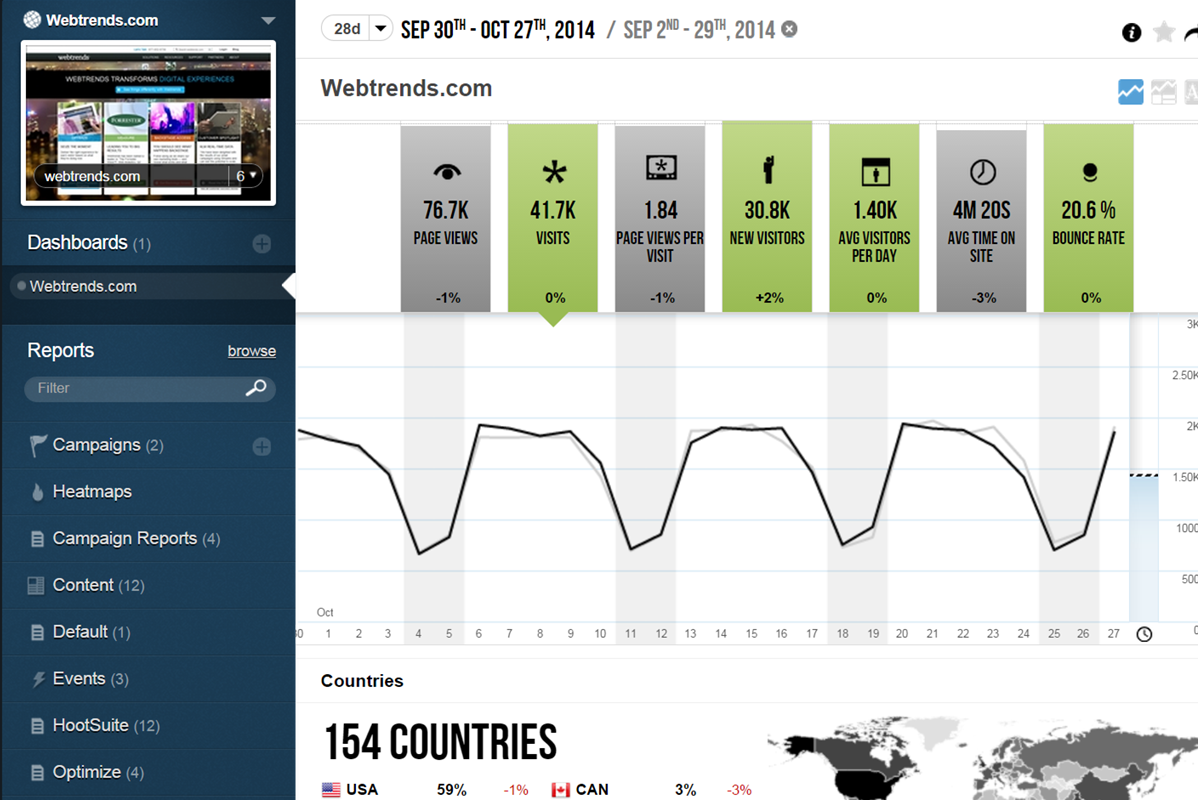 |