Amplitude Analytics is an analytics platform for mobile and web. It is designed to help organizations segment users and analyze funnels, retention and revenue. Amplitude Analytics helps product marketers to achieve actionable insights from customer digital journeys and uses behavioral graphs to build customer-focused products. Amplitude also optimizes digital products for increased quality engagements, increased conversion rates, and long-term customer loyalty.
$61
per month
Heap
Score 8.2 out of 10
Mid-Size Companies (51-1,000 employees)
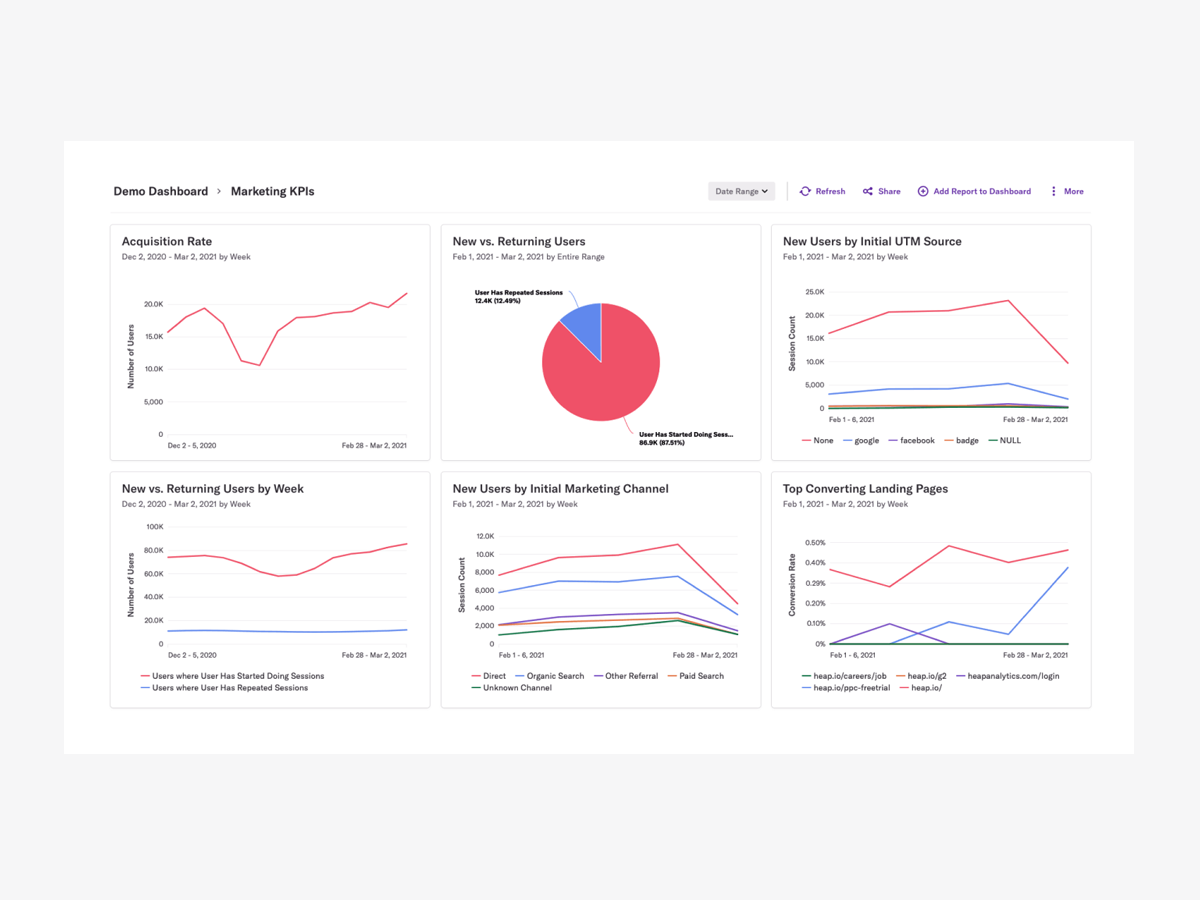
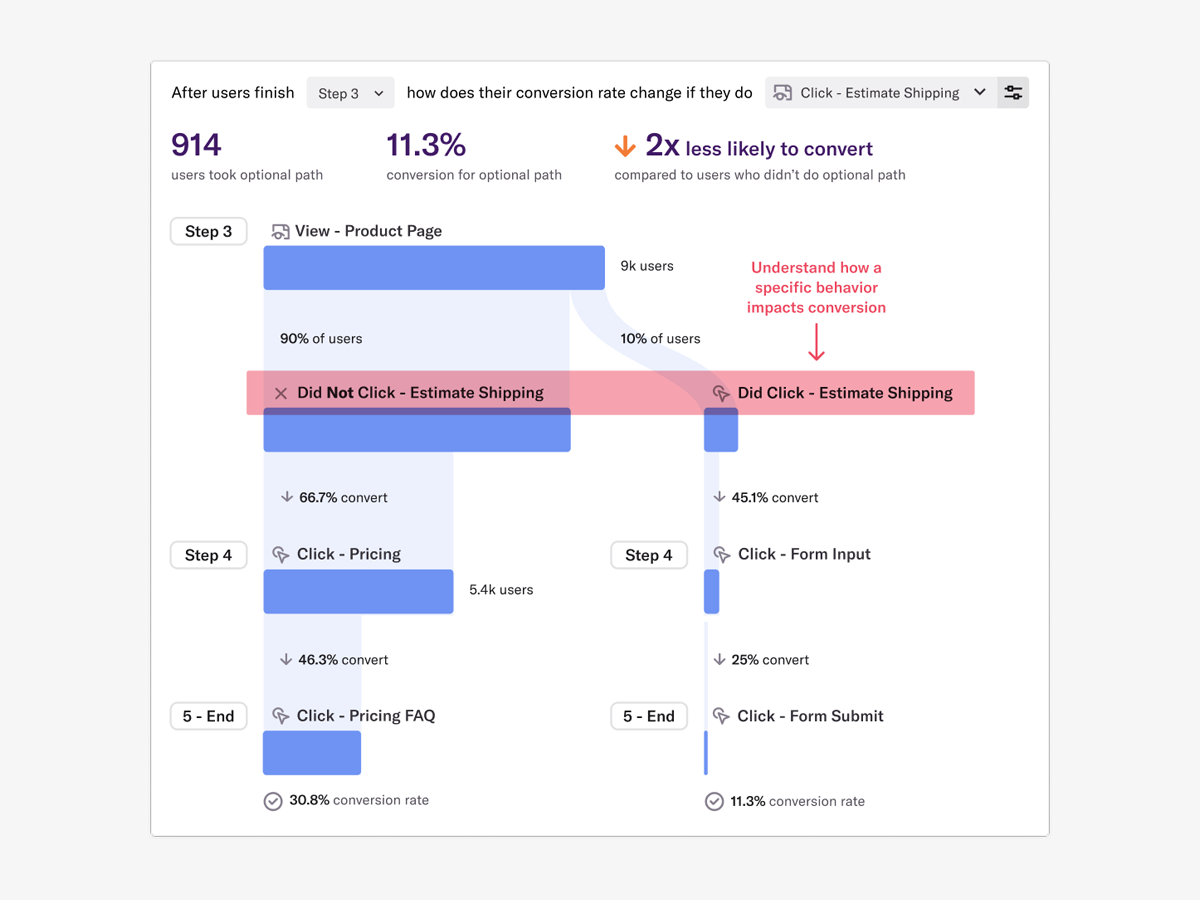
Heap is a web analytics platform captures every user interaction on web iOS with no extra code. The tool allows you to track events and set up funnels to understand user flow and dropoff. It also provides visualization tools to track trends over time.
$0
per month
Mixpanel
Score 8.3 out of 10
N/A
Mixpanel helps companies measure what matters, make decisions fast, and build better products through data. With self-serve product analytics solution, teams can analyze how and why people engage, convert, and retain—in real-time, across devices—to improve their user experience. Mixpanel serves over 26,000 companies from different industries around the world, including Expedia, Uber, Ancestry, DocuSign, and Lemonade. Headquartered in San Francisco, Mixpanel has offices in New York,…
$0
per month
Pricing
Amplitude Analytics
Heap
Mixpanel
Editions & Modules
Plus
$49
per month (paid annually)
Growth
Contact Sales
Enterprise
Contact Sales
Starter
Free
Free
$0
Up to 10k sessions/month
Growth
Starting at $3,600 annually
Up to 300k sessions/year
Pro
Contact Heap Sales
Custom sessions per month and unlimited projects
Premier
Contact Heap Sales
Custom sessions per month
Free
$0
per month
Growth
$17
per month
Enterprise
Contact sales
Offerings
Pricing Offerings
Amplitude Analytics
Heap
Mixpanel
Free Trial
No
Yes
No
Free/Freemium Version
Yes
Yes
Yes
Premium Consulting/Integration Services
Yes
Yes
No
Entry-level Setup Fee
No setup fee
Optional
No setup fee
Additional Details
—
Heap pricing is based on session volume. A session is a period of activity from a single user on your app or website. It can include many pageviews or events.
Mixpanel uses MTU (Monthly Tracked User) pricing, which is designed to scale with your company. MTUs are roughly equivalent to the number of unique visitors on your product and each user is counted once per month, even if they use multiple devices. If Events based pricing makes more sense for your business, reach out to us and we can work with you!
More Pricing Information
Community Pulse
Amplitude Analytics
Heap
Mixpanel
Considered Multiple Products
Amplitude Analytics
Verified User
Program Manager
Chose Amplitude Analytics
I find Amplitude much easier to use than Mixpanel or GA are. The UX is easy to grasp and as long as you have an intuitive set-up or good documentation on how your events are set up it makes for quick onboarding. Looker does a better job of easily allowing customization with SQL …
Amplitude has more advanced reporting whereas Mixpanel is mostly a “do-it-all” analytics tool. Choose Amplitude if you have enterprise-level marketing/users. Choose Mixpanel if you want to send notifications.
Amplitude Analytics & Mixpanel are both evenly matched in terms of features and value. Amplitude Analytics scores better in terms of conversion drives and cohort analysis in my opinion. In addition to that, Amplitude Analytics has done a lot more in terms of guiding …
Amplitude Analytics provides much more granular data than Google Analytics and gives you much more flexibility in how you can segment and splice the data. It also provides the ability to create closed funnels, which I have yet to find out how to do in Google Analytics. …
Amplitude provides better capabilities to consume real time event data and provide meaningful insights compared to other products like Mixpanel. It also provides better data governance capabilities to maintain accurate and high data quality.
Mixpanel was the top competitor to Amplitude when my organization was reviewing analytics tools. We went with Amplitude because it was more robust when it came to experimentation features and proactive insights. Amplitude also had an edge in team collaboration and data …
Amplitude Analytics is a robust platform that can take your data reporting beyond what's currently capable in GA. Heap is a great intermediate tool, that takes data analysis a step further and is an excellent product in it's own right. Mixpanel is the most comparable both have …
We've used a ton of analytics tools and Amplitude allows us to do everything we need for free. The other options we tried were either not robust enough to report on user level stats, or cost $. The platforms in this space are super competitively aligned so functionality wise …
I wasn't making the decision to use either product - my old company had Mixpanel and my new company has Heap. That said, I've found Heap to be much more intuitive and user friendly - it could be a feature of the different companies' setups, but it seems as though Heap is much …
I wouldn't know necessarily because I didn't get far with a Mixpanel evaluation. All I know is that it was much easier to set up the types of user events that we were looking to track out of the box with Heap. I also think the flexible pricing that Heap provided was a good …
More robust event capture that is easier to implement. Simplified capabilities that typically get the job done. However, customization was much more robust on Mixpanel.
We evaluated Heap against Mixpanel but realized that Mixpanel was a non-starter for us. (Kudos to their sales rep, who quickly identified this and told us.) We inherited a Google Analytics implementation but have since had to stop using it due to GDPR restrictions.
Google Analytics stacks up for high level traffic and marketing data but not ideal for enterprises looking user level product interactions in detail. On the other hand Heap stood out for its automatic data capturing, faster onboarding, easy to use dashboards, Highly integrable …
Heap is better because its easy to use, easy to install. With Heap you just add a snippet of tracking code to your header, instead of having to instrument each event like you do with other tools.
Heap is better then Pendo and Amplitude. Compared to Amplitude, Heap is cheaper and easier to analyze and use. Configurations might be cumbersome but in the long run, users find it very seamless and easy. Compared to Pendo, Heap offers much superior analytics, event …
The ability to view events in real time as they occur, restrict them to just show mine, and then create dashboards using those events is the finest feature for me. It eliminates the requirement for constant 100% accuracy in documentation maintenance and guessing. I can monitor …
Heap offers a ton of functionality on a single platform.It also has an smart data science layer to offers suggestions for next steps in the analysis, allowing us to explore alternative paths we may not think to take. The low-code option for updating data is appealing, and there …
Heap blows away the competition in this space in my opinion. Amplitude was the closest competitor but did not have the ease of instrumentation that Heap offers out of the box. Google Analytics has gotten worse year after year and was borderline worthless for our business, as …
Mix panel did not have automated event tracking so a developer would need to manually add every single event which was not functional. Outside of that, many core features were the same although mix panel did allow for custom reporting and querying. Mix panel felt much more …
During the procurement process, we looked at Google Analytics and Amplitude. Google Analytics is free, and it is a platform we are already using frequently at my company; however, it does not have the dynamic product analytics capabilities that we need. Amplitude is more …
We currently use Domo, Heap, and Amplitude. We chose to keep Heap because it is user-friendly and easy to learn. We need the rest to make it a bit easier to analyze and create more powerful charts.
What really stood out was the auto capture functionality and the ability to do as many custom reporting as we can, and it had very comparable features to a lot of other user analytics tools, but we liked how clean it was at pulling in data as well. definitely recommend for …
As I mentioned before, Heap has been by far the most user-friendly tool out there to easily get tracking events defined, and quickly create intuitive reports and dashboards. It doesn't require a lot of engineering effort once the tool is set up. It provides so many quick ways …
For web analytics, I prefer Heap over some of its competitors like Adobe Analytics, Looker, or Google Analytics, primarily because I find it more intuitive to use. For mobile, I actually prefer Amplitude as I'm not sure that has been a priority for Heap (yet) and Amplitude does …
Most other tools have good features but heap has the historical data and collects every type of data you can imagine. That allows us to make new queries as things evolve while we still have the point of reference from all these data points. Other tools are good but its harder …
Mixpanel does what it does very well. We sometimes don't see it as the only tool in the arsenal. When combined with other solutions, we get a more complete picture. It also allows us to validate data across different tools.
While Heap isn't as simple as Mixpanel, its major …
Amplitude Analytics is an excellent solution for anyone with a mobile app and you want to track what users are doing, are they completing conversion steps, and are they coming back more often. This all helps you visual your customer bases engagement and help project future engagement and create goals. This also helps with prioritizing products to address drop-off points in the product to increase conversions.
Scenarios when Heap was well suited: It is when a user claims that he encountered a bug without giving us the details of the error message. Scenarios where it is less appropriate: Its when we try to capture user interaction in our mobile app
As a worker in the sales area, I see closely how complex it can be to evaluate the commercial funnel and Mixpanel has been an indispensable guide to prioritize above all what customers expect to receive from our company, and thus be able to determine the main service we offer. Without a doubt, Mixpanel has special functions to be the one that guides the route and marks the objectives much more clearly.
Mixpanel is a daily use application for everyone in my organization; it helps us have a better flow of information and interaction between work teams.
The user interface of this platform is simple and has a wide variety of functions and resources to help us work in the most organized way, have better team coordination, and keep efficiency high.
I love that it is so easy to program our calendar to our liking, so we can prioritize our activities and know what is pending, and the best thing is that I can update the calendar if necessary.
The chat function is great to improve the interaction between colleagues and share work schedules and any information with third parties.
Some offerings seem duplicative, like dashboards and notebooks, which only seem to differ in that one can subscribe to dashboards
The messaging on valid vs invalid property types could be better explained to clarify which types (string, Boolean, integer, etc) are expected in particular scenarios. Though the type is usually set during event creation, we've often seen examples where the data received in production is different, leading to 'invalid type' errors
Mixpanel requires an explicit setting of events from your app. This means you need to be very thoughtful in the design of your events because missing one means you aren't collecting any data from it. Inserting it into the process later on then brings challenges in tracking when certain events came online.
A tool like Mixpanel comes packed with features that sometimes are harder to discover. It's very easy to get sucked into one part of its toolset and not be aware of other tools which may be very useful.
Great product Good value for the cost/initiate Support docs and FAQs are great - they limit the necessity of reaching out to in-person support. So when you do call them ... it is for a legit question/issue, no just a "where is it" or a "how to I do xyz123?"
It's a great platform. I'm glad that one of our product managers introduced it because it has allowed us to create all kinds of new functionality. We're not only able to create a better product experience from our communications because of Heap, but we're also able to generate all kinds of helpful analysis.
It's not an all encompassing solution like Google Analytics tries to be, but MixPanel offers much easier to use and understandable data insights. That's valuable when juggling many responsibilities as startup life demands, so a renewal would be easily justified.
It's a fairly straightforward platform that's beginner friendly. The biggest usability hurdle is most often created by your own team, as it's imperative to know what event sources are being sent to Amplitude and what those event names are. Within being properly onboarded by a team member it can be hard to get started using Amplitude. It takes time to understand what data your company may be sending to the product, the naming conventions of events (especially if there are old or deprecated events names
On a scale from 1-10, I find Heap to be incredibly user-friendly and easy to use. I enjoyed the training videos available and was quickly able to pick up how to create events and reports to track user interactions on our product. I would recommend Heap for its usability first and foremost.
Relativity easy to use. Once you get the hang of it, very easy to create dashboards for different use cases. I split my dashboards between customers or use cases
Alway up and running, or if there is a problem we can get back in the game right away. The reliability was a big selling point for me, and it was true when this company got it. Rollouts can be tough, but this was pretty seamless. Good support throughout the process, good documentation to handle questions/tips
I've never run into any issues with Heap's availability, Heap is always there when I need it. I haven't run into any issues like application errors or unplanned outages during my 2+ years of using Heap. Each and every time I log in to Heap I have a completely functional experience
No issues, problems, or negative remarks from us!! We had a plan, vendor support was rock solid, our data folks have experience, OCM supported as needed, and we got the rollout done on time, on budget, and with only minor hiccups. SInce the rollout, most of us have already forgotten the hiccups and generally speak highly of the product
Heap doesn't affect page load times considerably nor has a large impact [on] our overall score, as far as page loading times inside of the tool its pretty reliable to retrieve data as much as "instant" that it can be the delay seems to be on data getting tracked into the servers to be read but it's not significant.
I haven't used the Amplitude support other than their training docs so I can't speak too much to the in-person support but the docs are serviceable. Nothing too crazy but between the user tips, email notifications, and the decent number of docs I was able to get the support I needed to ramp up on the tool.
Heap support has allowed us to troubleshoot and test a lot of different items. Their support team is always helpful and friendly, even when we come to them with the most complicated questions. I think this greatly improves the value proposition of the product because their support team is knowledgable and friendly.
We have only ever had to use their support once, when we were setting up the account, but their responses were prompt and the solutions were well documented. The people who solved our issues were helpful, even to non-tech people.
Virtual Not bad considering the timeframe and turnaround. The biggest benefit was for my end-users to hear a voice (other than mine/ours! LOL) telling them about the new features and capabilities. The in-person training was really good for having an expert that knows the answers and could refer to past experiences, problems, solutions. THey were a great resource to ease the transition ... basically a "you are gonna be okay with this change ... you got this etc.!" kinda vibe
Good enough to get strong baseline. I always make sure our our users go to and/or focus on the vebndor-provided support docs rather than any formal training. Our instructors come and go, but written policy and how-to docs live much longer in a corporate setting. That said, the online training is sufficient. I like that the training curric is stacked and progressive.
Mixpanel has a great resource about their product, with videos on how to use it and real world examples from other companies on how they integrate Mixpanel into their business processes.
My team members all have background as data analysts, so Amp was pretty easy to for them. There was sufficient online training available. We also used the available support documents. The actual rollout went well. We did significant testing beforehand. We did a phased rollout, with partial silent rollout (part of OCM's plan) for the smallest line of business. THe silent one was "silent" b/c it was done without fanfare or public notices ... it was just a "we're doing some things, it wont impact your work or workday
The implementation was smooth and easy. The Heap team helped us with implementation and it went great! Within a few weeks, we were fully up and running and utilizing the platform to its full capability. This is an additional thing that has made this platform so great and we couldn't recommend it enough.
Again, somewhat annoying to be charged based on data points when many other analytics providers have one flat fee. Implementation was good, but I might have tracked a few more detailed points if I had the option.
Amplitude Analytics provides much more granular data than Google Analytics and gives you much more flexibility in how you can segment and splice the data. It also provides the ability to create closed funnels, which I have yet to find out how to do in Google Analytics. Amplitude has a very similar interface to Mixpanel, with a few handy additions, like the ability to name and categorize your events.
Heap offers a ton of functionality on a single platform.It also has an smart data science layer to offers suggestions for next steps in the analysis, allowing us to explore alternative paths we may not think to take. The low-code option for updating data is appealing, and there is a lot of automation with minimal engineering effort.
Like all the other grades, it was mostly an easy implementation ... we have experience people, the rollout in general is well planned, and the vendor was very supportive
The most challenging part of using Heap in a growing organization is the naming and structure in which reports and dashboards are organized. I work within the marketing department and our Heap leader internally works within the IT/Product department, which makes it challenging because we often don't speak the same language, so the learning curve has been steep without any specific use-case examples to leverage online.
We've been able to increase the funnel conversions of one of our new product funnels from a 1% conversion rate to a 5% conversion rate.
We've been able to increase the CTR on another of our main product pages from ~3% to ~10% (so far)
We've been able to segment out how users from different traffic sources behave, allowing us to eliminate thousands of dollars of wasteful spending on advertising campaigns that weren't working.