Fullstory’s behavioral data platform helps technology leaders make better, more informed decisions by injecting digital behavioral data into their analytics stack. The technology's behavioral data transforms digital visit into actionable insights.
N/A
Heap
Score 8.2 out of 10
Mid-Size Companies (51-1,000 employees)
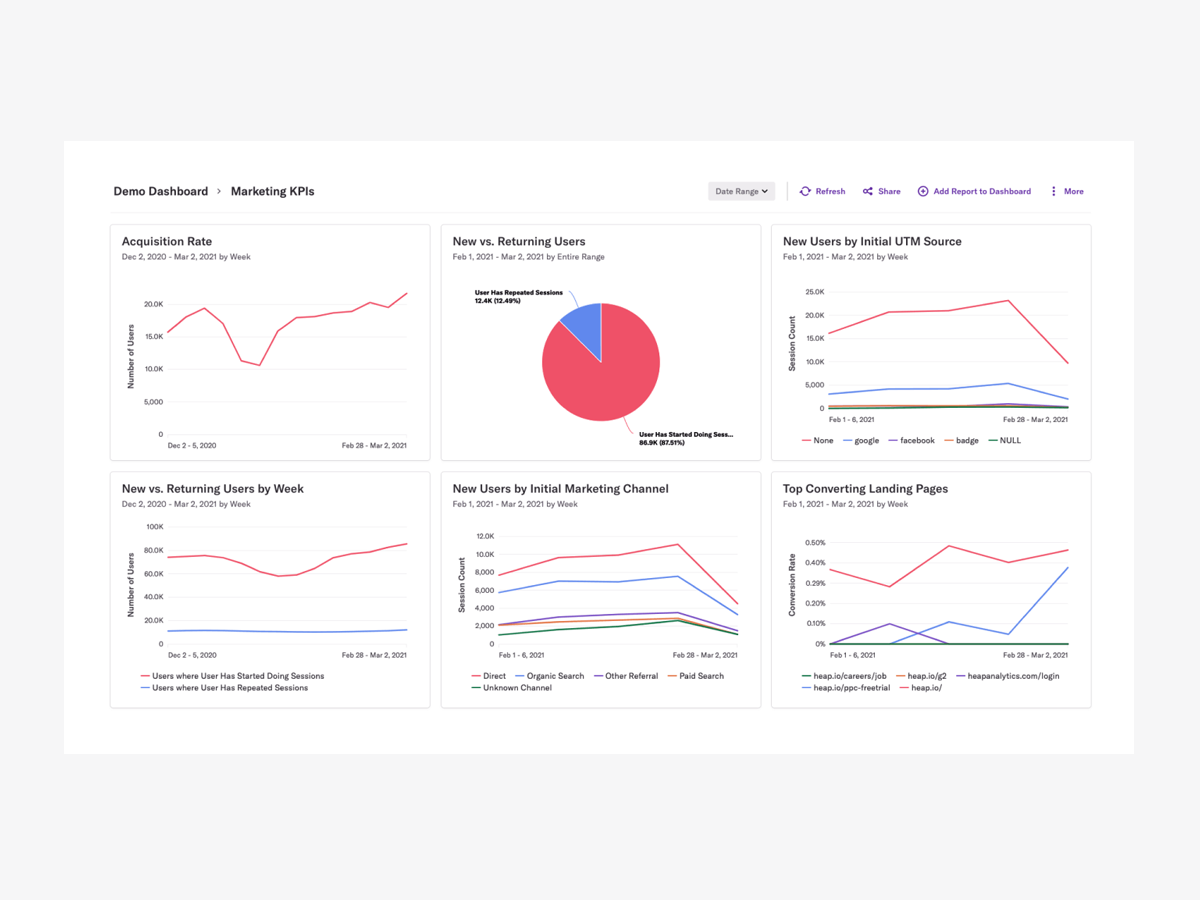
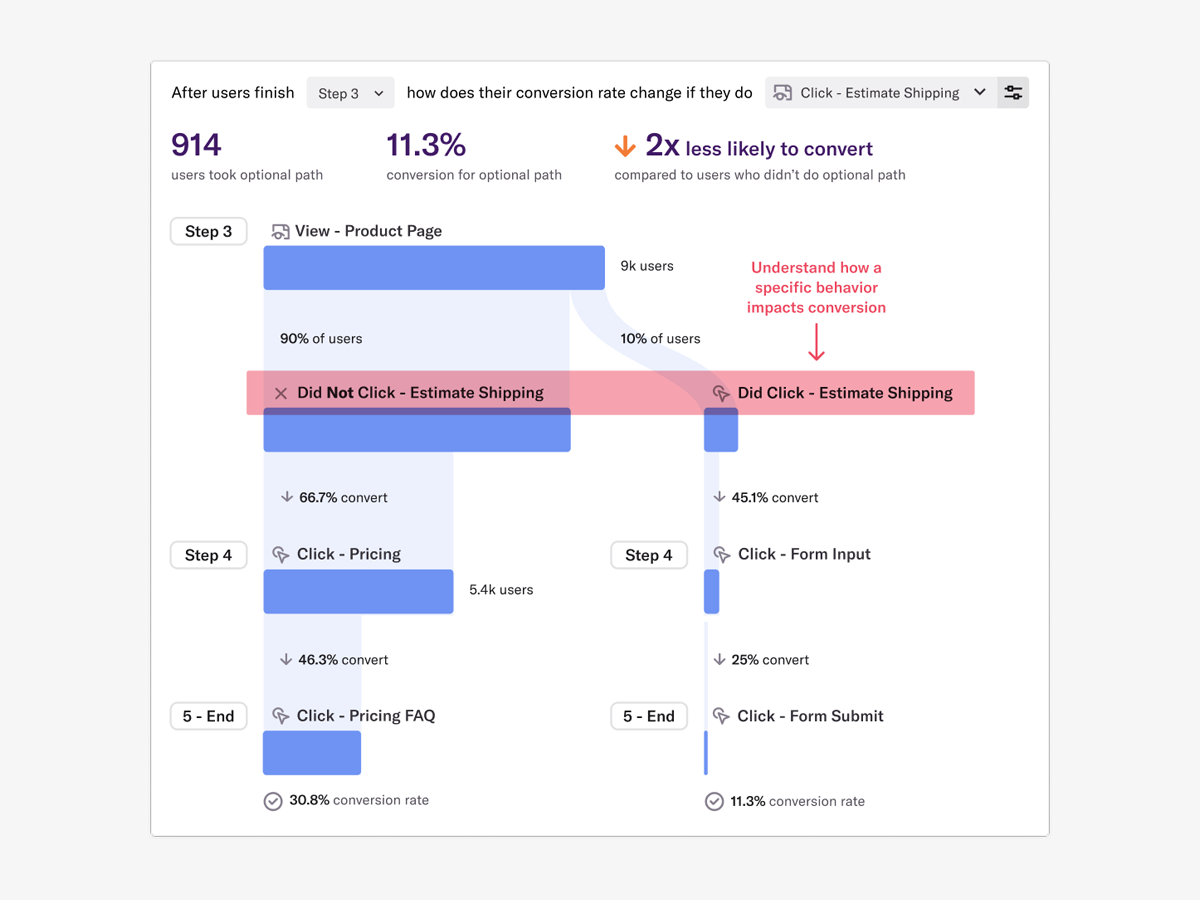
Heap is a web analytics platform captures every user interaction on web iOS with no extra code. The tool allows you to track events and set up funnels to understand user flow and dropoff. It also provides visualization tools to track trends over time.
$0
per month
Optimizely Web Experimentation
Score 8.7 out of 10
N/A
Whether launching a first test or scaling a sophisticated experimentation program, Optimizely Web Experimentation aims to deliver the insights needed to craft high-performing digital experiences that drive engagement, increase conversions, and accelerate growth.
N/A
Pricing
Fullstory
Heap
Optimizely Web Experimentation
Editions & Modules
Business
Contact Sales
Enterprise
Contact Sales
Free
$0
Up to 10k sessions/month
Growth
Starting at $3,600 annually
Up to 300k sessions/year
Pro
Contact Heap Sales
Custom sessions per month and unlimited projects
Premier
Contact Heap Sales
Custom sessions per month
No answers on this topic
Offerings
Pricing Offerings
Fullstory
Heap
Optimizely Web Experimentation
Free Trial
Yes
Yes
Yes
Free/Freemium Version
Yes
Yes
No
Premium Consulting/Integration Services
Yes
Yes
Yes
Entry-level Setup Fee
Optional
Optional
Optional
Additional Details
—
Heap pricing is based on session volume. A session is a period of activity from a single user on your app or website. It can include many pageviews or events.
Smartlook seemed very early in its stage, so there seemed to be plenty of bugs with how it worked. FullStory just seemed a bit more put together and ready to service a bigger company like ours. The breadth of features also seemed to be favoring FullStory over Smartlook.
FullStory is simpler to set up and use than some of the other more sophisticated (and expensive!) tools. It's also got a richer feature set than some of the freemium tools in the market. It's a nice 'middle man' in that sense. We wanted it because it was a nice easy way to get …
FullStory takes the best parts of session recording tools and analytics services. While it may not go as deep in the analytics area, it nonetheless provides a good suite of tools to work with. If all you need are the session recording capabilities, then there are few tools that …
Comparing to Mixpanel and Amplitude, the retro analytics option and the engineering light event implementation functions that Heap provides were crucial.
Comparing to FullStory, Heap analytics BI options and the data complexity were the reasons.
We are able to use FullStory for a more comprehensive view of user interactions and see trends in end-to-end user workflows, although we don't have an enterprise license to their software, we just enable it on a user-by-user basis. It is easier in FullStory to see where the …
Heap has an edge on Google Analytics due to auto-capture and ease of defining events. Heap has an edge on Hotjar, as it helps build funnels and has powerful filter/group by capabilities. FullStory is just session recording and focuses on one aspect of [the] engagement.
all of them may have their own strong suits but Heap is backed by best in class ML and AI algorithms. not only that all this powerful and robust backends are well handles also from the frontend. no matter how good your software is, if it is somewhat hard to navigate or to get …
Heap had an edge over Google Analytics in many ways. Few points to consider Heap over GA. 1. Low code implementation and less involvement of engineering team. 2. Great reporting dashboard with additional feature of of showing user journey, that helps understand user behaviour
One of the key features of Heap compared to other tools is auto-capture. Heap is now introducing session recordings, thereby covering features from other competitors as well.
From a startup perspective, Heap is one of the best and fastest ways to go from 0 analytics to nearly all of what one would need with the least amount of effort. It's faster and easier to implement than many above and it's better suited for quick quantifiable analytics that …
The big thing for me, that I've mentioned already, is Heap storing all event data retroactively. That's what keeps me with Heap. Google Analytics is industry standard and connected very intimately with all of the ad networks, so we have to use it, even if I think Heap is a …
Heap's implementation is by far the easiest across the different analytics products I've used. The only downside is that the analysis part is a bit more confusing to set up, and sometimes the confidence of the auto track is a bit shaky, although, these issues can usually be …
Heap is very similar to other tools out there including the ones I listed above. They all have a similar assortment of graphs, cohort analyses, and live views. Where Heap really stands apart is in its easy-to-use event visualizer, which lets you quickly create all the events …
Optimizely is a far more comprehensive solution. While it's true there are competitors to X Web, there's nothing to touch Optimizely's Full Stack product. Their customer support is based out of the USA, which cuts down wait times if we have questions/issues. This wasn't the …
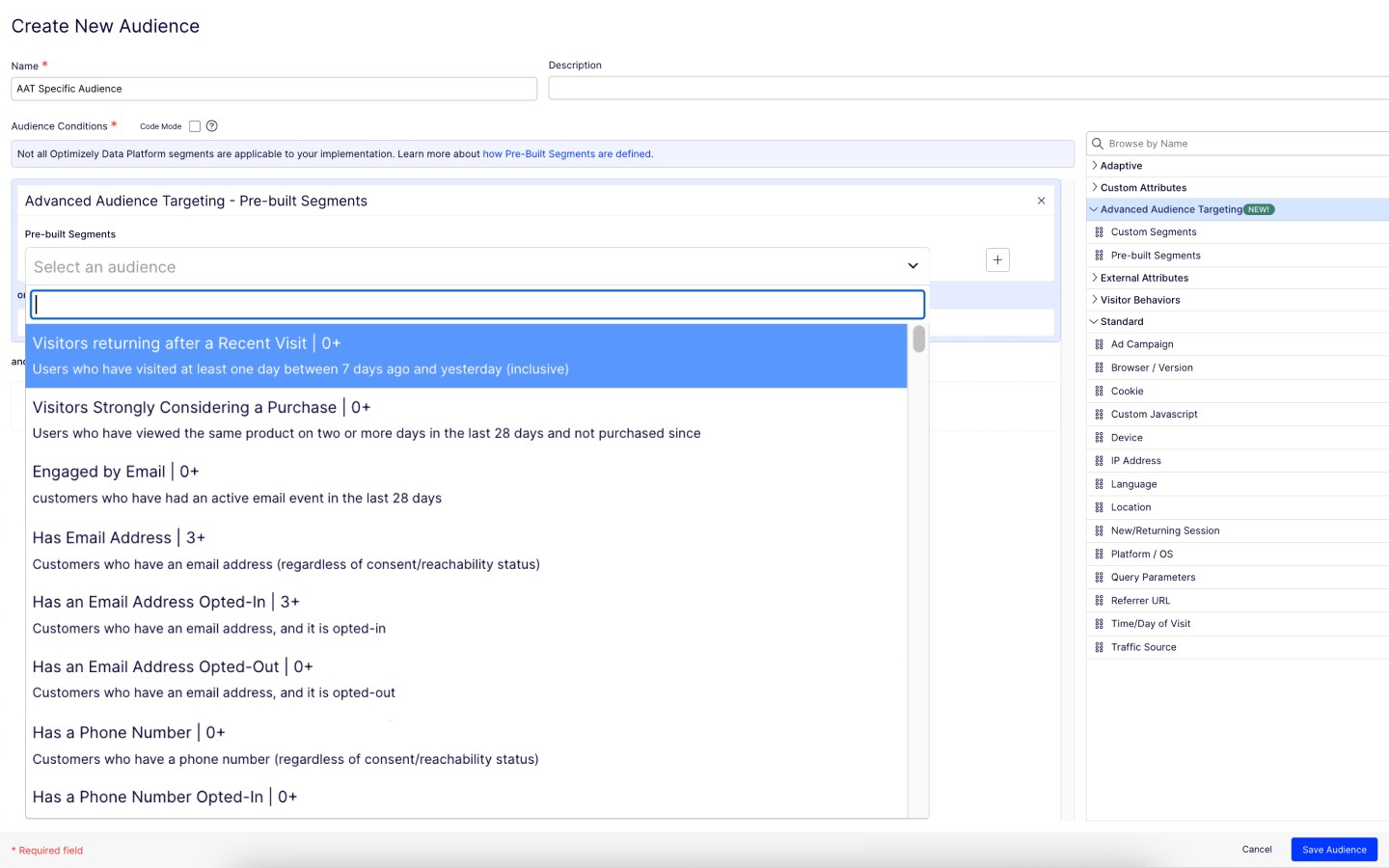
We chose Optimizely specifically for its split testing and advanced audience segmentation capabilities. It makes it way easier to see which option objectively performs better.
It was extremely useful in identifying places in our product where things weren't functioning, or where it looked like action was available to the end user but in reality, it was not and therefore caused lots of confusion. It doesn't help as much in other scenarios to see what catches a user's Eye or where they go if they leave our application as well as an actual in-person interview would help with eye-tracking software.
Scenarios when Heap was well suited: It is when a user claims that he encountered a bug without giving us the details of the error message. Scenarios where it is less appropriate: Its when we try to capture user interaction in our mobile app
I think it can serve the whole spectrum of experiences from people who are just getting used to web experimentation. It's really easy to pick up and use. If you're more experienced then it works well because it just gets out of the way and lets you really focus on the experimentation side of things. So yeah, strongly recommend. I think it is well suited both to small businesses and large enterprises as well. I think it's got a really low barrier to entry. It's very easy to integrate on your website and get results quickly. Likewise, if you are a big business, it's incrementally adoptable, so you can start out with one component of optimizing and you can build there and start to build in things like data CMS to augment experimentation as well. So it's got a really strong a pathway to grow your MarTech platform if you're a small company or a big company.
The Platform contains drag-and-drop editor options for creating variations, which ease the A/B tests process, as it does not require any coding or development resources.
Establishing it is so simple that even a non-technical person can do it perfectly.
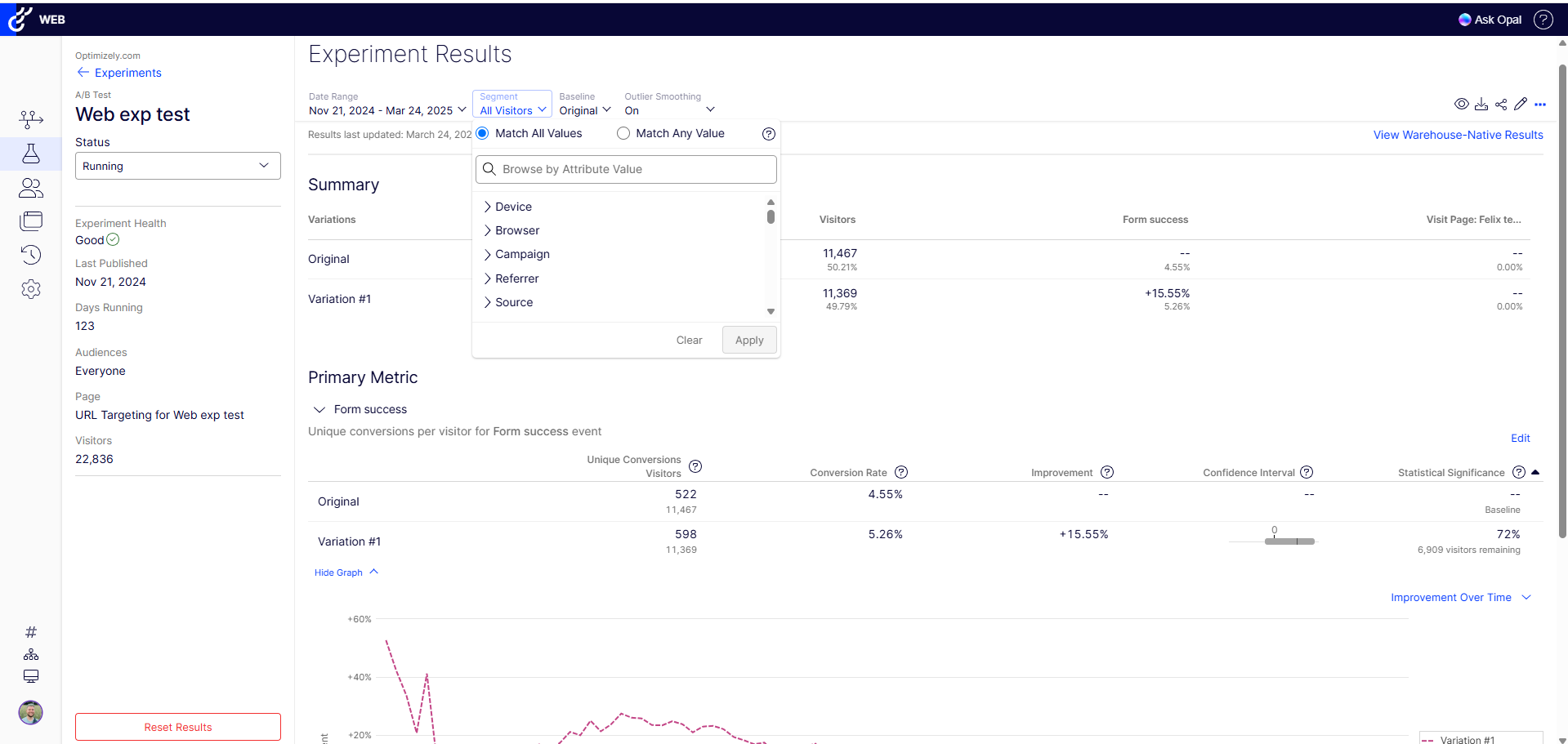
It provides real-time results and analytics with robust dashboard access through which you can quickly analyze how different variations perform. With this, your team can easily make data-driven decisions Fastly.
The ramp-up time to learn the entire product can take a little while. There are just so many absolutely wonderful tools and different ways to look at the same type of information that it can take a new user a few weeks to understand and then more time to master. However, FullStory has a ton of training resources to help with that! A lot of my own teammates have taught themselves FullStory through those training resources.
The UX of the product is totally wonderful, but there are tiny things that make getting to certain parts of the product slightly more challenging (like clicking into a modal in a modal). Sometimes buttons or links are placed out of my field of view, but those are minor things I notice because I work in UX.
It's been a phenomenal tool for us; every department that uses it has found something new and unexpected that it can do that they're really excited about. Even if we *only* used it for bug triage, it would be worth our time and money. The fact that we can use it for so many other things as well--gauging how customers interact and use our site, identifying UI problems, etc.--is above and beyond
It's a great platform. I'm glad that one of our product managers introduced it because it has allowed us to create all kinds of new functionality. We're not only able to create a better product experience from our communications because of Heap, but we're also able to generate all kinds of helpful analysis.
I rated this question because at this stage, Optimizely does most everything we need so I don't foresee a need to migrate to a new tool. We have the infrastructure already in place and it is a sizeable lift to pivot to another tool with no guarantee that it will work as good or even better than Optimizely
On a scale from 1-10, I find Heap to be incredibly user-friendly and easy to use. I enjoyed the training videos available and was quickly able to pick up how to create events and reports to track user interactions on our product. I would recommend Heap for its usability first and foremost.
Optimizely Web Experimentation's visual editor is handy for non-technical or quick iterative testing. When it comes to content changes it's as easy as going into wordpress, clicking around, and then seeing your changes live--what you see is what you get. The preview and approval process for sharing built experiments is also handy for sharing experiments across teams for QA purposes or otherwise.
I've never run into any issues with Heap's availability, Heap is always there when I need it. I haven't run into any issues like application errors or unplanned outages during my 2+ years of using Heap. Each and every time I log in to Heap I have a completely functional experience
I would rate Optimizely Web Experimentation's availability as a 10 out of 10. The software is reliable and does not experience any application errors or unplanned outages. Additionally, the customer service and technical support teams are always available to help with any issues or questions.
Heap doesn't affect page load times considerably nor has a large impact [on] our overall score, as far as page loading times inside of the tool its pretty reliable to retrieve data as much as "instant" that it can be the delay seems to be on data getting tracked into the servers to be read but it's not significant.
I would rate Optimizely Web Experimentation's performance as a 9 out of 10. Pages load quickly, reports are complete in a reasonable time frame, and the software does not slow down any other software or systems that it integrates with. Additionally, the customer service and technical support teams are always available to help with any issues or questions.
They have been overall pretty responsive and proactive. The tool is pretty straightforward to use. Most of the questions we have had to work with them on our how to use new features or adjust our integration to ensure we are gathering all the data from all of our tools.
Heap support has allowed us to troubleshoot and test a lot of different items. Their support team is always helpful and friendly, even when we come to them with the most complicated questions. I think this greatly improves the value proposition of the product because their support team is knowledgable and friendly.
They always are quick to respond, and are so friendly and helpful. They always answer the phone right away. And [they are] always willing to not only help you with your problem, but if you need ideas they have suggestions as well.
The tool itself is not very difficult to use so training was not very useful in my opinion. It did not also account for success events more complex than a click (which my company being ecommerce is looking to examine more than a mere click).
To successfully implement FullStory, it is important to plan your implementation carefully by defining your goals and user segments. You should also use tags and filters to analyze your user data, train your team to use FullStory effectively, and use FullStory in conjunction with other analytics tools to get a more complete picture of your user's behavior. By following these tips, you can gain valuable insights into your users' behavior and experiences, and use this information to improve your website or application.
The implementation was smooth and easy. The Heap team helped us with implementation and it went great! Within a few weeks, we were fully up and running and utilizing the platform to its full capability. This is an additional thing that has made this platform so great and we couldn't recommend it enough.
In retrospect: - I think I should have stressed more demo's / workshopping with the Optimizely team at the start. I felt too confident during demo stages, and when came time to actually start, I was a bit lost. (The answer is likely I should have had them on-hand for our first install.. they offered but I thought I was OK.) - Really getting an understanding / asking them prior to install of how to make it really work for checkout pages / one that uses dynamic content or user interaction to determine what the UI does. Could have saved some time by addressing this at the beginning, as some things we needed to create on our site for Optimizely to "use" as a trigger for the variation test. - Having a number of planned/hoped-for tests already in-hand before working with Optimizely team. Sharing those thoughts with them would likely have started conversations on additional things we needed to do to make them work (rather than figuring that out during the actual builds). Since I had development time available, I could have added more things to the baseline installation since my developers were already "looking under the hood" of the site.
Smartlook is software that records users on a website and mobile app. Finding useful information within thousands of recordings is made quick and easy with features that help you accomplish this. I have chosen FullStory because it is easier to use and has more advanced features compared to Smartlook.
Heap offers a ton of functionality on a single platform.It also has an smart data science layer to offers suggestions for next steps in the analysis, allowing us to explore alternative paths we may not think to take. The low-code option for updating data is appealing, and there is a lot of automation with minimal engineering effort.
The ability to do A/B testing in Optimizely along with the associated statistical modelling and audience segmentation means it is a much better solution than using something like Google Analytics were a lot more effort is required to identify and isolate the specific data you need to confidently make changes
The most challenging part of using Heap in a growing organization is the naming and structure in which reports and dashboards are organized. I work within the marketing department and our Heap leader internally works within the IT/Product department, which makes it challenging because we often don't speak the same language, so the learning curve has been steep without any specific use-case examples to leverage online.
We can use it flexibly across lines of business and have it in use across two departments. We have different use cases and slightly different outcomes, but can unify our results based on impact to the bottom line. Finally, we can generate value from anywhere in the org for any stakeholders as needed.
We're able to share definitive annualized revenue projections with our team, showing what would happen if we put a test into Production
Showing the results of a test on a new page or feature prior to full implementation on a site saves developer time (if a test proves the new element doesn't deliver a significant improvement.
Making a change via the WYSIWYG interface allows us to see multiple changes without developer intervention.