
T. Blane McMichen
President
Chose Google Analytics
Campaign tracking requires more set-up in Webtrends, and the additional cost is hard to justify.

| Product | Rating | Most Used By | Product Summary | Starting Price |
|---|---|---|---|---|
 Google Analytics | N/A | Google Analytics is perhaps the best-known web analytics product and, as a free product, it has massive adoption. Although it lacks some enterprise-level features compared to its competitors in the space, the launch of the paid Google Analytics Premium edition seems likely to close the gap. | $0 per month | |
 Semrush | N/A | Semrush is a relatively popular search engine optimization tool set from the company of the same name based in Pennsylvania and founded in 2008. Largely the platforms relies on competitive intelligence, and features SEO staples like backlink checking, keyword analysis to refine SEO and PPC campaigning and locate low-cost / high-yield keywords, analysis of competitors who co-occupy desired ad and listing spaces, domain vs. domain analysis, as well as site audit and domain tracking. Semrush can… | $139.95 per month | |
 Webtrends Analytics | N/A | WebTrends provides an enterprise web analytics platform and, according to Forrester, has a strong focus on support for mobile and social channels and a very open platform. Webtrends competes directly with Adobe Site Catalyst, IBM Coremetrics. and comScore DigitalAnalytix. | N/A |
| Google Analytics | Semrush | Webtrends Analytics | ||||||||||||||||||||||
|---|---|---|---|---|---|---|---|---|---|---|---|---|---|---|---|---|---|---|---|---|---|---|---|---|
| Editions & Modules |
|
| No answers on this topic | |||||||||||||||||||||
| Offerings |
| |||||||||||||||||||||||
| Entry-level Setup Fee | No setup fee | Optional | No setup fee | |||||||||||||||||||||
| Additional Details | — | 17% discount for annual pricing. | — | |||||||||||||||||||||
| More Pricing Information | ||||||||||||||||||||||||
| Google Analytics | Semrush | Webtrends Analytics | |
|---|---|---|---|
| Considered Multiple Products |  Google Analytics T. Blane McMichen President Chose Google Analytics Campaign tracking requires more set-up in Webtrends, and the additional cost is hard to justify.  Kenny Madison SEO Analyst Chose Google Analytics  Daniel Berry Digital Marketing Manager Chose Google Analytics  Alex Nejako Marketing Automation Manager Chose Google Analytics  sandro merkvilishvili Head of e-commerce deparment Chose Google Analytics Ease of use: Google Analytics is known for its user-friendly interface and straightforward setup process, making it accessible for beginners. Adobe Analytics has a steeper learning curve and requires more technical expertise. Features: Adobe Analytics offers a more comprehensive …  Martha McNeil Data Management Analyst Chose Google Analytics Built-in reports are beneficial but you can create custom reports if you need more details with different dimensions and metrics it also provides insights which is just little data about your site traffic in sentence format its the best way to know which strategy you are on …  Chris Williams Marketing Director Chose Google Analytics All of these products are geared at tracking your website performance among many other things that Google Analytics does not do. But all of these products need to connect to Google Analytics to track the actual traffic and analytics to make their platforms work. When it comes …  Adam Hatfield Head of Digital Chose Google Analytics We have been using Google Analytics for over 10 years. Over that time we have periodically reviewed our analytics platforms a number of times. For us, it made more sense to stay with google analytics primarily because if we migrated to another platform we would lose the …  James Arnold Chief Digital Officer (CDO) Chose Google Analytics GA is a free tool and is quite robust. Adobe was amazing but probably not worth the spend unless you are running an e-commerce site or need a deeper level of control.  Michael Baker Digital Marketing Manager Chose Google Analytics We tested Webtrends and purchased Omniture (which we used for 2 years). Webtrends wasn't a good fit overall. Omniture was too cumbersome and expensive. The support was HORRIBLE and for a paid product it lacked some basic, no-brainer features.  Jennifer (Utterback) Davis Vice President, Emarketing Chose Google Analytics We have used Omniture and WebTrends. WebTrends is an outdated analytics tool. Omniture, while robust is just not as customizable. Basically, if you have no intention or no need to do customization and you just want out-of-the-box reporting and not willing to spend the time in … | Semrush  Kyle Moloo Account Executive Chose Semrush - SERPs is great for keyword research (volume, cost, etc.), but when it came to reporting, I found the tool clunky and hard to use. It was difficult to manage multiple projects and I didn't feel like I was always getting accurate data. - HubSpot has great analytics tools, but …  Alanna Hawley SEO Specialist Chose Semrush SEMRush has many more features than the other tools, and the workflow, or ways you access the tool, were smoother as well.  Pemba Tshiring Sherpa Search Engine Optimization Specialist Chose Semrush  Jake Harding SEO Manager Chose Semrush Semrush is more intuitive and well-rounded. I didn't use Ahrefs too much, but it felt more complex to use and a bit more fragmented. Moz seemed to diminish in usefulness from when I started using it. Semrush does everything Moz does, but better, more comprehensively, and with …  Freddy Hunt Director of SEO & Content Marketing Chose Semrush Moz was unreliable and not as intuitive as Semrush. The one thing I liked better about Mox Pro was that we could track the same keyword across many zips. This is possible in Semrush, but Semrush requires you to create a new project for every zip. It would be easier if you could …  Mohamed Jemaa Senior Marketing Manager Chose Semrush Semrush gives you a complete overview of all the metrics that you should monitor in terms of SEO , so no need to check other tools. It makes you save a lot of time and act fast.  Dave Davies CEO (Chief Executive Officer) Chose Semrush I've reviewed a number of tools, and continue to periodically. Semrush easily wins for the breadth of coverage, and it does them well. Some tools designed for a single task win in those tasks, but none compare overall. Some other tools I've looked at are: Authoritas  Christina Giakoumaki Graduate Program Coordinator - MA in Digital Communication and Social Media Chose Semrush I went through a number of platforms and think that Semrush offers the best combination of capabilities and tools with usability and insight.  Mark Tietbohl Strategic Project Mgr / Mentor & Consultant / Change Catalyst / Founder Chose Semrush I have used ahrefs and MOZ in the past, but it was handled by other people and I was one of the business leads. ahrefs is very solid in certain areas of links, but SEMrush has a very deep database and that is part of the appeal. They also have a solid connection to Google. …  Mike Query Digital Marketing Manager Chose Semrush  Joseph Lesho Team Lead, Digital Marketing Services Chose Semrush SEMRush is simpler and easier to use compared to other platforms, yet is just as powerful.  Rahul Agarwal Digital Strategy Consultant Chose Semrush SEMRush has a much stronger position when you compare it to other alternatives. The reason being that there are only a few tools that provide an overall service including both SEO and SEM. Also, the fact that it allows competitor analysis and a side by side analysis of KPIs …  Tim Colling President Chose Semrush Google Search Console is free, so that's a point in GSC's favor. BrightLocal is excellent at search ranking reports but not as strong on other fronts. SEMrush is very good at analyzing companies to which you don't have direct access, such as competitors and prospects. |  Webtrends Analytics  Jaclyn Wallace Campaign Measurement & Reporting Coordinator Chose Webtrends Analytics I find Google Analytics to be very limiting. This may also be the way that the reports have been structured by our organization. It is viewed as an older way to obtain the metrics we are after and no new projects are implemented through Google Analytics.  David Cox Senior Business Intelligence Analyst Chose Webtrends Analytics We currently use WebTrends, Google Analytics, Kissmetrics and ClickTale. I would like us to consolidate our activities to be focused on just Webtrends as it covers all of the requirements we have very well.  Nathan Collins CRM Analyst Chose Webtrends Analytics Using Omniture at my current place of employment and using Google Analytics as a backup at both, Webtrends is the clear superior product. I go back to how easy the UI is to navigate and how simple it is to get user level data that isn't duplicated or doesn't try to pigeon hold …  Mary Kay Scott Web Developer III Chose Webtrends Analytics Compared to WebTrends, Google Analytics has a slicker interface, provides live site usage data, and is easier to jump into with basic usage. These days users expect to be able to create their own reports as needed, rather than have an "expert" do it for them. They are used to …  Matthieu Dejardins Head of Web Analytics & Testing Chose Webtrends Analytics Webtrends was selected because of the price for Google Analytics Premium ($110k per year) and Adobe Omniture Analytics (twice the price). Clearly, it needed the Visitor Data Mart to get additional capability that you would expect as part of a Web Analytics suite. In our case, …  Brian Mackintosh Director of eCommerce Chose Webtrends Analytics I have only had significant experience with Google Analytics (GA) and WebTrends in this space. Overall - it is easier to learn and modify GA reports as a casual user - I always struggled with the fact that GA only offered partial data (sampling based).  Chaim (Daniel) Arnstein Consultant (6+ Years) Sr. Systems Analyst - VP (7 Years) Chose Webtrends Analytics Have not use Webtrends competitors  Kevin Ornduff Marketing Analyst Chose Webtrends Analytics Webtrends is just an option, depending on client budget. It's a simple analytics tool that does the job but we always recommend Omniture whenever possible.  Adam Krause Manager of Web Analytics Chose Webtrends Analytics We evaluated Google Analytics, but we picked Webtrends as it offered better value for the price. |
| Google Analytics | Semrush | Webtrends Analytics | |||||||||||||||||||||||||||||||||||
|---|---|---|---|---|---|---|---|---|---|---|---|---|---|---|---|---|---|---|---|---|---|---|---|---|---|---|---|---|---|---|---|---|---|---|---|---|---|
| Web Analytics |
| ||||||||||||||||||||||||||||||||||||
| SEO |
| ||||||||||||||||||||||||||||||||||||
| SEO Channels |
| ||||||||||||||||||||||||||||||||||||
| SEO Platform & Account Management |
|
| Google Analytics | Semrush | Webtrends Analytics | |
|---|---|---|---|
| Small Businesses |  StatCounter Score 9.0 out of 10 |  Nozzle Score 10.0 out of 10 | StatCounter Score 9.0 out of 10 |
| Medium-sized Companies |  Optimal Score 9.1 out of 10 |  Advanced Web Ranking Score 8.2 out of 10 | Optimal Score 9.1 out of 10 |
| Enterprises | Optimal Score 9.1 out of 10 |  Dupli Checker (DupliChecker.com) Score 8.5 out of 10 | Optimal Score 9.1 out of 10 |
| All Alternatives | View all alternatives | View all alternatives | View all alternatives |
| Google Analytics | Semrush | Webtrends Analytics | |
|---|---|---|---|
| Likelihood to Recommend | 8.5 (192 ratings) | 8.2 (154 ratings) | 7.1 (30 ratings) |
| Likelihood to Renew | 9.0 (51 ratings) | 9.1 (3 ratings) | 5.4 (25 ratings) |
| Usability | 7.4 (19 ratings) | 8.0 (10 ratings) | 5.4 (7 ratings) |
| Availability | 10.0 (4 ratings) | 9.1 (1 ratings) | 9.0 (4 ratings) |
| Performance | 10.0 (2 ratings) | 7.3 (1 ratings) | 8.2 (3 ratings) |
| Support Rating | 7.0 (42 ratings) | 9.9 (17 ratings) | 8.8 (8 ratings) |
| In-Person Training | - (0 ratings) | - (0 ratings) | 9.7 (3 ratings) |
| Online Training | 10.0 (2 ratings) | - (0 ratings) | 9.0 (4 ratings) |
| Implementation Rating | 9.0 (7 ratings) | 7.3 (1 ratings) | 9.9 (5 ratings) |
| Configurability | 6.0 (2 ratings) | - (0 ratings) | 7.1 (2 ratings) |
| Ease of integration | 10.0 (1 ratings) | - (0 ratings) | - (0 ratings) |
| Product Scalability | 10.0 (2 ratings) | 9.1 (1 ratings) | - (0 ratings) |
| Vendor post-sale | 10.0 (1 ratings) | - (0 ratings) | 9.0 (1 ratings) |
| Vendor pre-sale | 9.0 (1 ratings) | - (0 ratings) | 9.0 (1 ratings) |
| Google Analytics | Semrush | Webtrends Analytics | |
|---|---|---|---|
| Likelihood to Recommend | Google
sandro merkvilishvili Head of e-commerce deparment | Semrush
| Webtrends
Chaim (Daniel) Arnstein Consultant (6+ Years) Sr. Systems Analyst - VP (7 Years) |
| Pros | Google
| Semrush
 Katie Wojciechowski SEO Copywriter | Webtrends
 Mitchell Teixeira Consultant |
| Cons | Google
| Semrush
 Daniel Drummond Head of Digital Marketing | Webtrends
 Chris Grant Associate Director of Analytics |
| Likelihood to Renew | Google
| Semrush
| Webtrends
|
| Usability | Google
 Victor Campos Web Developer | Semrush
| Webtrends
|
| Reliability and Availability | Google
| Semrush
 Keith Jones I am a CPA Specializing in IRS Tax Resolution and Small Business Accounting Automation & Tax Plannin | Webtrends
|
| Performance | Google
| Semrush
Keith Jones I am a CPA Specializing in IRS Tax Resolution and Small Business Accounting Automation & Tax Plannin | Webtrends
Adam Krause Manager of Web Analytics |
| Support Rating | Google
 Sarah Hoffman Media Director | Semrush
| Webtrends
 Matthew Koppel Analytics and Insights Supervisor |
| In-Person Training | Google No answers on this topic | Semrush No answers on this topic | Webtrends
Adam Krause Manager of Web Analytics |
| Online Training | Google
 Roy Morejon President | Semrush No answers on this topic | Webtrends
Adam Krause Manager of Web Analytics |
| Implementation Rating | Google
 Joshua Van Horsen Marketing Manager | Semrush
Keith Jones I am a CPA Specializing in IRS Tax Resolution and Small Business Accounting Automation & Tax Plannin | Webtrends
Mitchell Teixeira Consultant |
| Alternatives Considered | Google
| Semrush
 Joshua Poole SEO Manager | Webtrends
|
| Scalability | Google
| Semrush
Keith Jones I am a CPA Specializing in IRS Tax Resolution and Small Business Accounting Automation & Tax Plannin | Webtrends No answers on this topic |
| Return on Investment | Google
 Heide Rembold Director of Marketing & Analytics | Semrush
| Webtrends
 Lindsay Buescher Senior Manager, Analytics |
| ScreenShots | Webtrends Analytics Screenshots  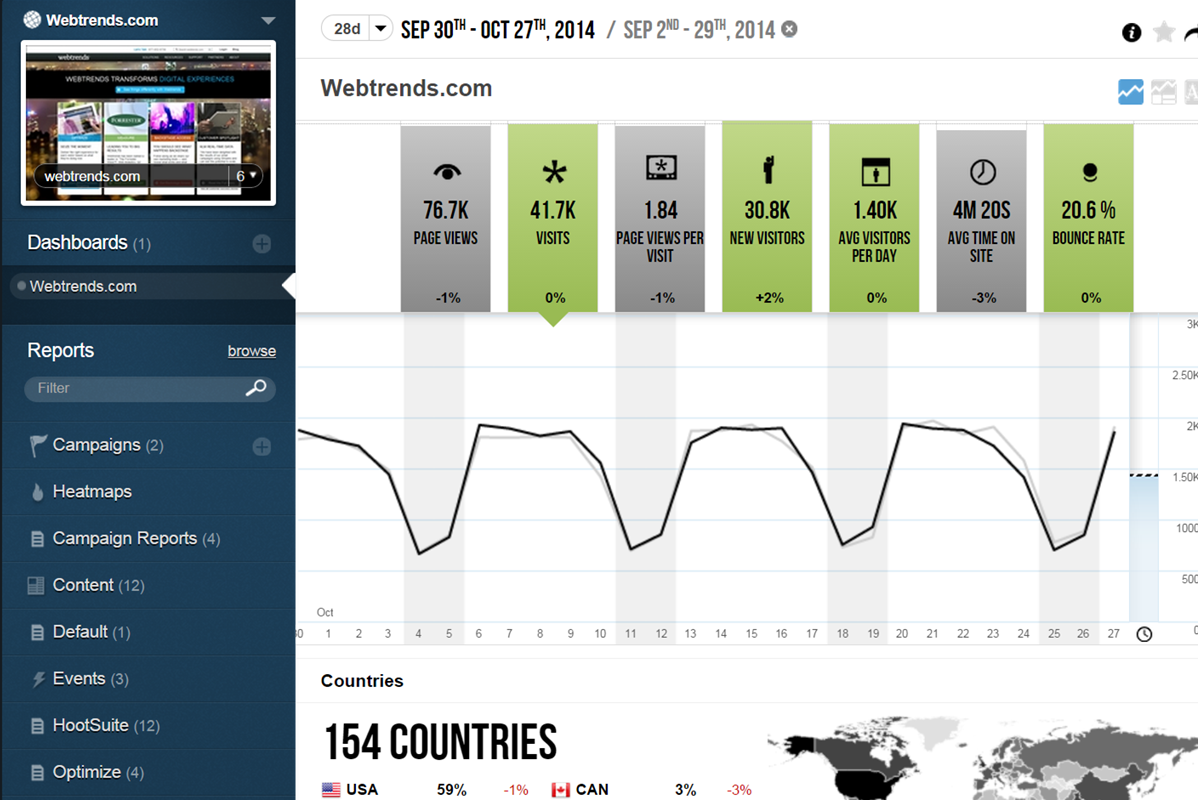 |