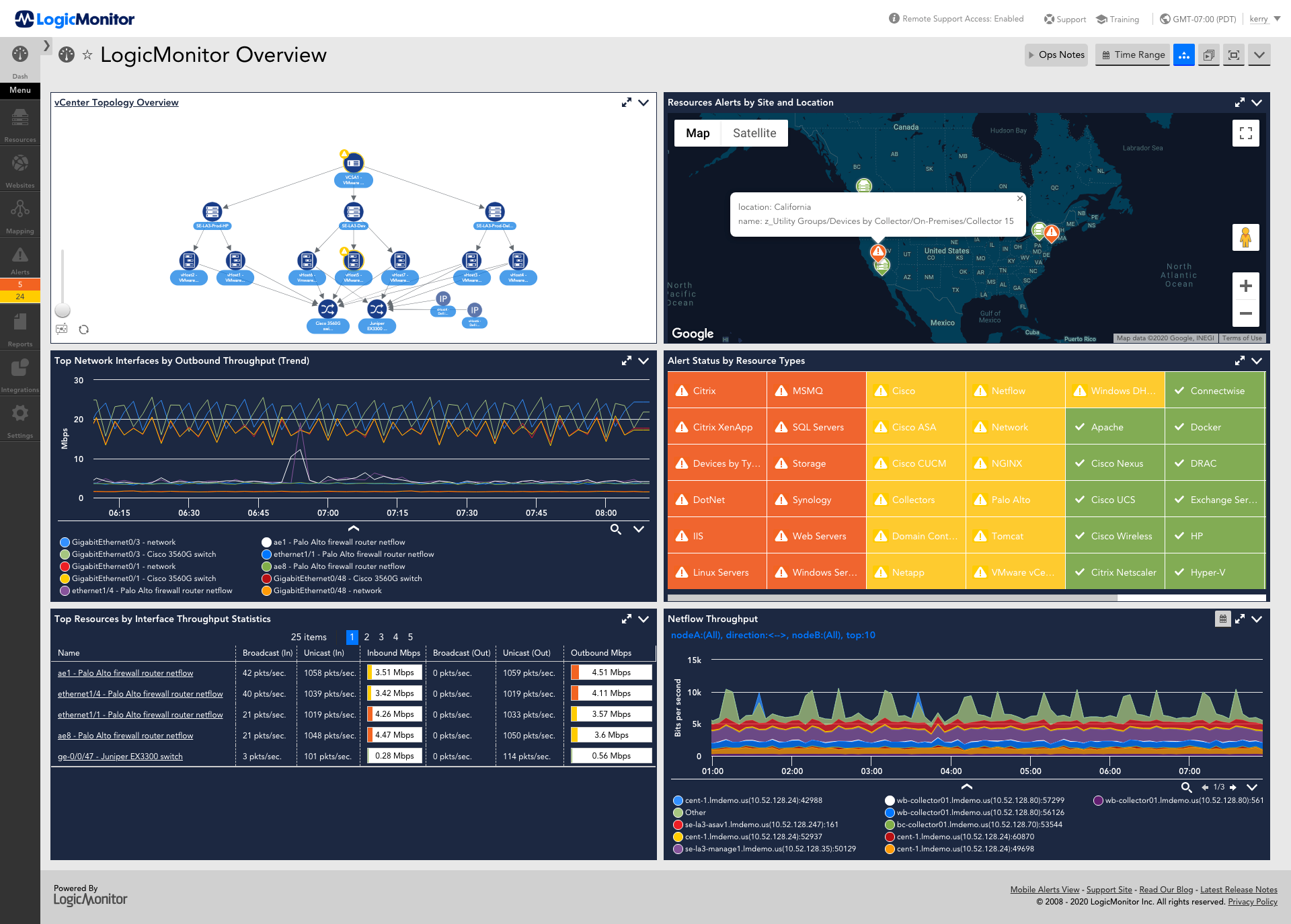
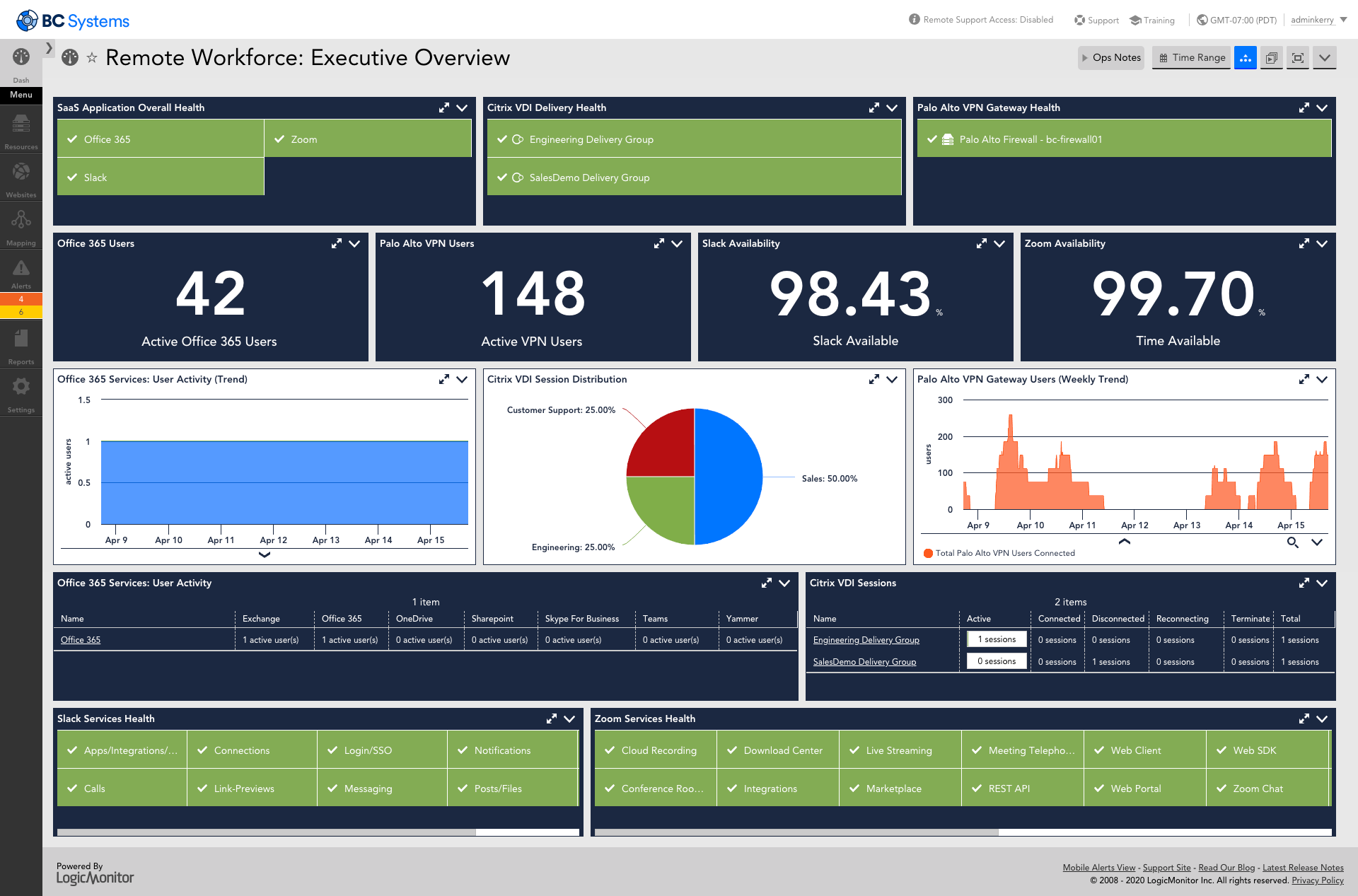
LogicMonitor’s SaaS-based platform, LM Envision, enables observability across on-prem and multi-cloud environments. It provides IT and business teams operational visibility and predictability across their technologies and applications.
N/A
New Relic
Score 7.9 out of 10
N/A
New Relic is a SaaS-based web and mobile application performance management provider for the cloud and the datacenter. They provide code-level diagnostics for dedicated infrastructures, the cloud, or hybrid environments and real time monitoring.
$0
No credit card required; 100 GB free ingest per month, 1 free full user + unlimited basic users, 8 days retention, 100 Synthetics Checks
Splunk AppDynamics
Score 8.4 out of 10
N/A
AppDynamics is an APM and Mobile APM program, with application mapping and predictive capabilities. These capacities enable automated remediation and code-level diagnostics in real time. It can be deployed on-premise or as a SaaS.
N/A
Pricing
LogicMonitor
New Relic
Splunk AppDynamics
Editions & Modules
Enterprise
Contact sales team
Website Monitoring
Contact sales team
Free (Forever)
$0
No credit card required; 100 GB free ingest per month, 1 free full user + unlimited basic users, 8 days retention, 100 Synthetics Checks
Telemetry Data Platform
$0.25
per month per extra GB data ingest (after first free 100GB per month)
Incident Intelligence
$0.50
per month per event (after first 1000 free events per month)
Standard
$99
per month per full user (after first free full user - unlimited free basic users)
Pro
Contact sales team
Enterprise
Contact sales team
No answers on this topic
Offerings
Pricing Offerings
LogicMonitor
New Relic
Splunk AppDynamics
Free Trial
Yes
No
Yes
Free/Freemium Version
No
Yes
Yes
Premium Consulting/Integration Services
Yes
No
Yes
Entry-level Setup Fee
No setup fee
No setup fee
No setup fee
Additional Details
Our platform is broken down into Pro and Enterprise Pricing. Pro includes monitoring for all of your cloud, hybrid, and on-premises infrastructure. Our Enterprise package includes all of this, plus our AIOps and Machine Learning functionality that provides dynamic thresholds, root cause analysis, anomaly detection and more!
LogicMonitor only charges by the device. What is considered a device? A device is anything with an IP address that you want to monitor, including a physical device or a cloud resource. This means multiple data sources under the same IP address can be monitored for the same price. Unlike some monitoring platforms. we don’t charge per node, interface, or metric.
Basically, we did not have any idea about it and how to choose, but we asked one of our former bosses, as they were very experienced with it, so they helped us by clarifying a few things between New Relic and LogicMonitor, as they told us that if you are looking for an …
Some teams in our company are also using New Relic, and they are pretty satisfied with it. However, I also used it for some time, and I did not find it as flexible as LogicMonitor for our needs. So, yes, I suggested that management remove New Relic, as we have a superior tool …
I was one of the members who were looking for a better application for our system security, and we tried Datadog and New Relic. Those software were very good for normal usage. New Relic was working fine until we started facing problems if any sudden system increase as it was …
I didn't keep my list of all the various products that we had POC'ed or even had demos with. Almost all were too narrow in their view to handle the breadth of environments that we have both in the cloud and in the data centers. Those few that did stack up against LogicMonitor …
One of our main objectives while choosing a next gen monitoring platform was scalability in that regard we were not interested in legacy on prem solution and SAAS model was our preferred solution which supports rapid scalability when needed. Another important objective was to …
Most vendors are experts in one area (APM, ITIM, Logs, Network, Cloud). LogicMonitor provides strong monitoring and alerting functionality in all areas. They are also leaders in innovation for the newest services we’re using (Kubernetes, Fargate, Fortigate, Cohesity). Most of …
New Relic has full stack visibility and gives us all options for observability like one stop shop. It gives you front end, backend as well synthetic monitoring capabilities.
Every other feature built into one cost model (usually) which ties to data that you send, it helps you …
New Relic has a native integration with the IaaS service that the company utilizes which made it very easy to set up, integrate, and it also has consolidated billing with that IaaS service which is a big plus for the organization. After evaluating, I also thought it had the …
We selected New Relic since it was very dynamic and versatile to use. It works well in all aspects of monitoring, and observability and would allow having a focus on collaboration with different repeatable processes. Also, New Relic has a good focus on working well with CLI, …
New Relic is easier to login and use as it's user friendly, its full-stack capacity lets us to monitor the whole system across all the tiers. However compared to Dynatrace its deep-dive analysis capacity needs to be improved, compared to Splunk its log analysis and reporting …
All the tools mentioned above are pretty much the same in terms of their capabilities for monitoring, reporting, and alerting. Uniqueness in New relic comes from its out-of-the-box functionality to provide visibility into every aspect of application performance and time to …
New Relic is competing neck to neck with other APM products in terms of capability, ease of doing business, implementation and configuration, prices, integrations, and future developments. No doubt New Relic is providing out of the box solution for business services monitoring …
All of these apps have pros and cons. AppDynamics is very powerful and provides excellent reporting and deep dives on performance. Tableau Desktop's setup can be a bit tedious, but once it is done, it is a great tool to provide visual performance reports. However, the lack of …
New Relic has a lot of benefits comparing to other solutions.
The main one is usability, compared to other solutions on the market, the interface and usability beats everything else and without good user experience, the user tends to ignore the solution.
Although not in the list, Google Stackdriver is also in the competitive landscape for New Relic.
We assessed all 3 of the alternatives above. We found AppDynamics to be the superior product, but with a price tag aligned with that superiority. Datadog was the best …
New relic let's us have transportation over the entire network infrastructure, which is a very important feature which makes new relic stand out. It provides an extensive monitoring experience, wherein we can compare multiple applications unlike the other tools.
AppDynamics is very similar to New Relic, and is probably the only product we evaluated that was competitive. There wasn't a clear winner between these two; we ultimately stayed with New Relic because AppDynamic's support wasn't incredibly impressive, and it didn't seem to have …
AppDynamics was trialled in a shoot-out between New Relic and Dynatrace and just about edged New Relic simply for the ability to drill down to the methods and lines of code in the error monitoring, which is an invaluable feature for a development manager. New Relic Insights …
Data dog, it's not an APM to me, yet. It's more like a Nagios or PRTG. And New Relic, it was good. Now it's poor in setup a .Net application. AppDynamics is simply perfect in setup, usage, tips, alarms. It's really what we needed for our environment. All in a single …
AppDynamics is almost the same as New Relic and I would say they both are at the same level. Datadog is infrastructure monitoring and AppDynamics can catch up on this impact.
We actually have different development teams using both of these tools currently. They are both very good at providing application monitoring. They in some ways have the same flaws. App Dynamics seems very focused on the end-to-end evaluation of the application and New Relic …
Unfortunately, I wasn't in the company when the decision was made, hence can tell just because. What I can tell from my experience, it was not a bad choice and alternatives like New Relic or Datadog provide more or less similar functionality. In most cases the main reasons are …
AppDynamics is easy to use, very good monitoring and provides us with detailed information about the performance of the underlying infrastructure, including servers, database,and external services.
Verified User
Engineer
Chose Splunk AppDynamics
AppDynamics is a mature product with probably the simplest of UIs to use which is a huge benefit. I can train users to be proficient in AppDynamics in under an hour. But the product can definitely do some very advanced operations... depending on the need.
It is distinguished from these programs because the platform provides visualizations of application processes, showing the interplay between various parts and services. Understanding the architecture of complicated apps and finding their weak spots is greatly aided by this.
It differs from these programs because it integrates seamlessly with a wide range of technologies and platforms and has strong integration capabilities, a crucial factor in adapting to different technology stacks.
AppDynamics excels at delivering extensive insights into the performance of apps at the code level. It enables developers to zero in on certain lines of code or modules that are causing performance difficulties, making it possible for more effective debugging and optimization. …
Verified User
Team Lead
Chose Splunk AppDynamics
Ease of use, the fast pace of the product growth.
Analytics and BiQ is a huge bonus for adding value to Business who ultimately are the owners as they pay for AppDynamics.
AppDynamics is still a good solution as this is one the earliest tool available in the APM space and people are used to this Application usage. However other products are also doing great as Dynatrace is the biggest competitor since it adds on all the AppDynamics features plus …
Ease of usage. Views key metrics of any application you can think of. Analyzes transactions easily. Helps resolve performance issues. Server and application performance management is now very easy with this tool. End user monitoring. Deep code level diagnostics in real time.
New Relic is only SaaS and keys off of AppDex scoring (i.e. industry baselines) and not on my application's baselines. Where most of our stuff is custom apps, going off of industry wasn't valuable to us. It was also cost prohibitive.
Appdynamics offered so much more functionality than New Relic, albeit at a more expensive price. The UI was easier to navigate in Appdynamics than in New Relic and it was considerably easier to configure and deploy AppDynamics than New Relic. We had extensive discussions with …
The example I will give will explain my rating for it. One employee left our company due to a personal issue, and at that time, our team was working on a highly secure project. He wanted to take revenge on our company, so he began hacking our systems from the outside. Since it appears that someone without authorization is attempting to access our systems, LogicMonitor simultaneously alerted our team to the problem. We stopped that threat with LogicMonitor.
New Relic its an excellent tool for monitoring services used on the SAAS universe, like web servers, relational and nosql dbms, reverse proxies, text databases, etc. Its also a powerful tool to monitor resource usage on said servers. However, its not well fitted to monitor custom services - if you need to generate alerts based on logs or database information, for example
Platforms for software as a service (SaaS) frequently cater to a large number of users with a variety of needs and usage patterns. Because AppDynamics offers multi-tenant monitoring capabilities to track performance across various customer environments, it is a good choice for SaaS platform monitoring. SaaS providers can maximize resource utilization, proactively detect and resolve performance issues, and provide a dependable and consistent user experience for their clients with AppDynamics.
Business Transaction Monitoring is one of its signature strengths. This represents a major differentiator from generic infrastructure monitoring tools.
AI‑driven anomaly detection and intelligent alerting provide a significant advantage over traditional monitoring.
When combined with Splunk AppDynamics, full‑stack observability becomes a key part of Cisco/Splunk’s unified observability strategy.
And while powerful, building tailored dashboards with organ-specific metrics (such as energy load variance across regions) can be difficult to navigate. The UI isn't as drag-and-drop easy, and query-based widgets typically involve some trial and error for non-devs.
Alerts may be hypersensitive or over general. I We often get a spam of non-critical alerts while doing load testing, all overhauling to me alone and making it difficult to identify actual issues especially in energy systems where spikes are very common.
With our expanding fleet of Iot devices, the per-host pricing model is becoming expensive, quickly. More detailed billing based on microservices, or that works at sensor level, would make it more adaptable for energy platforms.
AppDynamics may enhance its capacity to track transactions through complex distributed systems and microservices, offering a more comprehensive understanding of application behavior.
Better search and filtering capabilities would enable engineers to quickly obtain deeper context by drilling down into individual data points.
AppDynamics might be more widely available to engineers and organizations if it offered subscription plans or tiered pricing options.
This product has met virtually all of our needs. It was easy to implement and has been simple to support. Customization has been intuitive with many options available. They keep adding features and expanding available options. The future of LogicMonitor looks even better than it is today which is very promising. The management and support teams at LogicMonitor are always helpful
The only issue that we have had with New Relic is that the price might be a little expensive for smaller companies. The amount of data you store in New Relic impacts the cost, and can get away from you if you don't work closely with the vendor. Overall though the application is top notch.
cause it achieves all our targets and we are satisfied with using Splunk also stable no technical challenges or problem caused by Splunk a lot for innovative integrations also all layers are using splunk NOC team , DEV team, application support team, managers security team also in forcasting for EA team
Set up is super easy. Just stand up a small Linux or Windows server to act as a collector. There are no agents to install on monitored devices and all you need is SNMP or WMI access. When creating dashboards, all you have to do is find the widget on the device you want to show up and choose the menu option to add it.
I have given this much rating as I am used New Relic in different sectors and for different use cases like its K8s monitoring, infra monitoring, full stack monitoring as compare to other tools New Relic gives data in a formatted and connected way, and also it is giving us value for money. It also launches new features day by day which helps users to track the issue very quickly. It also supports OTel integrations which is the latest trend of observability tools. thats why I had given this much rating to New Relic.
Splunk AppDynamics is great product that has positively maintained solid application workflows. It has simple and clean UI that displays graphical representation of our database and application behaviour. It gives us an opportunity to customize and set most reliable alerts and data configurations that aligns with our policies. It is easy to monitor operation hypothesis and lower RCA if you identify application coding errors.
On a scale of 1 to 10, I would rate the availability of Splunk AppDynamics as a 9. Overall, the platform has proven to be highly reliable and is available when we need it. It consistently supports our monitoring and performance management needs across critical applications and infrastructure. There have been occasional issues with platform availability, such as intermittent application errors or brief unplanned outages. However, these instances have been infrequent and typically resolved quickly, minimizing any significant impact on operations. The stability and uptime of the platform have met our expectations, and we continue to rely on it as a core component of our APM strategy.
On a scale of 1 to 10, I would rate the performance of Splunk AppDynamics as a 6. While the platform generally delivers the expected functionality, we’ve experienced periodic slowness—particularly with page loads and report generation. These performance issues can be frustrating, especially when trying to quickly access critical data during incident response or analysis. One contributing factor may be our use of a shared controller environment with other enterprises, which can introduce resource contention and impact overall responsiveness. In some cases, this has led to delays in accessing dashboards or completing complex queries. Despite these challenges, the platform remains a valuable tool, and we’re exploring options to improve performance, including potential changes to our deployment model and support agreements.
The sales team support we received was top notch. They worked hand in hand to make sure the product met all expectations. So far we have not really had to work with support that much; we have worked with setup team after purchase to deploy product fully. No issues so far and we are four weeks in.
The support team has been really helpful and resolved most of the issues on time. However, for a couple of issues, several follow-ups were needed to elicit a reasonable response. The issue was deeply technical and could have been investigated only by their Architects, and bringing them into the ticket took longer than needed
AppDynamics has its own community site that includes forums and a knowledge base. On the forums, you can converse with other members of the community and ask technical questions as you have them. Though this forum isn’t filled with people there are active members for you to gain some valuable insights.
On a scale of 1 to 10, I would rate the online training for Splunk AppDynamics as a 7. The training was generally acceptable and covered the core concepts and functionality of the platform. However, there were some challenges with communication during sessions—particularly around clarity and instructor engagement—which occasionally made it difficult to fully grasp certain topics. Additionally, the training could benefit from being more focused and tailored to specific roles or use cases. A more structured approach with clearer learning paths and practical, hands-on examples would enhance the overall effectiveness and help users apply the knowledge more confidently in real-world scenarios.
I did not truly dedicate myself to implementing LogicMonitor. However, I overheard the IT team members explain that "LogicMonitor is perfect for us as it has made most of the work automated, and implementation and training sessions were perfect for us." Thus, I can state that everything went smoothly with our implementation.
It's better to start by implementing New Relic in one project and test everything. Try to follow best recommended practices and read all the official documentation. Everything seems well tested. Then, start by installing agents to the rest of your projects and keep a close look to all logs and metrics New Relic gives you.
On a scale of 1 to 10, I would rate our satisfaction with the implementation of Splunk AppDynamics as a 9. The deployment process was smooth and well-coordinated, thanks to the collaborative efforts between Cisco Professional Services, our internal business stakeholders, and agency technical teams. Key Insights from the Implementation: Cross-functional Collaboration Was Critical: Engaging both technical and business teams early in the process ensured that the platform was configured to meet a wide range of operational and strategic needs. Value of Expert Guidance: Cisco’s Professional Services provided invaluable expertise, helping us navigate complex configurations and tailor the solution to our environment. Their involvement accelerated deployment and ensured best practices were followed. Importance of Planning and Communication: A well-defined implementation roadmap and regular communication across teams helped us stay aligned, manage expectations, and address challenges proactively. Scalable Architecture: We designed the implementation with scalability in mind, allowing us to expand usage across agencies and applications without major rework. Overall, the implementation laid a strong foundation for our APM program and positioned us for long-term success.
Basically, we did not have any idea about it and how to choose, but we asked one of our former bosses, as they were very experienced with it, so they helped us by clarifying a few things between New Relic and LogicMonitor, as they told us that if you are looking for an automated option, then there is no better option than LogicMonitor.
Data Dog has solutions that look more attractive, but not at their price point. We have also tried to build a solution straight from the Cloud, where our business is built, but some things are too hard to replicate. This shows that New Relic is useful and helps our efficiency.
It is distinguished from these programs because the platform provides visualizations of application processes, showing the interplay between various parts and services. Understanding the architecture of complicated apps and finding their weak spots is greatly aided by this.
Pricing seems to be getting more and more aggressive, I worry that it's going to turn into ServiceNow or SAP and everything minor feature will be an extreme cost that prices out us and our customers
While the overall value of the Splunk AppDynamics platforms is strong, the pricing structure and contract terms can be complex and difficult to navigate. Unit pricing, licensing tiers, and billing frequency are not always intuitive, which can make it challenging to align purchases with the State’s evolving needs. I rely heavily on our Account Manager to help interpret and tailor the licensing model to our specific requirements. Their support has been invaluable in ensuring we make informed decisions. The most impactful change would be to simplify the licensing and pricing model. Clearer documentation, more transparent pricing tiers, and streamlined purchasing processes would significantly improve the experience and reduce administrative overhead.
On a scale of 1 to 10, I would rate the overall scalability of Splunk AppDynamics as a 7. The platform is designed to support enterprise-wide deployments across multiple departments and sites, and it performs well in large-scale environments. Its architecture allows for horizontal scaling and supports a wide range of application types and infrastructures. However, the agent management and deployment process can be complex and time-consuming, especially when onboarding a large number of applications or systems. Coordinating agent installation, configuration, and updates across diverse environments requires careful planning and often significant manual effort. Streamlining these processes—perhaps through more centralized management tools or automation—would enhance scalability and reduce operational overhead. Despite these challenges, once deployed, AppDynamics scales effectively and provides consistent performance and visibility across the enterprise.
Haven't really used it but our initial onboarding PS was disappointing. Felt like we were being told what we needed to cover as opposed to what we wanted to cover. In addition, we were pushed into using the PS in tight time frames and we were not ready to do so.
Our experience with the professional services team supporting Splunk AppDynamics has been exceptional. They demonstrated deep technical expertise, strong collaboration skills, and a clear understanding of our business objectives. Their guidance was instrumental in the successful implementation of our APM program and platform integration. The rating of 9 reflects our high level of satisfaction, with a small margin left to acknowledge that continuous improvement is always possible. Overall, their support has been a key factor in the success of our deployment.
Through the identification of performance bottlenecks and efficient resource allocation, AppDynamics has contributed to cost savings and resource optimization. This has a direct positive impact on our overall return on investment.
While AppDynamics' numerous capabilities help maximize efficiency, they may place a strain on your system. Organizations with limited infrastructure capacity may have difficulties and therefore give this serious thought before implementing it.