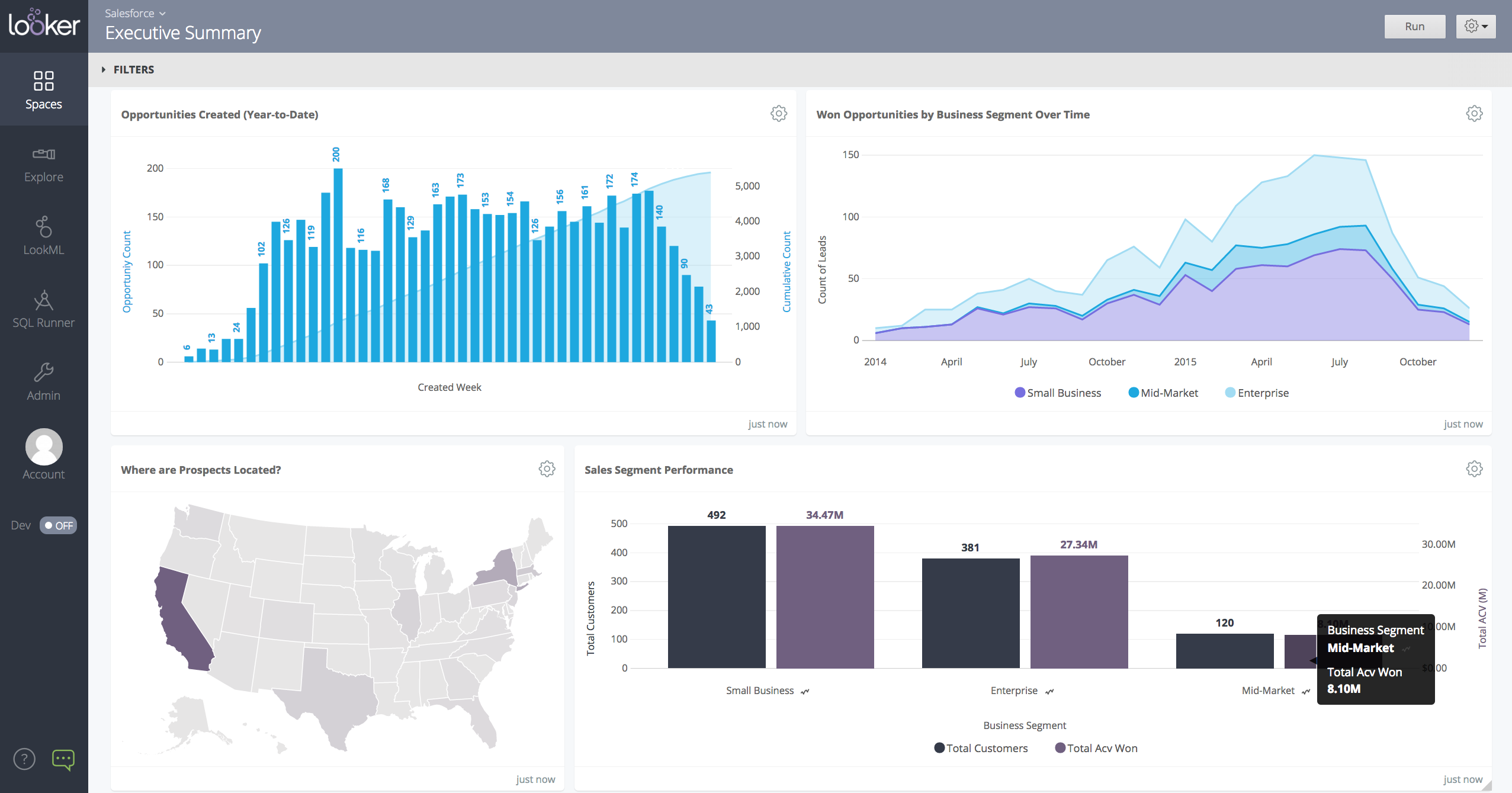
Looker is a BI application with an analytics-oriented application server that sits on top of relational data stores. It includes an end-user interface for exploring data, a reusable development paradigm for data discovery, and an API for supporting data in other systems.
N/A
Microsoft Power BI
Score 8.5 out of 10
N/A
Microsoft Power BI is a visualization and data discovery tool from Microsoft. It allows users to convert data into visuals and graphics, visually explore and analyze data, collaborate on interactive dashboards and reports, and scale across their organization with built-in governance and security.
$10
per month per user
Sisense
Score 7.5 out of 10
N/A
Sisense is a BI software and analytics platform. With what the vendor calls their In-Chip™ and Single Stack™ technologies, users have access to a comprehensive tool to analyze and visualize large, disparate data sets without IT resources.
The biggest advantage that Looker Studio has is that it's really easy to use and to distribute to other use. You can have a really complex report set up in a couple of minutes with an extract data source that enables Looker to update really fast.
Looker was the most customizable option for our business and cost wise made the most sense. They do have a free tier option that some of the other weren't offering to us at the time. Looker has a great- mobile app solution while Tableau is a desktop-based platform. Tableau also …
Looker is less complex to use and links directly to google suite which we use across the business and personally think is a better user experience than microsoft.
Looker stacks up well against other data providers for usability and friendly interfaces, plus the ability to customise. We actually integrate Looker with other analytics tools in the same sphere (power bi, Dreamdata and others) so that we can have one comprehensive dashboard …
Verified User
Director
Chose Looker
In my opinion, Looker is no Power BI. It is good, but I think Power BI is amazing. That said, in my experience, Power BI is nowhere near as easy to setup and report on Google services as Looker is. We plan to continue using Power BI for c-suite and corporate reporting, …
If you company is using Google suite products, Looker is a no-brainer. Tableau is probably the most flexibly but as a result it has the least governance capabilities. Power BI is kind of old-school in terms of how it feels to use it. I think in general, Looker brings a lot of …
Better in terms of data configuration with slight harder learning curve, available help material is not that much and we usually have to connect with Looker Help with chat for our data and analysis questions. While Looker offers a wide range of visualization options, there were …
Technically, Power BI is much more complete and powerful, but it's like an ocean liner. I didn't need all that equipment. In my case, I needed to move more quickly, like on a speedboat, to build a page with several data sources in a single source of truth that could be easily …
There are some specific use cases where other tools are not useful in our organization. Some software solutions are shared with other organizations inside the company and Looker is the only tool where we can collaborate good enough.
Looker works and exists in the Google ecosystem. If you are a Google Cloud Platform user, Looker is a no brainer. There is also Looker Studio, the small (free) brother with less features which is basically a report only viewer/creator. The reason we choose Looker is because can …
Looker is a great fit for our company because we have collaborative analytics workflows and complicated data ecosystems and because of its strengths in data modeling, integration, and collaboration. Brand name and peer recommendations also helps us to select Looker against …
Our organization is going all in on Google products so switching out of the Microsoft suite of tools is a no brainer. All the Google tools work incredibly well together and once you transition it’s incredibly hard to be half in half out between Google and Microsoft. If you’re a …
We haven't had a proper benchmarking done. We might consider looking at other options, but this thing is deeply integrated into our platform, so not anytime soon.
Actually, I use both power BI and Looker. Power BI has more data connectors and power query, one of the most important things that Looker does not have. You can customize the visuals in power bi in a higher level than Looker as well. Besides, Looker is much more advanced when …
Verified User
Strategist
Chose Looker
Looker is an off-the-shelf, free tool for Google business users. Other than the internal cost of time to build, we had no costs to set up what we needed to do. Knowledge sharing internally and using templates greatly reduced this cost, making the overall cost very low.
Legitimately, every other business solution is superior to Microsoft's product offerings. They are a business that doesn't listen to their customers because they know that they don't have to and that someone will always be a client. That being said, Looker does care about your …
Complexity: Microsoft Power BI is more powerful and complex, Looker Studio is simpler and easier to use. Data: Microsoft Power BI handles complex data modeling and diverse sources, Looker Studio is better for simpler data and Google ecosystem sources. Analytics: Microsoft Power …
I prefer Power BI because of its affordability and fewer complicated tools than Tableau. It's easy to use and compatible with other Microsoft products, which are mostly used in the IT industry. It's not limited to only one platform like Looker Studio, which is mostly used in …
After several years using Google Looker Studio and BigQuery, Microsoft Power BI is a step-up in terms of visualizations. It is also much more powerful, leading to less errors and has a more intuitive interface. Looker Studio has a focus on Google Analytics whereas Microsoft …
Some of the strengths are 1. User-Friendliness 2. Self-Service BI (Caters to all levels of the employees 3. Cost-effective. 4. Easy integration with Microsoft Suits. 5. DAX Calculations 6. Familiar Interface like traditional Excel. 7. Easier Self-Service platform for …
Microsoft Power BI excels against its competition in being a great combination between feature set and scalability. Tableau is more integrated with Salesforce but it has a high starting price point whereas Microsoft Power BI can start out with a single license for less than $20 …
Verified User
Director
Chose Microsoft Power BI
Microsoft PowerBI is easy to use, has leadership alignment, and is liked by everyone using it in the past and in the current setup. Thus, we decided to continue renewing Microsoft Power BI. We had also evaluated some competitors, but those platforms were not as easy to onboard. …
Overall Microsoft Power BI has more capabilities, it is more customizable and it also has it's own query language DAX which is really powerful for complex calculations and that's something you just don't get in their competitors, also when integrated with the other power apps, …
Due to microsoft user and all the data into excel it was found more feasible from the organization to get Microsoft Power BI. Also due to access of microsoft licence we don't need to survey other vendors and feasibility. Also price wise it was more competitive then Tableau.
I selected Power BI because it is the best in all because of its ecosystem and its ability to connect with multiple data source like Microsoft Excel, Microsoft SQL Server, web, analysis services etc. Moreover, its available on both Cloud and Desktop with some pro and cons …
Director, eCommerce Analytics and Digital Marketing
Chose Microsoft Power BI
Power BI from a price perspective is the lowest cost (probably even from a total cost of ownership perspective) of all the offerings I have ever evaluated. The piece that really stands out for Power BI is the data transformation layer called Power Query. This section allows you …
Microsoft Power BI is the leader of this category, but it is a little expensive. It could use some more customization features, but other than that, it gives stellar returns for your investment.
Cost-effective but has a lot of features to offer. The perfect tool to build reports and dashboards with a large amount of data and complex data modeling. End users do not require much knowledge to get used to the tool. Regular updates from Microsoft to add new features and has …
We selected Microsoft Power BI because it was the easiest to integrate with our primary systems, allowed us to embed reports for our partners, allowed us to host our data and some reports on premise. It also provided the shortest route to production deployment allowing us to …
Microsoft BI tool does a better job than most of the other software. The reason is excellent visualizations and its capability to connect with various other software and data sources. Tableau does a better job when it comes to tutorials and being more user-friendly. Also …
We selected Power BI because it had more flexibility in modelling/measurement definition, excellent per-user pricing, easy self-implementation, integration with our other Office 365 tools, and easy distribution of content to others in the organization.
Power BI performs quite well in comparison to it's competitor's products. We compared it mainly to GoodData and Tableau. Power BI has a great pricing. It's affordable and efficient with mid-sized datasets. Hence many companies go for it. Competitive products like Tableau are …
Senior Manager Business Intelligence Data Architect
Chose Sisense
Sisense allows you to export individual widgets as iframes. It provides cube and row level security and can manage lots of data without interfering with the data sources. Tableau data sources were harder to manage and version. The customer support team with Sisense was head and …
Verified User
C-Level Executive
Chose Sisense
Before purchasing Sisense and began recommending it as a solution to our clients, we tested four other BI visualization tools. All four of these ranked high on the Gartner Magic Quadrant. We researched Domo, Looker, MS Power BI and Tableau. Looker could be a better solution if …
Verified User
Director
Chose Sisense
As someone coming from more of an enterprise tool level Sisense seemed like a step down at first. Compared to other tools in the market or tools that it replaced (Looker), it provides far better data integrations and the ability to build their data cubes meant less reliance on …
Each tool has strengths, but Sisense stands out for its ease of use, scalability, and robust data integration. We chose Sisense for its balance of robust functionality and ease of use. We are happy that it can handle complex data integrations that aligned perfectly with our …
Sisense truly stacks up against Power BI, Domo or Tableau as one of the most accurate data analysis applications that offers an intuitive approach to data exploration. You can use its web-based interface to tap the expertise of your data analytics team. They can build and share …
Sisense does very well against most of the tools in the market. We chose this tool because of its great visualizations and easy to deploy procedures. The reports are very easy to generate and distribute them across departments and organization. It provides a great interface to …
I've used a few different analytical engines over the last few years and none have the efficient ability as both a data manager and a dashboarding tool - usually, other platforms excel in one area or another. To expand further, tools that succeed in data management and …
Sisense can't compare to any tool for the ease of user, intuitive interface and "time to data". I gave been working with both large enterprise and small SMB's using Sisense, and it is amazing to see how small companies quickly learn how to use it and how practical and efficient …
When data drives potential for new orders, Looker earns its place in our tech stack. If, on the other hand, we are hoping for pipeline generation, Looker is useful if you are willing to repeatedly go check customer utilizations .... it is not appropriate if you are hoping to automate data analysis for this purpose.
Has significantly improved collation of data and visualisation especially with business across Europe. Has given me the ability to see the Site availability at the click of a button to see which Site is in the "money" and seize opportunities based on Market data
I believe Sisense is perfectly suited for any organization of any size that have access to the proper resources, as the tool is very expensive. The data connectors come in all shapes and sizes out of the box, which allows a great deal of data control within the ElastiCubes. Additionally, while the platform only runs on Windows platforms, the web application can be accessed on any client: mobile, Apple, Windows, etc. This allows a much more flexible user experience, resulting in data and dashboards reaching further than any other tool.
Show visited pages - sessions, pageviews - which programs are viewed the most.
Displays session source/medium views to see where users are coming from.
It shows the video titles, URLs, and event counts so we can monitor the performance of our videos.
It gives a graphic face to the numbers, such as using bar charts, pie graphs, and other charts to show user trends or which channels are driving engagement.
Our clients like to see the top pages visited for a month.
I like the drop-and-drag approach, and building charts is a little easier than it was before.
Options for data source connections are immense. Not just which sources, but your options for *how* the data is brought in.
Constant updates (this is both good and bad at times).
User friendliness. I can get the data connections set up and draft some quick visuals, then release to the target audience and let them expand on it how they want to.
The usability of the application on mobile devices needs some improvement, especially navigation and filtering.
Dashboards that are created by multiple users can be a bit of a hassle to share by Admins.
If you need to embed dashboards into your website, you are require to buy a license separate from the user and platform license. This is a norm on most BI visualization tools, but Sisense can seem a bit on the high side, cost-wide.
I give it this rating because it deems as effective, I am able to complete majority of my tasks using this app. It is very helpful when analyzing the data provided and shown in the app and it's just overall a great app for Operational use, despite the small hiccups it has (live data).
Microsoft Power BI is an excellent and scalable tool. It has a learning curve, but once you get past that, the sky is the limit and you can build from the most simple to the most complex dashboards. I have built everything from simple reports with only a few data points to complex reports with many pages and advanced filtering.
I think the business and myself as a user has come to rely on SiSense as a dashboarding and quick ad-hoc reporting tool. I am hoping to integrate SiSense dashboards into more parts of the business in the future. We have reduced our report turn-around time for the most part from hours/days to minutes and in some cases almost the speed of thought. Reports are also easier on the eye and more easily distributed. I would also like to say that the support and professionalism from the SiSense team has been excellent.
Looker is relatively easy to use, even as it is set up. The customers for the front-end only have issues with the initial setup for looker ml creations. Other "looks" are relatively easy to set up, depending on the ETL and the data which is coming into Looker on a regular basis.
Automating reporting has reduced manual data processing by 50-70%, freeing up analysts for higher-value tasks. A finance team that previously spent 20+ hours per week on Excel-based reports now does it in minutes with Microsoft Power BI's automated Real-time dashboards have shortened decision cycles by 30-40%, enabling leadership to react quickly to sales trends, operational bottlenecks, and customer behavior.
New V5 is ground floor of an exciting collection of possibilities. Weekly Sisense developers come up with new functionality that they share with us in their forums. The move to HTML5 has been pleasing in that widgets auto size themselves into appropriate forms in the board but everyone of them can be popped out to full page size to be looked at in more detail
There are very few situations when there is unexpected downtime. Mostly during development, new dashboard implementation and during upgrades. other then that there were very few crashes.
Somehow resources heavy, both on server and client. I recommned at least 50Mbs data rate and high performance desktop comouter to be abke to run comolex tasks and configure larger amount of data. On the other hand, the client does not need to worry when viewing, the performance is usually ok
SiSense is usually performing better then other solutions even if going for complex reports/dashboards(of course within reasonable frames). I haven't noticed any bad influence on other systems, usually if something happens it stays within SiSense.
Never had to work with support for issues. Any questions we had, they would respond promptly and clearly. The one-time setup was easy, by reading documentation. If the feature is not supported, they will add a feature request. In this case, LDAP support was requested over OKTA. They are looking into it.
It is a fantastic tool, you can do almost everything related with data and reports, it is a perfect substitutive of Power Point and Excel with a high evolution and flexibility, and also it is very friendly and easy to share. I think all companies should have Power BI (or other BI tool) in their software package and if they are in the MS Suite, for sure Power BI should be the one due to all the benefits of the MS ecosystem.
SiSense's support ninjas are very knowledgeable and are exceptionally responsive. So far, all of the issues we ran into were resolved within minimum time. My sense of dealing with the support staff at SiSense is that they are very focused on not just answering your immediate question, but also to delve into the cause of the matter.
Easy and free training that allowed us quickly understand basics in SiSense and start using them. More advanced features requires some browsing through SiSense forums, but there is always support to help, and SiSense support is one of the best whith which I worked so far.
Many examples, videos and scenarios which you try on your own right away. This combined with in-person training gives you enough to utilize most of SiSense's power.
Looker Studio, you can easily report on data from various sources without programming. Looker Studio is available at no charge for creators and report viewers. Enterprise customers who upgrade to Looker Studio Pro will receive support and expanded administrative features, including team content management. So it's good.
Microsoft Power BI is free. If I didn't want to create a custom platform (i.e. my organization insisted on an existing platform that I *had* to use), I'd use Microsoft Power BI. For any start-up or SMB, I'd just use Claude & Grok to build it quickly, also for free. Would not pay for Tableau or Sigma anymore. Not worth it at all.
1) Easy to use, really, there is nothing too much to say. The set up is easy and not confusing. You can use it internally or externally.
2) Customer Service, having spoken to various product reps from similar industry. Sisense rep provides you with the best support to get started, and it is really appreciated.
Looker has a poignant impact on our business's ROI objectives. As an advertising exchange we have specific goals for daily requests and fill, and having premade Looks to monitor this is an integral piece of our operational capability
To facilitate an efficient monthly billing cycle in our organization, Looker is essential to track estimated revenue and impression delivery by publisher. Without the Looks we have set up, we would spend considerably more time and effort segmenting revenue by vertical.
Looker's unique value proposition is making analytical tools more digestible to people without conventional analytical experience. Other competing tools like Tableau require considerably more training and context to successfully use, and the ability to easily plot different visualizations is one of its greatest selling points.