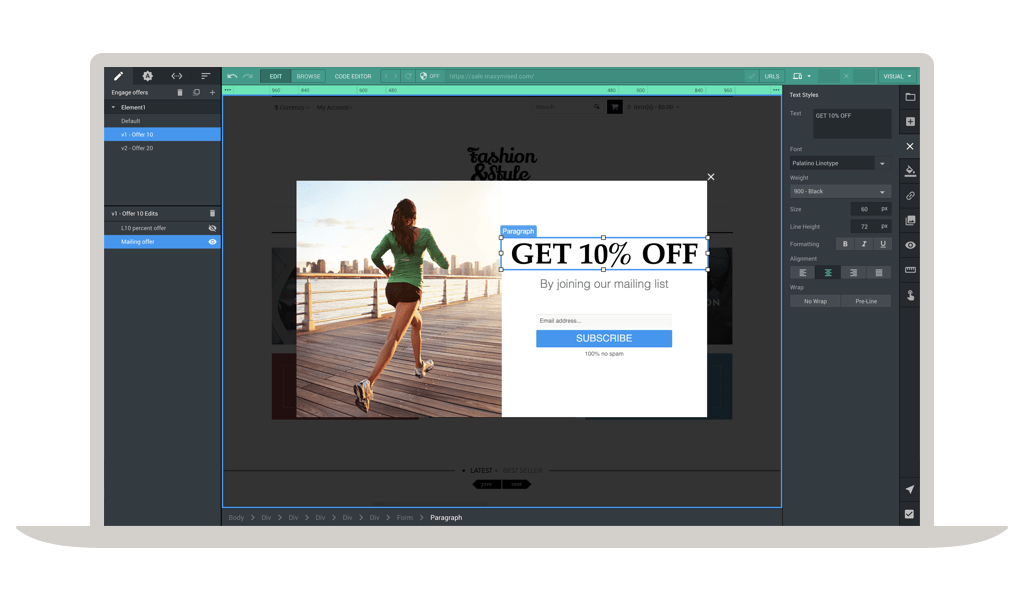
Adobe Test and Target is an A/B, multi-variate testing platform which Adobe acquired as part of the Omniture platform in 2009. It is now part of the Adobe Marketing Cloud. It offers tight integration with Adobe analytics and content management products.
N/A
Google Optimize
Score 6.7 out of 10
N/A
Google offers the Optimize A/B testing tool for testing website content and versions.
N/A
Oracle Marketing
Score 7.0 out of 10
N/A
Oracle CX Marketing (formerly Oracle Marketing Cloud) is a solution designed to enable marketers to plan and execute automated marketing campaigns via email, display search, video advertising, and mobile while delivering a personalized customer experience for their prospects.
$2,000
per month
Pricing
Adobe Target
Google Optimize
Oracle Marketing
Editions & Modules
No answers on this topic
Google Optimize
Free
No answers on this topic
Offerings
Pricing Offerings
Adobe Target
Google Optimize
Oracle Marketing
Free Trial
No
No
No
Free/Freemium Version
No
Yes
No
Premium Consulting/Integration Services
No
No
Yes
Entry-level Setup Fee
No setup fee
No setup fee
Optional
Additional Details
—
—
CX Marketing pricing is a function of usage.
More Pricing Information
Community Pulse
Adobe Target
Google Optimize
Oracle Marketing
Considered Multiple Products
Adobe Target
Verified User
Analyst
Chose Adobe Target
In my personal opinion, Optimizely is a clear choice here while Google Optimize is for the low-budget minded decision-makers and Evergage for the COE more geared toward personalization; however, in our case we were already locked into using Target prior to my arrival. I don't …
Adobe Target is extremely powerful and provides features Google Optimize does not, but Adobe Target is also more expensive and harder to use. Google Optimize could benefit by offering basic built-in reporting so it doesn't require Google Analytics events.
Google Optimize is a great entry-level test platform and is an ideal solution for my clients that want something simple to start with and see value. Although not as robust as the paid platforms, it still does the job well and delivers believable data ties to one of the most …
If you're using the Adobe stack and tools to power your website, Target is a great solution to implement. I've utilized Target within two organizations, one running on Adobe Experience Manager (AEM), and the other on Adobe Magento. I don't see how companies could harness the full capacity of Target without also having Adobe Analytics integrated. This is their 'secret sauce' and might not be a good solution for companies who are invested in Google Analytics 360. Integration was straightforward but did require support from the Adobe team to implement successfully. While Target is a great tool for digital teams to support, you'll need your tech team aligned and available to support implementation.
It is a little too limited for a full stack experimentation programme. Many times we required development support or tech advise but we were simply unable to get this due to it being google. This was a big problem for us. However it is quite good if you were looking to get started in experimentation and didn’t have the budgets for a wider tool
A duration of one and a half years is enough for us to recognize the capabilities of a tool and in my opinion, this one is just a great tool to manage marketing campaigns of even massive-sized firms. Its marketing automation tool and its way of managing campaign and the way it executes digital initiatives is enough to get an inkling of its abilities. Less favorable for the people who want to have something at a cheap price and are more dependent on the reports as its reports have nothing much in detail.
This application gives us an incredible integration with Adobe Analytics that allows its operation to be the best and determine the performance of our website.
It offers us an analysis based on user behavior and a web page customization option to adapt and meet the needs of those users.
Easy to follow set up procedures. Once I walk a client through the process, it's effortless for them to emulate on subsequent tests.
Lots of geo and user attribute customization features to be able to drill down into specific targeted audiences — all based on the power of Google's immense data system.
Google Optimize is the logical choice for many people to start with since most are already familiar with and using GA.
This is something a lot of testing tools struggle with, but I think the WYSIWYG ("What you see is what you get") editor - or Visual Experience Composer (VEC) in Adobe terminology - could definitely use some work. It's a struggle to execute many tests beyond simple copy, color, placement changes, and even the features that do exist are often clunky if not altogether broken.
The interface itself can be a bit counterintuitive in certain parts. If you are familiar with other tools, it's likely middle of the road in this respect; think much easier to understand than Monetate for instance, but a far cry from the simplicity of an Optimizely.
It can be a bit buggy from time to time. The worst example is the frequency at which the tool will fail to save due to an error, but not inform you of this until you try to save, at which point your only option is to log out, log back in, and make all of your updates once again. It can become an extreme pain point at times, and I personally have just gotten into the habit of saving every couple of minutes to avoid a massive loss of productivity.
Integration options outside of auto-syncs. I am currently having an issue trying to find an adapter to use with Eloqua to API into our data warehouse but keep the functionality on the Eloqua side.
To provide more transparency and visual details of the syncs (integrations of outside data) from any other system that is feeding Eloqua, like what is being updated or changed, better explanations of errors, drill down to newly created records.
Custom Objects - Need to have a way to create CDOs outside of just form submissions and uploading of lists, like if you needed to import a file nightly to feed that CDO data but automate the import and make sure it maps to a contact record.
Import of data from a file on SFTP - There is no way to filter or create logic to control what is being fed into Eloqua. Currently, that manipulation has to be done by the IT side first. Less flexibility.
Better auditing capabilities within the canvas. meaning, sometimes if something is changed or not working the problem may not necessarily show up in immediately, the pattern could take a while to present itself. For example, the feeders into the program. If there is a problem, I don't know that maybe contacts are not entering the program until we do reporting that month and realize there was a lull of contacts going through. Then we have a whole month of missed records or other potential data issues. When you get do large and your Eloqua machine is very robust, the harder it is to see everything
Be able to add more than 250 custom contact records. That definitely inhibits my organization in how we need to use that record.
We have a team of people trained on how to use the application and it integrates well with the other Adobe products we use. Our future roadmap of testing will require some complex scenarios which we hope Target will be able to accomplish
We have been able to automate so many marketing processes with Eloqua over the past 5 years that the only direction would be to adopt the latest and greatest features Eloqua adds. The alternative would be to go back to the marketing stone-age and start over again. And we would rather move forward with increased automation and efficiency.
The recent UI update is a complete mess. It is difficult to navigate and find features that previously existed. The reactiveness of the page depending on window size is also ridiculous and it is absurd that depending on how large your window is, entire columns of functions will disappear with no indication that they are missing. The usability of the tool has fallen off a cliff.
Personally, I find it quite easy to use. But for those members of our team who have little or no testing experience, it's been a bit more difficult. There's also training required for development teams in order to have your campaigns coded and set up in the most efficient way. Our developers have been able to do basic and intermediate tests with no difficulty, and they find the interface itself quite intuitive... it's just the extremely complex tests that require a bit more understanding.
There are occasional complaints about slowness to refresh a screen or build a report. However, this is as much a factor of network access speeds as the system itself, since often the complaints occur when someone is accessing on a wireless network.
On several occasions, we have had the need to ask for help from the Adobe Target support team, and I must say that they have provided us with an excellent experience, as they take care of solving the problems quickly and with high precision
We found that we often were telling support people how the system worked. Because we were on E9 that created a lot of support issues as well since few people on the support team seemed to know how E9 worked. That was mostly okay except when we had major system issues (like SSO preventing us from logging in after an update), it became really hard to get answers that weren't vague. It was always the issues that had the highest visibility within the organization (like with Sales) that seemed to take forever to resolve and didn't have a clear escalation path. When Oracle switched Eloqua over to the Oracle support portal it just got worse
The instructor that came to train us was awesome and this training was very useful. I would recommend it for anyone who is going to be using this software. I only mark it lower because it is an added expense to an already expensive product, and a lot of the training covered the "Target" portion of the software (which again, we didn't use)
They offer very basic classes which are required for master certification.
After having been through it, I would not consider anyone with a master certification any more qualified, unlike Salesforce.com certification which is a more difficult thing to acquire. For example, one of the classes towards certification was around social media. I would have expected examples of how to incorporate into campaigns in the product, with a demo and hands-on test. Instead, it was a powerpoint slideshow that went on way too long and covered really basic stuff like “what is Facebook, what is Twitter”
The training was very easy to understand, however it would have been more useful to my development team than me. It was also primarily over-the-phone, which is never as easy to follow as in-person. We ended up scheduling and paying for an in-person training session to supplement the online/phone training because it wasn't helpful enough.
Ok, so, this sounds like it could be horrible because it was all remote, but we loved it... the Adobe training environment was easy to use, and the trainers were engaging. It was simple to switch back and forth between the meeting and the hands-on exercises in their training instances. We took the fundamentals training early in our implementation-- before the consultants came onsite-- and I know this made a big difference in our implementation, because we were able to ask informed questions throughout
Implement using a global mBox on the page so you can change any and everything over the traditional method. Traditional method is good if you do not have technical web dev resources, do not know Javascript/jQuery, or you have money to blow on mBox calls. Global deployment reduces mBox calls and allows you to touch many parts of the page easily. A lot more customizable
I give it a 10 because the only issue we had was a result of not following the guidance we were given. Maxymiser provided a customized implementation guide for each site where we were adding the code. On our site implementations when we followed that guide to the letter, it was extremely fast and easy and has worked very well.
We seriously considered another software but because we use so many other Adobe products this made the most sense for us. If you are not dependent on other Adobe software and are a smaller company, in my opinion, Target may not be the best fit.
Google Optimize being part of the Google stack makes it great in reporting and analysis. Wish Google would add more features like dynamic tests, multi funnel tests, conversion calculator based on the total number of traffic of the page being tested instead of using the websites total traffic. Should integrate form analysis, heatmap, and page analytics.
It was quite complex to generate segments with Adobe analytics and I wasn’t personally satisfied with the overall performance of Adobe Analytics and wasn’t enough flexible in any way. So we decided to switch to something else better than Adobe Analytics and is available in the market at a cheap rate and we ended up doing our research for the most suitable tool at Oracle Infinity and we don’t regret our decision.
Eloqua is definitely good for larger companies that have 100,000+ contacts and complex marketing workflows and data. Personalization is fairly robust with Eloqua for larger campaigns with smart content and features. Scaling across channels is also seamless - as the platform has great options for non-email channels like SMS, Direct Mail, Chat, etc.
We have been able to run specific A/B tests that have shown an increase in conversion, which in turn has led to very large banked sales numbers for the year.
We have been able to prove that using and automated Merchandising process did not decrease conversion. This allowed us to greatly increase efficiency by opening up resource time.
We are able to use it to help our clients scale through testing
We have been able to measure the impact of our events and sales events so we can determine which events to continue in the future and determine future investment
Launch a new brand out of Eloqua and measure awareness