
Nancy Ryerson
Marketing Officer
Chose Domo
It's easier to use and much more robust than analytics tracking through individuals platforms, like Google Analytics.

| Product | Rating | Most Used By | Product Summary | Starting Price |
|---|---|---|---|---|
 Domo | N/A | Domo is a full self-service business intelligence software that combines several data analysis and reporting tools into one platform. It helps users connect to multiple data sources, create robust visual reports, manage their data, send messages in real-time, manage projects, and develop new apps. | N/A | |
 Google Analytics | N/A | Google Analytics is perhaps the best-known web analytics product and, as a free product, it has massive adoption. Although it lacks some enterprise-level features compared to its competitors in the space, the launch of the paid Google Analytics Premium edition seems likely to close the gap. | $0 per month | |
 Looker | N/A | Looker is a BI application with an analytics-oriented application server that sits on top of relational data stores. It includes an end-user interface for exploring data, a reusable development paradigm for data discovery, and an API for supporting data in other systems. | N/A |
| Domo | Google Analytics | Looker | ||||||||||||||||||||||
|---|---|---|---|---|---|---|---|---|---|---|---|---|---|---|---|---|---|---|---|---|---|---|---|---|
| Editions & Modules | No answers on this topic |
| No answers on this topic | |||||||||||||||||||||
| Offerings |
| |||||||||||||||||||||||
| Entry-level Setup Fee | No setup fee | No setup fee | Required | |||||||||||||||||||||
| Additional Details | — | — | Must contact sales team for pricing. | |||||||||||||||||||||
| More Pricing Information | ||||||||||||||||||||||||
| Domo | Google Analytics | Looker | |
|---|---|---|---|
| Considered Multiple Products | Domo Nancy Ryerson Marketing Officer Chose Domo It's easier to use and much more robust than analytics tracking through individuals platforms, like Google Analytics.  Kyle Tucker Business Operations Engineer - Marketing Chose Domo Domo is by far the industry leader. Other tools/platforms have unique strengths, but from an overall perspective, Domo is the most versatile and does an exceptional job in all areas. This is critical when it comes to "scale". A BI project may start with a siloed scope, but as …  Ainun Najib Head of Data Chose Domo Domo is the only one truly all-in-one platform. For example, at the time of assessment (mid-end 2016), Tableau didn't have alert feature off the shelf, Domo is the only one with powerful mobile apps, no other even come close. Domo not only has alert feature but it's also …  Brandon Adawi Intern Chose Domo Domo is a superior product to the other analytic software that I have used because it is so much cleaner visually. It has a better user interface and the data displayed is more clear to understand. For other software I remember there being a steeper learning curve than for Domo.  Trevor Schrotz, MBA Vice President of Analytics & Technology Chose Domo DOMO was a more well-rounded product. The other products we looked at filled specific needs. DOMO was flexible enough to meet largely any data representation need. |  Google Analytics  Maria Sergeeva UX and Content Designer Chose Google Analytics Wix and other website platforms have a built-in analytic tool, but it is not as sufficient as Google Analytics, so I always use GA as the main source of information about sales. Most of the analytic tools on web platforms can't visualize user flows, which is very important when …  sandro merkvilishvili Head of e-commerce deparment Chose Google Analytics Ease of use: Google Analytics is known for its user-friendly interface and straightforward setup process, making it accessible for beginners. Adobe Analytics has a steeper learning curve and requires more technical expertise. Features: Adobe Analytics offers a more comprehensive …  Jonghee Jo Manager, Dealer Website Analytics Chose Google Analytics Google Analytics is free and easy to implement, so we use Google Analytics in smaller projects that have a limited analytics budget. However, Google Analytics has a relatively limited analytics capacity compared to Adobe Analytics so it is not being used for large-scale … |  Looker  Gleb Mezhanskiy Product Manager, Analytics Chose Looker Mode & Chartio require user to write SQL. Looker – Looker has very powerful data modeling layer – LookML that allows data engineers to abstract end users away from the complexity of underlying data (and SQL). End users can perform analysis by selecting dimensions, measures, …  Lee L Kennedy Senior Marketing Data Analyst Chose Looker Tableau did not have the customization that we were told it had, and it was expensive. Domo looks promising, but is also expensive so we haven't purchased it (we may in the future). Google Sheets was very basic and did fine for what it was, but we needed something a bit more …  John Beadle Director of Product Management Chose Looker Tableau provides additional visual functionality and is great for more in-depth visuals or further data exploration, but it is costly and an extremely robust solution for simple data reporting. Looker can't be beat when it comes to integrating with other G-Suite tools. All in …  Francois Salvert Web Analytics and Dashboarding Chose Looker Free, simpler...less enterprise grade level  Thomas Holland Senior Manager of Digital Paid Marketing Chose Looker Looker Studio is not as robust as Tableau or Microsoft BI. So it does not provide quite as much insight or depth and it has more limitations overall then the other major reporting products. However, it is also free and connects perfectly with other Google products. Plus, all of …  Missy Geyer Media Director Chose Looker Looker is a free tool to use on the basic level, which can't really compare apples to apples since all of the other services are paid services. Looker already has a leg up because of that. The other platforms definitely have more features and capabilities off the bat because it …  Dustin Hovey Sr. SEM Manager, Twilio SendGrid Chose Looker Looker is easier to use and look at compared to many of its peers.  Mohammed Anzil Founder and Chief Editor Chose Looker I think working on Looker could be hard, but in performance, it can easily overtake Wave and Zoho Reports. The flexibility of the system and it being super fast makes Looker a standalone from other similar software.  Tom Hosford Product Manager, Data & Analytics Chose Looker Tableau- Not web based which makes it more difficult to use and share templates etc. Seems more dated. ChartIO - Looker's LookML layer that predefined joins was appealing to us vs a tool like ChartIO which requires more raw SQL comprehension.  Michael Shostack Head of Online Advertising Chose Looker I considered Looker along with RJ Metrics and Domo. The other platforms seemed to be offering much more of a service-focused offering, with fees that would likely scale quite high without certainty. Looker is focused on more of a product-driven approach and would be a good fit …  Jim O'Sullivan Director of Data Services Chose Looker I think Looker is easier to use than Business Objects, Domo, Pentaho and Tableau. Tableau offers better visualizations than Looker but the overall package in Looker is better. |
| Domo | Google Analytics | Looker | |||||||||||||||||||||||||||||||||||
|---|---|---|---|---|---|---|---|---|---|---|---|---|---|---|---|---|---|---|---|---|---|---|---|---|---|---|---|---|---|---|---|---|---|---|---|---|---|
| BI Standard Reporting |
| ||||||||||||||||||||||||||||||||||||
| Ad-hoc Reporting |
| ||||||||||||||||||||||||||||||||||||
| Report Output and Scheduling |
| ||||||||||||||||||||||||||||||||||||
| Data Discovery and Visualization |
| ||||||||||||||||||||||||||||||||||||
| Access Control and Security |
| ||||||||||||||||||||||||||||||||||||
| Mobile Capabilities |
| ||||||||||||||||||||||||||||||||||||
| Application Program Interfaces (APIs) / Embedding |
| ||||||||||||||||||||||||||||||||||||
| Web Analytics |
|
| Domo | Google Analytics | Looker | |
|---|---|---|---|
| Small Businesses |  Yellowfin Score 8.7 out of 10 |  StatCounter Score 9.0 out of 10 | Yellowfin Score 8.7 out of 10 |
| Medium-sized Companies |  Reveal Score 10.0 out of 10 |  Siteimprove Score 9.0 out of 10 | Reveal Score 10.0 out of 10 |
| Enterprises |  Kyvos Semantic Layer Score 9.5 out of 10 |  Optimal Score 9.1 out of 10 | Kyvos Semantic Layer Score 9.5 out of 10 |
| All Alternatives | View all alternatives | View all alternatives | View all alternatives |
| Domo | Google Analytics | Looker | |
|---|---|---|---|
| Likelihood to Recommend | 10.0 (75 ratings) | 8.6 (193 ratings) | 8.3 (132 ratings) |
| Likelihood to Renew | 8.0 (2 ratings) | 9.0 (51 ratings) | 9.3 (8 ratings) |
| Usability | 9.5 (36 ratings) | 7.4 (19 ratings) | 8.8 (12 ratings) |
| Availability | - (0 ratings) | 10.0 (4 ratings) | 10.0 (1 ratings) |
| Performance | - (0 ratings) | 10.0 (2 ratings) | 6.0 (1 ratings) |
| Support Rating | 9.2 (14 ratings) | 7.0 (42 ratings) | 8.8 (14 ratings) |
| Online Training | - (0 ratings) | 10.0 (2 ratings) | - (0 ratings) |
| Implementation Rating | 9.1 (21 ratings) | 9.0 (7 ratings) | 10.0 (1 ratings) |
| Configurability | - (0 ratings) | 6.0 (2 ratings) | 10.0 (1 ratings) |
| Contract Terms and Pricing Model | - (0 ratings) | - (0 ratings) | 10.0 (1 ratings) |
| Ease of integration | - (0 ratings) | 10.0 (1 ratings) | 10.0 (1 ratings) |
| Product Scalability | - (0 ratings) | 10.0 (2 ratings) | 10.0 (1 ratings) |
| Professional Services | - (0 ratings) | - (0 ratings) | 10.0 (1 ratings) |
| Vendor post-sale | - (0 ratings) | 10.0 (1 ratings) | 10.0 (1 ratings) |
| Vendor pre-sale | 7.5 (6 ratings) | 9.0 (1 ratings) | 10.0 (1 ratings) |
| Domo | Google Analytics | Looker | |
|---|---|---|---|
| Likelihood to Recommend | Domo
 Nastassja Rodriguez CRM Data Lead | Google
sandro merkvilishvili Head of e-commerce deparment | Google
 Daniel Dammerman Regional Sales Director |
| Pros | Domo
Kyle Tucker Business Operations Engineer - Marketing | Google
| Google
|
| Cons | Domo
 David Hills ★ Hubspot Specialist & Analyst | Google
| Google
|
| Likelihood to Renew | Domo
 John Orate Sr. Manager | Google
| Google
|
| Usability | Domo
 Lara Dunwell Director: Global Institute | Google
 Victor Campos Web Developer | Google
|
| Reliability and Availability | Domo No answers on this topic | Google
| Google
 David Mynář Head Of Online Marketing |
| Performance | Domo No answers on this topic | Google
| Google
David Mynář Head Of Online Marketing |
| Support Rating | Domo
| Google
 Sarah Hoffman Media Director | Google
 Anson Abraham Data Lord |
| Online Training | Domo No answers on this topic | Google
 Roy Morejon President | Google No answers on this topic |
| Implementation Rating | Domo
Jonghee Jo Manager, Dealer Website Analytics | Google
 Joshua Van Horsen Marketing Manager | Google
David Mynář Head Of Online Marketing |
| Alternatives Considered | Domo
| Google
| Google
|
| Contract Terms and Pricing Model | Domo No answers on this topic | Google No answers on this topic | Google
David Mynář Head Of Online Marketing |
| Scalability | Domo No answers on this topic | Google
| Google No answers on this topic |
| Return on Investment | Domo
| Google
 Heide Rembold Director of Marketing & Analytics | Google
|
| ScreenShots | Domo Screenshots  | Looker Screenshots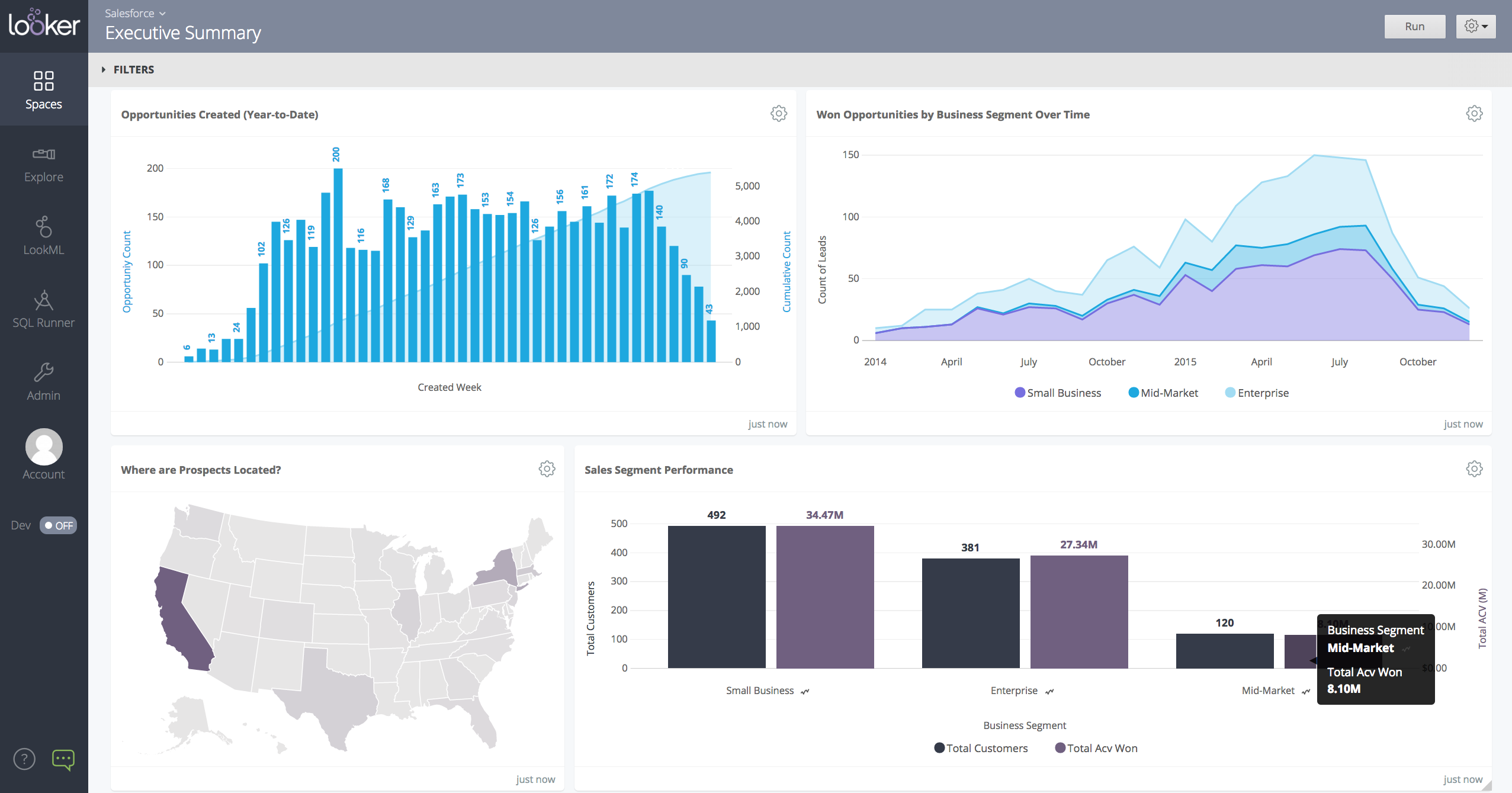 |