Microsoft 365 (formerly Office 365) is a Microsoft Cloud subscription service that includes Microsoft Office products (Word, Excel, PowerPoint, OneNote, Outlook, Publisher, and Access). The software can be installed across multiple devices and ensures that users always have the most up-to-date version of the included Office applications.
$5
Per User Per Month
SharePoint
Score 7.7 out of 10
N/A
Microsoft's SharePoint is an Intranet solution that enables users to share and manage content, knowledge, and applications to empower teamwork, quickly find information, and collaborate across the organization.
$5
Per User Per Month
monday.com
Score 8.3 out of 10
Mid-Size Companies (51-1,000 employees)
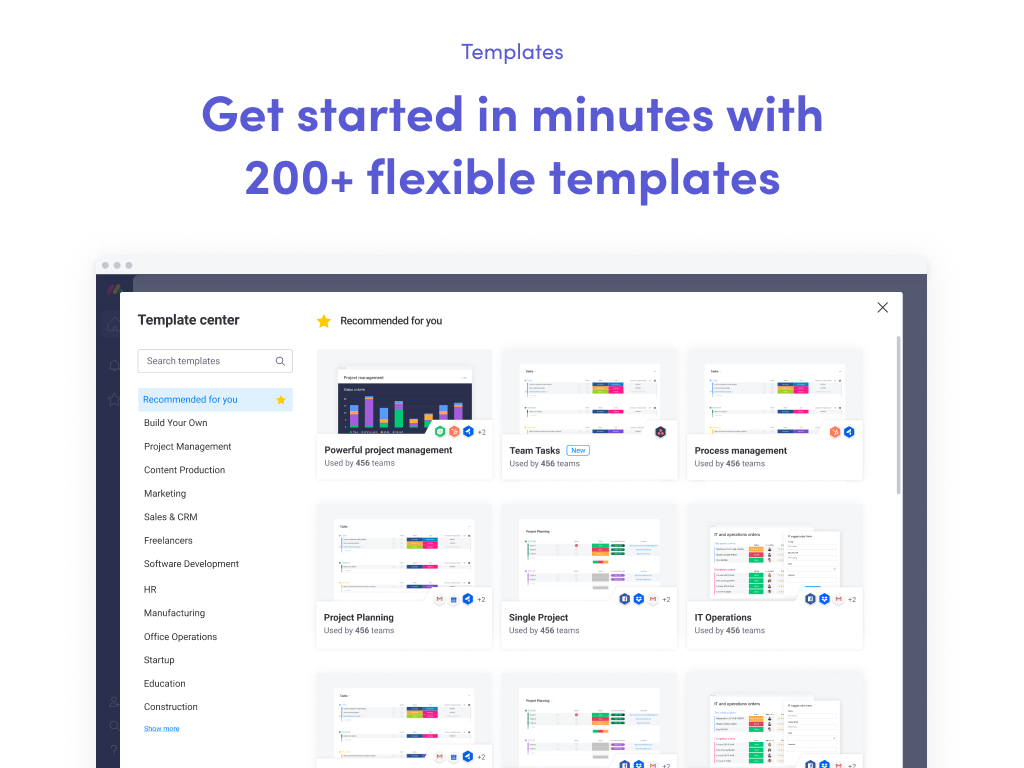
monday.com Work OS is an open platform designed so that anyone can create the tools they need to run all aspects of their work. It includes ready-made templates or the ability to customize any work solution ranging from sales pipelines to marketing campaigns, CRMs, and project tracking.
BTE, this search bar is not the best; I couldn't find Google Suite. In any case, it's challenging to find a suite with advanced tools that serves as an office. Google comes close, no one uses OpenOffice (hyperbole), and there isn't much else to use. If you add to that the …
Microsoft Office 365 is definitely the industry leader when it comes to having a suite of basic tools to create, collaborate and share within and outside of your organization. It’s also very valuable since so many other companies use it as the skills for employees are …
It's still a Microsoft product, but the Online model is far superior to the on-prem offerings. Especially with Microsoft focusing on their online platform over their on-prem servers. Migration from these on-prem services is fairly simple and Microsoft has done a great job to …
The only other software I have used similar to Office 365 is G Suite (Google docs, sheets, hangouts, etc.). Hangouts is buggy and does not compare to Teams at all. Teams is superior. The other apps are comparable, but there are no native applications to install and if they are …
365 was already selected when I was hired into my Company and I just have a couple years working with this Tool, but it is flexible to set up and use based on your own needs and it is a terrific tool when you can't get to your normal Company email solution.
We used other cloud e-mail provider but then we have to pay separately for office documents like Word, Excel, PPT, and Project. We compared the ROI and features and hence we selected Office 365.
Having all of the offerings and services in one easy to use administrative interface makes administration of our Microsoft suite of applications much easier. We are not able to get that same integration with separated applications. Gmail is not very intuitive if you're coming …
I like Microsoft SharePoint over Google Drive for its organization. I believe that Microsoft SharePoint keeps things much more organized than Google Drive. Also, typically when you purchase Microsoft SharePoint, you get the rest of the Microsoft Suite. However, Google Drive has …
Verified User
Engineer
Chose Microsoft SharePoint
One drive I think is more for personal use as a cloud storage. SharePoint can be more of use in businesses where teams can easily collaborate in various documents and files. This can also automate other processes to make it easier for the business in their day to day work tasks.
There is no competitor to SharePoint for an organization our size. The integration into our development environment, active directory, and other office tools just can't be matched (specifically from a contractual agreement and holistic perspective with ALL of our toolsets). Micr…
I have only used Google Drive for personal reasons, not at work. SharePoint has a larger corporation safer feel to it as it uses the comfort of MS Office products for users.
Being integrated into Office 365 and included with your subscription, there are no added costs associated with setting up SharePoint. Also being able to sync one drive and being able to open files SharePoint files via file explorer is a great added benefit.
We found that Google Docs was basically much more user-friendly that MS SharePoint, but was much more consumer-focused (which was a good thing from a usability point of view). However, its features were not robust enough for full business implementation. We all use Outlook and …
I've looked at JIRA and Confluence and found that SharePoint was superior in user familiarity, since our users already knew what SharePoint did using a previous version, and also better for future-proofing since we were also interested in migrating to Office 365 eventually. We …
I personally haven't seen anything else that compares to SharePoint. There are other tools out there that do a small portion of what SharePoint does, and in some cases, it still makes sense to use some of those, if the requirements are there. For example, the Task list in …
Box has functioned very similar to Microsoft Share Point, however, the integration that SharePoint has with the rest of the cloud and on-premise applications that the company has, makes the solution more robust and allows us to make more developments based on the flow of …
Google Docs: Not enterprise ready, but great at multi user edits. Subsites and integration not native. Use of service accounts not a strong suit. Not audit friendly
Slack: Discontinued due to security features and lack of AD integration (At the time)
The decision of selecting MS Sharepoint was relatively easy, as we have all our servers and applications in Microsoft Environments. So, by selecting SharePoint, we didn't have to worry about compatibility issues. Also, the majority of our partners are Microsoft Gold Certified, …
Corporate Development and Strategic Product Management
Chose Microsoft SharePoint
In terms of user experience and usability, other apps have done a better job proving an intuitive workflow and behaviors that just work. In contrast, SharePoint's use cases (in particular sharing with non-Microsoft users) result a bit more confusing sequence of events.
My Company had already selected and had been using SP prior to my hiring in, so I can't speak to why it was selected. But, I can tell you from past work experience, nothing comes close as a collaboration tool. There are many "copycat" software packages out there but none can …
SharePoint was already in place when I came into my current role. We've reevaluated a couple of times and it works well given our current team, each person's technical "knowledge" (such as it is), and processes.
Ultimately we are an agency that makes everyday use of the Microsoft Office Suite, Exchange Servers and O365 Email Services, so it only made sense to go with MS SharePoint based on its great integrations with these other systems. It fills a much-needed gap in the agency, …
monday.com offer much of the standard tools and seems to be ever evolving. They seem to take feedback and constantly upgrade the tools. If all the tools are there, the differentiating factor might be the cost, any integrations you may need, and the visual "chemistry". To me, …
monday.com seems to solve the issues and concerns for our marketing and graphics needs. I personally use Asana for my projects and tracking purposes and monday.com for my interations with Marketing and their needs.
monday.com has the only interface that is 100% customizable, can use public and private boards, can be shared with customers, produce Gantt charts, and has THE MOST integrations "in house". The professional relationships that monday.com has established to be "on board" with …
The easy of use and configuration is where monday.com has had an advantage. The ability for all our users to startup on the platform has helped to incorporate it into our enterprise environment quickly.
monday.com is simpler and easier to grasp, apply and navigate than ClickUp, but the ClickUp free version has so much more functionality available than the monday.com free / low-cost options (sorry, but it's true!). Google Tasks is really simple and I shouldn't really compare …
I'd put monday.com and Asana on par, then ClickUp and lastly Jira. Jira would be more appropriate for exclusively technology engineering teams. Jotform offers better choices for forms use cases especially ones with complexity. Zoho makes more sense when you have the full suite, …
I do think that monday.com can be utilized as a service desk or DevOps board, but that service-specific software such as ServiceNow or MS Azure DevOps is better suited for those for medium and large-sized companies.
Monday is much easier to use and learn. So far everyone has figured it out just by using it or after watching a brief training video. Most other tools have parts that we wouldn't use or be just too complicated for the average user. We feel with Mondayulse we are not struggling …
We've been using Microsoft SharePoint as a way to manage and track or projects. With that said, we were able to lock down certain people from seeing different parts of the project that does not pertain to them. Monday.com did some of this, but as a company, we were all more …
We considered a few other options, including the Sharepoint Workflow tool and Basecamp. Both of these options were vastly more expensive or extremely complicated and cumbersome. Monday.com was purchased and set up within a day for what we needed. You really can't ask for …
Monday.com is far more easy to learn then MS Project and eliminates the need to install applications and maintain applications. One of the key benefits is being able to access Monday.com from anywhere in the world.
I've used Basecamp, Central Desktop & SharePoint in the past. And they're fine. But this had a nicer user-interface and a free trial period to let me use it and determine if it could be useable by the team.
monday.com is much more versatile than Microsoft Teams. When it comes to getting work done, Teams couldn't stand a chance. Trello was our former tool and it just couldn't keep up with what we needed, especially when it came to having a clear picture of all projects.
In the past we have used Harvest as an organizational tool, while we still use it for budgeting, Dapulse is a much more user-friendly interface for organization.
Microsoft 365 would be well suited for medium to large enterprises. This is where there are several hundreds or thousands of people. Since most everyone has used one of the applications the learning curve would be reduced. Another reason would be the ability to implement security measures to prevent access to sensitive data. This could justify the cost of an Enterprise license.
SharePoint Document Management excels as a central repository for storing, organising, and retrieving documents. It supports version control, metadata tagging, secure access, and integration with tools like Power Automate. At our organisation, it's used for managing contracts, policies, and supplier documents. SharePoint Workflow Automation integrates with Power Automate to streamline approvals, gather feedback, and automate recurring tasks. This reduces reliance on email chains and manual trackers.
The platform has a good deal of versatility and extensibility, but I do not feel it is well suited for anything too complex. More complexity seems to bog down performance and increase maintenance to keep everything humming. As much as possible, avoid creating too many bespoke workarounds that will end up creating tech debt. The platform seems to work best for more straightforward scenarios and smaller to mid-size companies. Pricing can be reasonable for specific teams, but can feel a little too pricey for company-wide usage. It has served us well for the early stages of our company, but we find ourselves offloading the more complex use cases to other apps specifically developed for those, and reducing to just those teams that are more deeply embedded in the functionality.
I like summary of subitems, especially with subitasks as subitems and add item tracking for each subtask it can show total tracked in parent item. Similar with other columns, like numbers, status, date.
Dashboard features, Many kinds of dashboard view available, we can utilize on the basis of requirements.
monday.com workform is very powerful, easily share form link when submitted it will create line item in board with provided data.
monday.com automation is very helpful in order to automate steps with specific rules and easy setup.
monday.com also provides integrations in order to automate processes if need to integrate multiple app together. or need to transfer data between multiple apps.
Windows Explorer users have some difficulty having to constantly UPLOAD / DOWNLOAD files. Specifically on the DOWNLOAD when they are used to Drag & Drop in & out of LOCAL folders via Window's explorer.
Microsoft SharePoint supports multiple "library" types. When implementing our "image" library the search function is done via "tags" and boolean logic. This is challenging to most end users. I'd like our users to be able to search our Microsoft SharePoint image library without having to enter KEYWORD or other BOOLEAN logic.
Microsoft SharePoint can also be an internal website for each department or company wide communication tool but I believe these features are geared for much larger organizations. Since we are a SMB we really aren't using these features. So maybe something more useful to SMBs would be nice.
I would like to see our company logo show up larger on the form feature.
I prefer the version of the form they have now instead of the new version for 2025. The current form shows the questions in bold font, and the new version does not. This may mean it could take our volunteers longer to get to the pertinent information on the form.
It would be nice if monday.com staff had monthly webinars showing how to use some features. such as, using formulas effectively.
So far the Microsoft 365 platform provides features and tools that can cater to 100% of present organizations needs considering both technical and business necessities, however most features are not been effectively utilised at present. The current featureset is able to cover for most of the future needs of the business and technical functions.
It's integral to our business. It's already included with most of the Office 365 licensing we buy, so the cost is effectively zero. It stores our files, it is the foundation for custom applications, and Microsoft only continues to enhance its functionality and its connections to other Microsoft tools. SharePoint just keeps getting better and better.
Teams involved in content creation, such as marketing or editorial teams, could use monday.com to manage the entire content lifecycle. Boards might track content ideas, assignments, drafts, reviews, approvals, and publication schedules, helping teams collaborate and keep content production on track.
Microsoft 365 is the gold standard for performing project tasks in a professional environment, enabling the quick transfer and exchange of files and ideas for team members who work locally and remotely. Its suite of tools is familiar and has evolved to being cloud based, allowing for files to be updated in real time from near and far.
No usability issues reported. Individual teams also have allocated areas which replace legacy shared drives on local LANs. Access to Sharepoint resources is fully integrated with corporate Active Directory with additional two-factor authentication required for administrative users. Users have access to Microsoft Services Hub which allows you to create, manage, and track support requests while staying current on Microsoft technologies with access to select self-paced learning paths
I give monday.com a 10/10 because I almost never encounter any lag or connectivity issues despite all of the many templates, boards, and automations we have. As a matter of fact, I feel like the last issue I encountered was over a year ago... and I'm in monday.com every single work day. Not only is monday trustworthy, it is easy to find what I'm looking for... making the overall usability extremely hard to beat.
To-date Microsoft 365 platform has offered an amazing uptime and availability percentage per year compared to all other products which provide the stability and overall business resilience of their ecosystem which is a great relief for information technology service entitites which heavy rely on Microsoft offerings as a whole to redeliver their own custom products
The Microsoft 365 tools expects and demands a substantial amount of system resources to operate at optimal level and even more when integrated with other applications which is a downside, however given that external supporting tech factors such as fibre/broadband speed bandwidth, high speed RAM and ample storage resources are allocated the tools work error free providing robust communication
Everything performs fairly well. Every now and then there are user errors where an employee will not click "ok" on a note they've created and simply exit out (I do wish that something was in place to prevent this, such as a pop "are you finished?")
Over the past 8 years of using Microsoft 365, I have noticed that they change vendors often. This always leads to a poor experience in the beginning, then levels out after some time for the company to get things worked out. As a customer, it is really frustrating because I don't have time when something isn't working to have them "look into my issue" and get back with me. They have even closed a ticket I specifically told them to keep open. Your applications are only as good as the support.
monday.com only really care about accounts that have 20 seats or more. While this is great for monday.com, it pushes smaller organisations to evaluate alternatives. We rate monday.com highly in our organisation because key staff have already got good experience with the application and we know we will get to 20+ seats one day. But, till then the billing model and lack of permanent enterprise features is a dread.
The resellers involved with selling Microsoft products are reluctant to provide in person specialist trainings to consumers due to the fact of costs of economies of scale and is not provided free of charge most of the time. In Person trainings needs to be agreed to at the initiation of projects and implementations for better ROI.
The face to face training I received was on SharePoint Administration. It was rushed as there was a lot of information to cover and the application of the labs weren't that great either. I like to be able to relate what I am learning to what I am currently doing.
The standard training offered with 3rd part resellers are fairly standard and covers the basic workability however the trainings needs to be specifically customised according to unique requirements of the organizations. for example an MSP would need to master specific communications verticals within Microsoft 365 whereas and online store using Microsoft 365 would needs to master a different set of tools within the suite to get the best ROI post implementation.
I like to learn at my own pace and online training allows for that. Additionally, you can skip through pieces of content that you already know or are already comfortable with. Microsoft actually offers great videos on their website for basic fundamental SharePoint Training. I have used these training videos in some of my own training sessions with end users.
To have someone walk you thru the features and capabilities of Monday.com is priceless. Someone also coming along later in the contract to see if you are maximizing the program to suit your company needs is beyond helpful. The staff that have provided this training are fun, creative and very patient.
The Microsoft support partners are more than capable of handling implementations and dealing with unprecedented errors during the implementations. Not part of the implementation though the setup was done with minimum misconfigurations which is evident with present live setup which works fine without any bugs and gaps at present context.
We signed up for the accounts. Created the accounts. Ran the trial version and tested it live while we were running multiple projects and found that it was fitting our needs perfectly. When the trial ended and we were asked to purchase the full version, we did. We have found other ways to use it and it's a breeze.
Typically I prefer working with companies with Microsoft 365 as their main tool because they're usually a fast growing company with a global presence. I like using it for work because it's easy to collaborate, share, review, comment, reply in any of the tools. The mobile app for Outlook and Teams are lifesavers when we're constantly traveling and you can join meetings on the mobile Teams to never miss a beat.
The reasons for selecting MS SharePoint are: SharePoint provides ease of use and web design assistance and support SharePoint helps you schedule your content for publishing. enables users to share documents with external parties and offers a better internal structure of the content and better indexing and searching capabilities.
monday.com is cleaner, offers more customization and is easier to design out with a team project focus in mind. With the ability to automate steps as well, it is super easy to move tasks along, have stages auto-update and to go through my personal to-do list of tasks to get things done.
Microsoft pricing is not very expensive and yet not very cheap as well, and it hovers in between the baseline. The charges are mostly based on the tier level partners who charge based on their individual reputation in the market. Power negotiation will lead to cost effective and attractive pricing
Multiple tools within the same platform have been deployed successfully within different functional technical and non technical teams such as Devops, SOC, NOC, Shared services, Managed services, Global Information technology, Cloud operations, Finance, Administration, human resources and all these teams collaborate while maintaining central uniformity in terms of global standards who are dispersed in different geographical locations with ease
For it to work across multiple departments and sites, I would like to see improvements made with integrations and automation. For this question, I am acknowledging not only the addition of internal triggers/automation, but also an expansion on external ones.
Have not directly obtained professional services from Microsoft but rather obtained specialized services such as implementations and configurations, setting up and integration support with Microsoft authorized suppliers, 3rd parties, and resellers, which has been a pleasant experience. Again the level of delivery quality on professional services is based on the level of hands on exposure of the 3rd party
We have a lot of nonprofit users, so they have a good ROI.
I like the constant updates without having to purchase the software repeatedly.
I used to purchase each Office (insert year here) often, so the software was up to date and had the newest options and connectors. I think my return on investment would have been much better if Microsoft had updated those versions to keep them current; after all, we did pay for them.
Microsoft 365's offering a monthly fee or a discount for a year helps, and you can look at it as a free backup if you have everything set to back up to One Drive. (Cloud-based document filing you can access anywhere ( with an internet connection)—you Can't beat that!)
Much easier to review my prior month and report to clients on work completed; easy to extract the information and work done to Excel to add budget tracking etc - I see this is possible in monday.com and I will investigate how/if this is possible on our current plan.
Very fast and easy set-up of Boards.
Still lots to learn and grasp - many more opportunities to become more efficient using monday.com. I'm only just getting started.
The initial automations are quick and easy to set up, and if set up correctly.
My month-end client status and progress reports are now more accurate, and I can keep track of all the information in one place (inside monday.com).