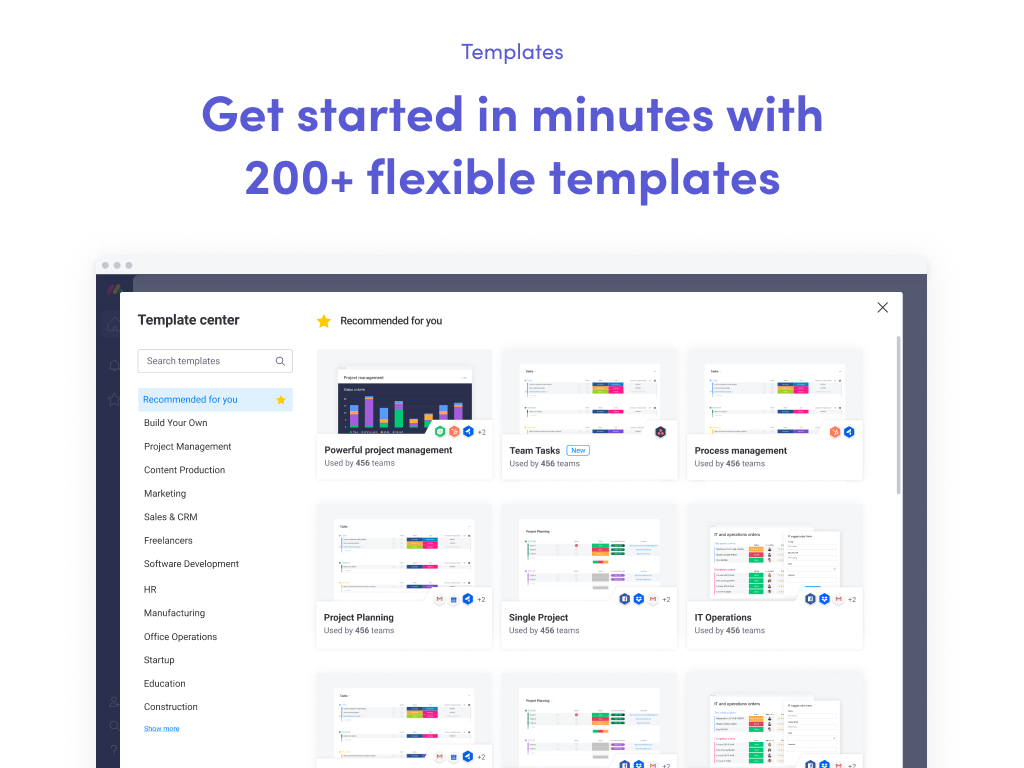
monday.com Work OS is an open platform designed so that anyone can create the tools they need to run all aspects of their work. It includes ready-made templates or the ability to customize any work solution ranging from sales pipelines to marketing campaigns, CRMs, and project tracking.
$36
per month (3 seats)
Wrike
Score 8.5 out of 10
Mid-Size Companies (51-1,000 employees)
Wrike is a project management and collaboration software. This solution connects tasks, discussions, and emails to the user’s project plan. Wrike is optimized for agile workflows and aims to help resolve data silos, poor visibility into work status, and missed deadlines and project failures.
$240
per year 2 users (minimum)
Zendesk Suite
Score 8.6 out of 10
N/A
Zendesk is a customer support solution with built-in ticketing, conversational messaging, and live chat, designed to help businesses of all sizes and industries deliver personalized service at scale. Zendesk's AI agents are trained in CX to help Service teams resolve customer issues faster and more accurately while still providing a human-centered experience. Zendesk ultimately aims to help businesses improve time to value, reduce effort per ticket, and keep costs low.
$69
per month per agent
Pricing
monday.com
Wrike
Zendesk Suite
Editions & Modules
Basic
$12
per month per user
Standard
$14
per month per user
Pro
$24
per month per user
Enterprise
Contact Sales
Contact us
Wrike Free
$0
per month per user
Wrike Team
$10
per month (billed annually) per user (2-15 users)
Wrike Business
$25
per month (billed annually) per user (5-200 users)
Apex
Request a quote
per month per user
Pinnacle
Request a quote
per month per user
Suite Team
$69
per month per agent
Suite Growth
$115
per month per agent
Suite Professional
$149
per month per agent
Suite Enterprise
Contact Sales
Offerings
Pricing Offerings
monday.com
Wrike
Zendesk Suite
Free Trial
Yes
Yes
Yes
Free/Freemium Version
Yes
Yes
No
Premium Consulting/Integration Services
Yes
Yes
Yes
Entry-level Setup Fee
No setup fee
No setup fee
Optional
Additional Details
Yearly plan: Save 18%
Monthly plan also available
Every premium plan begins with a 14-day trial period.
We were evaluating monday.com and Wrike at the same time, and ended up going with Wrike because we felt that the flexibility, integration options, and collaboration tools were much more user friendly and intuative compared to monday.com. The look and feel of monday.com felt …
monday.com is far superior to Microsoft Planner and Basecamp, and arguably superior to Trello and Slack Lists as well. Asana (for work management and Zendesk (for request management) put it to shame. My main monday-using client selected it primarily because of its slightly …
monday.com has the only interface that is 100% customizable, can use public and private boards, can be shared with customers, produce Gantt charts, and has THE MOST integrations "in house". The professional relationships that monday.com has established to be "on board" with …
I feel monday is more intuitive and easy to use compared to the others. Otherwise they pretty much do the same function. Assignments are significantly less liable to be overlooked. It causes us to consider each other responsible. I exceptionally prescribe it for groups that …
I've used monday.com in the past for project and task management for a large team. Wrike is better suited when it comes to integrating with our development tools (such as Azure Dev Ops integration) as monday.com didn't offer that functionality. I also prefer the calendar …
monday.com and Asana both offer more straightforward customization and, therefore, simplicity that make them much easier to use for teams like mine who do not typically manage large projects, but instead maintain smaller task lists that are frequently updated.
We use both monday.com and Wrike. While Monday does have a better user interface, Wrike allows us to have more visibility into tasks where multiple people are collaborating. And also to receive project brief-ins and requests for new projects. We use both differently and I would …
Wrike is definitely more robust in totality, but it doesn't have some of the customization around custom fields that monday.com has. Additionally the UI and UX of monday is slightly more user and mobile friendly, even if it's a bit more simplistic and 'bubbly' for lack of a …
Wrike has a much better layout and user-friendly setup than monday.com. monday.com is okay, but I prefer Wrike - the platform is easier to use and allows for more in-depth communication between my team members.
monday.com is popular and it's easy to understand why. If you're looking for a low-commitment personal task manager, it might be for you. I found it was complicated in the wrong ways and too simple where I needed it to be complicated. I also found it distracting to use. …
I could list a ton more... but in reality, what has been a nice trend in this industry is that the top competing platforms with Wrike, all have adapted and added very similar features, things that didn't exist 5 years ago, are commonplace today among these listed. I would say, …
Verified User
Team Lead
Chose Wrike
Better structured and more powerful features. Initially had less/no AI forced in and complicating matters.
Great timekeeping linked to actual project planning
We used Trello (free version) previously and it worked for us for when we were smaller and not ready to spend on a true PM software. The other options either did not fit from a functionality or price standpoint when we were comparing them. Smartsheet checked the boxes we needed.
I find Wrike far more robust, especially for multi-step processes and team collaboration. It’s more flexible and suits our operational needs better than Monday.
Wrike is completely customizable. I began my project management tool in Monday, but really established myself when I switched to ClickUp. I felt like I wanted to keep some similarities to how I worked in ClickUp when our company made the switch to Wrike, and I was able to mimic …
After researching and experimenting with several other products, Wrike was chosen for it's customization capabilities, and because it was a product inherited due to a company merger.
My previous organization used Asana and the features and interface lacked the buy in from the team. It was not set up the same easy to maneuver way that Wrike is.
Wrike is great for large corporate teams, on par with Asana. I did not have the choice in Wrike, and was initially skeptical after coming from an Asana company but I have been pleasantly surprised in my year+ of using the platform. Wrike is better for cross team projects where …
Wrike is more robust and stacks well due to the amount of features and customization for project tracking. I would have Monday as the next contender for visualizing project management and Jira would be more for managing dev. tasks but full campaign management would be more in …
There is a time and place for any project management tool, and it largely depends on what your team has historically used and where they feel comfortable. Many of the tools are so similar in their features that feel becomes such a significant factor in how teams handle work …
I think Wrike is comparable against these competitors - it reminds me of Trello the most in terms of interface. I did not personally select Wrike, I am a user, not the purchase decision maker.
I think the ease of use and cross collaboration is really useful here against other platforms. Also one of the biggest differences is actually really helpful how the app stores files and images which makes them useful to look for previous images (especially when you upload a …
Monday is the program we switched to. It seems to be more customizable and easier to customize for general layouts for projects and tasks to be complete. The team collaboration within Monday seems to be pretty simple and straightforward as well. I have not noticed some of the …
We chose Wrike after careful software selection with three other products. The goal is to identify and define a working standard for greater efficiency during the definition, planning, execution, monitoring, and finalization of products. Wrike proved to be the best and easiest …
The fact that Zendesk will allow us to integrate a lot of apps by our own, to create rules, triggers, automation and severall other features by our own was a great opportunity. - even in the situation we are, that we are not having the people available to adjust the support …
I prefer Zendesk, though I find engineers are often in Jira. Zendesk is, in my opinion, far easier to navigate, but that might just be my personal preference and comfort with the application. Both maintain a history/record of who and what, but I think Zendesk is more intuitive, …
Features
monday.com
Wrike
Zendesk Suite
Project Management
Comparison of Project Management features of Product A and Product B
monday.com
8.3
2257 Ratings
7% above category average
Wrike
8.0
908 Ratings
3% above category average
Zendesk Suite
-
Ratings
Task Management
9.22243 Ratings
9.1899 Ratings
00 Ratings
Resource Management
8.41916 Ratings
7.8772 Ratings
00 Ratings
Gantt Charts
8.21313 Ratings
7.9633 Ratings
00 Ratings
Scheduling
8.41871 Ratings
8.3787 Ratings
00 Ratings
Workflow Automation
8.61949 Ratings
8.0776 Ratings
00 Ratings
Team Collaboration
9.22197 Ratings
8.6899 Ratings
00 Ratings
Support for Agile Methodology
8.21167 Ratings
7.7501 Ratings
00 Ratings
Support for Waterfall Methodology
7.01 Ratings
7.9451 Ratings
00 Ratings
Document Management
7.91814 Ratings
7.6755 Ratings
00 Ratings
Email integration
7.91616 Ratings
7.8679 Ratings
00 Ratings
Mobile Access
8.21793 Ratings
7.8654 Ratings
00 Ratings
Timesheet Tracking
7.71052 Ratings
7.7425 Ratings
00 Ratings
Change request and Case Management
9.21165 Ratings
7.723 Ratings
00 Ratings
Budget and Expense Management
8.11042 Ratings
7.6324 Ratings
00 Ratings
Professional Services Automation
Comparison of Professional Services Automation features of Product A and Product B
monday.com
8.2
1021 Ratings
6% above category average
Wrike
8.1
331 Ratings
4% above category average
Zendesk Suite
-
Ratings
Quotes/estimates
8.1683 Ratings
8.21 Ratings
00 Ratings
Project & financial reporting
8.3905 Ratings
7.8326 Ratings
00 Ratings
Integration with accounting software
8.1509 Ratings
8.0197 Ratings
00 Ratings
Invoicing
00 Ratings
8.35 Ratings
00 Ratings
Incident and problem management
Comparison of Incident and problem management features of Product A and Product B
monday.com
-
Ratings
Wrike
-
Ratings
Zendesk Suite
8.8
173 Ratings
7% above category average
Organize and prioritize service tickets
00 Ratings
00 Ratings
9.3172 Ratings
Expert directory
00 Ratings
00 Ratings
8.2118 Ratings
Subscription-based notifications
00 Ratings
00 Ratings
8.7119 Ratings
ITSM collaboration and documentation
00 Ratings
00 Ratings
8.2122 Ratings
Ticket creation and submission
00 Ratings
00 Ratings
9.4173 Ratings
Ticket response
00 Ratings
00 Ratings
9.2172 Ratings
Self Help Community
Comparison of Self Help Community features of Product A and Product B
monday.com
-
Ratings
Wrike
-
Ratings
Zendesk Suite
8.2
157 Ratings
2% above category average
External knowledge base
00 Ratings
00 Ratings
8.1151 Ratings
Internal knowledge base
00 Ratings
00 Ratings
8.3144 Ratings
Multi-Channel Help
Comparison of Multi-Channel Help features of Product A and Product B
The platform is very well suited for our nonprofit programs that serve low-income clients who need diapers, wipes, and period products. It has helped us run our programs, capturing information and allowing us to view the data for reporting purposes. The ability to filter data is very helpful by allowing us to categorize information to get a better picture of the progress of our programs.
I think that Wrike is customizable enough to fit most needs, so I would generally recommend it as a starting point to anyone that is looking for a project management tool. Some people on my team don't like it, but I think that is moreso due to lack of exposure than any flaws in the tool itself. I predominately taught myself many of the features, and I found it to be straightforward. There is lots of great documentation out there, plus the community forums are incredible helpful as well. Wrike might not be THE perfect tool for every single need, but I think that there would be very few situations where it would ultimately be incompatible with a team's workflow needs.
Being a customer support agent, I found it very good when it comes to send an email or call or chat- with the user. I can do all that from the one single platform which is so easy and time saving for you. It does not take much time to use this, We can chat- with the user and at the same time we can send an email to them as well.
I like summary of subitems, especially with subitasks as subitems and add item tracking for each subtask it can show total tracked in parent item. Similar with other columns, like numbers, status, date.
Dashboard features, Many kinds of dashboard view available, we can utilize on the basis of requirements.
monday.com workform is very powerful, easily share form link when submitted it will create line item in board with provided data.
monday.com automation is very helpful in order to automate steps with specific rules and easy setup.
monday.com also provides integrations in order to automate processes if need to integrate multiple app together. or need to transfer data between multiple apps.
The desktop app for Mac seems to have a few issues with visual glitches appearing on screen, it only seems to go away when I close the tool and reopen it
Subtasks don't show on the individual users to-do list, only main level tasks
Is there a way for AEs and CSMs to be informed in a weekly summary of all their accounts and any tickets? Example: Disney submitted a ticket on XYZ. Google has an urgent issue on X still unresolved.
Is there a way for CSMs or AEs to have a Dashboard that's specific to their accounts instead of seeing all the tickets in the queue that are not relevant to them?
Teams involved in content creation, such as marketing or editorial teams, could use monday.com to manage the entire content lifecycle. Boards might track content ideas, assignments, drafts, reviews, approvals, and publication schedules, helping teams collaborate and keep content production on track.
I wish that Wrike had more drag and drop functionality that would be connected to assignee and also I wish that the finish date of a task would update to the date where you checked completed. It does not do that. Also finishing a task doesn't move the start date of the next task it "protects your time in that way", but our management team wants us to quickly see what we have down the pipeline rather than having to scroll down the list of upcoming tasks.
Zendesk is an amazing tool for communicating with your customers easily. The communication tickets from sellers to us or from us to sellers are stored, and there are statuses used to make communication easy. We have internal conversations between departments, linked with useful software such as Zingtree, Talkdesk, and Webs.
I give monday.com a 10/10 because I almost never encounter any lag or connectivity issues despite all of the many templates, boards, and automations we have. As a matter of fact, I feel like the last issue I encountered was over a year ago... and I'm in monday.com every single work day. Not only is monday trustworthy, it is easy to find what I'm looking for... making the overall usability extremely hard to beat.
It's easy as pie to use. I don't have any issues and only the oldest, most un-tech savvy of coworkers on my team seems to have issues with it. It's quick to pick up, intuitive, and effective. I have no criticism for it.
Pros: The agent interface is sleek, contemporary, and relatively easy to learn compared to many other enterprise tools. For common tasks, admins are given point-and-click options- adding fields, modifying workflows, constructing macros. The knowledge base (Guide) editor is easy to use for non-developers. Drawbacks: Once you move past the initial things - complex automations, reporting/analytics in Explore, and/or customizations integrating the API, it requires much more advanced training to use successfully. Navigating between the different modules (Support, Explore, Chat, Guide) can feel very disconnected; often you are reminded that it really is a "suite" of products brought together -not really one unified platform. If you're using multiple brands managing simultaneous support tickets, or heavily customizing workflows to meet your brand, you may run into a bit of struggle with usability. So: it's a lot more user friendly than the palaces (Salesforce Service Cloud, ServiceNow), but is not used as quickly or with as much streamlined flow as a product made for a small shop. So if you are looking for a great balance, this is a good option if you are a net new organization or an organization on their way to scaling from 15 - 50 employee. Expect some elbow grease from the admin team once learning, adapting, and working efficiently once you move past the basics with your support tickets and initial customizations.
Over two years of (almost) daily usage without outages. Don't remember any errors. I give it 9 only because some Wrike plugins (for online document edit) are based on NPAPI architecture. These types of plugins are being phased out in new browsers, and NPAPI plugins are disabled by default in recent versions of Chrome so you have to do some browser adjustments when you switch browsers or move to another computer.
Everything performs fairly well. Every now and then there are user errors where an employee will not click "ok" on a note they've created and simply exit out (I do wish that something was in place to prevent this, such as a pop "are you finished?")
Wrike tasks loads fine, but I hate clicking files and wait for a bit of time since it is powerpoint or word, Wrike assumes I want to open those on Wrike. My suggestion is to link it to office 365 so we do not need Wrike based decoder for PPTX and DOCX
monday.com only really care about accounts that have 20 seats or more. While this is great for monday.com, it pushes smaller organisations to evaluate alternatives. We rate monday.com highly in our organisation because key staff have already got good experience with the application and we know we will get to 20+ seats one day. But, till then the billing model and lack of permanent enterprise features is a dread.
During my learning phase with Wrike, I initially struggled with setting up automation rules and request forms. However, Wrike support was always my go-to, resolving issues within seconds or minutes. Their assistance made the learning process much easier. My best experience was receiving step-by-step screenshots to follow, with the support team on standby until I was completely satisfied.
We rarely need to contact their support team, but when we do they are responsive. However there have been notable times when communication between myself and the support rep was challenging despite me providing clear explanation of the issue, screenshots, and a thorough explanation of the goal we hope to achieve. It took several back and forth attempt, on a few occasions, to get resolution on an otherwise simple request
To have someone walk you thru the features and capabilities of Monday.com is priceless. Someone also coming along later in the contract to see if you are maximizing the program to suit your company needs is beyond helpful. The staff that have provided this training are fun, creative and very patient.
I love the Wrike training options. Wrike Discover has tons of courses, learning plans, certifications, etc. This is an area where Wrike definitely shines! I wish these resources were more in your face for new people, because it seems like a lot of coworkers didn't know all of this training was available to them.
Zendesk has tons of available material for training - videos, webinars, articles, etc. The only reason this is not a 10 is because it can be hard to figure out how to navigate to these things and find what you are looking for.
We signed up for the accounts. Created the accounts. Ran the trial version and tested it live while we were running multiple projects and found that it was fitting our needs perfectly. When the trial ended and we were asked to purchase the full version, we did. We have found other ways to use it and it's a breeze.
There are a lot of bells and whistles in Wrike, and not all of it is easy or intuitive to understand once it's plopped in your lap. It's easier when there are a few choice people who understand Wrike as a platform and articulate it in such a way where it makes it easy to pass it along to others in the group
I was very satisfied. They have a free trial for 30 days and I recommend you do that and use it. It is very easy to get started with the basics and the build on over time.
The only thing technically complex was single sign-on and integration to Salesforce.com required some tweaks – otherwise setting up system was very easy
monday.com is simpler and easier to grasp, apply and navigate than ClickUp, but the ClickUp free version has so much more functionality available than the monday.com free / low-cost options (sorry, but it's true!). Google Tasks is really simple and I shouldn't really compare them - it's just really nice to be able to see my tasks right next to my Google Calendar or Gmail (widget) - the "all on one" view on the screen is really nice ease of access, but the power of monday.com outweighs the nice-to-have of an all-in-one screen layout - it feels clumsy to bring in all my Calendar items from Google to monday.com, so an integration app to the Google screen where you can see monday.com tasks would be amazing.
We use both monday.com and Wrike. While Monday does have a better user interface, Wrike allows us to have more visibility into tasks where multiple people are collaborating. And also to receive project brief-ins and requests for new projects. We use both differently and I would say for us Wrike is more the collaboration tool than the day to day individual task management tool - and it works great.
The customisable reporting every time. Our leadership reply on me to run my team and want to know what customers are telling us so they can elevate our products. We have extensive custom reports that tie up all aspects of our product and customer journeys. I've not found another product that allows me as much freedom as Zendesk Suite explore does, so far.
For it to work across multiple departments and sites, I would like to see improvements made with integrations and automation. For this question, I am acknowledging not only the addition of internal triggers/automation, but also an expansion on external ones.
The sky is the limit for what can be done in Wrike. We started with 1 use case and within 5 months we migrated several key business practices over to Wrike because they were easier to manage. Use cases so far: process improvement, management review, corrective actions, maintenance requests, month-end financial closing, and document management. As we grow, it's easy to imagine putting even more into Wrike where it becomes a cornerstone for how we do business
Different teams (e.g., contracting, compliance, provider relations) can view updates in real time, comment directly on tasks, and escalate items when needed.
Wrike allows us to template the contracting process (from intake to signature) to ensure consistency across payers and reduce administrative overhead.
Leadership can see the status of negotiations at a glance, identify bottlenecks, and prioritize resources accordingly.
Integrating other AI solutions for an organization with high volumes can cost about USD5000 monthly. With Zendesk AI and by building onto the same with AI powered apps built for Zendesk Suite we save a projected USD4000 monthly.
Robust Zendesk APIs have enabled us to integrate our internal system with a customized app saving us hundreds of hours every quarter spent loading customer profiles that are not loaded instantly from the app.
Plug and play apps like Round robin save us weeks of sprint delay timelines as they do not require additional coding or developer support to install and start using.