Action1 is an autonomous endpoint management platform that is cloud-native, scalable, and configurable in 5 minutes. It is free for the first 200 endpoints, with no functional limits. By pioneering autonomous OS and third-party patching - AEM’s foundational use case - through peer-to-peer patch distribution and real-time vulnerability assessment without needing a VPN, it eliminates costly, time-consuming routine labor, preempts ransomware and security risks, and protects the digital…
N/A
Apple Remote Desktop
Score 7.1 out of 10
N/A
Apple Remote Desktop (ARD), from Apple, is a remote administration tool for managing Apple computers running OS X across a network.
While other RMMs may only be good at one thing, Action1 is really good at everything that their does. If they don't have it in the platform yet, that's because it's not good enough for their standards. From a pricing standpoint on Patch/Software management there is no match for …
Action1 has a sweet spot with the functionality it provides at a great price point. The product is not overwhelming yet continues to grow with functionality that customers request.
Freshdesk and Freshservice are great products with Freshservice being the better of the two. However, in comparison to Action1 with regards to our budget, it was an easy choice to select Action1. I selected Action1 not only because of the "free" price tag, but also because I …
Aforementioned regarding the high cost of Lansweeper. In my experience, it also has a greater effort to configure and isn't as easy to deploy and customize out of the box. In my opinion, their platform is built around the assumption everyone is a long-time customer and/or a big …
To be honest, I might have been lucky, but Action1 was the first I actually tested. I've heard from our mother company from Italy, that they have tested NinjaOne but it was not what they were expecting in terms of vulnerability and patch management. I've recently suggested them …
GFI Languard was pretty nice, but that was ages ago. I do pay for PDQ deploy and inventory though and am happy with that software...however, while its feature set does overlap with Action1, it is not just another flavor of the same thing, so I find that I use both of them.
Action1 excels with patch management and their ability to show if applications have been marked as vulnerable. It is also hard to beat their free model where the first 200 are free. When I first started with Action1 it was only 50 endpoints so seeing that expand so much is …
From a functionality point of view the platforms are very similar, when we worked with NinjaOne they tried the hard push for us to onboard our entire organization. We didn't want that and they refused to scale down to the requirements of our small satellite office (<10 …
For the amount of functionality you get with the cost, no other product compared to Action1 did. The free trial and free endpoints they offer help prove there is no time trial to rush and select a product. The support has been fantastic with the company as well as the Action1 …
Action1 is a similar but less feature-filled product than ConnectWise or Kaseya. However, Action1 can fulfill the main use-case scenarios of both products at a much lower cost per endpoint. Action1 is also constantly innovating and working with its users to improve upon the …
Price for one. The cost is extremely reasonable IMO. Action1 is easier to use for a non-technical person and there is zero maintenance since it is cloud hosted.
After looking at different solutions, Action1 [Cloud Remote Monitoring and Management Solution] was the perfect fit for us that delivered all of the features we wanted without being as costly as some of the others alternatives we've looked at. There was no minimum endpoint …
Action1 Cloud Remote Monitoring and Management Solution may not be as feature rich as SCCM and Intune, but it does its job without having to set up and support additional infrastructure on your network. It's more user friendly than ManageEngine's Desktop Central but does most …
Apple Remote Desktop is very Apple specific, which as both good and bad aspects. We actually use both Bomgar/BeyondTrust and Apple Remote Desktop because each is good at certain aspects and bad at certain aspects. For instance, BeyondTrust is very good at ad hoc sessions with …
Apple Remote Desktop is far simpler than TeamViewer, especially for MacOSX. With Apple Remote Desktop native within OSX, it is simple and easy to use, and can be used with other Mac users with ease. I selected it because it has a much simpler design and is already integrated …
Apple Remote Desktop is Apple specific. There is no other software suite that controls the Mac like ARD. Apple built it specifically for Apple products and it has abilities that are definitely MacOS ONLY. If you administer Macs it is a must-have over the other solutions …
Apple Remote Desktop still requires more work on its functionality, but the other market giants are way ahead of it when it comes to utilities and services. Teamviewer was the first software that we used and it was so good, we wanted to try something else so we switched to …
Microsoft Remote desktop tends to perform better, especially over the internet and has multiple implementations, including open source. AnyDesk is multi platform (both server and client) and more suitable for ad-hoc remote sessions.
Apple Remote Desktop is a good product when you have a need to manage Apple computers on-site and don't want a cloud solution with a recurring cost. We prefer it as an alternative or secondary solution in case your primary software has issues. I wouldn't use it as my only …
For apple/mac products - hands down has the upper advantage when it comes to remote administration. It lacks in some areas that Datto and Kasyea have the upper hand on like some system monitoring. Overall, if I had multiple macs I needed to monitor and service, I would use …
I think that the one feature that sets ARD apart is the UI when in a remote session. There have been times where I've used Zoom, TeamViewer, etc. and couldn't access a part of the menu bar or accidentally closed a session due to the third-party UI that's been applied on the …
Chrome Remote Desktop is cross-platform but lacks the cool features especially automation related features like Apple Remote Desktop does. For supporting Mac computers, Apple Remote Desktop was a clear choice.
I would feel much more comfortable having one of these alternative solutions as our Remote Desktop management tools. Each has their drawbacks and expenses associated with them, but we simply have too large of a deployment to not be considering alternatives. If it is the only …
If you are managing Apple systems, ARD is hands down the number one way to manage these systems. It beats every other product out there with its deep macOS integration. No other product has as much focus on Apple as this one. We are primarily a Mac environment so it makes total …
I actually use ConnectWise and ARD, if within my LAN. If I have VPN access I use ARD, if it's a new client and I haven't worked on their network or it's too small to warrant a VPN setup then I'll use ConnectWise
I have used the above two remote desktop services and have found it to be much harder than using the Apple Remote Desktop. They are slow to login with a lot of errors, time outs constantly, and interface its self moves incredibly slow. I felt a sense of relief when I started …
Apple Remote Desktop is the best device we were able to use for education that served the function. Being a school with all Apple products and Mac labs, using Apple Remote Desktop was the most logical choice. The only other alternative was to use the Adobe screen share software …
For multi-site remote support we utilize TeamViewer and for enterprise-wide device management we are using Cisco Meraki System Manager. ARD is a great Mac tool, but there are many options out there, that are cloud-based, that don't require you to have network tunnels into your …
Systems Administrator/Technology Support Specialist
Chose Apple Remote Desktop
Apple Remote Desktop allows me access and control that Casper doesn't always have. I love the use of the Remote sessions to be able to get on and see what exactly is going on and then to be able to fix it without having to run across campus to that classroom.
I use Teamviewer with users who are having trouble connecting to the VPN. I think TeamViewer is a good alternative when ARD isn't working. However supporting the number of users we support, Teamviewer can come with a pretty hefty price tag.
Any place that has multiple computers that need to be managed can benefit from using Action1. Currently that means Windows PC's and servers, Linux PC's and servers and devices running MacOS can be managed by Action1 and benefit from their patch management and software management tools. Mobile OS need not apply at this point.
ARD for me is based on a LAN, but can be used over WAN via VPN, but the latency makes ARD a less ideal tool. There are other cross platform tools that can do what ARD does which to me add value when managing a mixed environment
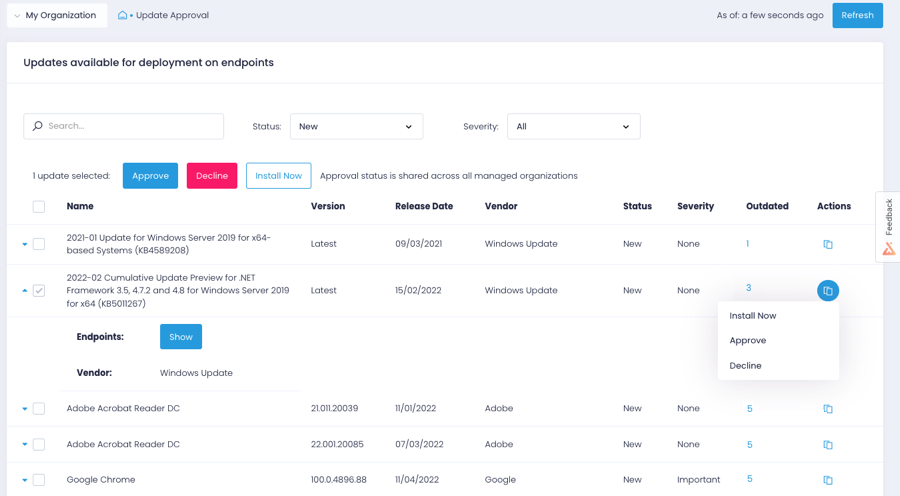
Automations. We utilize scheduled tasks that we define within Action1 to provide additional controls for reporting, alerting, and for endpoint management. It is a unique way to expand functionality by use of centrally managed scripting events.
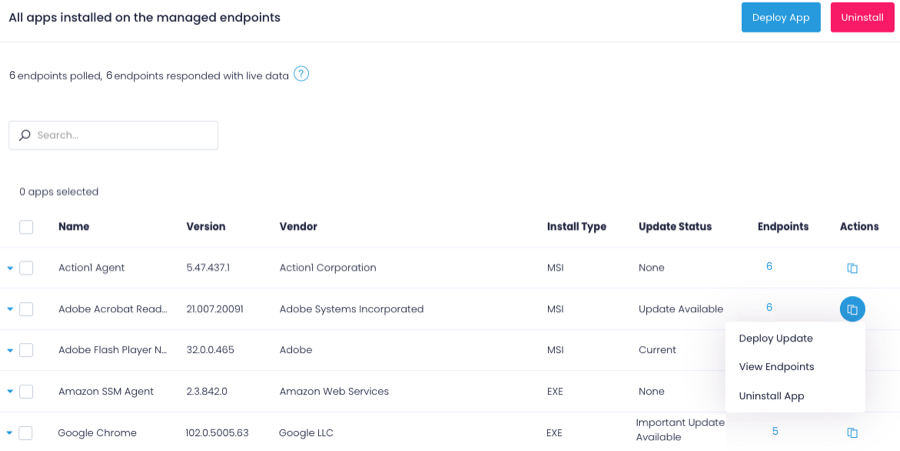
Able to create and view reports showing detailed information of all types of endpoints within my enterprise. We can also create custom reports from a large set of available data points and can also create custom alerts based on these data points.
Vulnerability detection and resolution management. Able to detect vulnerabilities and apply controls or actions based on the vulnerabilities found. Along with the Security patching, this adds and extra layer of visibility and control to secure my environment.
Custom application deployments. Action1 provides a large set of third part applications you can deploy and patch updates for, but if you have custom applications built in-house or just an application that is not available in the software repository that Action1 has, you can build your own custom deployments easily.
The deployment screens for update deferrals can be hard to understand at first and easy to skip since it carries some default info when you create a new automation rather than a more conspicuous prompt to update.
It is a fairly unique tool in the level of integration it has with Apple Desktop products. It definitely needs some engineering attention, and it should be expanded to the iOS arena. It is not perfect, but it is very useful and fills an otherwise fairly empty niche in the support toolkit realm. The built-in screen sharing app in macOS handles the direct screen control or viewing function fairly well, but it does not have all of the other mass control features that Apple Remote Desktop supplies.
Easy to use. Straight Forward. No hidden settings or stuff that's buried several layers deep and you have to watch a video before you do it. Point. Click. It works and I can feel assured that my CVE issues are being handled.
It can be more usable, and if you are not in the Apple ecosystem, most likely you haven't even heard of it. Does it need improvements? Absolutely. Will it get improved? Most likely not. I believe this app is just part of the system app, which is nice to have, but any user will most likely choose some other option from the available apps.
Freshdesk and Freshservice are great products with Freshservice being the better of the two. However, in comparison to Action1 with regards to our budget, it was an easy choice to select Action1. I selected Action1 not only because of the "free" price tag, but also because I didn't need a full fledged ITSM product. Action1 is cheaper, easier to setup and use, and is cloud based as well so you don't need to install it on a server to utilize.
I would feel much more comfortable having one of these alternative solutions as our Remote Desktop management tools. Each has their drawbacks and expenses associated with them, but we simply have too large of a deployment to not be considering alternatives. If it is the only solution you can afford, it is OK to start here. I could see where this would have a return on investment, but it is really only suitable for a very small and localized scale. If employees are at all mobile, the duct taping of products necessary (VPN, distribution points, script repositories) would be very cumbersome.
It's pretty hard to negotiate investments / costs in IT when you have a small team in a mid size company. Everything is seen as useless cost and not investment. As of now, I'm pretty sure that if we ever cross the free-tier, I'll have no problems with investment approval since the tool is proven and useful on a daily basis. I believe this was the single most importat decision that Action1 took in their sales model.
Apple Remote Desktop has a positive return on investment because for the expense to the school, the value it brings to teachers is important. The return on improved student performance is very difficult to measure financially, but there is a definite return.
The overall objective of education is to increase student learning, ARD does that phenomenally. Parents see the tool used and are impressed at what the capabilities of the tool can do and how it impacts how active their students are as well as how well they can learn.
One negative impact is that teachers rely too much on this tool rather than on actually teaching sometimes.