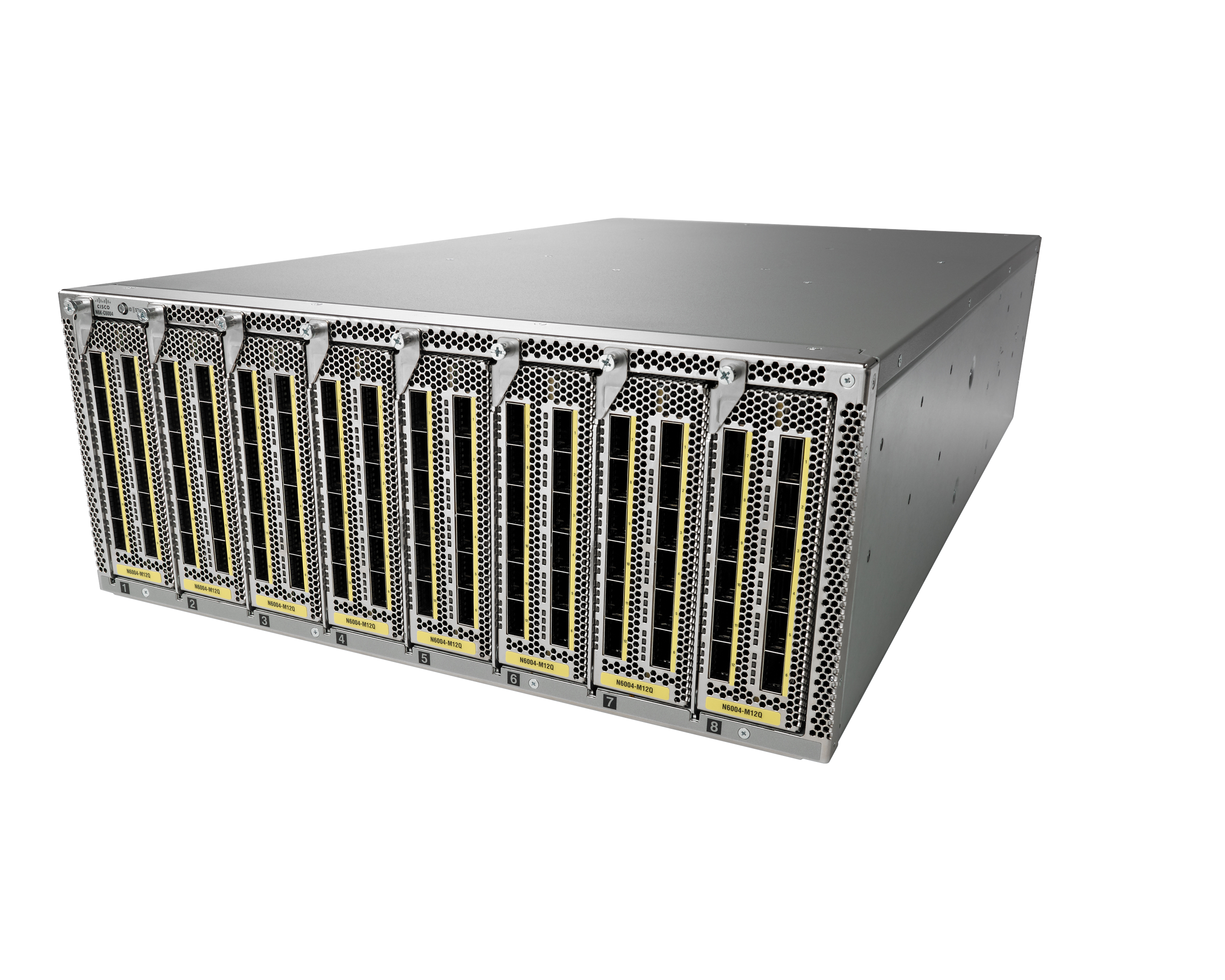
We use Cisco Nexus Series Switches on Cisco ACI. It helps to make new and easy connections. It will better if we can use Generative Artificial Intelligence with them.. We manage many domains in one place. We manage more than one company’s network, so Cisco ACI is really helpful.
Switching from NX OS to ACI OS made configuration easier after initial migration and getting to know ACI principles. There are no L2 loops and configuration mistakes as often as it used to be. There is only one management console, and policies are easily reused. The “Submit” …
We have made the decision for ACI over NX-OS for the following: - no more self-made configuration of the underlay network - ease of scaling out port capacity
Because it was quilcky to install and needed less people for the first install and automation. If we had the time I think we select the nxos with a vxlan fabric and automation like ansible but it needed to much time.
ACI is more mature compare to other cloud and fabric products. It's proven on the Cisco nxos and the engineers have the flexibility of knowing the system. Compared to the competition, TAC support is better for Cisco and the documentation covers good use cases. Power to extend …
Lower cost than FabricPath, maybe a little bit cheaper than Arista when we looked into it. I wasn't involved in the initial purchasing of ACI, and was kind of against it at first, but the product has evolved a lot over the last few years and I now believe that it can …
We just started deploying Cisco ACI to replace our Cisco Nexus infrastructure. The ACI platform allows us to do more with fewer devices, while expanding on features such as changing the Virtual Device Contexts to a better multi tenant platform. Additionally, we are able to have …
Easier configuration, no need for special stack cables when using multi-chassis ether channel and extremely high speed interfaces (1/10/25/40/50/100/400/800 Gbit/s). Cisco Nexus Series Switches is capable of both being a L2 switch and L3 switch at the same time. Possibility to …
We are using both Arista 7280 and Cisco Nexus 9300 devices. Arista switches have deep buffer features and helps us for handling the big data packets. But these switches are a little bit more expensive than nexus 9300 switches. And also Arista 7050x Series can be competitive …
I feel that Cisco ACI is quite good at different architecture designs. You can have it as just a straight layer two network. You can have it like we have with a vast layer three network and I think just for the layer three network it has easen up the use. I think the use cases for layer three networking is better for ACI. If you just want to do the layer two, you can still use Cisco Nexus and so on and that should be almost simpler in some way.
It fits perfectly in all our data centers where we are using it. For small companies or smaller racks or something. I don't think it fits there because Cisco Nexus Series Switches is a big one. It's the most advanced one.
Cisco ACI, The object model is very complicated. It's something difficult to understand and also because there is a user interface, there's a web user interface, but it's not optimal to use it because if you want to deploy a large amount of VLAN or a large amount of tenants, it's quite difficult to do it or it's quite challenging. Maybe if you want to configure a large amount of ports using the web interface, it's not appropriate because it takes a lot of time. It also provides APIs to do that, but as I say, the object model is very difficult to understand and there is very little documentation about automation of the ACI and maybe there is but it's not so easy to find.
Maintenance, upgrades, and software certification can be performed without service interruptions because of the modular nature of NX-OS and features such as In-Service Software Upgrade (ISSU) and the capability for processes to restart dynamically
FabricPath:
Enables each device to build an overall view of the topology; this is similar to other link state routing protocols. Each device in the FabricPath topology is identified by a switch-id. The Layer 2 forwarding tables are built based on reachability to each switch-id, not by the MAC address. Eliminates spanning-tree to maximize network bandwidth and flexibility in topological configurations, as well as simplify operational support and configuration. This enables a tremendous amount of flexibility on the topology because you can now build FabricPath topologies for Layer 2-based networks the same as for Layer 3-based networks
Overlay Transport Virtualization (OTV): Enables the Layer 2 extension between distributed data centers over any transport Layer 3 network
I think something I've just went to a session with hyper fabric and the ideas that hyper fabric has. Keep it really simple because Cisco ACI is a complex system and adopt some of the ideas behind hyper fabric, bring it to ACI that will be really beneficial. So as I said, automation is a great thing, but it's still, you need to have the background and the really complex stuff that happens behind the scenes to leverage the value of that solution. And by adding more simplicity to it, I think that will be a great thing. And also integrating with other applications in terms of the automation.
Implementing jumbo frames on interfaces of its fabric extender series (N2k, etc.) by editing the network QoS does not have to be a global configuration that would affect all its interfaces. It can be improved to become just an interface configuration.
Licensing on the NXOS is a bit complicated and expensive. I understand that the Nexus is made for core data center switching but it does not have to break the bank.
OTV technology is for Nexus only. Based on the advantage of the technology, it should be made vendor-neutral to accommodate other vendor devices.
Provided with the intensive fault isolation for the CISCO ACI, we are glad that we have this Data Center Solution in place and we will continue to renew as long as the future needed requirements are meet and more helpful features will be enabled in the future with the integration of security
Actually if we need to implement or develop our actual DC we will use Cisco Nexus Series Switches again. The solution is well known and we will be able to interconnect easily the switches, as we're not using all the possibilities of features we know what is solution is a long term solution.
You'll need a lot of training and hands on experience to get the most out of the product. There are a lot of very useful features in the ACI product. Often times there are a lot of ways to get to a solution for chalanges in the field. The solutions might be different eacht time. Knowing which one to implement is somtimes a challenge.
The platform has a good performance. The major issue is all the bugs you can discover across the operations, and it can be a big challenge depending on the number of Cisco Nexus Series Switches you have deployed. In our case, we own more than 200 Cisco Nexus Series Switches 9k, and we face an upgrade process, it could be a long time project to grant a new software deployment in all our switches platform.
It allways works. If there are problems with links going down by accident (say someone accidentally unpatches something they shouldn't have), we rarely miss more then one packet over the link. Also, using VPCs we are able to upgrade the software on the switches without the attached EPs ever noticing.
Day to day operations on Cisco ACI do not require much human intervention, the platform ticks over without any major faults. Being able to rapidly replicate the communication between two groups of machines across multiple sub networks speeds up new application delivery, and the integration into vmWare allows multiple teams within IT to work together to problem solve rapidly.
These switches are very fast. They've been designed to work within the data center. We connect them to Cisco UCS-B Mini servers with the storage being directly attached. They are able to handle the data traffic pretty easily. We can also move servers pretty fast from data center to data center without overloading them. This has allowed our company to stay running during any kind of conditional outage. We have come to really rely on them for business continuity.
Cisco provides users and partners with a multitude of data for you to consume. I think that the stuff in the public domain goes a long way to assisting you find any answers you may need, plus insights and information from areas such as DevNet provide you with access to more than just the traditional release notes and the like
Overall, Cisco has great products and I believe that they believe in the philosophy of a great customer experience. Although there have been a few technical support issues that caused a lot of company anxiety, in most cases, Cisco has gone above and beyond in making a valiant effort to help the customer solve any issues.
The Cisco ACI training provided by Cisco was in depth, covered all of our requirements, and allowed us to implement and maintain the platform without issues.
Being involved in the implmentation gives you more overview on how things are supposed to be working and communicating, you can easily performce troubleshooting and understanding the troubleshooting scenario
Actually we start our learning in networking career with Cisco. So it is very useful or easier to learn this product. And honestly speaking, I didn't work in any other data center solution other than Cisco. So I cannot compare what it gives us more than other popular stuff. But this is very nice product like from Cisco.
The Cisco 9000 stacks up quite well against the Cisco Catalyst 3850 switches. The additional features available in the Nexus 9000, such as VPN, FCoE, 40 gigabits, give us the ability to support the future needs of the company in our data center. The Nexus 9000 allowed us to condense our core and aggregation environment that comprised of 2 Catalyst 6504 and 2 Catalyst 6509 to a port of Nexus 9000. Although the Catalyst 3850 would be sufficient to handle routing, those features in the Nexus 9000 made it the clear choice for us.
We recently use the entreprise agreement on another perimeter, I could say that is linked to the typology of deployment. On our nexus perimeter, pricing and contract terms are defined without any evolution also is quite simple.
Cisco ACI scales well and is suited in scenarios such as multi-cloud or large data centre implementations. It is not suited to smaller deployments as the efficiencies that it provides are not fully realised. It is well suited in large environments that contain both virtual and bare-metal machines allowing a great deal of flexibility. It is also perfect to support multi-tenancy platforms.
The Nexus 3000 series switches are data center switches, so I would say they have similar security ability to other switches in this segment. I don't have a lot of experience doing more than basic ACL security on switches, but I know these can be integrated into other security solutions like Cisco ISE and 802.1x authentication. It could also be integrated into an ACI solution to add micro segmentation, which would bring in other security functions.
We've definitely spent quite a bit of time relearning how to do things in ACI, but I think the investment has been well worth while considering that we can now deploy tenants and leaves from the ground up in a matter of seconds.
We can if we choose to upgrade an entire datacenters worth of switches in a single night. (We've chosen to break it up for availability requirements, but if you didn't require 99.999% uptime like us you may be able to do it)