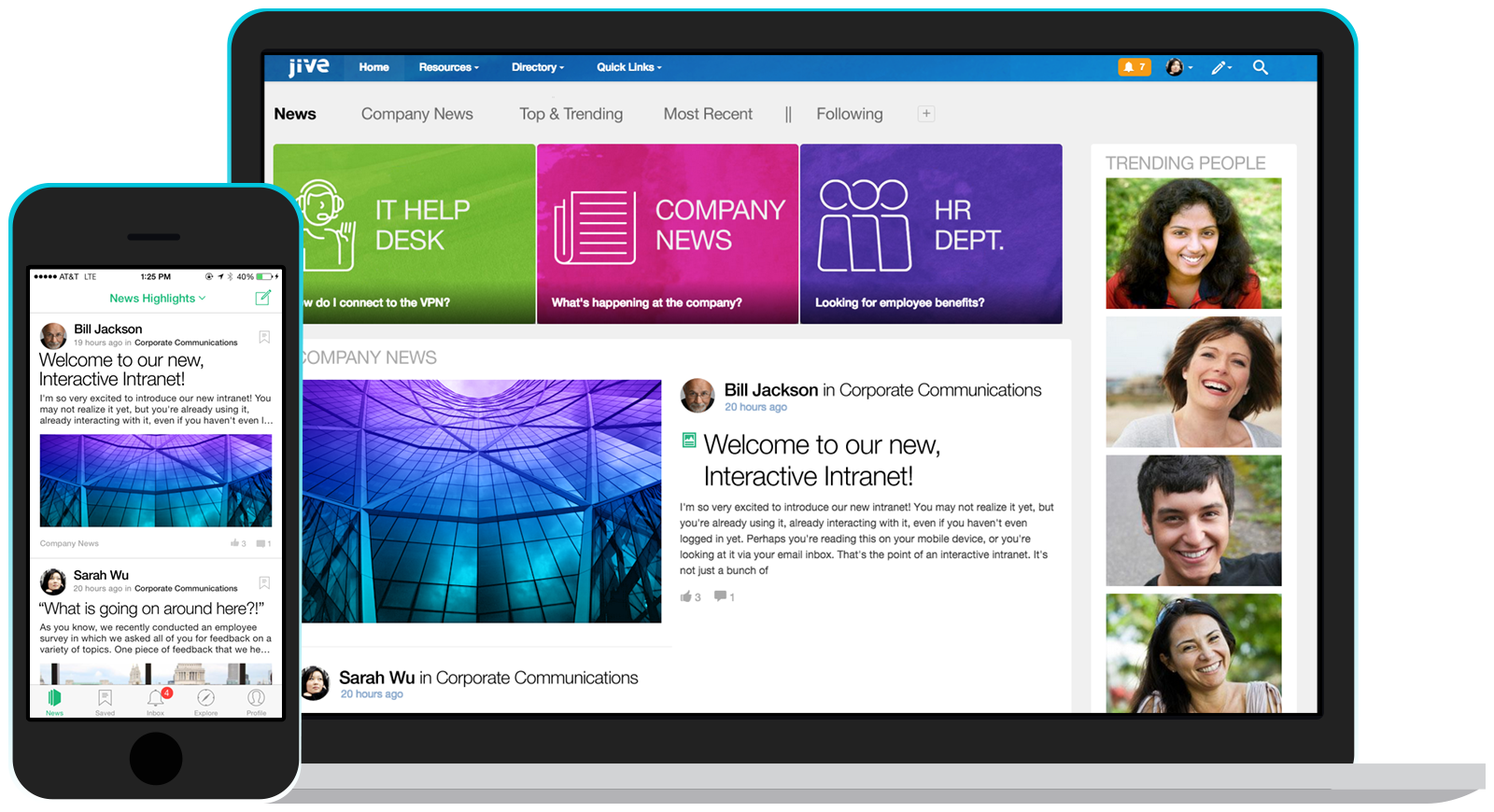
Jive Software, part of the Aurea family of customer experience solutions, provides the gateway to an organization's most important assets – its knowledge and people. Jive's interactive intranet solution promises to connect people, information and ideas to help businesses outpace their competitors. The vendor says the product has more than 30 million users worldwide across every industry, and is consistently recognized as a leader by top analyst firms.
N/A
Slack
Score 9.0 out of 10
N/A
Slack is a group messaging or team collaboration app that aims to simplify communication for businesses. Features include open discussions, private groups, and direct messaging, as well as deep contextual search and message archiving, and file sharing. Slack integrates with a number of other tools, such as MailChimp, Dropbox, and Google Drive. Slack was acquired by Salesforce in December 2020.
The product is free to use, and also has paid plans with more features and greater controls.
The…
$8.75
per month per user
Zoom Workplace
Score 8.5 out of 10
N/A
Zoom Workplace, Zoom’s open collaboration platform with an AI Companion, empowers teams to be more productive, and strengthen customer relationships throughout the customer lifecycle with Zoom’s Business Services for sales, marketing, and customer experience teams, including Zoom Contact Center.
$16.99
per month per user
Pricing
Jive
Slack
Zoom Workplace
Editions & Modules
No answers on this topic
Free
$0
Pro
$7.25*
per month per user
Business+
$12.50*
per month per user
Enterprise
Contact Sales
Add-On Zoom Translated Captions
$5
per month per license
Pro
$16.99
per month per user
Business
$21.99
per month per user
Add-On - Conference Room Connector
$499
per year
Basic
Free
Enterprise
Custom
Add-On - Zoom Whiteboard
starting at $2.49
per month per user
Add-On - Large Meetings
starting at $600
per year
Add-On - Cloud Storage
starting at $120
per year
Add-On Audio Conferencing
starting at $1200
per year
Add-On Zoom Phone Power Pack
Starting at $300
per year per user
Add-On - Quality of Service Subscription
Contact Sales
Offerings
Pricing Offerings
Jive
Slack
Zoom Workplace
Free Trial
No
Yes
Yes
Free/Freemium Version
No
Yes
Yes
Premium Consulting/Integration Services
No
No
Yes
Entry-level Setup Fee
No setup fee
No setup fee
No setup fee
Additional Details
—
*Per active user, per month, when paying once a year.
Pro is $8.75 USD per active user when paying month to month. Business+ is $15.00 USD per active user when paying month to month.
We also use Skype to communicate in our organization. They are both useful for organizational communication. The good thing is in Jive, you will have your own personal timeline. Jive also has a newsfeed or timeline that you can browse where you can see the latest updates from …
We found that Jive had integrations with the existing IT infrastructure/tools which was nicely aligned with our strategy of playing nice with the existing ecosystem, rather than compete against it. Jive uses a technology stack that is well known by our organisation …
I honestly don't recall what we briefly used before Jive - it wasn't good and didn't last long. I think it was under-utilized because you couldn't really do a whole lot with it. Jive does pretty much everything we need it to do, so for that reason alone, Jive is the superior …
Jive is a little behind the curve in comparison with the latest Microsoft features. Jive's lack of native capabilities to support work that requires process or structure increasingly puts it at a disadvantage.
Slack is still one of the best Chat tools on the market, but Zoom Team Chat (Zoom Workplace) is coming up quickly and overall, provides a great tool that is included at no cost. I believe that Slack still has some development advantages over the competitors at this point still, …
Verified User
Engineer
Chose Slack
My company selected Slack and my previous company too. As Enterprise architect this tool is perfect to me. It goes straight to the point, it's fast, it's light and clear on the purpose. You can prepare your message without anoying others. You can format your text with enough …
In my opinion, the closest to Slack in terms of UI is Discord. But Slack is much more professional with more functionalities that doesn't require very technical knowledge (good for our older staff who began their digital journey within the last decade). In terms of workflow …
I've dabbled with Microsoft Teams and Zoom's chat features in past roles at startups. Teams integrates well with Office but feels clunky for quick searches and daily chats. Zoom is great for video but lacks robust file sharing and app integrations.
Slack wins for us with its …
Slack is hands down a winner compared to these other tools. Simplicity and user choice win out every time. Also, add that it has a ton of great integrations, which means it is more than just a messaging app. It can allow you to organise your day, remind people in your team to …
The functionalities of this kind of platform are quite similar, as they have the same objective: a place where teams with multiple people can communicate. The big difference with Slack is that it has many little functionalities to help with planning, organization and …
Surpasses all of these in terms of features and integrations provided. Does a lot more than just internal chats. Way more organization and ability to host a ton of different channels and spaces. Incredibly responsive.
Much simpler and more pleasant to use than the alternatives. Provides integrations, with external services, that work out of the box which is often an Achilles heel of competitive solutions. Pricing is unfortunately not that great when compared to alternatives that come in a …
I like Slack a lot better than teams because it's more user friendly. Teams UX/UI is not ideal in my opinion and not as intuitive. I think Slack has a lot of integrations that make my life easier vs with Teams, it's hard to even figure out what can be integrated.
Slack is selected by bigger organizations. There is much more flexibility in organizing group chat, team groups. Each notification can be easily noticed and replying is faster. The mobile app is very user-friendly. I enjoyed using it while I'm away from my laptop. I can see and …
Slack is more than just a communication tool - its an organization tool as well and it helps keep my teams and thoughts all in the right place. It scales up effectively as your org grows which is really helpful. It also includes enough features to make it fun and let people's …
Due to the notification systems of the other tools, we shifted to Slack. Sometimes HipChat was showing duplicate messages and sometimes the order was messed up. Similarly with Skype, if the other guy is online then the message was delivered but if not, they did not have a good …
The feature set of the chat capability in GoToMeeting is quite limited, fine for basic communication but not much else.
Discord is a fine tool for online communities, but the lack of control over the data and environment makes it a less than ideal business tool (if something is …
The great advantage that Slack has over Microsoft Teams is the versatility that the software it offers, something that Microsoft has had a hard time with, and that makes it an unreliable software with many problems when it comes to performance. Also, Slack does not need to be …
Verified User
Employee
Chose Slack
There are more options with Slack and better integrations. We can also add contractors to individual channels and share easily, regardless of their email platform. The Google features are still available, but Slack provides more options for customization and usability. The …
Slack has the easiest user interface to navigate of all similar products. Slackbot and the self chat window are useful features which are not given by other applications of this sort.
Skype for Business was cool but did not provide so rich management functionality, after switching to Slack we got rid of a number of problems of Skype for Business such as internal hosting of hardware and necessity of system administration. Slack is provided as a service, so we …
I used a number of softwares for communication purposes. Slack offers some unique features. It integrated with a number of third party services like GIT. Slack offers channels to communicate with more than one person. The channels can be set with a topic name for discussions. …
We prefer Slack for interoffice communications. We find it more convenient, easier to use, and more customizable. Administration is pretty easy too. We utilize Microsoft Teams otherwise, as we are a Microsoft shop and integrating Teams is easier when we are already heavily …
Zoom Workplace is less resource-intensive compared to Microsoft Teams. Slack appears very basic and does not have the app offerings that Zoom boasts. I've also encountered a significant amount of audio issues when using Slack to conduct meetings. Zoom has found its niche and …
I feel, Zoom Workplace stands out for its superior video conferencing and meeting features, making it ideal for large meetings and webinars. While Slack and Teams excel in messaging and collaboration, Zoom is more user-friendly for video communication. It integrates well with …
Zoom Workplace is typically on the more expensive end against other options, but it's the industry leader for a reason. It has the most brand credibility by far, but that doesn't mean it's perfect. There are limitations when it comes to technical performance, customization and …
Zoom Workplace meetings, filters, etc. are much better than Slack and Teams. However, channels, DMs, and anything around conversations are far behind those platforms. Would really like to also see the platform push more towards being a broader workspace app first so that it …
We stopped using Microsoft Teams because it was difficult for Linux users to use. Slack is useful for text messaging and sharing files. It can be convenient for a quick call, but the sound quality is not good. Also, a call between more than two people is not good. Google Meet …
Cost and easy user interface. customer support is easily reachable. Value for money. User management, Phone management, profile management and storage of cloud recording, which are all located in one single portal which is easy to manage. It can be synced or integrated with …
Zoom Workplace is superior in my opinion. It is the best for training clients and allows for annotation. Teams does not allow you to annotate and that makes it VERY hard to direct someone where to go on a screen.
None on the list above, but Zoom Workplace allows our company at its current size (250 people) it meets our needs of usability and cost. We have considered switching over to Google Meets though that does not offer the same ease of screen sharing and large webinars which is an …
I prefer Zoom Workplace over microsoft and google as it have more in meeting functionality that I've noticed and use. I.e reactions, raise hand feature, annotations. I also prefer Zoom Workplace because of the filter options, that beauty filter really works wonders.
We use Microsoft 365 for everything we do as a company. Except for video communication. For that we use Zoom Workplace, even though Teams is integrated into our other Microsoft products. We found Teams difficult to use and buggy, whereas Zoom Workplace always just works. It is …
I think that Zoom is a little less intuitive than google meets. I prefer it though because ore people have it so it feels like the industry standard to use Zoom for meetings. I would rely more on Zoom than on google meets as well because sending invites is easier and better …
Verified User
Engineer
Chose Zoom Workplace
TeamViewer is sloppy, and its SSO sign-in is faulty. I am so glad the company steered towards Zoom for all communications.
To have all of the tools and features within one application makes it much easier to on-board new employees, acclimate, and manage. To split features across different platforms is cumbersome to manage and costs much more.
I think Zoom Workplace is about equivalent to the Webex suite. However, Microsoft has the edge due to the breadth of capabilities packaged with Microsoft 365/Entra.
Yes with Zoom you need to actually have people answering phones but at least you are providing quality and accurate information unlike other services that do not know your business. Keep it in house and get the most out of it and it is worth every penny. Never outsource your …
It's definitely worth considering Jive for the type of application we've developed i.e. a central shared repository for all employees to host and discuss information. I can't say I have ever used a superior tool, but they may exist. I'm just not sure I would want to use it exclusively for file hosting, though. It does integrate with various other tools, so perhaps it would be fine if used in conjunction with another tool for that purpose.
Slack is great for tracking commits to new coding projects. You can take parts of code that still need to be implemented later and easily search through the history of comments if there is something that goes wrong with a code commitment. It can be difficult for people that only like Teams to adjust to a new platform if you are using both to communicate.
In most cases, and I mean almost all, Zoom is vastly superior to Teams in terms of functionality and ease of use. Case in point: I recently tried to join a Teams meeting in the web browser, and it took me multiple attempts to access it. This NEVER happens with a Zoom link.
Presence of Russian language (localization can be independently established)
You can configure several information tapes with different themes. One for work, the second for communication
A newly-arrived network user immediately receives a prepared block for beginners. After completing several game tasks, the user will receive the basics of using Jive.
There is a template for each scenario. There is even a template for planning R&D, and there are more than twenty of them.
Integrates with MS Office, Google Drive, Google Docs
There are all platforms (even Winphone and blackberry)
Audio quality of phone calls is spot on. Calls are clear and crisp.
Video quality of video meetings are clear and there aren't any pixelization artifacts that some systems can have.
Having AI summaries have been life changing for us. We no longer have to concentrate on note taking, like we did in the past. The summaries are accurate and enable us to put our efforts in the meeting or conversation. Plus, we can save them into our practice management system as required.
Would love a better integration with GitHub. For example, notifications when your PR is updated, when review is requested, @-mention in comments, etc.
Improved "Later" tab, for example the ability to create to-do lists or making the "Later" tab into a more powerful to-do list (annotate items with notes)
More powerful integrations, e.g. Google Calendar could render a calendar view within Slack, rather than sending the daily schedule
Allow a way to group individual people chats - not channels just individual peeps into groups for ease of finding - like how you can group shared calendars into sections in Outlook
There are always external factors that can impact this decision but currently, the Jive platform is maintaining its lead in the market place in this area. If the innovation in this space by Jive continues, then this number will remain high. Integration with other systems and adaptability to changes in the market or in client needs will also make this decision hard to predict more then 6 months into the future
To be more transparent, I give 10 because Slack serves our collaboration needs. It provide us a good platform for team communication relaying important update within the company, it has even mobile app where you can install in your phone to monitor any updates within that team that needs your immediate attention and intervention.
We're sticking with Zoom for the foreseeable future--given its compelling feature set, ease of use, and advanced technology, there's just no other competition to be excited about. Plus it's a Gartner-recognized industry leader, so it's a rather easy choice.
It was harder to use that expected. The admin needs to be code savvy to truly customize the system. And users need to trained on the system and the setup. Trainings and monitoring need to continue to enforce use.
My rating was 7. Its intuitive interface and user-friendly features like channels, threads, and integrations make it excellent for team communication and onboarding. However, its usability is held back by the resource-intensive desktop app and cluttered feeling in large workspaces. The mobile app's performance and unreliable notifications have also been noted as weaknesses.
Zoom is made for the non tech office. It has features that can be made to do what you need to run things on a day to day basis. Immediately we we able to get meetings going with remote employees. The ability to be able to add smartphone connected people was a big plus. Zoom met our needs at the time.
Uptime was OK. But there was one day that the system crashed for a whole day. Our company was unable to operate. And all the plugins to word/excel froze causing those systems to freeze.
Jive posted a statement to the media saying all customers were up, but we were not.
Yes, the app works 24/7. I don't even recall having any period that we could not use since the implementation. Even the maintenance periods are barely noticeable and our work is not impacted by it when it happens.
There have been less than a handful of outages during our two years with Zoom, and whenever there was one, an email informing us of the outage went out immediately, and they had the issue resolved shortly thereafter.
Slack is a soft app, we don't have many issues with it. I recall one or two people complaining about something during our usage period, but I didn't have a bad experience. When the app is slow, usually the problem is with my computer or my internet. The app works just fine.
Zoom has among the best performance of any video conference platform, as I've mentioned several times. Besides that, their Chat platform works great, and their back end always runs smooth. It's unfortunate that reporting can now only be done by one month at a time, but nonetheless, it only takes a second to run any kind of Zoom report, whether it's an attendee report, Poll results, a user report, a list of meetings from the past month, etc.
They did an OK job when I needed them. Except for the one day the system went down. Jive pointed the finger at the hosting company, and the hosting company pointed the finger at Jive. No reliable information came to us.
Whenever I've had to troubleshoot an issue with Slack (which, to be honest, has not happened very often), their online documentation has been easy to locate, easy to understand, and effective in resolving my issue. Slack's ever-growing popularity also means that there's a large community of practice out there that can be depended upon.
Because I got a response right away, and was assigned one specific individual to work with me from the beginning to the resolution. I had an actual email address and direct contact with this person without having to start over and over every time I contacted Zoom - this singular individual remained attentive and was well informed on the subject matter and quite able to resolve my needs.
Jive online training is there. It is OK/average. I feel some other companies are doing better. It is not a piece that is required to have a successfully implementation, but it could be useful to improve it
If you receive any pushback from higher ups, point to any of the various positive reviews like this one. Or show Zoom's excellent Gartner report, or articles describing Zoom's partnership with Sequoia capital. It's not difficult to show how Zoom is a trustworthy industry leader with best-in-class technology.
We had a Google phone number set up before and Jive was a lot better option than that. It is more consistent and can be configured much easier and with more advanced settings. Additionally, based on the pricing as well as working with the rep on our account, it was a perfect option for us
I like Slack better than ClickUp, because I would spend 30-60 minutes a day updating my ClickUp tasks. The way ClickUp was used was very micromanaging. I billed by the hour, so I was willing to put in the time to alert the boss what tasks I was working on.
One of my jobs used Hive - I mostly just ran it in the background in case anyone messaged me. I did not use it often.
Zoom Workplace is typically on the more expensive end against other options, but it's the industry leader for a reason. It has the most brand credibility by far, but that doesn't mean it's perfect. There are limitations when it comes to technical performance, customization and video/audio quality. I prefer Slack myself for communication apps, but Zoom Workplace is a good alternative.
The billing and price model is really fair for so many functions that they offer, our remote work requires each of the features that Zoom offers, so accepting payment for a tool like this is the least we can do. I like that billing arrives on time and that they offer opportunities and payment times.
Because the Basic licenses are completely free, and because it's very easy to configure and install Zoom, and because anyone can join Zoom from a link without needing an account, scaling is a Breeze. There are absolutely no roadblocks. My company keeps adding more Zoom Pro license every week since it's so in demand. We were able to convert users from several different platforms onto Zoom with no trouble at all.
Zoom is perfect for our business. We use it to video chat with prospective clients. The name recognition alone gives us credibility and it is very easy to screen share and send content out.
reduce amount of files/documents scattered & lost across shared drives
increased discovery, awareness and interaction of historically more separated individuals & team functions across the organisation
from an IT perspective, we've benefited from improved IT operations (e.g. troubleshooting info shared and easily searched/found with all team members - such that even junior team members can solve technical problems outside of business hours, lessening the burden for standby/call-in for more senior team members)
Slack has been incredibly helpful in connecting various tech apps and ecosystems, creating a more streamlined and responsive process.
Slack has made it significantly easier to communicate with our team members across multiple time zones, creating a more engaging environment for our all-remote team.
We have not lost much productivity in our teamwork during the pandemic because of the ability to have Zoom video calls and keep everyone in touch. This is definitely a positive.
We are able to have more people participate in coaching sessions (described earlier) because we don't have room space limitations. This is a big positive.
Being able to start a meeting instantly is great when we are doing support and/or training with a client over the phone and need to be able to share a visible