Act-On is an adaptive marketing platform designed to drive personal and purposeful multi-channel marketing. Its foci are inbound and outbound marketing, for enabling a tighter alignment with sales and turning data into actionable insights.
$900
per month
Google Analytics
Score 8.2 out of 10
N/A
Google Analytics is perhaps the best-known web analytics product and, as a free product, it has massive adoption. Although it lacks some enterprise-level features compared to its competitors in the space, the launch of the paid Google Analytics Premium edition seems likely to close the gap.
$0
per month
Webtrends Analytics
Score 4.4 out of 10
N/A
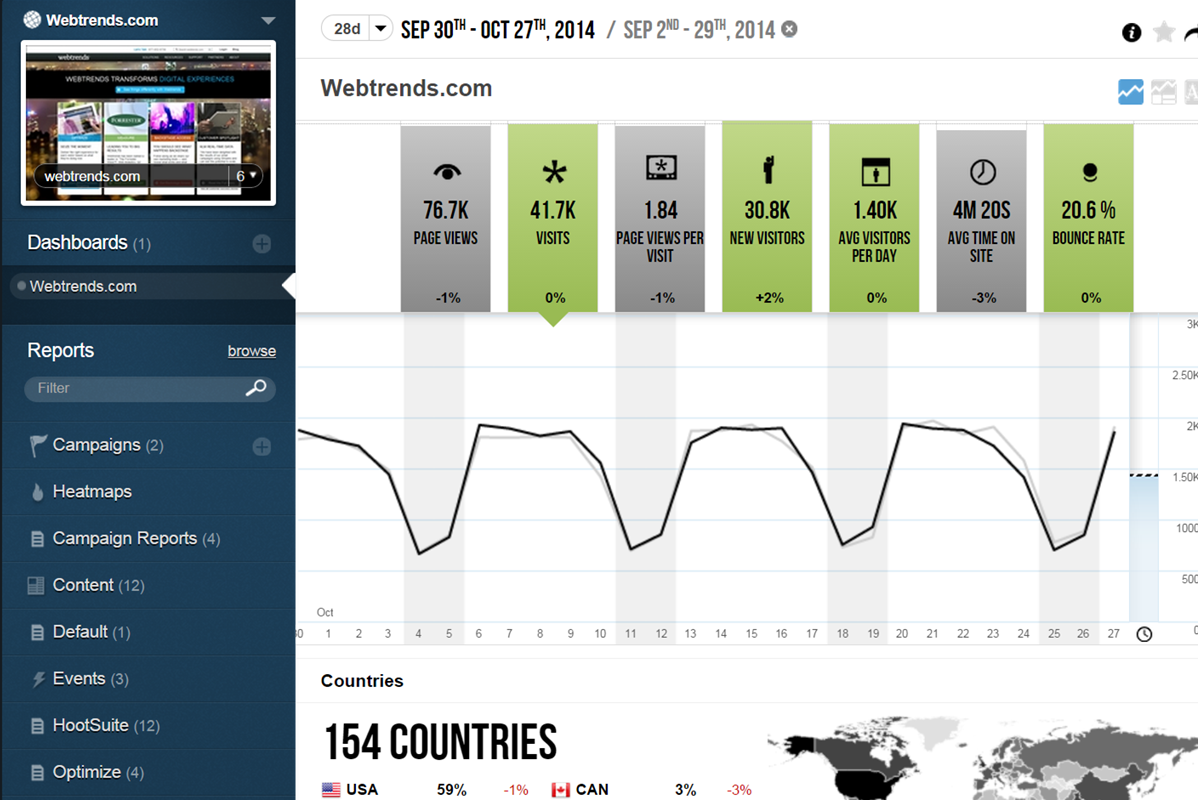
WebTrends provides an enterprise web analytics platform and, according to Forrester, has a strong focus on support for mobile and social channels and a very open platform. Webtrends competes directly with Adobe Site Catalyst, IBM Coremetrics. and comScore DigitalAnalytix.
N/A
Pricing
Act-On Software
Google Analytics
Webtrends Analytics
Editions & Modules
Professional
$900
per month
Enterprise
$2,000+
per month
Google Analytics 360
150,000
per year
Google Analytics
Free
No answers on this topic
Offerings
Pricing Offerings
Act-On
Google Analytics
Webtrends Analytics
Free Trial
No
No
No
Free/Freemium Version
No
Yes
No
Premium Consulting/Integration Services
Yes
No
No
Entry-level Setup Fee
No setup fee
No setup fee
No setup fee
Additional Details
The Professional package starts at 2,500 active contacts, 3 marketing users, 50 sales users and 30,000 API calls per day.
The Enterprise allows for much more customization, the package starts at 2,500 active contacts, 6 marketing users, 100 sales users and 30,000 API calls per day.
Annual contract required for all packages.
We chose Act-On for its ability to support our customers within a single account. The Marketing Network is a huge benefit to our business and the offerings we provide to our customers. In previously working with Hubpsot and Salesforce, we found the support to be lacking - often …
When our contract was running out, we were exploring all options. We looked at Pardot as the other option. Ultimately, we stayed with Act-On for three reasons.
1) The customer support is a slam dunk in Act-On's favor. In fact, I'm willing to bet there's not another marketing …
The cost of ownership vs. functionality and ease of use is second to none, add in the speed of implementation and their customer success programs and nothing comes close.
We selected Act-On because it provided our organisation with exactly what we wanted in terms of marketing automation. Data-driven insight, an easy to use nature and provided us with the platform to develop a high quality lead nurturing strategy, maximising the results of our …
Act-On was a much more price competitive product than Marketo and similair providers and had by far the best customer service and support. Act-On had no hidden costs and we were able to scale up when we needed to with ease. Other colleagues have advised that Act-On is also much …
Verified User
Employee
Chose Act-On Software
Act-On is so much easier to use and offers so much more in terms of marketing automation than RealMagnet. Act-On's email composer is also very much easier to use. List management is also much easier, and allows us to integrate with our CRM, making segmentation possible and easy.
We use multiple platforms for different clients. SharpSpring is great for clients that are new to the content marketing game and haven't had much of a business development / CRM tracking process in place while Act-On has a more robust platform with a larger suite of options. Str…
Marketo, Pardot and ExactTarget. ExactTarget didn't have the features we needed, Marketo had more than we needed and a much higher price, and Pardot was a pretty good comparison - their UI was a little more slick, but Act-On was easier to use and the core functions were better.
Act-On is an easy system to implement, learn, and use. They offer extensive training and onboarding to get you up and running in a very short period of time. Some of the other options like Marketo are extremely robust, and at the time seemed to be overkill for our small …
Verified User
Manager
Chose Act-On Software
I've used MailChimp and Constant Contact (both on lower level versions, not the more robust enterprise versions). I've evaluated Marketo.
The former two are not full service automation, but I would prefer them over Act-On solely for email services. I'd love Marketo, but I wasn't …
Webtrends as a platform is older than Google Analytics and still quite good. If you have a company that is used to using Webtrends, it's likely still a good fit for you. Google Analytics has a lower entry cost and more accessible training to new Users, so that's why I would …
We have been using Google Analytics for over 10 years. Over that time we have periodically reviewed our analytics platforms a number of times. For us, it made more sense to stay with google analytics primarily because if we migrated to another platform we would lose the …
We tested Webtrends and purchased Omniture (which we used for 2 years). Webtrends wasn't a good fit overall. Omniture was too cumbersome and expensive. The support was HORRIBLE and for a paid product it lacked some basic, no-brainer features.
We have used Omniture and WebTrends. WebTrends is an outdated analytics tool. Omniture, while robust is just not as customizable. Basically, if you have no intention or no need to do customization and you just want out-of-the-box reporting and not willing to spend the time in …
The cost-free aspect of GA is undeniably a key feature for organisations which don't require the level of customisation offered by the paid-for solutions. An organisation which opts for GA won't need any paid solutions to fill in gaps.
I find Google Analytics to be very limiting. This may also be the way that the reports have been structured by our organization. It is viewed as an older way to obtain the metrics we are after and no new projects are implemented through Google Analytics.
We currently use WebTrends, Google Analytics, Kissmetrics and ClickTale. I would like us to consolidate our activities to be focused on just Webtrends as it covers all of the requirements we have very well.
Using Omniture at my current place of employment and using Google Analytics as a backup at both, Webtrends is the clear superior product. I go back to how easy the UI is to navigate and how simple it is to get user level data that isn't duplicated or doesn't try to pigeon hold …
Compared to WebTrends, Google Analytics has a slicker interface, provides live site usage data, and is easier to jump into with basic usage. These days users expect to be able to create their own reports as needed, rather than have an "expert" do it for them. They are used to …
Webtrends has its work cut out for itself considering you have the behemoth Google Analytics and Google Analytics Premium having a strong offering and brand recognition for the price of free. After reviewing the paid service I'd suggest you start off with GA as a cheaper …
We've used Google Analytics - and Webtrends really wipes the floor with them. The data we get from Mixpanel can be mirrored in Webtrends - which is something we're working on at the moment with the Webtrends team. As for competitors to Webtrends, we did consider Adobe and …
Webtrends was selected because of the price for Google Analytics Premium ($110k per year) and Adobe Omniture Analytics (twice the price). Clearly, it needed the Visitor Data Mart to get additional capability that you would expect as part of a Web Analytics suite. In our case, …
I have only had significant experience with Google Analytics (GA) and WebTrends in this space. Overall - it is easier to learn and modify GA reports as a casual user - I always struggled with the fact that GA only offered partial data (sampling based).
Webtrends is just an option, depending on client budget. It's a simple analytics tool that does the job but we always recommend Omniture whenever possible.
We often have quick turnaround time requests, and Act-On's new composer is great because it is easy to make an email look great in desktop or mobile views. This has been a huge time-saver for us! We have benefited from using Act-On for many years and are accustomed to where everything is and how to use it. For the new accounts we train, we will sometimes hear that the organization of where things are could be improved.
Google Analytics is particularly well suited for tracking and analyzing customer behavior on a grocery e-commerce platform. It provides a wealth of information about customer behavior, including what products are most popular, what pages are visited the most, and where customers are coming from. This information can help the platform optimize its website for better customer engagement and conversion rates. However, Google Analytics may not be the best tool for more advanced, granular analysis of customer behavior, such as tracking individual customer journeys or understanding customer motivations. In these cases, it may be more appropriate to use additional tools or solutions that provide deeper insights into customer behavior.
Scenarios 1. If you want to use web server log files as input to your web analytics, then Webtrends will provides a good product, with great ease of implementation. Don't even think about being cheap on hardware, and make sure Webtrends runs on real servers, not in a VM environment. 2. If you want to use Data Tagging, similar to Google Analytics or Site Catalyst, Webtrends has a powerful product, just be prepared to pay. 3. If you are new to Web Analytics, but it is the strategic direction, start with Webtrends on Premises. Questions to Ask 1. What are you trying to accomplish? 2. Can you place a dollar value on the benefit that you expect/need from Webtrends? 3.Can you live with Webtrends running SaaS?
Control privacy, data sharing and competitive industrial knowledge using Webtrends on premises
Great control over custom reports, custom dimensions and metrics
Flexible tool which allows multiple methods of data capture. To my knowledge it was the first tool with a Tag Builder / Tag Management function built in via a supporting website.
The designer tools, especially for emails, were often difficult to use. The formatting of the text would be all over the place and change / refuse to change at random. Moving boxes around was shifty and sometimes nearly impossible. It just wasn't customizeable enough. No "undo" functionality either.
The only way to collect information expansively over time (there's a term Act-On uses for it, I can't recall) where it adds questions to the form each time a user fills it out, is if the person were to fill out the same form multiple times. I know this does happen for some websites/resources, but as a company that wanted to collect new information each time someone filled out any form, regardless of the resource or the URL, that was simply not an option, and that doesn't really make a lot of sense. I know it's not really possible to track someone but if they filled out the first part of the form and then it added new questions to answer, and then they submitted and got through the gating, that would actually be helpful.
There was no "trash can" of sorts in case you deleted something by mistake. This could be so stress-inducing if it was a major project. My coworker did this once, contacted Act-On, they couldn't even recover it.
The big downside, the elephant in the room, is that it does not (as of right now) have on-demand segmenting, drilldowns, etc. You have to think of what you want in advance and create those reports then analyze some data. This is huge. You can, of course, re-analyze old data after creating new reports but you still have to wait. (This deficiency may become obsolete with the release of Webtrends Explore later this month (May 2014).)
It has fewer mature integrations with other products and databases than competitors do, although I'm told it works with SharePoint better than anything else does.
Its attribution modeling capability is behind Google Analytics'. In my humble opinion, this could be changed quickly if Webtrends would make some tweaks to its standard visitor history files (i.e. preserve the order in which past visits were sourced beyond the single most recent one, rather than storing all those past sources as a randomized list).
It doesn't incorporate statistical tests, confidence intervals, or statistical associations. However, this same criticism can be applied to its competitors (other than A/B Testing products). It's a tabulation program, as they all are. In this respect, web analytics tools as a group are relatively primitive. Sorry to bring this up as a criticism of Webtrends but it's my pet peeve about the whole industry and I just have to say it. (p.s. take advantage of the heavy-duty Webtrends Scheduled Export functionality to get really granular data that you can feed to a stats program to get significances.)
Although the documentation, help screens, phone support and the knowledge base have improved tremendously in recent years, there is still a pretty steep learning curve because it is different from the tools that entry-level users may have already been exposed to. This can be a shock and many users are alienated at first because they just don't get some of the fundamentals at first. I'd like to see much better help screens that are thoroughly interlinked with the KB and documentation. Having superb online support would make a world of difference with the adoption of this basically powerful tool.
It's my single biggest asset in my current role. With limited resources, its enabled Anachron to punch well above our weight marketing wise and although we're still at the beginning of our journey I know the system can scale with us
We will continue to use Google Analytics for several reasons. It is free, which is a huge selling point. It houses all of our ecommerce stores' data, and though it can't account for refunds or fraud orders, gives us and our clients directional, real time information on individual and group store performance.
I would be willing to try Webtrends again AFTER some research from other users. I would need to see that users mention better and faster customer support on questions and issues that arise while using the software. The software is capable of vast and incredible things, but if it isnt properly set up and supported during use, it is just a big hassel and waste of everyones time and money.
It's a great tool for our business, and we get a fantastic ROI on it every year based on wins for customer service and automation responses. It's save projects, repaired salesperson/customer relationships and generated new sales and interest yearly. We really wouldn't hesitate to recommend this platform at all.
Google Analytics provides a wealth of data, down to minute levels. That is it's greatest detriment: find the right information when you need it can be a cumbersome task. You are able to create shortcuts, however, so it can mitigate some of this problem. Google is continually refining Analytics, so I do not doubt there will be improvements
If I could give it a 0, I would. Not having an intuitive user interface made it impossible to convince non-analytic business users to use the tool on their own. Even as a seasoned analyst, frequent calls were needed to get what should be simple tasks done. Account managers don't understand the tool either, and have to refer you to technical support
I have always found them quick to respond to my query by web inquiry. In those instances when I call, I have always reached help quickly. They are conscientious and skilled in discussing my concern and finding a solution to my problem. Other tech organizations should use Act-On as a model for top-notch customer service.
We all know Google is at top when it comes to availability. We have never faced any such instances where I can suggest otherwise. All you need is a Google account, a device and internet connection to use this super powerful tool for reporting and visualising your site data, traffic, events, etc. that too in real time.
This has been a catalyst for improving our site's traffic handling capabilities. We were able to identify exit% from our sites through it and we used recommendations to handle and implement the same in our sites. We have been increasing the usage of Google Analytics in our sites and never had any performance related issues if we used Analytics
The v9 admin interface and v10 reporting interface work as well as expected, but have a tendency to be pokey, especially for bulky reports and whenever you're connected to wifi. I much prefer using the REST API for all reporting for this reason, which simply dumps out the data and doesn't bother with the user interface.
Since we start using Act-on for ourselves and our clients, we have been supported very well. Often we need to integrate with legacy systems and we find the support team on our side during the whole endeavor. Always asking if they can help us further, always willing to do a better job. The support of Act-On is one of the main differentiators
The Google reps respond very quickly. However, sometimes they can overly call you to set up an apportionment. I'm very proficient and sometimes when I talk to reps, they give beginner tutorials and insights that are a waste of time. I wish Google would understand my level of expertise and assign me to a rep (long-term) that doesn't have to walk me through the basics.
I once went on to Twitter to ask for help from my network of analytics people, and Webtrends themselves responded. They have been an excellent partner in making sure that their product is being used to the best of it's ability and I greatly appreciate that. Both Omniture and Google Analytics, do not have that level of support over social media
The in-person training was comprehensive enough to get you started, but I strongly recommend having a more experienced person when beginning with the tool.
Act-On had a lot of resources, and their staff was great at answering any questions I had to make sure we got started on the right foot. Looking back, I would have preferred some additional training sessions since we didn't have any previous experience with Marketing Automation and best practices.
love the product and training they provide for businesses of all sizes. The following list of links will help you get started with Google Analytics from setup to understanding what data is being presented by Google Analytics.
Webtrends provides several free webinars over the course of the year, many of which I would expect to pay for. The people providing the webinars seem to have a good feel for real-world application of the product.
What impressed me most is that Act-On showed full committment in making our implementation successful, even when it required additional support from their team. This gave me a lot of warm and fuzzy feelings. Most other software software vendors are not anywhere close to being this responsive and effective
I think my biggest take away from the Google Analytics implementation was that there needs to be a clear understanding of what you want to achieve and how you want to achieve it before you start. Originally the analytics were added to track visitors, but as we became more savvy with the product, we began adding more and more functionality, and defining guidelines as we went along. While not detrimental to our success, this lack of an overarching goal resulted in some minor setbacks in implementation and the collection of some messy data that is unusable.
Careful planning and patience. Use a non-public test site to fine tune tags and reporting. Despite best laid plans, there will be surprises when you collect the data, run the analysis and begin generating reports using the tool. Perform a tag audit to ensure tags fire as desired.
Act-On is easier to use than Marketo, but not as visually appealing and user-friendly as HubSpot. It's much better than Pardot, as Pardot feel clunky every step of the way. SharpSpring is comparable because of its price point but surpasses Act-On in its tools and intuitive interface. We selected Act-On because of the pricing model and thought all things would be close to parity with other options. It depends on the team you have. If you have developers and a marketing team that knows some html/css, you can get by with Act-On.
I have not used Adobe Analytics as much, but I know they offer something called customer journey analytics, which we are evaluating now. I have used Semrush, and I find them much better than Google Analytics. I feel a fairly nontechnical person could learn Semrush in about a month. They also offer features like competitive analysis (on content, keywords, traffic, etc.), which is very useful. If you have to choose one among Semrush and Google Analytics, I would say go for Semrush.
Webtrends has its work cut out for itself considering you have the behemoth Google Analytics and Google Analytics Premium having a strong offering and brand recognition for the price of free. After reviewing the paid service I'd suggest you start off with GA as a cheaper alternative that is just as robust, if not much more flexible in regards to the reporting and goal tracking needs for our company.
Google Analytics is currently handling the reporting and tracking of near about 80 sites in our project. And I am not talking about the sites from different projects. They may have way more accounts than that. Never ever felt a performance issue from Google's end while generating or customising reports or tracking custom events or creating custom dimensions
With the Automated Series, we were able to put in place campaigns that generated revenue that took no time to continue running once set up. This was a positive feature allowing employees to work on another project while the campaign ran on their own.
Webtrends has had a positive impact on site visitation because it allowed us to understand the sources by domain for site traffic and find out ways to increase visits from those domains.
Webtrends has also allowed us to understand areas of optimization on the site, which has had a positive impact on the overall user journey on the site, likely leading to longer site duration and engagement.