Adobe Workfront, acquired by Adobe in late 2020, is a web-based project-management tool. It is designed for both IT and marketing teams, but can be implemented for any kind of project. Workfront offers all the features standard to project management platforms, as well as resource allocation, automation, and agile workflow.
N/A
Asana
Score 8.5 out of 10
N/A
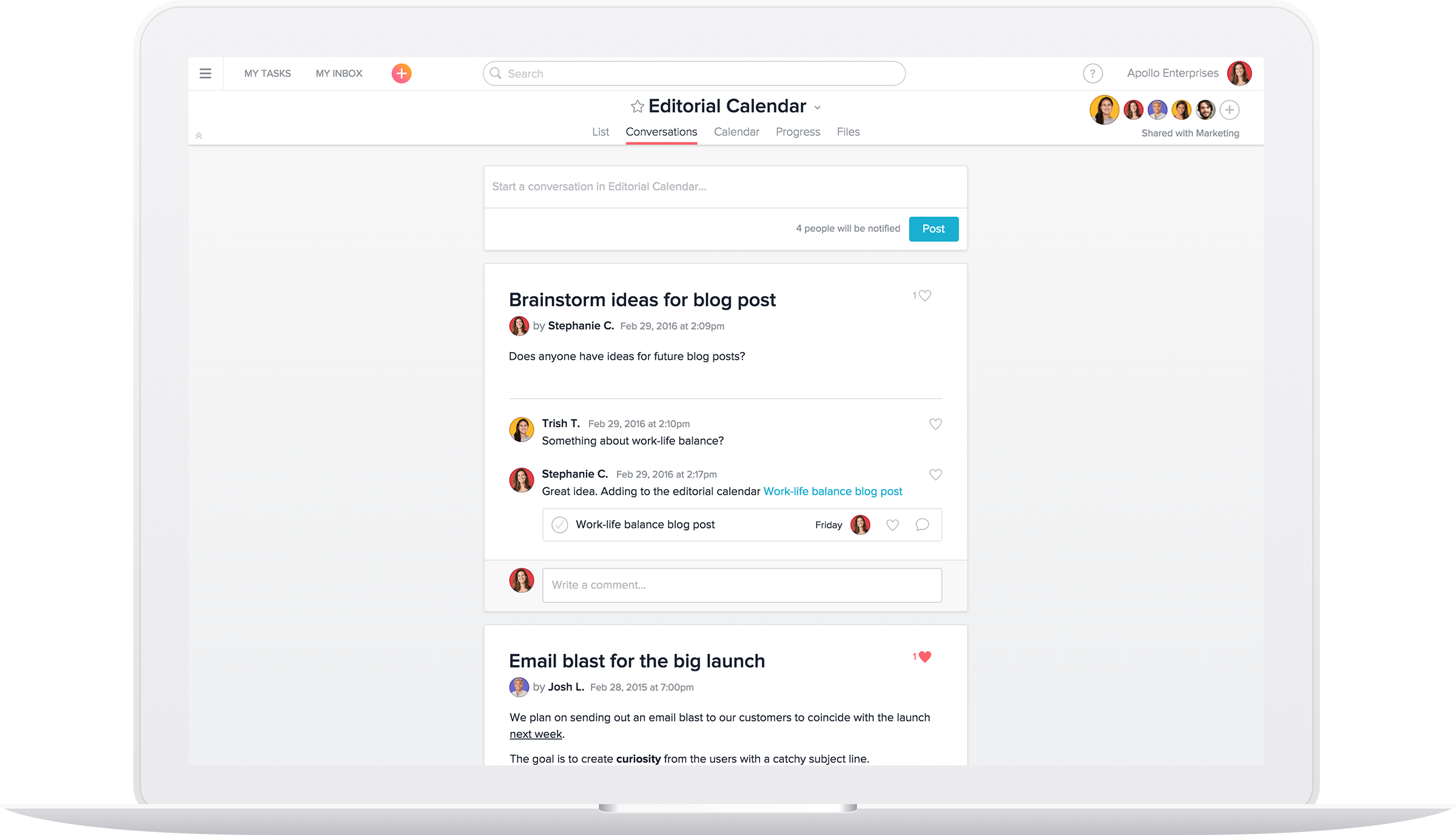
Asana is a web and mobile project management app. With tasks, projects, conversations, and dashboards, Asana lets an entire team know who's doing what by when, enabling workload balancing. Users can also add integrations for GANTT charts, time tracking and more.
$13.49
per month per user
monday.com
Score 8.3 out of 10
Mid-Size Companies (51-1,000 employees)
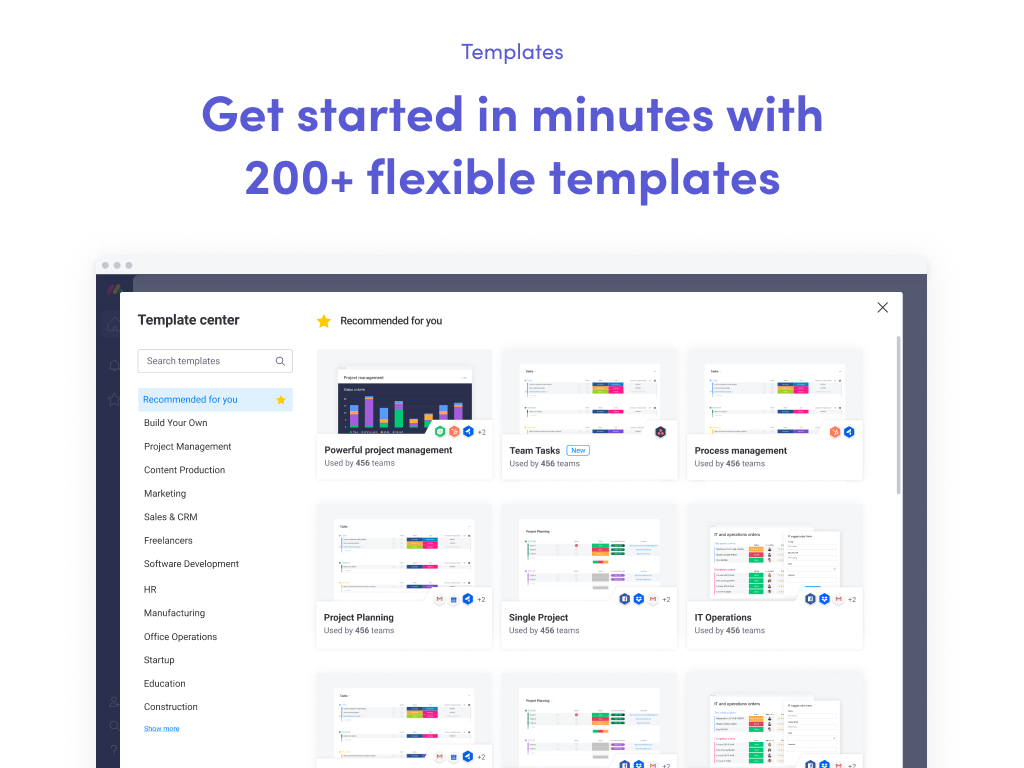
monday.com Work OS is an open platform designed so that anyone can create the tools they need to run all aspects of their work. It includes ready-made templates or the ability to customize any work solution ranging from sales pipelines to marketing campaigns, CRMs, and project tracking.
monday.com is better suited for a smaller company like the one I am working within. There are several other project management platforms that work within the Project Management space, but it's about personal preference. All of them have their pros and cons. Workfront is nice …
We also use Wrike and Asana. Workfront is way better for in-depth reporting compared to Asana, but lacks the intuitive task management that Asana offers. Asana is just easier to use. Workfront is night and day better than Wrike in almost every aspect. Better reporting, …
I would find that feature-to-feature comparisons and extensive features put Workfront at the same class level as Workamajig. It may come down to preferences and UX of the platform that would make for the ultimate decision on which to go with for project management needs. Asana …
Workfront is more robust and versatile than Asana and Smartsheets, which is why we did not go with those tools. It is pretty comparable to Wrike in many ways. We use Workfront over Wrike because we are set up in Workfront already.
For me, monday.com is a bit more intuitive and user-friendly oriented, but Adobe Workfront has more tools to administrate the available budget of the project, the utilization and occupation of the team members and the general progress of the project. However, it would be great …
My organization used Adobe Workfront due to familiarity with other Adobe products. But it was more manual than the system is replaced (DaVinci Workflow) so it was a struggle for my team at first. Using Asana currently, but we don’t have the full version with proofing so can’t …
Workamajig is great specifically for marketing project management. Jira is great specifically for software development project management. However, if you want all of the company on the same PM software, you need something less purpose-built. Asana is good for both, but lacks …
monday.com gives a slighly easier view of projects and ability to organize and access each project within a given task and timeline. Adobe Workfront is simple to use and manage, but I feel monday.com has a lower onboarding process and ability for teams to learn quick. Either …
Adobe Workfront simply offers a better user experience than Microsoft Project and monday.com. The ease of use, simplified training, and custom configuration made it the ideal choice for an organization of 100+.
I like the look and feel for Adobe Workfront better. It's cleaner and easier to read my work order. Asana looks a bit TOO complicated to navigate and often time it's harder to find things.
But I do like Asana's tabs better than Adobe Workfront. I like Adobe Workfront's pin …
I like both Jira and Asana. They both help streamline campaign processes and provide visibility into the work being completed by multiple departments. However, with Workfront, it syncs with other Adobe products, giving it an edge over other products.
Adobe Workfront doesn't stack well with these other tools. monday.com and Airtable have great interfaces and are very easy to set up and use. That is what my team currently uses.
It gave better structure for marketing/creative operations where intake, approvals and governance actually matter. Compared to Asana/Monday/Trello, it felt heavier but it handled standardised workflows, audit trails and stakeholder drived demand reliably.
We needed a single …
I love that Workfront is easy to configure and change as your organization grows. It's easy to stay up to speed with and make changes based on system changes and your organization changing. I also am in love with the reporting and custom data features. Custom forms and the …
Compared to other software which the organization had implemented before, Workfront has proved to be the best because of its detailed project reporting capabilities. Also, its ability to facilitate virtual proofing has been of great benefit to our project planning team. …
Our team chose to implement Workfront for its detailed project reporting capabilities. Furthermore, Workfront's ability to perform complex virtual proofing is a huge benefit to our work team. Overall, my team's experience has been extremely positive as we continue to implement …
Asana is simpler and easier to manage than Teamwork Projects and Wrike for smaller teams, but still offers more features than Basecamp and requires a lot less customization than monday.com.
Personally, I didn't have a say in this as I had not started at the company when the team decided on Asana. That said, I have used monday.com, and we also have JIRA, which is used by our dev team, and us occasionally if we need to. JIRA has too many bells and whistles and is …
We selected ASANA based on the feature set, and ease of rollout. monday.com had very good workflow automation but we found that ASANA was quicker and easier for staff to build a task eco-system that worked for them.
Zoho Projects was a very strong contender but was much more …
Side by side with the other two Asana by far beats monday.com and is comparable and slightly better than ClickUp. Monday is completely browser-based and is hard to navigate and figure out how to set up. Asana and ClickUp are the exact opposite. Both are easy to set up and …
Verified User
Employee
Chose Asana
I prefer Asana's user interface over monday.com. Asana's app is also incredibly helpful and I am not sure if monday.com's app is as loaded with features as Asana's is.
Asana is a top-tier project management software that helps us organize and track projects from start to finish. It allows us to apply tasks/to-dos to multiple projects without duplication, divide complex projects into smaller tasks, and track project progress. It also helps us …
The other agency we were working with selected Asana as it's a tool with easy access. Other more broad project management tools require contracts and setup time, this is easy to create an account and login to. We used it for one project and it helped give a full picture of the …
I like how extensive the capabilities are for Asana. With other softwares it seems there are many things lacking. I feel like Asana is also a very user friendly platform and aesthetically pleasing which is important in a modern office. We have many young people entering our …
Asana does well at the assignment of tasks and task management, but it is not a resource planning tool. Other tools do better at resource planning and some principles of agile/scrum. It is simple and easy to use within the mobile application and on desktop, but it doesn't have …
Asana hit our sweet spot of easy to try, appropriate pricing for our mid size non-profit team, flexibility, and features. Lots of other platforms have very similar features organized in other ways, but Asana made sense and was fun to work with right off the bat. there were …
Asana is more complex than other alternatives that we have used within the organization, but is great for organizations with upwards of 10 people inside a department
Asana has a better user experience and user interface than other project management software I have used. It is much easier to learn than the other products, and I have been able to customize its use in better ways than I have accomplished with others. Much more than a to-do …
Asana stack over its various major competitors as its costing is quite under budget. The support to user is 24 x 7 and call centers available. The mail reply within 24 hours. Apart from it its user community is quite big and helps in the system to grow. It is widely accepted in …
Asana is lightweight and relatively inexpensive. For our marketing and advertising team, it works great. For teams with stricter needs (development teams, product teams, and other scrum teams), looking at other options might be worthwhile.
There were a combination of factors that led us to decide on Asana, including ease of use and external system integrations, but primarily we could use it across geographically distributed offices successfully and incorporate a variety of end user work flows based on global …
Lead Graphic Design Specialist/ Social Media Marketer
Chose Asana
Asana and Monday are similar in that they are both task tracking softwares however I feel that Asana is a bit too simple for our team as opposed to Monday. Asana is great for a small to medium sized team, we are looking for a software that we can use across multiple departments …
Asana is very simple and straight forward, other more expensive products offer more features but require you to do project management their way. Asana provides a nice interface for task management.
monday.com
Verified User
Manager
Chose monday.com
Monday.com's layout is closer to a spreadsheet, and has better features to categorize and search data. I can go deeper, adding more and more insight to a task, than I could with a card, even when I used premium add-ons. I couldn't get a good grasp on what was going on with Asana…
I think monday.com is a more complete tool than Asana or Trello. It has many more features and help for many other things, such as integrations and automations.
I didn't select monday.com. The company where I work did it and I don't really know why.
monday.com seems to solve the issues and concerns for our marketing and graphics needs. I personally use Asana for my projects and tracking purposes and monday.com for my interations with Marketing and their needs.
I would say this is one of my least favorite applications. I don't find it super user friendly due to the extreme amounts of customization. It feels like my information is in there somewhere, but I can never find it easily. I think that it looks a lot prettier than Asana which …
When I arrived at my org, I was initially disappointed to hear that we used something other than Asana for project management. Fast forward just a few months, and I became a complete monday.com convert. While its organization is similar to Asana's, it's user interface, …
I didn't use Asana that much, and I kind of liked it, but the visuals of Monday.com are just way more appealing. Also, I found Monday's customisation and adaptability stronger and easier than Asana's.
It's been a while since trying Asana, so it's hard to say. I think they are very similar from what I remember, but maybe monday.com has more reporting and customization possibilities?
monday.com is far superior to Microsoft Planner and Basecamp, and arguably superior to Trello and Slack Lists as well. Asana (for work management and Zendesk (for request management) put it to shame. My main monday-using client selected it primarily because of its slightly …
Workfront offered a more intuitive user interface, which made team adoption easier. It also included additional products that aligned well with the needs of our Dev, Work Management, and Service teams.
monday.com offer much of the standard tools and seems to be ever evolving. They seem to take feedback and constantly upgrade the tools. If all the tools are there, the differentiating factor might be the cost, any integrations you may need, and the visual "chemistry". To me, …
As a developer, I have utilized the mentioned apps to integrate processes for clients, and I have found monday.com to be superior due to its abundance of features compared to others. Choosing monday.com provides enough capabilities for teams and managers to handle work in one …
I also use the other selected. But I prefer monday.com because it is more clear (visually and intuitively), and also because I have been using it for longer than the others. However, there is the price factor that must be taken into consideration
I'd put monday.com and Asana on par, then ClickUp and lastly Jira. Jira would be more appropriate for exclusively technology engineering teams. Jotform offers better choices for forms use cases especially ones with complexity. Zoho makes more sense when you have the full suite, …
Airtable served us well for data management. However, our senior management told us Project Managers we would no longer be using Airtable. monday.com serves us well with project management AND light-weight database usage.
Workfront served we Project Managers very well. However, …
Is far away the best!! With monday.com I find everything I need easily. As I said before, its user-friendly interface, which is intuitive and easy to navigate.
Although monday.com costs more than the other services, it can handle more as a platform. The functions, features, integrations, and automations allow you to do so much more than, than just keeping track of project & task deadlines.
Monday.com is much easier to use and isn't as complex. We didn't need a complex project management tool for what we are using it for, and monday.com is perfect for that.
Monday is much easier to use and learn. So far everyone has figured it out just by using it or after watching a brief training video. Most other tools have parts that we wouldn't use or be just too complicated for the average user. We feel with Mondayulse we are not struggling …
Basecamp has some very nice project management features but Monday.com really focuses on task management and keeping teams accountable/organized. We fell in love with the visual task boards that Monday.com offers and that's why we chose to go with it. We also really enjoyed …
We have tried many other project management programs. In the end, we were able to customize Monday more easily to fit our team's needs and handle more things in Monday than the others. It's nice to have everything in one place (campaign planning, team task lists, upcoming …
Candidly, we still use both as monday.com and Smartsheet, as monday.com only recently added dependencies, and that was integral to our proposal and pricing process.
It works super well for creative brief intake and brand reviews. It took us more time than I'm willing to admit to get it all set up, but for our limited use case, it's working very well now. I'm not sure where it wouldn't be a good fit, honestly. As a newer user, it's still something I'm getting to know and learn.
The usability of Asana is broad since it's available in a variety of platforms that are widely used nowadays. I think that it would be great for people who are constantly on the move and switching devices, since it has allowed me to work from my phone, too. I also think that Asana has proven itself to handle a large quantity of work
The platform has a good deal of versatility and extensibility, but I do not feel it is well suited for anything too complex. More complexity seems to bog down performance and increase maintenance to keep everything humming. As much as possible, avoid creating too many bespoke workarounds that will end up creating tech debt. The platform seems to work best for more straightforward scenarios and smaller to mid-size companies. Pricing can be reasonable for specific teams, but can feel a little too pricey for company-wide usage. It has served us well for the early stages of our company, but we find ourselves offloading the more complex use cases to other apps specifically developed for those, and reducing to just those teams that are more deeply embedded in the functionality.
Through it, we were able to communicate and cooperate with the rest of the team to complete the work in the required manner and at the appropriate time.
I like summary of subitems, especially with subitasks as subitems and add item tracking for each subtask it can show total tracked in parent item. Similar with other columns, like numbers, status, date.
Dashboard features, Many kinds of dashboard view available, we can utilize on the basis of requirements.
monday.com workform is very powerful, easily share form link when submitted it will create line item in board with provided data.
monday.com automation is very helpful in order to automate steps with specific rules and easy setup.
monday.com also provides integrations in order to automate processes if need to integrate multiple app together. or need to transfer data between multiple apps.
Allow nonusers to add requests, our organization has no need to add all 10,000+ team members to Adobe Workfront, but would like them to be able to send requests to our team
I would like to see our company logo show up larger on the form feature.
I prefer the version of the form they have now instead of the new version for 2025. The current form shows the questions in bold font, and the new version does not. This may mean it could take our volunteers longer to get to the pertinent information on the form.
It would be nice if monday.com staff had monthly webinars showing how to use some features. such as, using formulas effectively.
Workfront is sometimes a bit clunky to use, but overall it works well for our teams when it comes to project management and collaboration across multiple, involved teams. It also has flexibility that allows us to adapt it to diverse use cases, some of which aren't necessarily always the first things that one would think of using workfront for.
Teams involved in content creation, such as marketing or editorial teams, could use monday.com to manage the entire content lifecycle. Boards might track content ideas, assignments, drafts, reviews, approvals, and publication schedules, helping teams collaborate and keep content production on track.
Workfront is overly complex, but it is functional as a tool to keep track of projects. It is a shame that sometimes it takes a lot of clicks to find anything. Workfront is slowly modernizing its interface but at the same time, hides certain information away thus making the experience feels worse.
It is very user-friendly. Takes a new employee an hour to start figuring out how the system works. That's an important factor. You don't want to encounter the issue where employees need a week to understand how the system works. For example, JIRA, I tried using it for a week and I still don't understand the complicated layout. Asana has a simple interface. Once you see it, you get it type of program.
I give monday.com a 10/10 because I almost never encounter any lag or connectivity issues despite all of the many templates, boards, and automations we have. As a matter of fact, I feel like the last issue I encountered was over a year ago... and I'm in monday.com every single work day. Not only is monday trustworthy, it is easy to find what I'm looking for... making the overall usability extremely hard to beat.
Maintenance is required, but usually after work hours, Some days the proofing tool function is not operational, but this is a new function of the tool that WF is working out. the kinks on. Chrome is the best browser to use the system in and we find Firefox and Explorer lose some view functionality - Gantt Chart, Resource Grid
I think overall, Adobe Workfront performs well. There have been some times when it doesn't load or run as quickly as our team would like. This is frustrating when it is such a crucial tool that our team utilizes on a daily basis. It can show our workflow when it lags.
Everything performs fairly well. Every now and then there are user errors where an employee will not click "ok" on a note they've created and simply exit out (I do wish that something was in place to prevent this, such as a pop "are you finished?")
I know that this particular company has it's own Adobe Workfront employee that builds out things they need from the software, and meets with them regularly to troubleshoot. I'm not part of this process, but it's refreshing to see Adobe provide this level of customer service to people, and they're expedient.
I haven't had to use their support so I can't rate it. The fact that I haven't needed them reflects the ease of use of the product. I would recommend that any new users schedule a complete demo of the product to ensure that they are using it to it's fullest (there's a lot of useful features).
monday.com only really care about accounts that have 20 seats or more. While this is great for monday.com, it pushes smaller organisations to evaluate alternatives. We rate monday.com highly in our organisation because key staff have already got good experience with the application and we know we will get to 20+ seats one day. But, till then the billing model and lack of permanent enterprise features is a dread.
The training is very easy to use and you can simply choose the topics included in the course(s) that are most important to your training needs. After each training course, you are tested on what you have learned. If you need a refresher course, they provide Course Catalogs as well as instructor-led courses & workshops.
To have someone walk you thru the features and capabilities of Monday.com is priceless. Someone also coming along later in the contract to see if you are maximizing the program to suit your company needs is beyond helpful. The staff that have provided this training are fun, creative and very patient.
Most people learn as you go, a lot of this stuff requires trial and error throughout so my suggestion is to provide as much information in the upfront and keep it as simple as possible. You can add other tools and features as you go but everyone should have the basics down so no bad habits can start to develop. Be persistent with everyone, and don't be afraid to correct and talk through steps again so everyone is on the same page
We signed up for the accounts. Created the accounts. Ran the trial version and tested it live while we were running multiple projects and found that it was fitting our needs perfectly. When the trial ended and we were asked to purchase the full version, we did. We have found other ways to use it and it's a breeze.
Adobe Workfront blows the other systems out of the water. It just delivers more - out of the gate, and at every quarterly update. Innovation is top of mind, and meeting customers' needs is key. We have been extremely satisfied with Workfront and look forward to all the new features on the horizon, especially AI.
Asana is a top-tier project management software that helps us organize and track projects from start to finish. It allows us to apply tasks/to-dos to multiple projects without duplication, divide complex projects into smaller tasks, and track project progress. It also helps us organize work on Kanban boards or linear lists. It stands out from the crowd in a big way compared to the competition.
monday.com is cleaner, offers more customization and is easier to design out with a team project focus in mind. With the ability to automate steps as well, it is super easy to move tasks along, have stages auto-update and to go through my personal to-do list of tasks to get things done.
As I stated earlier, I didn't have to pay for Workfront myself- I'm a user under a large organization. I know it's not cheap to implement, I don't know how the price scales for a small-business, but I do like the product enough that I'm going to look into it in the future for my own company.
Our organization has thousands of users that use Workfront and it seems to hold up very well. I have not encountered any issues using it and I think it makes it very easy for multiple people to be involved in a project and keep things organized and clear for everyone involved.
For it to work across multiple departments and sites, I would like to see improvements made with integrations and automation. For this question, I am acknowledging not only the addition of internal triggers/automation, but also an expansion on external ones.
Resource Management - Year over year, we were able to validate time and money saved by the implementation of Workfront by more than 2%, saving in non-working dollars and 9% savings in working media dollars.
Organization Restructuring and Automation- We also restructured our teams and implemented automation based on our analysis of how and what we spend our time on and the ROI for our respective business units.
Much easier to review my prior month and report to clients on work completed; easy to extract the information and work done to Excel to add budget tracking etc - I see this is possible in monday.com and I will investigate how/if this is possible on our current plan.
Very fast and easy set-up of Boards.
Still lots to learn and grasp - many more opportunities to become more efficient using monday.com. I'm only just getting started.
The initial automations are quick and easy to set up, and if set up correctly.
My month-end client status and progress reports are now more accurate, and I can keep track of all the information in one place (inside monday.com).