Basecamp is a web-based project-management tool. Basecamp offers features standard to project management platforms, as well as mobile accessibility, unlimited users, and 3rd party integrations. Basecamp is priced by space requirements and concurrent projects.
$15
per month per user
Google Workspace
Score 9.1 out of 10
N/A
Google Workspace enables teams of all sizes to connect, create and collaborate. It includes productivity and collaboration tools for work: Gmail for custom business email, Drive for cloud storage, Docs for word processing, Meet for video and voice conferencing, Chat for team messaging, Slides for presentation building, and shared Calendars.
$6
per month per user
monday.com
Score 8.3 out of 10
Mid-Size Companies (51-1,000 employees)
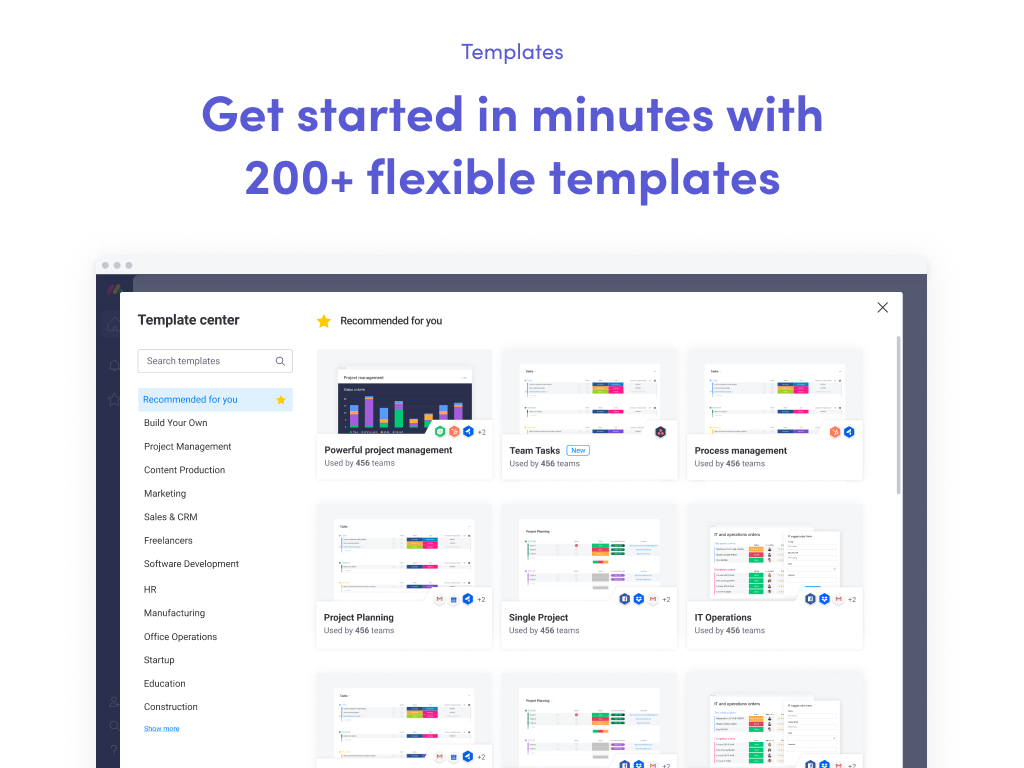
monday.com Work OS is an open platform designed so that anyone can create the tools they need to run all aspects of their work. It includes ready-made templates or the ability to customize any work solution ranging from sales pipelines to marketing campaigns, CRMs, and project tracking.
JIRA is a project management tool for IT developers built on the Agile principle, while Trello is built on a board style methodology. monday is a grid style project management tool that works great for visual project management. Basecamp on the other hand is all about team …
Basecamp is probably towards the bottom of the totem pole here based on what our needs were. Trello lacks reporting as well, but there's much more customization with Trello. Asana has more reporting and integration capabilities. monday.com is my favorite so far. The amount of …
We moved from Basecamp to monday.com. Monday is much better suited to an environment where most projects are similar to other projects you are currently working on or have already completed. Monday isn't as "social" or as "community building" as Basecamp, but we've always used S…
We found that Basecamp worked better for our needs than these competitors. ML is a bit slow for our purposes, and it doesn't handle images/video in as nice of a way. InVision could potentially work alright for our needs but would require too many different screenshots being …
Basecamp is the best application we've found for our team to interface with external clients. It makes project management simple, and allows our clients visibility into their projects, which in turn builds trust, fosters open communication, and improves customer satisfaction. …
Basecamp is a feature-rich and user-friendly platform that outpaces other solutions we've explored. The vast number of integrations available, as well as the years of dedicated developers as well as the natively available mobile apps, really make Basecamp a leader in this …
Trello is less expensive and the free version works pretty well. For the paid version, Trello is also a really great tool. Overall, I do like Basecamp better. It's a more simple layout and structure to the software. I like the communication threads better on Basecamp. Trello …
Basecamp is simple to understand, easy to use, and does not come with the bloat and complications of a solution like Teams. It is certainly more organized and easy to follow than simply having a group chat on Slack and Viber. If you need to easily find information, it can be …
There is a simplicity that basecamp offers where most other project management systems seem to miss. They've worked hard at keeping the right things in place and not adding so many of the extra features that just get in the way of getting work done. The thing I liked most …
We selected Basecamp for the low cost of entry for the org and the number of users who had previous experience on Basecamp. We ultimately will be transitioning to another project management tool that includes relational decision capability and Gantt chart capacity.
Comparatively, Basecamp has been found to be the easiest to use and onboard new users. Additionally the cost model for our organisation is much lower on Basecamp compared to the competition.
Other products are more aligned with Agile practices but for most of our operational …
Verified User
Contributor
Chose Basecamp
Basecamp seemed to be more user-friendly compared to the others I've previously used. It is really easy to use and doesn't require intensive training for its users.
I have used both Asana and Basecamp and have liked both for different reasons. I like Asana for solo projects and to keep a running to do list. I think the layout and interface just works well for that. For client projects, I think Basecamp is better because it's a bit easier …
Lead Graphic Design Specialist/ Social Media Marketer
Chose Basecamp
Basecamp is a similar type of software but is on a totally different playing field than Monday. Basecamp is definitely a lot more bare bones, it is a task tracking software and that is all. Basecamp is more of a "To Do" list where as Monday is a full-on task scheduling, time …
Haven't tried any other software or platform other than Basecamp, but before the purchase process we reviewed other products and they seem very similar and the decision that got us to buy Basecamp was because of the price and the understanding of the web page related to the …
Google got a good jumpstart on building out a more comprehensive and consolidated platform. Microsoft has been around such a long time that they still have some archaic tech debt in their platform. Dropbox feels like it decided to pursue the more comprehensive suite a little …
From an ease of use standpoint, Google Workspace is far simpler and easier to use. It offers what we need where Office offers too much of each app/service adding complexity over convenience. Our prior use of Office and even some occasional use of 365 just as a backup is often …
The closest comparison to G Suite, specifically Drive, is Dropbox and Sharepoint. Sharepont is clunky and hard to use, and ended up costing us more time trying to use it then it saved us. While Dropbox was much better, it had a higher cost and less features than G Suite, and …
Part of our organization is still using Basecamp. I am leading my team with Dapulse, because its visual platform and capacity to measure progress across the boards helps me lead our team better. Basecamp has great features, but Dapulse is helping me visualize. As a creative …
With both Asana and Basecamp, unless you are the organizer, it is very hard to control how much information you are receiving. That is one reason we chose dapulse because each specific user has more control over how involved they want to be. Asana and Basecamp are also both set …
I've used Basecamp, Central Desktop & SharePoint in the past. And they're fine. But this had a nicer user-interface and a free trial period to let me use it and determine if it could be useable by the team.
Basecamp has some very nice project management features but Monday.com really focuses on task management and keeping teams accountable/organized. We fell in love with the visual task boards that Monday.com offers and that's why we chose to go with it. We also really enjoyed …
I'd put monday.com and Asana on par, then ClickUp and lastly Jira. Jira would be more appropriate for exclusively technology engineering teams. Jotform offers better choices for forms use cases especially ones with complexity. Zoho makes more sense when you have the full suite, …
Jira can be complicated to setup, but offers the most versatility. Basecamp is simple to use; however, doesn't provide everything a team or many teams may need. Monday fits in the middle and is easy to use and versatile.
monday.com is far superior to Microsoft Planner and Basecamp, and arguably superior to Trello and Slack Lists as well. Asana (for work management and Zendesk (for request management) put it to shame. My main monday-using client selected it primarily because of its slightly …
Monday.com is the broadest scope work management software I have used. Its interface is basic and takes some getting used to, but the programming options are highly advanced and extremely effective.
monday.com is simpler and easier to grasp, apply and navigate than ClickUp, but the ClickUp free version has so much more functionality available than the monday.com free / low-cost options (sorry, but it's true!). Google Tasks is really simple and I shouldn't really compare …
I actually prefer Salesforce because it is more customizable and has better integrations for day-to-day asset and task tracking. However, I do like the Gantt chart feature with Monday and have a hard time finding a better alternative.
I think monday.com is a more complete tool than Asana or Trello. It has many more features and help for many other things, such as integrations and automations.
I didn't select monday.com. The company where I work did it and I don't really know why.
Although monday.com costs more than the other services, it can handle more as a platform. The functions, features, integrations, and automations allow you to do so much more than, than just keeping track of project & task deadlines.
Monday is much easier to use and learn. So far everyone has figured it out just by using it or after watching a brief training video. Most other tools have parts that we wouldn't use or be just too complicated for the average user. We feel with Mondayulse we are not struggling …
Monday.com is definitely a good platform—it has the things you need if someone is looking for a project management software, but we found Airtable and Google Sheets as fine alternatives to what we wanted at a lower price. Teamwork was also good and they had a free version for …
We have tried many other project management programs. In the end, we were able to customize Monday more easily to fit our team's needs and handle more things in Monday than the others. It's nice to have everything in one place (campaign planning, team task lists, upcoming …
Monday.com has been the first task management/project management tool we have assessed that met every need our digital agency requires. And to top it all off, we've had an amazing time with the customer support team, who have been helpful and timely in their assistance. We …
Learning Management System Analyst -- CornerstoneOnDemand
Chose monday.com
We selected monday for the user interface. The idea we had in mind for how we wanted to set up updates and workflows just aligned perfectly well with that monday offered. we had to create accounts for everyone but once the setup/homework was complete the workflows fell into …
Monday.com is overall a better program that is much more visually appealing. It's easy to use as well and couldn't see using another program at this point.
dapulse is much more organised in terms of the platform functionality and general layout. It's easier to use and easier to use as a group tool and central hub for our team.
Dapulse is great for team checklists and assigning tasks. It is a great way to see everything in one spot. I like that I don't have to sign out and into another system to see other projects. It gives me a good look at what needs to be done and by whom.
Basecamp is a wonderful tool for teams of varying degrees of technical knowledge, teams managing lots of different types of "agifall" and waterfall projects, and teams that are remotely distributed. It's probably less useful for more strictly agile-focused development teams, compared to other more flexible software applications like Jira and Asana.
Google Workspace does offer several different plans that can match well with the stage of your business. As your business grows, the higher plans can provide the better tooling or expanded features/products to scale with your needs. It would probably become very complicated to swap over to, if you are deeply embedded with another competitor. But, it could be a nice platform to consolidate several disconnected systems under one roof.
The platform is very well suited for our nonprofit programs that serve low-income clients who need diapers, wipes, and period products. It has helped us run our programs, capturing information and allowing us to view the data for reporting purposes. The ability to filter data is very helpful by allowing us to categorize information to get a better picture of the progress of our programs.
Task management - It is very easy to add, organize and discuss tasks within Basecamp's interface.
The "Campfire" function is great for communicating when you just have a quick question for someone on the team.
Notifications - Basecamp lets you decide how often and about what you'd like to be notified. The ability to respond to messages in Basecamp directly via email saves a lot of time.
Google Calendar...amazing. I don't need to ask team members when they're busy anymore and play this game of bouncing times back and forth. All I need to do is enter their email address and it shows my calendar and theirs side by side and then select the day and time I find that works best for the both of us.
I actually prefer Google Meet over Zoom. Zoom bogs down my computer and I find their UI overcomplicated for what it actually does. Google Meet is simple and does practically everything Zoom does without needing to pay any extra money.
Sheets integrates with our CRM (Copper) so it's perfect for us. Being able to export information out of our CRM into sheets and then create pivot tables from that data makes our lives a million times better.
I like summary of subitems, especially with subitasks as subitems and add item tracking for each subtask it can show total tracked in parent item. Similar with other columns, like numbers, status, date.
Dashboard features, Many kinds of dashboard view available, we can utilize on the basis of requirements.
monday.com workform is very powerful, easily share form link when submitted it will create line item in board with provided data.
monday.com automation is very helpful in order to automate steps with specific rules and easy setup.
monday.com also provides integrations in order to automate processes if need to integrate multiple app together. or need to transfer data between multiple apps.
High Learning Curve. It's true that it can be easy to use, but to use well and effectively takes some time to learn. It's recommended to have an agreed-upon system in your team of what tools to use and when.
Notification Overload. If people aren't careful they could send a notification to everyone when only a couple people were meant to be prompted. And since emails are sent by default, you could have your mailbox overloaded with unnecessary updates. This is where it takes a bit of training in your team to have an agreed-upon system.
Lack of organization with Archived Projects. I will often need to reference an archived project to make a new one, but there is only a list of archived projects in alphabetical order, with no way to organize by archive date, or even search.
Pricing is a little bit higher than other services
The cost of each email inbox costs the same whether you want just email or all of the features. For example, we wanted a support email address that we could setup our support desk with. The cost of that added account is the same as the account I use with all of the features.
They removed their free tier for small organizations like mine and restricted the free tier from adding new domain names. This was likely due to abuse, but everyone lost the privilege of the free service.
The desktop app for Mac seems to have a few issues with visual glitches appearing on screen, it only seems to go away when I close the tool and reopen it
Subtasks don't show on the individual users to-do list, only main level tasks
When I bring new people onto a project, it's immediately obvious how to use Basecamp. I don't have to worry about teaching them the features or walking them through it, it's just incredibly user-friendly. For this reason, I'll continue to renew my subscription even as new people are brought onto production jobs or the client changes.
There is no better solution for cloud storage and real time collaboration. The amount of features included in G Suite is unmatched and out of other things we’ve tried over the years, nothing comes close to being as great of a tool.
Teams involved in content creation, such as marketing or editorial teams, could use monday.com to manage the entire content lifecycle. Boards might track content ideas, assignments, drafts, reviews, approvals, and publication schedules, helping teams collaborate and keep content production on track.
It is easy to use, even for clients who have no experience with the platform. It can only get a little cumbersome to ensure that a client can't see certain documents you might want to keep in the Docs & Files folders. And sometimes, getting a client to actually use an unfamiliar platform can be a challenge.
Google Workspace is incredibly intuitive and user friendly. It's easy to adopt through simple features, for example the prompts to enable Gemini on each call for note taking is reliable, and helps to stop you forgetting to use the feature. The main reason for a strong rating is the consistency and reliability, whilst there's definitely areas for improvement, for example additional calendar features (sharing), or deeper functionality in sheets. The level that it provides means that anyone adopting it will be able to take full use of features within a day or two. Gmail, calendar and the documentation suite contain all the basic features for a small / medium business to run at a high level day to day, with minimal downtime or learning curves.
I give monday.com a 10/10 because I almost never encounter any lag or connectivity issues despite all of the many templates, boards, and automations we have. As a matter of fact, I feel like the last issue I encountered was over a year ago... and I'm in monday.com every single work day. Not only is monday trustworthy, it is easy to find what I'm looking for... making the overall usability extremely hard to beat.
I've never experienced downtime while using Basecamp, or been unable to access it when I needed it. That's not to say they've never had downtime, but I've been lucky enough not to encounter any, and I work odd hours, including late nights when maintenance is often undertaken.
Everything performs fairly well. Every now and then there are user errors where an employee will not click "ok" on a note they've created and simply exit out (I do wish that something was in place to prevent this, such as a pop "are you finished?")
For the many reasons I've given, Basecamp is a very strong program. There are a few features I can imagine that might make it even better, but I don't have a basis for comparison to be able to say that there is definitely a better one out there. I've noticed that Basecamp has evolved a bit from the time I started using it until now, so that makes me think that the producer of this program values it and believes in continuous improvement. If you could use the features offered by Basecamp, I would think you could use it with confidence.
My experiences of getting support have been positive. Calling in is not overly difficult, but it does require getting a PIN. The knowledge of those responding to the calls has been impressive. I have managed to work with them to fix two Google bugs that I had identified. These bugs required a some technical expertise and the support staff were able to understand the issue and forward the concerns to the appropriate persons. The first bug was fixed with 24 hours. The second bug took a little longer, but it was also more complicated to reproduce.
monday.com only really care about accounts that have 20 seats or more. While this is great for monday.com, it pushes smaller organisations to evaluate alternatives. We rate monday.com highly in our organisation because key staff have already got good experience with the application and we know we will get to 20+ seats one day. But, till then the billing model and lack of permanent enterprise features is a dread.
To have someone walk you thru the features and capabilities of Monday.com is priceless. Someone also coming along later in the contract to see if you are maximizing the program to suit your company needs is beyond helpful. The staff that have provided this training are fun, creative and very patient.
Decide the process before implementation - i.e. when it's due 8/9 does that mean 8am, noon, 5pm, 11:59pm? Check your to-do list frequently Set-up templates - just not with the dates (they can be funky)
We signed up for the accounts. Created the accounts. Ran the trial version and tested it live while we were running multiple projects and found that it was fitting our needs perfectly. When the trial ended and we were asked to purchase the full version, we did. We have found other ways to use it and it's a breeze.
Pretty good, but [Basecamp] has its drawbacks. Honestly I find the interface non-intuitive and sometimes have trouble figuring out how to change the status of a task. Perhaps it has something to do with the way it was originally set up by the admin, but I'm not sure. I liked Jira's drag and drop obvious functionality, but the project management side of the software was lacking. Smartsheet has excellent project management functionality, but the task management isn't as good.
There are lots of competitors to various tools in Workspace, like Meet versus Zoom. However, Microsoft is the other big competitor I can think of for Google Workspace as a whole. To me, at least, the strength of Workspace is how easy it is to share and collaborate with others. For items that I only need for myself and can keep on my own computer, I typically rely on Microsoft Word, Excel, etc. For items that I need to share, I turn to Workspace a lot. Being able to collaborate in real-time and not having to send documents back and forth is so amazing, and such a time saver. And I love that Workspace is also a built-in tool with Dropbox now.
monday.com is simpler and easier to grasp, apply and navigate than ClickUp, but the ClickUp free version has so much more functionality available than the monday.com free / low-cost options (sorry, but it's true!). Google Tasks is really simple and I shouldn't really compare them - it's just really nice to be able to see my tasks right next to my Google Calendar or Gmail (widget) - the "all on one" view on the screen is really nice ease of access, but the power of monday.com outweighs the nice-to-have of an all-in-one screen layout - it feels clumsy to bring in all my Calendar items from Google to monday.com, so an integration app to the Google screen where you can see monday.com tasks would be amazing.
For it to work across multiple departments and sites, I would like to see improvements made with integrations and automation. For this question, I am acknowledging not only the addition of internal triggers/automation, but also an expansion on external ones.
It has saved me time when having to get the same message out to multiple restaurants
It has helped us make smarter operational decisions because we can all collaborate on an answer in a shorter amount of time (instead of calling a meeting!!!)
The calendar function allows us to plot out our marketing agenda for the month and add/change it together as needed. The chef will post his recipe, the managers will cost it out, the social media manager will post pictures on it, and ultimately we will get that information out on an info sheet to the staff by printing the page.