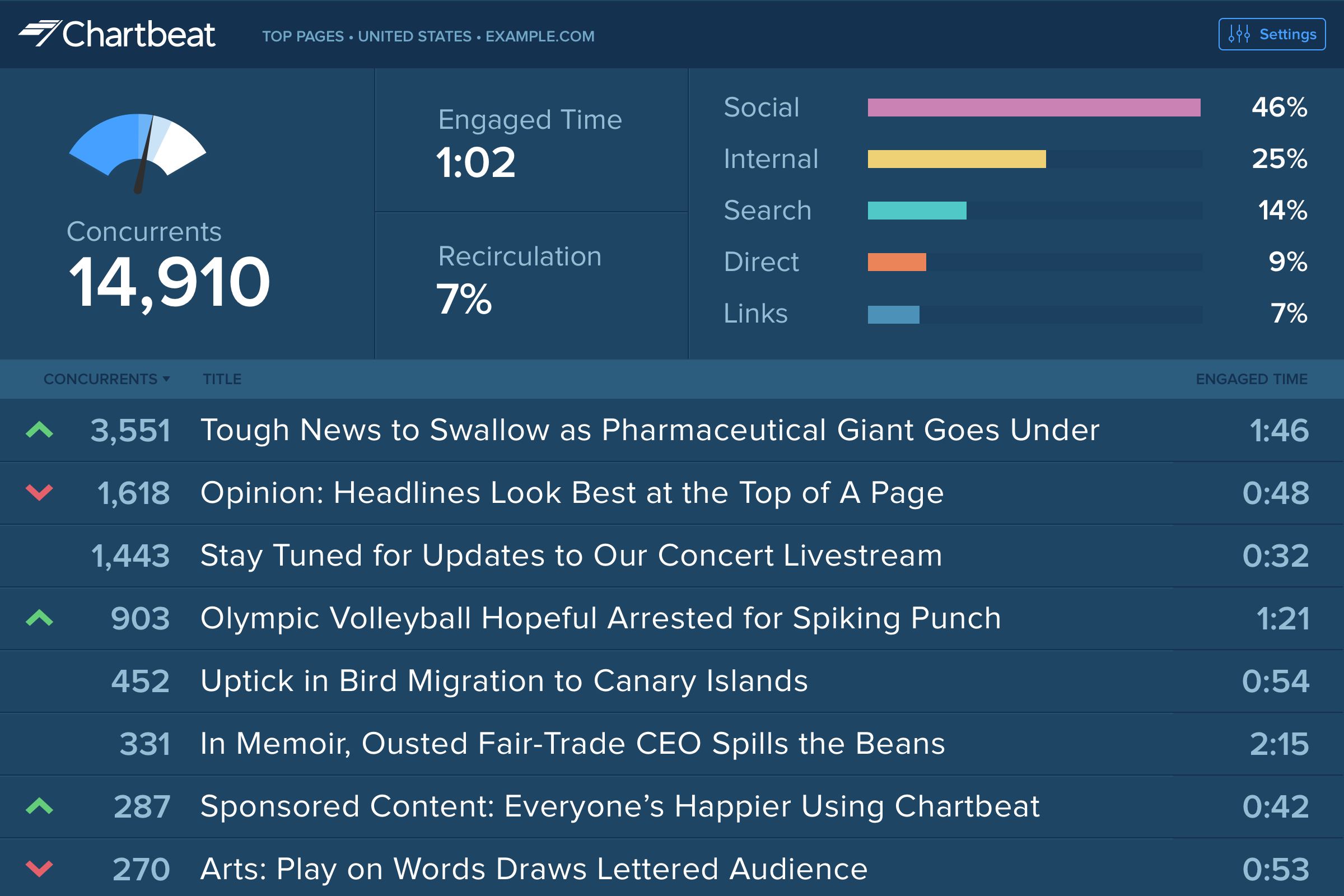
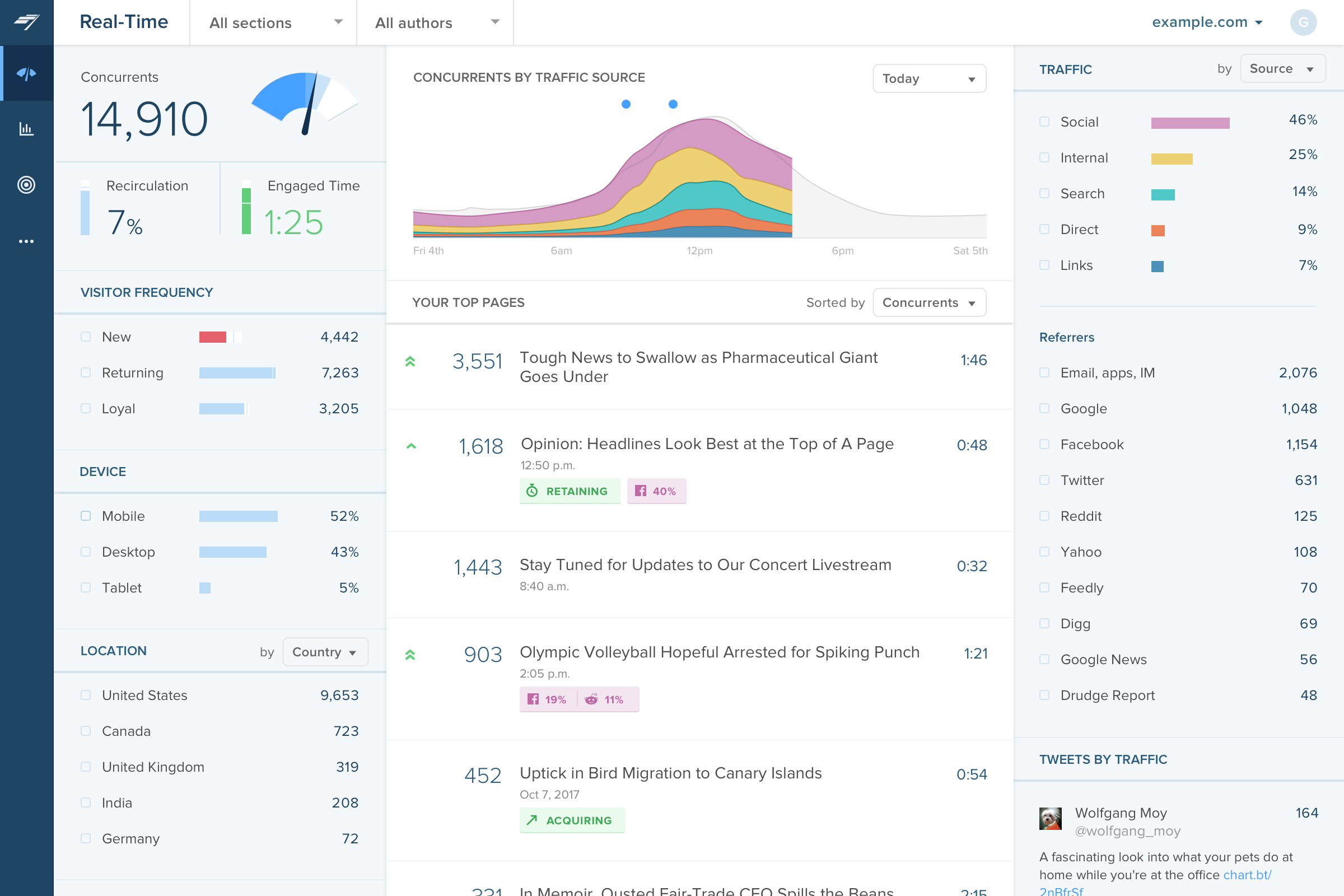
Chartbeat delivers real-time analytics, insights, and transformative tools for content teams around the world, to help improve audience engagement, inform editorial decisions, and increase loyalty.
N/A
Roku OneView
Score8 out of 10
N/A
The OneView Ad Platform (formerly Dataxu, acquired by Roku October 2019) is a solution for marketers and content owners to, according to the vendor, reach more cord cutters and measure performance using the largest TV identity dataset, where advertisers can manage their entire campaigns – including OTT, linear TV, omnichannel, and more – all in one place.
N/A
Pricing
Chartbeat
Roku OneView
Editions & Modules
No answers on this topic
No answers on this topic
Offerings
Pricing Offerings
Chartbeat
Roku OneView
Free Trial
Yes
No
Free/Freemium Version
No
No
Premium Consulting/Integration Services
Yes
No
Entry-level Setup Fee
No setup fee
No setup fee
Additional Details
Chartbeat pricing is based on monthly site page views. Discounts are applied to multi-year contracts. The Basic Plan includes the Real-time Dashboard, Historical Dashboard, Heads Up Display, Reports, Big Board, iOS and Android app, and Real-time API endpoints.
The Plus Plan includes all of the Basic Plan features, plus ONE of the following Premium features: Headline Testing, Advanced Queries, or Multi-Site View.
The Premium Plan includes all of the Basic Plan features, plus ALL Premium features: Headline Testing, Advanced Queries, Multi-Site View, and enterprise-level support and custom trainings.
The main point of benefit is the realtime data. This is vital to our team as we are publishing a lot of content per day, so we have a busy homepage to manage and it's important to know which content is performing well. We also like to get an understanding as quickly as possible - which Chartbeat offers - of where traffic is coming from. Often we will see an example where a page is getting high traffic from Google, for example, and we know that might not need to be placed so prominently on the homepage because the traffic is arriving to us externally anyway. Without that depth of understanding what is performing best and why - updated immediately, unlike in Google Analytics now - our homepage would not be as well optimised for users coming to us direct
A de minimis incentive was given to thank the reviewer for their time. The incentive was not used to bias or drive a particular response, nor was the incentive contingent on a positive endorsement. More Info
Dataxu is great for running multiple campaigns at the same time. It's reporting features are great as well as the exchanges it has to offer. For a company just wanting to run one campaign, I don't think it would be worth their time learning how to navigate Dataxu; however, for a company running to run multiple campaigns, Dataxu makes the process easier. Dataxu has great customer service representatives that provide superior training whenever needed.
A de minimis incentive was given to thank the reviewer for their time. The incentive was not used to bias or drive a particular response, nor was the incentive contingent on a positive endorsement. More Info
The platform's mobile serving capacity is great; spending is always consistent and the impression numbers are some of the highest we've seen. We can always depend on this method of ad serving to get us the results that we and our clients expect.
The intelligence and audience information (found under the Reports tab) is helpful when writing a "story" for the client; it assists us in determining future targeting strategies. Custom Queries are also available under the Reports tab and these are extremely helpful when we need to view specific details about the campaign.
The dashboard's spend-to-date graphic helps us to immediately recognize what campaigns are falling behind so that we may adjust the budgets accordingly.
Source of traffic needs improvement. Search and social make sense, but "internal" and "links" is a grey area. It would be helpful to define those with an organization and provide an information icon so users can easily remember what each of those buckets is tracking.
More ways to customize the real-time board. For example, with video content, that's great that I can see a user has started a video, but what is the completion rate, was that only on O&O or can that track Facebook, too?
Would like to see demo (age) information included as a way to slice the data so I can see what's working with my older and younger demo.
A de minimis incentive was given to thank the reviewer for their time. The incentive was not used to bias or drive a particular response, nor was the incentive contingent on a positive endorsement. TR verified that a representative sample of customers was invited. More Info
Flagging problems. For example, if a campaign has been running a week and hasn't spent any of the budgets, there could be a setting enabling it from doing so. When you have multiple campaigns running, it's hard to track this.
A de minimis incentive was given to thank the reviewer for their time. The incentive was not used to bias or drive a particular response, nor was the incentive contingent on a positive endorsement. More Info
I gave Chartbeat a 5 for a renewal rating, because, while it delivers clear and understandable content, Google Analytics also provides many of the same features for free. For a small to medium website, I believe it would be more cost effective to use Google Analytics. A website with a high amount of traffic, however, could merit spending the money on Chartbeat to maximize their potential.
I am able to "set it and forget it," keeping it up on my monitor for either constant checking or just keeping an eye on the numbers during the day. I'm also able to keep track of what times are perfect to post a story and which stories rack up the most traffic.
A de minimis incentive was given to thank the reviewer for their time. The incentive was not used to bias or drive a particular response, nor was the incentive contingent on a positive endorsement. More Info
I have had limited experience of support for Chartbeat but whenever I have needed help it has been there. Recently there was an issue of seeing different forms of data in real time - app and otherwise effectively, and the issue was being clearly dealt with and communicated back to us.
A de minimis incentive was given to thank the reviewer for their time. The incentive was not used to bias or drive a particular response, nor was the incentive contingent on a positive endorsement. More Info
At Haberfeld, we had our own customer service representative out of Boston. He provided superior and timely support for all of our questions and needs. He also ran test campaigns to show us what our potential impact could be before we put dollars towards anything. He even came all the way down to Nebraska to visit with us at one point. Whenever we needed something, he was quick to respond and provide appropriate resources and training.
A de minimis incentive was given to thank the reviewer for their time. The incentive was not used to bias or drive a particular response, nor was the incentive contingent on a positive endorsement. More Info
Omnilytics is more robust, detailed, and catered for an intermediate media user, while I think Chartbeat is a more user-friendly and beginner-oriented piece of technology. That being said, there is an impressive amount of lift for Chartbeat, and it's evident that simplicity is the key to using a software daily (which is absolutely the point in the content world).
A de minimis incentive was given to thank the reviewer for their time. The incentive was not used to bias or drive a particular response, nor was the incentive contingent on a positive endorsement. More Info
We work with multiple platforms, not solely DataXu. As of late, AdWords has proven more beneficial to us. AdWords is very user-friendly and they are easy to contact. If we need a question answered, we can simply hop onto a Google Chat and get the responses we need to move forward. DataXu is much harder to get in contact with and their Help Beta tab is not especially informative. If we need to serve impressions, DataXu is certainly the server to utilize
A de minimis incentive was given to thank the reviewer for their time. The incentive was not used to bias or drive a particular response, nor was the incentive contingent on a positive endorsement. More Info
A de minimis incentive was given to thank the reviewer for their time. The incentive was not used to bias or drive a particular response, nor was the incentive contingent on a positive endorsement. More Info