Dynamic Yield is presented as an AI-powered Experience Optimization platform that delivers individualized experiences at every customer touchpoint: web, apps, email, kiosks, IoT, and call centers. The platform’s data management capabilities provide for a unified view of the customer, to allow the rapid and scalable creation of highly targeted digital interactions. Marketers, product managers, and engineers use Dynamic Yield for: Launching new personalization…
N/A
Google Analytics
Score 8.2 out of 10
N/A
Google Analytics is perhaps the best-known web analytics product and, as a free product, it has massive adoption. Although it lacks some enterprise-level features compared to its competitors in the space, the launch of the paid Google Analytics Premium edition seems likely to close the gap.
$0
per month
Webtrends Analytics
Score 4.4 out of 10
N/A
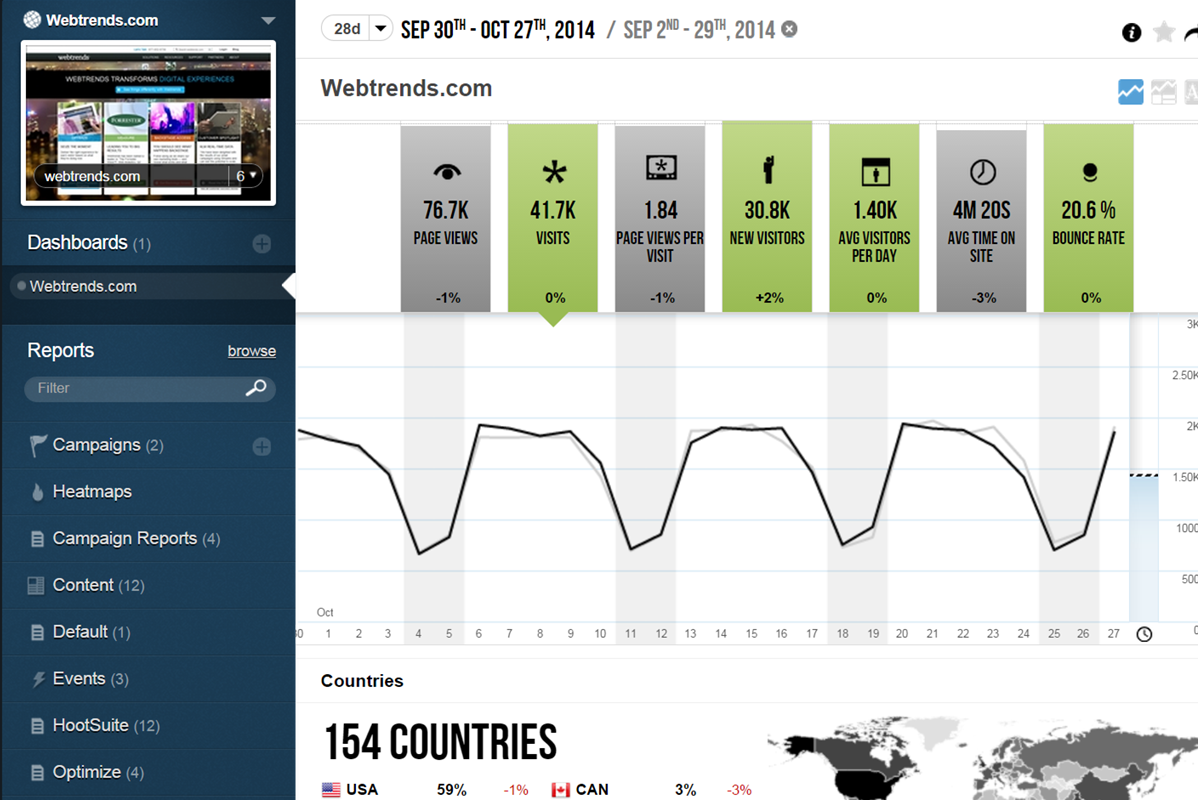
WebTrends provides an enterprise web analytics platform and, according to Forrester, has a strong focus on support for mobile and social channels and a very open platform. Webtrends competes directly with Adobe Site Catalyst, IBM Coremetrics. and comScore DigitalAnalytix.
N/A
Pricing
Dynamic Yield
Google Analytics
Webtrends Analytics
Editions & Modules
No answers on this topic
Google Analytics 360
150,000
per year
Google Analytics
Free
No answers on this topic
Offerings
Pricing Offerings
Dynamic Yield
Google Analytics
Webtrends Analytics
Free Trial
Yes
No
No
Free/Freemium Version
No
Yes
No
Premium Consulting/Integration Services
Yes
No
No
Entry-level Setup Fee
No setup fee
No setup fee
No setup fee
Additional Details
—
—
—
More Pricing Information
Community Pulse
Dynamic Yield
Google Analytics
Webtrends Analytics
Considered Multiple Products
Dynamic Yield
Verified User
Analyst
Chose Dynamic Yield
Dynamic Yield is on a whole different level compared to anything I've tried before. The different types of campaigns you can make with DY covers all your needs. If you can't find a suiting campaign type, or even template, you can use Dynamic Content or Custom code to create …
No contest between Convert and Optimizely - those are very decent A/B test programs but also standard. The biggest contender was A/B Tasty and we chose DY due to the ease of client vs server side implementation within the platform and robust analytics/product recommendation …
We moved from Qubit to Dynamic Yield for a number of reasons. Qubit was very clunky, had limited out-the-box capabilities and thus required a wait for coders to build tests or make small site changes. The features they intended to be quick and easy to use were invariably not, …
Monetate is good also but I found learning to navigate round DY so much quicker and easier. May sound silly but the platform is also a lot cleaner in its design.
Much more optimization possibilities. Deeper and automatic analysis of tests, product recommendations, email widgets and much more. VWO is the chimpanzee and Dynamic Yield the human.
Now I have a single centralized tool for several things while before we had to maintain at least 3 tools to do what we are currently doing with Dynamic Yield. Having a single tool helped us a lot also in increasing our level of precision and to avoid fixes across different …
We have not used any other tool but went through discovery with a couple other vendors. In the end, Dynamic Yield won for its ease of use and customer service. As well, another key factor was the ability to trigger personalization in email, which a number of other vendors do …
This alternative is cheaper and does its job. They appear to be new and hungry for business and therefore we were able to get more attentions from them. The reporting function is easier to understand than the above providers and we don't have to spend time trying to calculate …
[It has] the most confident functionality of use cases. It's hard to implement something and it does not work because of something wrong on the Dynamic Yield side.
When we've compared solutions, Dynamic Yiled impressed us as better in terms of their focus on e-commerce, built-in features, durability, value for money and agility.
First of all, the other tools we looked at was more focused on A/B testing and personalization but one of the that we loved immediately of Dynamic Yield was the recommendation engine: given that we were missing such a feature in our e-commerce, that really made the difference.
I have used Optimizely in the past but the out of the box features Dynamic Yield offers really is a cut above.
The use of custom actions have been invaluable in enabling us to really bridge the gap between our online and offline worlds. I haven't come across any other tool that …
I have used Visual Website Optimizer previously which was recommended by an agency; they are both similar tools. Though simply on the support factor I feel Dynamic yield is better suited for our business. We have been using the tool now for over two years, and have had a lot of …
Webtrends as a platform is older than Google Analytics and still quite good. If you have a company that is used to using Webtrends, it's likely still a good fit for you. Google Analytics has a lower entry cost and more accessible training to new Users, so that's why I would …
We have been using Google Analytics for over 10 years. Over that time we have periodically reviewed our analytics platforms a number of times. For us, it made more sense to stay with google analytics primarily because if we migrated to another platform we would lose the …
If it was my choice I would have used IBM Digital Analytics (DA) for everything. DA has it quirks but it really gives some deep analysis on the data and with a bit of development work you can really get all the data you could possibly want. If every website and newsletter was …
We tested Webtrends and purchased Omniture (which we used for 2 years). Webtrends wasn't a good fit overall. Omniture was too cumbersome and expensive. The support was HORRIBLE and for a paid product it lacked some basic, no-brainer features.
We have used Omniture and WebTrends. WebTrends is an outdated analytics tool. Omniture, while robust is just not as customizable. Basically, if you have no intention or no need to do customization and you just want out-of-the-box reporting and not willing to spend the time in …
The cost-free aspect of GA is undeniably a key feature for organisations which don't require the level of customisation offered by the paid-for solutions. An organisation which opts for GA won't need any paid solutions to fill in gaps.
I find Google Analytics to be very limiting. This may also be the way that the reports have been structured by our organization. It is viewed as an older way to obtain the metrics we are after and no new projects are implemented through Google Analytics.
We currently use WebTrends, Google Analytics, Kissmetrics and ClickTale. I would like us to consolidate our activities to be focused on just Webtrends as it covers all of the requirements we have very well.
Using Omniture at my current place of employment and using Google Analytics as a backup at both, Webtrends is the clear superior product. I go back to how easy the UI is to navigate and how simple it is to get user level data that isn't duplicated or doesn't try to pigeon hold …
Compared to WebTrends, Google Analytics has a slicker interface, provides live site usage data, and is easier to jump into with basic usage. These days users expect to be able to create their own reports as needed, rather than have an "expert" do it for them. They are used to …
Webtrends has its work cut out for itself considering you have the behemoth Google Analytics and Google Analytics Premium having a strong offering and brand recognition for the price of free. After reviewing the paid service I'd suggest you start off with GA as a cheaper …
We've used Google Analytics - and Webtrends really wipes the floor with them. The data we get from Mixpanel can be mirrored in Webtrends - which is something we're working on at the moment with the Webtrends team. As for competitors to Webtrends, we did consider Adobe and …
Webtrends was selected because of the price for Google Analytics Premium ($110k per year) and Adobe Omniture Analytics (twice the price). Clearly, it needed the Visitor Data Mart to get additional capability that you would expect as part of a Web Analytics suite. In our case, …
I have only had significant experience with Google Analytics (GA) and WebTrends in this space. Overall - it is easier to learn and modify GA reports as a casual user - I always struggled with the fact that GA only offered partial data (sampling based).
Webtrends is just an option, depending on client budget. It's a simple analytics tool that does the job but we always recommend Omniture whenever possible.
For us, it is well suited for personalization. Since we are hospitality brand, we have different rooms sales inclusion based on different segmentation like Mem or Non-mem, Global or UAE, we have to personalize our landing pages accordingly so that we show the relevant information to relevant audience. The inactivity pop up box and newsletter signup popups work good for us. It does not work well in some scenario like Dynamic Yield offers built-in analytics focused on campaign and test performance, but it’s not a replacement for tools like GA4, Adobe Analytics. It lacks deep funnel tracking or complex reporting capabilities.
Google Analytics is particularly well suited for tracking and analyzing customer behavior on a grocery e-commerce platform. It provides a wealth of information about customer behavior, including what products are most popular, what pages are visited the most, and where customers are coming from. This information can help the platform optimize its website for better customer engagement and conversion rates. However, Google Analytics may not be the best tool for more advanced, granular analysis of customer behavior, such as tracking individual customer journeys or understanding customer motivations. In these cases, it may be more appropriate to use additional tools or solutions that provide deeper insights into customer behavior.
Scenarios 1. If you want to use web server log files as input to your web analytics, then Webtrends will provides a good product, with great ease of implementation. Don't even think about being cheap on hardware, and make sure Webtrends runs on real servers, not in a VM environment. 2. If you want to use Data Tagging, similar to Google Analytics or Site Catalyst, Webtrends has a powerful product, just be prepared to pay. 3. If you are new to Web Analytics, but it is the strategic direction, start with Webtrends on Premises. Questions to Ask 1. What are you trying to accomplish? 2. Can you place a dollar value on the benefit that you expect/need from Webtrends? 3.Can you live with Webtrends running SaaS?
Provide fantastic support, both in relation to strategy/best practice and troubleshooting.
An easy to use interface, as a user who is relatively new to Dynamic Yield I find that it is an intuitive platform to use.
The ability to segment and drill down on data allows for really specific insights which, whilst not necessarily being leveraged on a testing basis, can be super valuable from a greater marketing perspective.
Control privacy, data sharing and competitive industrial knowledge using Webtrends on premises
Great control over custom reports, custom dimensions and metrics
Flexible tool which allows multiple methods of data capture. To my knowledge it was the first tool with a Tag Builder / Tag Management function built in via a supporting website.
Brand templates could need complex CSS/custom code.
We'd like to see a little "i" next to specific labels, which elaborates on what is meant. For example, when I hover over "Dynamic allocation," I get something like "An advanced form of A/B testing where the best-performing variations receive higher traffic."
Jargon (for example, for audience targeting) can be overwhelming for new users; therefore, clearer, user-friendly explanations are needed.
The big downside, the elephant in the room, is that it does not (as of right now) have on-demand segmenting, drilldowns, etc. You have to think of what you want in advance and create those reports then analyze some data. This is huge. You can, of course, re-analyze old data after creating new reports but you still have to wait. (This deficiency may become obsolete with the release of Webtrends Explore later this month (May 2014).)
It has fewer mature integrations with other products and databases than competitors do, although I'm told it works with SharePoint better than anything else does.
Its attribution modeling capability is behind Google Analytics'. In my humble opinion, this could be changed quickly if Webtrends would make some tweaks to its standard visitor history files (i.e. preserve the order in which past visits were sourced beyond the single most recent one, rather than storing all those past sources as a randomized list).
It doesn't incorporate statistical tests, confidence intervals, or statistical associations. However, this same criticism can be applied to its competitors (other than A/B Testing products). It's a tabulation program, as they all are. In this respect, web analytics tools as a group are relatively primitive. Sorry to bring this up as a criticism of Webtrends but it's my pet peeve about the whole industry and I just have to say it. (p.s. take advantage of the heavy-duty Webtrends Scheduled Export functionality to get really granular data that you can feed to a stats program to get significances.)
Although the documentation, help screens, phone support and the knowledge base have improved tremendously in recent years, there is still a pretty steep learning curve because it is different from the tools that entry-level users may have already been exposed to. This can be a shock and many users are alienated at first because they just don't get some of the fundamentals at first. I'd like to see much better help screens that are thoroughly interlinked with the KB and documentation. Having superb online support would make a world of difference with the adoption of this basically powerful tool.
implementation took a long time but also, DY has really proven that they are transforming and adapting their platform to be more user friendly and the right technology choice for their brand or company
We will continue to use Google Analytics for several reasons. It is free, which is a huge selling point. It houses all of our ecommerce stores' data, and though it can't account for refunds or fraud orders, gives us and our clients directional, real time information on individual and group store performance.
I would be willing to try Webtrends again AFTER some research from other users. I would need to see that users mention better and faster customer support on questions and issues that arise while using the software. The software is capable of vast and incredible things, but if it isnt properly set up and supported during use, it is just a big hassel and waste of everyones time and money.
Setting up strategies, audiences, and experiences is simple and fast. It is incredibly easy to modify the appearance of your site and optimize every aspect with the Dynamic Yield Personalizations. However, while the data visualization on an experience level is easy to modify and analyze, exporting the data in meaningful ways is time consuming.
Google Analytics provides a wealth of data, down to minute levels. That is it's greatest detriment: find the right information when you need it can be a cumbersome task. You are able to create shortcuts, however, so it can mitigate some of this problem. Google is continually refining Analytics, so I do not doubt there will be improvements
If I could give it a 0, I would. Not having an intuitive user interface made it impossible to convince non-analytic business users to use the tool on their own. Even as a seasoned analyst, frequent calls were needed to get what should be simple tasks done. Account managers don't understand the tool either, and have to refer you to technical support
We all know Google is at top when it comes to availability. We have never faced any such instances where I can suggest otherwise. All you need is a Google account, a device and internet connection to use this super powerful tool for reporting and visualising your site data, traffic, events, etc. that too in real time.
This has been a catalyst for improving our site's traffic handling capabilities. We were able to identify exit% from our sites through it and we used recommendations to handle and implement the same in our sites. We have been increasing the usage of Google Analytics in our sites and never had any performance related issues if we used Analytics
The v9 admin interface and v10 reporting interface work as well as expected, but have a tendency to be pokey, especially for bulky reports and whenever you're connected to wifi. I much prefer using the REST API for all reporting for this reason, which simply dumps out the data and doesn't bother with the user interface.
Overall, the support is very good. If you are a partner (my case), they assign you a customer success manager, that helps a lot. Also, there is a technical person to provide support to the partners, again a great help.
My only "complain" is that with some complex issues, the support may delay in providing you with a solution. Sometimes that can cause some tension with your client.
The Google reps respond very quickly. However, sometimes they can overly call you to set up an apportionment. I'm very proficient and sometimes when I talk to reps, they give beginner tutorials and insights that are a waste of time. I wish Google would understand my level of expertise and assign me to a rep (long-term) that doesn't have to walk me through the basics.
I once went on to Twitter to ask for help from my network of analytics people, and Webtrends themselves responded. They have been an excellent partner in making sure that their product is being used to the best of it's ability and I greatly appreciate that. Both Omniture and Google Analytics, do not have that level of support over social media
The in-person training was comprehensive enough to get you started, but I strongly recommend having a more experienced person when beginning with the tool.
love the product and training they provide for businesses of all sizes. The following list of links will help you get started with Google Analytics from setup to understanding what data is being presented by Google Analytics.
Webtrends provides several free webinars over the course of the year, many of which I would expect to pay for. The people providing the webinars seem to have a good feel for real-world application of the product.
I think my biggest take away from the Google Analytics implementation was that there needs to be a clear understanding of what you want to achieve and how you want to achieve it before you start. Originally the analytics were added to track visitors, but as we became more savvy with the product, we began adding more and more functionality, and defining guidelines as we went along. While not detrimental to our success, this lack of an overarching goal resulted in some minor setbacks in implementation and the collection of some messy data that is unusable.
Careful planning and patience. Use a non-public test site to fine tune tags and reporting. Despite best laid plans, there will be surprises when you collect the data, run the analysis and begin generating reports using the tool. Perform a tag audit to ensure tags fire as desired.
Dynamic Yield provides far more capability and ready-to-go templates for small-medium sized businesses, as well as decent API implementation for businesses who want to have a deeper integration. The ease of implementation and faster time-to-market is why we chose Dynamic Yield.
I have not used Adobe Analytics as much, but I know they offer something called customer journey analytics, which we are evaluating now. I have used Semrush, and I find them much better than Google Analytics. I feel a fairly nontechnical person could learn Semrush in about a month. They also offer features like competitive analysis (on content, keywords, traffic, etc.), which is very useful. If you have to choose one among Semrush and Google Analytics, I would say go for Semrush.
Webtrends has its work cut out for itself considering you have the behemoth Google Analytics and Google Analytics Premium having a strong offering and brand recognition for the price of free. After reviewing the paid service I'd suggest you start off with GA as a cheaper alternative that is just as robust, if not much more flexible in regards to the reporting and goal tracking needs for our company.
Google Analytics is currently handling the reporting and tracking of near about 80 sites in our project. And I am not talking about the sites from different projects. They may have way more accounts than that. Never ever felt a performance issue from Google's end while generating or customising reports or tracking custom events or creating custom dimensions
Most tests have had a positive impact on either revenue or conversion rate - quite often in double digits.
Dynamic Yield has also helped us to stop some particular initiatives through direct interaction with the customer base via questionnaires or by a test proving negative quicker than rolling out a permanent feature.
Webtrends has had a positive impact on site visitation because it allowed us to understand the sources by domain for site traffic and find out ways to increase visits from those domains.
Webtrends has also allowed us to understand areas of optimization on the site, which has had a positive impact on the overall user journey on the site, likely leading to longer site duration and engagement.