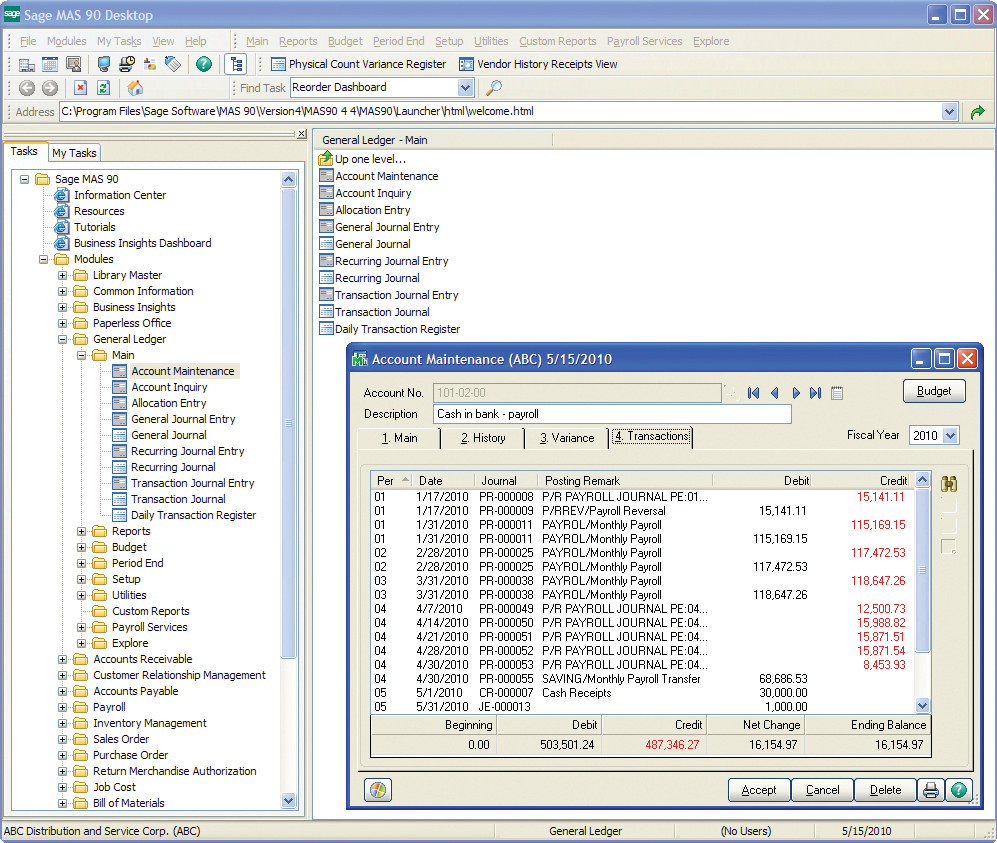
Sage 100 (or Sage 100cloud is a business management software offering a broad range of modules designed to meet the many needs of virtually any business. It encompasses financial operations and accounting, payroll, business intelligence, CRM, eBusiness, manufacturing and distribution.
N/A
Sage 100 Contractor
Score5.2 out of 10
N/A
Sage 100 Contractor is a construction accounting and project management software. It is intended to provide primary accounting and other management capabilities across a construction project lifecycle, including estimating, service management, and reporting.
President, CEO in Corporate at Medina Consulting Company, Inc. (Environmental Services, 1-10 employees)
Chose Sage 100 Contractor
I have use Sage 50, Sage 90, Peachtree Quantum, QuickBooks, Great Plains. They are all good for what they can do. Sage 100 Contractor is the best at what it does. It's a good fit.
A de minimis incentive was given to thank the reviewer for their time. The incentive was not used to bias or drive a particular response, nor was the incentive contingent on a positive endorsement. More Info
Verified User
Chose Sage 100 Contractor
We are currently looking at Vista as a replacement Sage 100. The estimating features appear to be exactly what our department is looking for and the accounting staff is very pleased as well. We brought in Procore about a year ago and are very happy with it. The field staff …
A de minimis incentive was given to thank the reviewer for their time. The incentive was not used to bias or drive a particular response, nor was the incentive contingent on a positive endorsement. More Info
A de minimis incentive was given to thank the reviewer for their time. The incentive was not used to bias or drive a particular response, nor was the incentive contingent on a positive endorsement. More Info
Sage 100 has been well suited for running the monthly accounts receivable and accounts payable aging reports. This helps us track our accounts that need to be collected and payments that need to be made. Our field operations team has been slow and unwanting to adopt the Sage Field Ops just because they're resistant to change and technology. It's less appropriate for really detailed accounting reports spanning for long periods of time with all accounts because it takes a very long time to run and process.
A de minimis incentive was given to thank the reviewer for their time. The incentive was not used to bias or drive a particular response, nor was the incentive contingent on a positive endorsement. More Info
If you want a SQL-based ERP, this is a great solution. You can host it locally or on a cloud-based SQL instance. If you want a more modern, browser and cloud-based system, Sage 100 Contractor will not work.
A de minimis incentive was given to thank the reviewer for their time. The incentive was not used to bias or drive a particular response, nor was the incentive contingent on a positive endorsement. More Info
A de minimis incentive was given to thank the reviewer for their time. The incentive was not used to bias or drive a particular response, nor was the incentive contingent on a positive endorsement. More Info
Sage integrates very well with our field time tracking software called Exaktime. We import the start/end time card data that includes job costs directly to the PR module which greatly reduces the time it takes to process payroll.
Sage 100 C payroll calculations and WC/GL overhead calculations are easy to use and understand. The WC/GL overhead calculations are posted to project costs in real-time allowing for accurate total cost reporting of the project.
A de minimis incentive was given to thank the reviewer for their time. The incentive was not used to bias or drive a particular response, nor was the incentive contingent on a positive endorsement. More Info
Sage 100 at times will simply not connect to our server, we get remote support & all is well but, that issue tends to happen 2-3X a year.
Other than the above, I really can't complain. Coming from a more custom U.V. type database that used a whole bunch of codes to navigate, I think Sage 100 is 10x easier to use.
A de minimis incentive was given to thank the reviewer for their time. The incentive was not used to bias or drive a particular response, nor was the incentive contingent on a positive endorsement. More Info
A de minimis incentive was given to thank the reviewer for their time. The incentive was not used to bias or drive a particular response, nor was the incentive contingent on a positive endorsement. More Info
I would put this out to bid, if I were at the same organization. There have been a lot of improvements and changes in enterprise software and my preference would be to find a good web-based or cloud-based tool. Lower overall cost of ownership and improved efficiency would be my target criteria for a rebid of this.
A de minimis incentive was given to thank the reviewer for their time. The incentive was not used to bias or drive a particular response, nor was the incentive contingent on a positive endorsement. More Info
The cost of Sage 100 Contractor software is relatively inexpensive compared to some higher-priced options like Foundation and Microsoft Dynamics GP. But more importantly, the cost of implementing new software is costly. Implementation costs include testing and training. There are also risks involved with switching software such as missing data after conversion. Plus, there are always some unknown downsides to switching that are not apparent until the switch is made such as perceived capabilities that really don't exist. For these reasons, we will likely stay with Sage 100 Contractor for a long time. If we grow (say double) in size, we would consider other options.
A de minimis incentive was given to thank the reviewer for their time. The incentive was not used to bias or drive a particular response, nor was the incentive contingent on a positive endorsement. More Info
Overall Sage 100 has been pretty user friendly. If we have a question on anything, we are able to contact our implementation rep who helps us right away. Some of the Sage Field Operations may not be as intuitive for our field personnel to use. I wish the reports ran faster so that we could run and put together many reports quickly at once.
A de minimis incentive was given to thank the reviewer for their time. The incentive was not used to bias or drive a particular response, nor was the incentive contingent on a positive endorsement. More Info
In the end there are tons of other products that are much better. Time cards don't work, we needed an external software to track this for employees. Estimation is cumbersome, we just used Excel. Payroll was ok, but didn't do employee taxes correctly when they make a certain amount for some reason. Overall, it's a bad product.
A de minimis incentive was given to thank the reviewer for their time. The incentive was not used to bias or drive a particular response, nor was the incentive contingent on a positive endorsement. More Info
A de minimis incentive was given to thank the reviewer for their time. The incentive was not used to bias or drive a particular response, nor was the incentive contingent on a positive endorsement. More Info
If we ever have issues with Sage 100, the live chat is an awesome tool. However, most of our live chat inquiries are not because of the issues we have, but more for us to better understand how we are supposed to use the software. Sometimes we ask ourselves "what if we" and if we need guidance, the live chat will provide us with the answers or resources to figure out what we need. They always follow up to ensure the problems we encounter have been fixed. If our issue is an indicator of an upgrade that could be made, Sage 100 C offers a way to submit the idea for review and improvement of the software.
A de minimis incentive was given to thank the reviewer for their time. The incentive was not used to bias or drive a particular response, nor was the incentive contingent on a positive endorsement. More Info
We had an advantage in implementing the tool in that our director of Ops had been part of the team implementing the ERP for other users so we knew what to expect and were able to avoid a lot of the challenges people sometimes face with implementations. However, the process still took far longer than desired.
A de minimis incentive was given to thank the reviewer for their time. The incentive was not used to bias or drive a particular response, nor was the incentive contingent on a positive endorsement. More Info
I didn't choose Sage 100 ERP -- it was already in use when I started at the organization over five years ago. It has the same types of pros and cons as other big hulking software suites meant to power the infrastructure of corporations. It's slow, tough to customize, and doesn't connect well with other software. It does bring all the information into one place, which is great
A de minimis incentive was given to thank the reviewer for their time. The incentive was not used to bias or drive a particular response, nor was the incentive contingent on a positive endorsement. More Info
I have use Sage 50, Sage 90, Peachtree Quantum, QuickBooks, Great Plains. They are all good for what they can do. Sage 100 Contractor is the best at what it does. It's a good fit.
A de minimis incentive was given to thank the reviewer for their time. The incentive was not used to bias or drive a particular response, nor was the incentive contingent on a positive endorsement. More Info
Sage 100 overall had a very positive overall ROI for the business. All users were making decisions based on the same information and valuable time was no longer spent trying to analyze data from a number of sources.
Moving the warehouses to using Sage 100 reduced the operating expense of the distribution side of the business by 5% on an annual basis (~$100K).
A de minimis incentive was given to thank the reviewer for their time. The incentive was not used to bias or drive a particular response, nor was the incentive contingent on a positive endorsement. More Info
A de minimis incentive was given to thank the reviewer for their time. The incentive was not used to bias or drive a particular response, nor was the incentive contingent on a positive endorsement. More Info