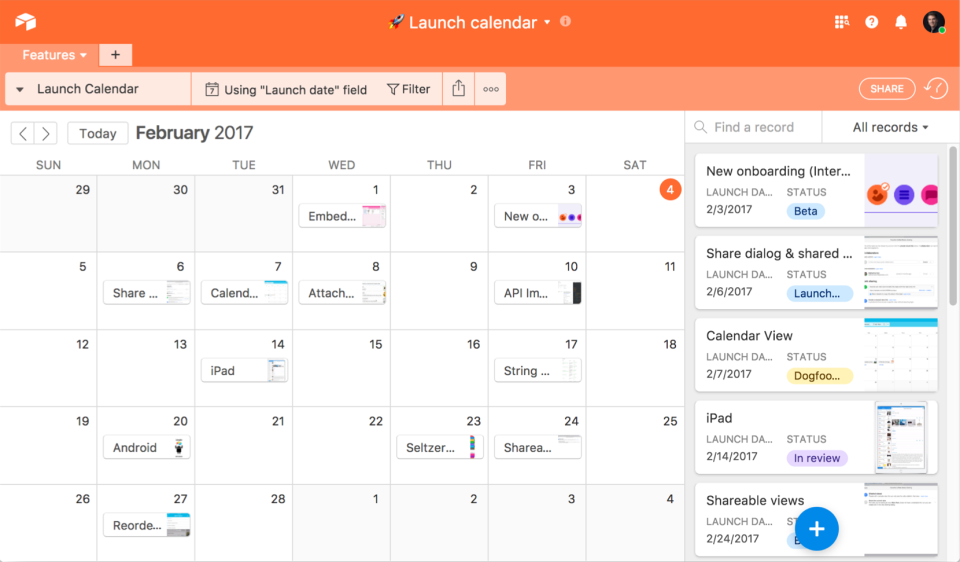
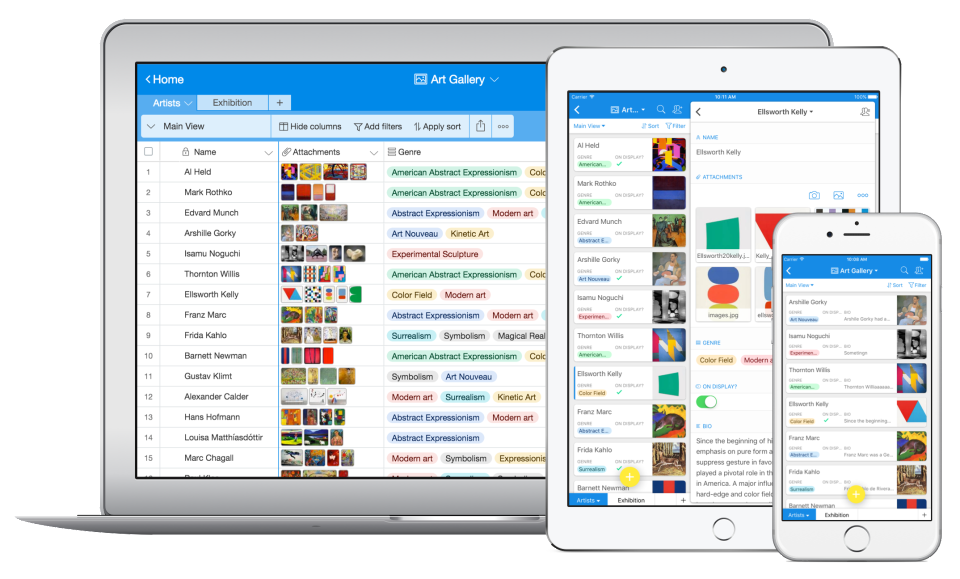
Airtable is a web-based application builder that combines spreadsheet usability with relational database architecture. The platform enables users to construct custom operational applications, configure automated workflows, and design tailored interfaces without traditional software development.
$24
per month per seat
OpenAir PSA
Score 5.5 out of 10
N/A
NetSuite OpenAir is a cloud-based Professional Service Automation (PSA) product which includes capabilities around project management, resource management, project accounting, etc.
N/A
Pricing
Airtable
OpenAir PSA
Editions & Modules
Team
$24
per month per user
Business
$54
per month per user
Enterprise
Custom Pricing
No answers on this topic
Offerings
Pricing Offerings
Airtable
OpenAir PSA
Free Trial
Yes
No
Free/Freemium Version
Yes
No
Premium Consulting/Integration Services
No
No
Entry-level Setup Fee
No setup fee
No setup fee
Additional Details
—
—
More Pricing Information
Community Pulse
Airtable
OpenAir PSA
Features
Airtable
OpenAir PSA
Project Management
Comparison of Project Management features of Product A and Product B
Airtable
7.8
235 Ratings
2% above category average
OpenAir PSA
7.3
15 Ratings
5% below category average
Task Management
8.9199 Ratings
8.015 Ratings
Resource Management
8.0193 Ratings
7.515 Ratings
Gantt Charts
8.489 Ratings
8.09 Ratings
Scheduling
7.4165 Ratings
6.012 Ratings
Workflow Automation
8.0143 Ratings
6.09 Ratings
Team Collaboration
7.9218 Ratings
8.012 Ratings
Support for Agile Methodology
8.3108 Ratings
6.07 Ratings
Support for Waterfall Methodology
8.580 Ratings
7.08 Ratings
Document Management
7.5170 Ratings
8.56 Ratings
Email integration
7.1115 Ratings
7.09 Ratings
Mobile Access
5.9191 Ratings
7.512 Ratings
Timesheet Tracking
7.893 Ratings
7.014 Ratings
Change request and Case Management
8.2102 Ratings
8.010 Ratings
Budget and Expense Management
7.1127 Ratings
7.514 Ratings
Professional Services Automation
Comparison of Professional Services Automation features of Product A and Product B
Airtable is an ideal platform for small and growing businesses to keep track of just about EVERYTHING they need to keep things running smoothly. It's a great way to keep tasks organized, and keep everyone on the same page with progress on all things. Our company finds the kanban particularly useful, as products go through a lifecycle from ideation to retirement, it's good to keep a database of what is in production, what's working, and what we've tried before. I can see the platform being challenging with much larger businesses, but for the small to medium businesses I've used the platform with, it is ideal.
This product is well suited for an organization that is focused on client services, project delivery, time tracking, expense reporting, and revenue recognition. From a pure project management perspective, this product is not as feature rich as say Microsoft Project Server. For organizations that are looking for detailed complex project plan and resource management (along with resource leveling, etc.), this is probably not the best suited product
Airtable has capabilities commonly found in spreadsheet applications, but also has some of the features found in databases.
The ability to filter fields. I set up a filter on the status field, so when a project is marked, complete, on hold, or canceled, that record is hidden from my current projects table view. If it is marked complete, the record is moved to the completed projects table view. In this way I can easily access a record of past projects
Being able to duplicate tables and create alternate views
Collapse and expand records. When I collapse the rows, I can easily scan current projects, next steps, project status, and due dates. When I expand the row, or field, I can see more detailed information about that field or record very easily. I can also expand or open the entire record. This is is helpful, when I am entering a lot of information to multiple fields in that record.
Netsuite OpenAir PSA is highly configurable and has a large ecosystem of assets to work with.
Tasks are easily designed to automate processes in your business workflow.
OpenAir is designed in such a way that it can communicate and receive information from external systems without having to re-engineer your systems to make them work if you are following standard business practice.
Compared to QuickArrow, setting up reports to reflect the data accurately seemed to require a bit more consultant time and collaboration. Getting the numbers correct is essential, so budget extra time for this iniative. We also learned that certain calculations can not be displayed in the executive dashboards. Ask these questions upfront to ensure your dashboards are complete for your needs (again, working backwards in the preparation stages).
Compared to QuickArrow, NetSuite OpenAir PSA falls short in the resource management capabilities. UI, flexibility, and scheduling options all could be improved. This is on their roadmap, timeline yet to be defined. Scheduling is vitally important to our company and this is THE area where we feel is the applications weakest. However, the application does provide everything critical to scheduling and provided the elements we needed in order to be successful. We altered our scheduling process accordingly.
During our System Administration 3 day online training, when a question was asked about detailed functionality, sometimes the trainer would share..."Yes, OpenAir has a configuration for that. Just inquire with your consultant and they can flip that flag in your instance." The responsibility for obtaining these special application configurations was placed on the System Admin [in training] to ask and to take notes. If your company needs the application to work a certain way, speak up and ask your OA consultant. There seems to be MANY flags that can be flipped in the background to allow for the system to meet your needs. My complaint is that these are not published, rather made available if one inquires.
OpenAir is able to generate invoices directly and we strongly encourage using this feature to keep everything housed under one application. However, this did not work for our organization and we leveraged a financial integration. A bit of a pioneer integrating with Softrax -- the integration works well, however is quite fragile. We do receive appropriate support when needed, but would prefer the integration to be a bit more stable. We recommend integrating with their stated supported financial systems, as staying the course will likely net a more stable integration.
We will 10/10 renew the use of Airtable because it has brought great value to our team. Not only is Airtable affordable, but it's also user-friendly and helps our team be efficient. We no longer need to rely on Excel spreadsheets being passed from person to person via email. Furthermore, we aren't dealing with corrupt Excel spreadsheets and the need to salvage data when a file is accidentally altered.
It all depends. We are still looking at moving our consultants to Oracle PAC, in order to get our financial systems in line (we use Oracle Financials currently). We are feeling a lot of pain with integration and segmented systems.
Ultimately,it depends on how much pain is felt there. OpenAir has given us a path to follow on from QuickArrow. I foresee either moving onto Oracle PAC by end of calendar, or staying on OpenAir.
OpenAir to Oracle integration is not easy. From a reporting and process perspective, there’s been pain from being in different systems
IMO the usability of this product is its greatest asset. The UI is clean and the menus are intuitive to the point where I'd feel confident having a non-spreadsheety colleague take on building an Airtable for the first time with next to no training. I can't say that about every table-like software product that I've used such as Notion.
In this day and age I should not have to read a manual to understand a product. It should be intuitive to administrate and perform basic tasks. It feels like a ton of intelligence was poured into making OpenAir feature rich but no where near as much attention was given to the user experience.
I have rarely experience downtime, compared to other tools, and given how much time we spend on the tool. Even if there were to be, their updates on it are very timely, and our support team are able to provide any questions regarding
I never had any issues with load time, even with the integrations that we use today (google sheets) However, I'm curious if adding additional layers of integrations would slow down performance. We do carry quite a bit of data in Airtable, but, again, no impact on overall performance
Airtable has great support. They have a variety of support features to answer any questions. They have great self teaching instructions for templates and product tours. They also have support for teams and project management. They also have a fantastic customer help line. They are able and willing to answer customer questions and never have customers waiting long
As an admin, I've had more contact with OA support than most. I've found their response to tickets typically timely and helpful, however many of the responses to tickets are "we will file an enhancement request" and then I never hear about it again. So not terrible, but not a very fulfilling experience.
Very knowledgeable and able to articulate how other customers configured the solution to meet their needs as well as the best practices they recommended.
Recorded trainings were provided by the Airtable team. Great as an evergreen resources to new team members and for anyone that wants to refresh their Airtable knowledge
We did a 3 day online remote course back in April. NetSuite prefers training to occur before migration. We went over the functionality of tool and three months later we migrated. Personally, I didn’t find it that beneficial. Certain parts of it were beneficial as they applied to me – talked a lot about invoicing capabilities that didn’t apply to me. They also have knowledge base / e-learning assets, but I haven’t referred to them
Training all users was an important part of the implementation, which did take considerable time and effort. At first glance without training, the content calendar can be overwhelming because of the amount of data. The features within Airtable seem to be endless but our team was able to identify the most important to be successful.
It went fine. Everything came over the way we wanted. In addition to migrating the current projects we wanted to migrate historical data – did that seamlessly. The finished product looked pretty good – just needed to tweak – and they helped us with that
Airtable was a really good fit for this specific use case as it provided a huge number of collaboration features in an intuitive and pleasant-to-use interface. The free tier worked initially with our work, and the upgrade pathway was fair and made sense for us.
OpenAir accurately reflects changes in real-time as well as lends itself to see where a draw is at, when payment is expected and what percentage of the contract has been billed or approved to date. This helps with project billing and tracking as well as cash flow. Quickbooks lacks the ability to show progress draws, approved changes, and pending changes on a given project where OpenAir excels.
There are TONS of opportunity to scale, but I think it's a matter if you have the time and resources to do so because the initial setup can be fairly time consuming and prioritized dedication
Through this platform, I always have the idea bout which of my team member is working on which particular part of the project, I can easily track their progress, and also I can easily correct them where it is required by adding sticky notes, by sending the attachments and URLs.