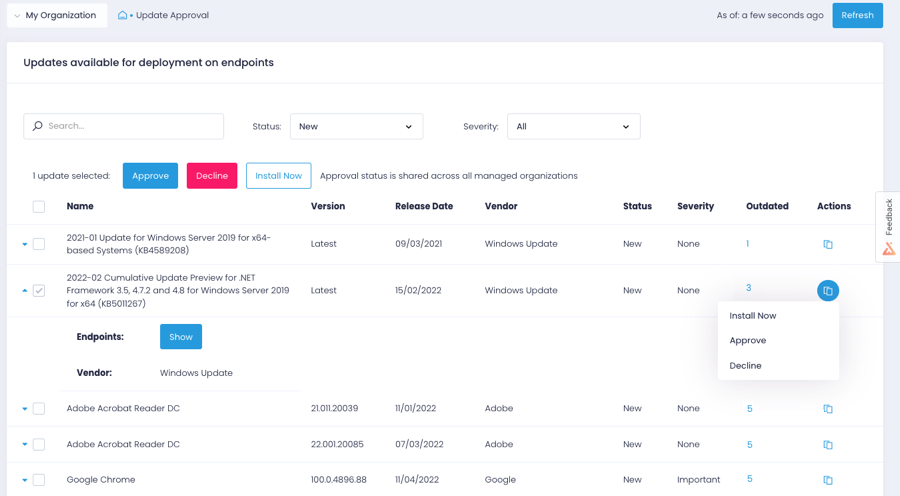
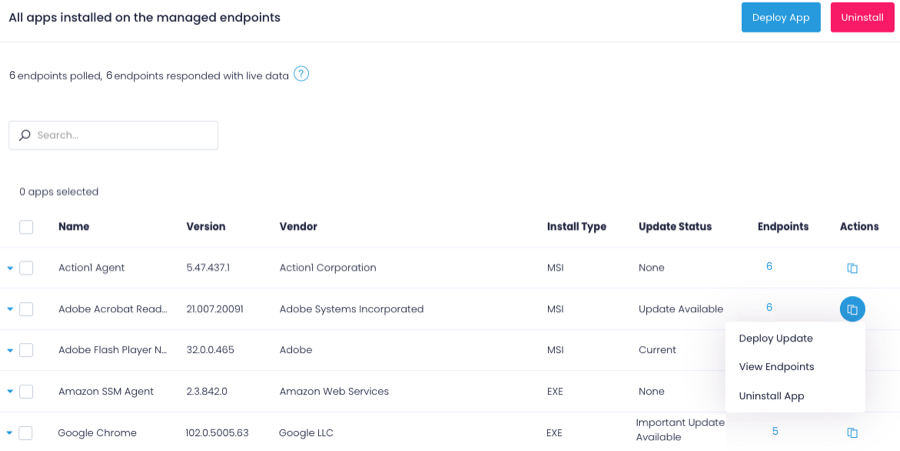
Action1 is an autonomous endpoint management platform that is cloud-native, scalable, and configurable in 5 minutes. It is free for the first 200 endpoints, with no functional limits. By pioneering autonomous OS and third-party patching - AEM’s foundational use case - through peer-to-peer patch distribution and real-time vulnerability assessment without needing a VPN, it eliminates costly, time-consuming routine labor, preempts ransomware and security risks, and protects the digital…
N/A
Ivanti Endpoint Manager
Score 7.8 out of 10
N/A
Ivanti Endpoint Manager increases user and IT productivity by helping IT administrators gather detailed device data, automate software and OS deployments, and quickly fix user issues.
N/A
Pricing
Action1
Ivanti Endpoint Manager
Editions & Modules
No answers on this topic
No answers on this topic
Offerings
Pricing Offerings
Action1
Ivanti Endpoint Manager
Free Trial
No
No
Free/Freemium Version
Yes
No
Premium Consulting/Integration Services
No
No
Entry-level Setup Fee
Optional
No setup fee
Additional Details
—
EPM is licensed per device (endpoint) in a subscription model. Each license allows for managing one endpoint.
If your organization is like mine (nonprofit and tight budget) this product is for you. The first 200 endpoints are free and being we are a small organization, this product is perfect for us. I was able to use Action1 to upgrade all my endpoints from Windows 10 to 11 pretty much effortlessly. If you are not a nonprofit and have more endpoints over 200, this is still a great product to use as I don't find it very expensive to incorporate into your infrastructure.
There is no direct replacement for the on-prem Ivanti [Unified Endpoint Manager (formerly LANDESK Management Suite)] solution. Ivanti has a companion product called Neurons, but that is in additional cost, and requires configuration with your on-prem [Unified Endpoint Manager] instance to perform basic functions. If cloud-based is a requirement for your organization, this is likely a dealbreaker. You can implement [Unified Endpoint Manager] in a cloud instance such as AWS, but the support for this appears limited. If on-prem is not an issue for you, this is a great tool for device management. It has robust features, impressive inventory, massive customization options, and excellent vendor support. If Patch Management is a problem in your company right now, this is the first product I would evaluate.
Easy remote access to devices. That simple. We have some very unskilled users in the field where asking them to access their PC via conventional remote tools like TeamViewer, Anydesk, etc. was always a pain. Now, all they have to do is ensure their PC is online, and we can connect to them.
Remote software deploy. Before Action1, we did have some GPOs and scripts, but again - being able to deploy to PCs outside of our office/LAN, is just beautiful. On top of the standard repository, being able to create new packages is very useful for our scenario.
Inventory Reporting. Recently we had to identify PCs running old versions of Windows. Can't highlight enough how easy it is.
Patch(Security) is done really well. You can use roll out projects or built-in automation as well as the use of groups and scopes to design pilot and other use cases.
It takes a solid inventory of what you have of your endpoints and can do an agentless scan as well if you need to collect data that way as well.
Provisioning is rather simple and even allows you to use other products' software for the image or the built-in if you wish to do so.
Software distribution works well and has a lot flexibility built into the module.
The deployment screens for update deferrals can be hard to understand at first and easy to skip since it carries some default info when you create a new automation rather than a more conspicuous prompt to update.
Setup - Boy it is a pain to configure everything correctly. Be aware that you'll probably be giving an AD service account some God rights to get everything working....and security just loves that....
Cost - Boy you have to pay for everything. I suppose it lets you buy into just what you want but having repeated items go through procurement is a pain if your procurement branch is a pain.
We are happy with the product but the support and development process is far superior to any other company we have worked with. Having a good support structure is very important in today's marketplace of products that do so many things and have so many robust options and capabilities. We are very satisfied with our contract, pricing, support and product execution.
Action1 has taken many of the tasks that are time consuming and made them simple automated tasks that can be run on a schedule. I can schedule tasks to run off-hours and know that they will be done and I no longer have worry about it. As someone who does IT support for a living, it just makes my job so much simpler with less stress.
Items are logically laid out and most are easy to find. The more advanced stuff can be trickier, but it is still not hard to find. There are a lot of options though, so remembering where some settings are, especially if you do not alter them often, can take a minute, but you will get to them fairly qiickly.
TRM\TAM support has been generally very good. Getting reported bug fixes, design changes, UX problems resolved has been a pain. It is often difficult to get problems escalated beyond the TRM\TAM level. Support is fantastic when you can get it, getting it can often require more work than it should, and that is probably our biggest issue.
After looking at different solutions, Action1 [Cloud Remote Monitoring and Management Solution] was the perfect fit for us that delivered all of the features we wanted without being as costly as some of the others alternatives we've looked at. There was no minimum endpoint count and they even offer up to 50 endpoints for free, which is really great for a small organization like us to help us lower our starting costs and still allows us to grow at our pace without having to commit to a defined amount of endpoints to start.
It's been many years since I did a full evaluation of other products but at the time we purchased it, the main competitors were Microsoft's SMS and Alteris. SMS just looked horribly ugly and complicated (which fit in very well with Microsoft's other server tools) and Alteris looked okay but had a piecemeal approach where even a basic deployment meant purchasing a half dozen or more components. LANDesk had one bundle for all the tools we were looking for and had a great interface for presenting the data.
Saved hours per week on patching and able to ensure a 100% patching success rate.
Able to create custom alerting on potential problems as well as able to create some automation to automatically address problems.
Improved support to our remote locations and users.
Custom deployments allow us to have a mechanism to deploy custom applications we build as well as other third party applications we need to distribute.