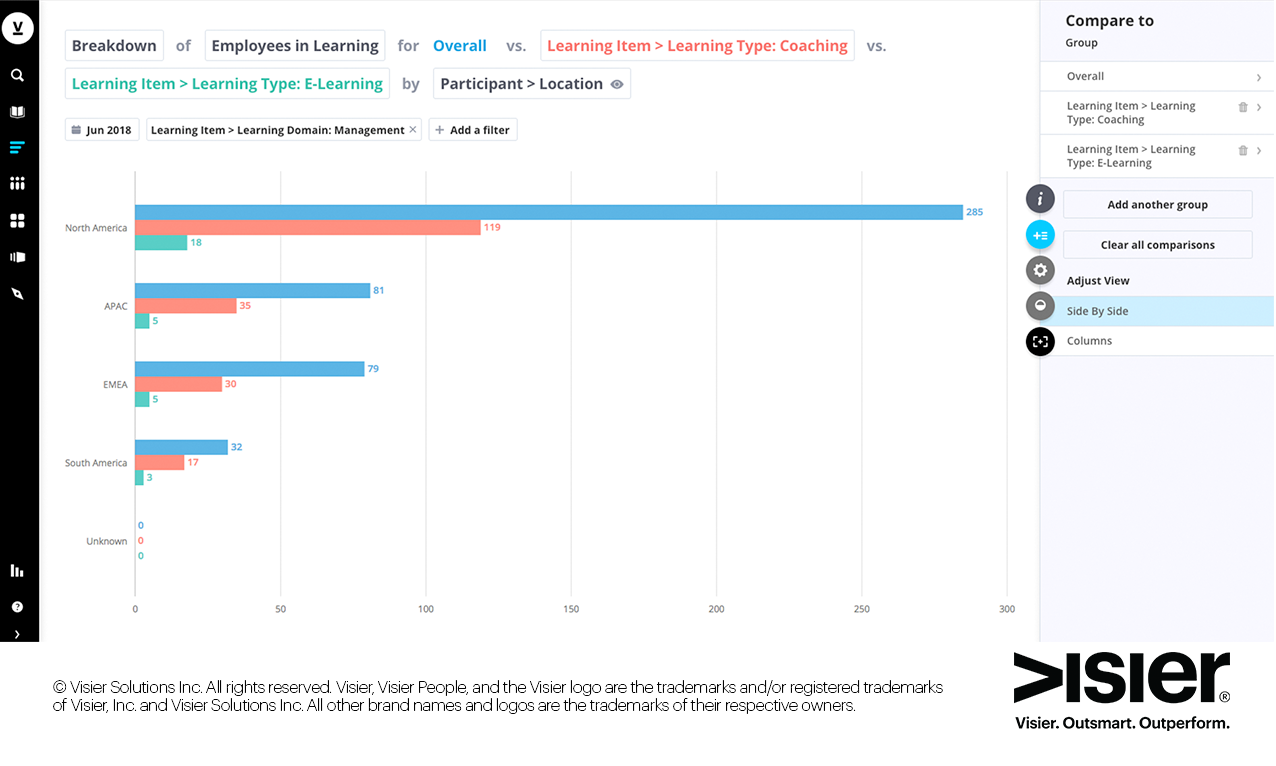
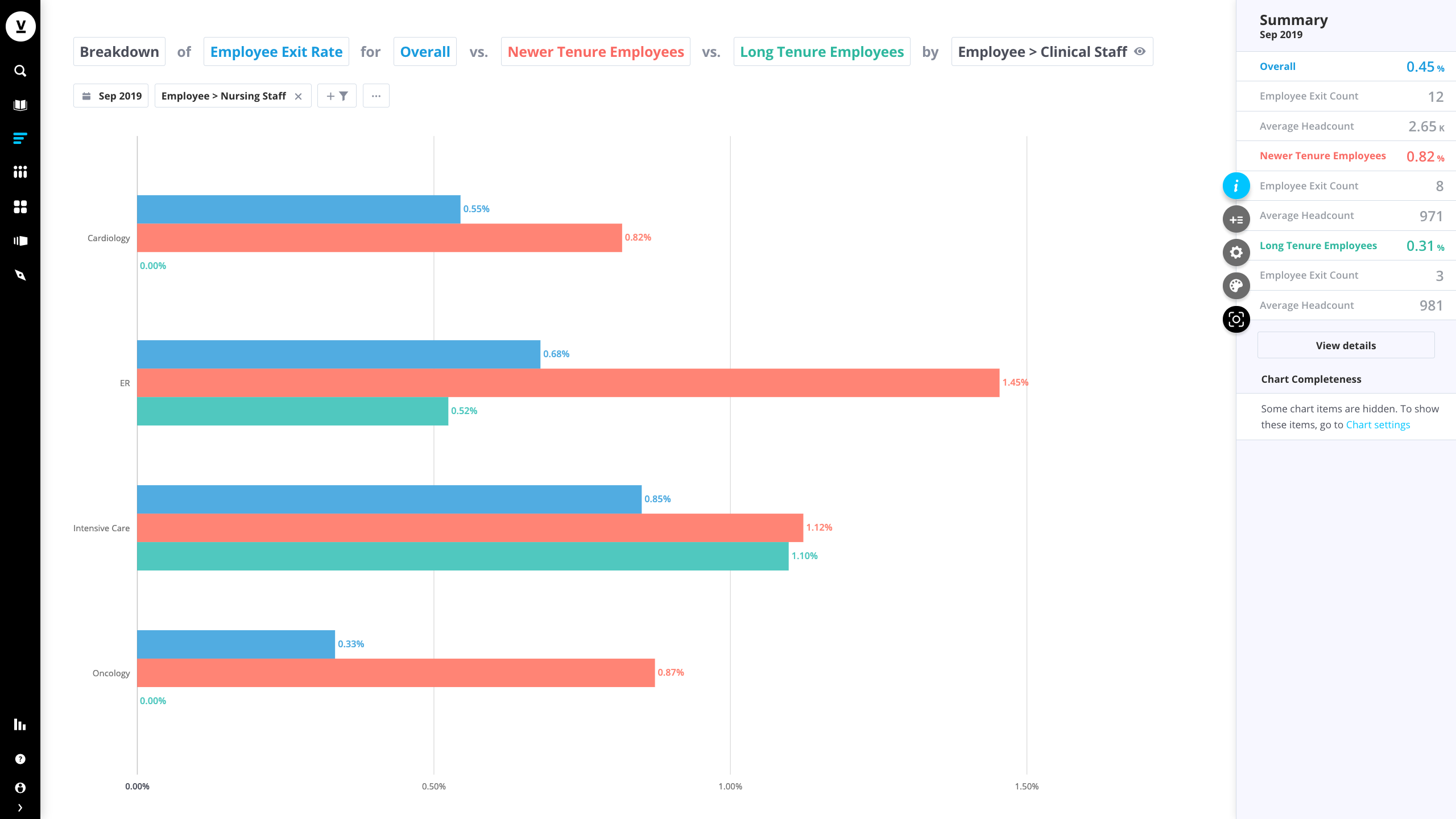
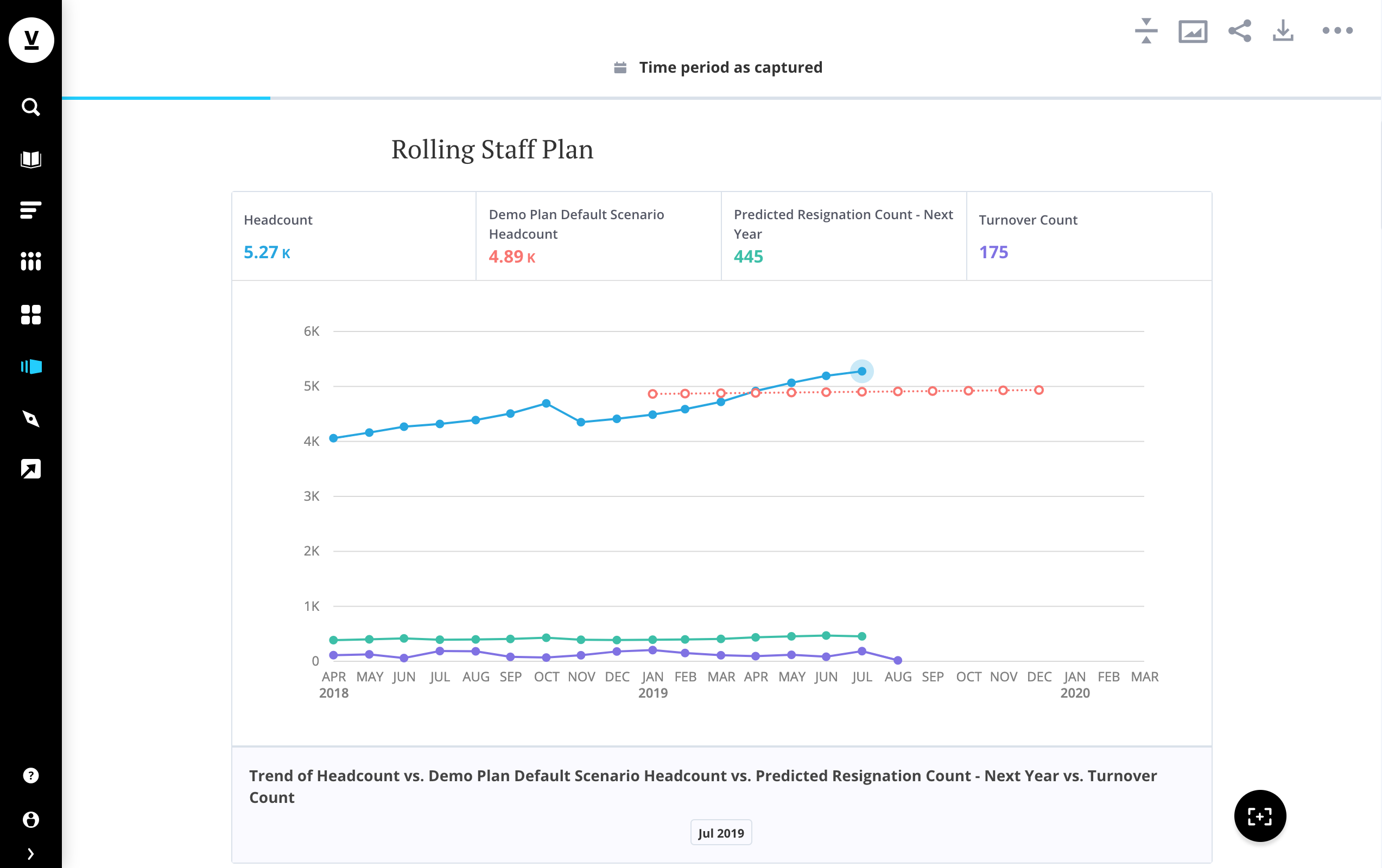
Visier aims to give organizations a "Workforce AI Edge:" A set of AI-powered capabilities that help leaders understand the relationship between people and work, elevate employee productivity, and win by adapting to change faster. The company offers people analytics, workforce planning, and compensation allocation. All Visier technology is underpinned by its Real-time People Data Platform, which uses AI to unlock the business-transforming potential of people data, work data, and the fusion…
N/A
Workday Adaptive Planning
Score7.8 out of 10
Mid-Size Companies (51-1,000 employees)
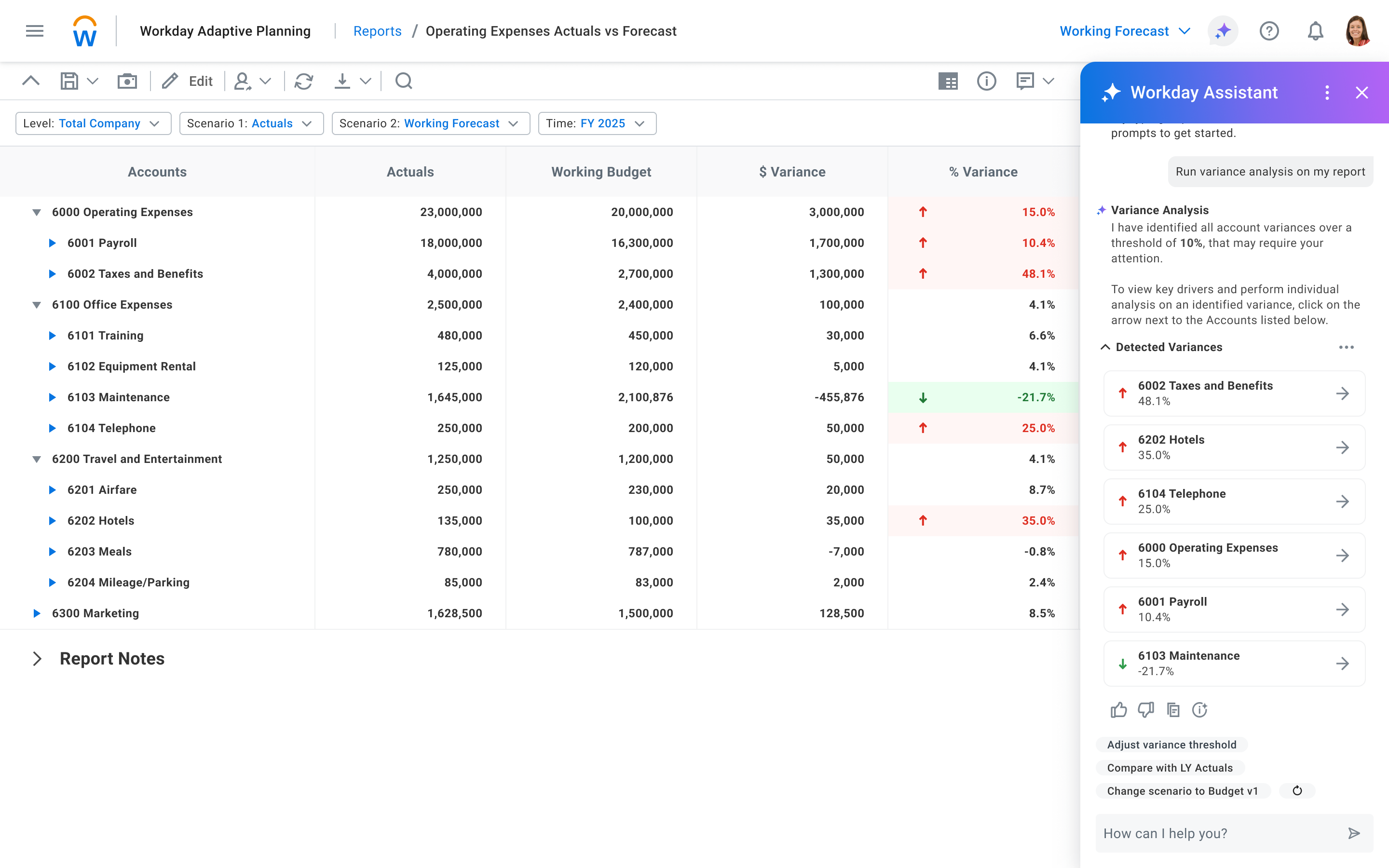
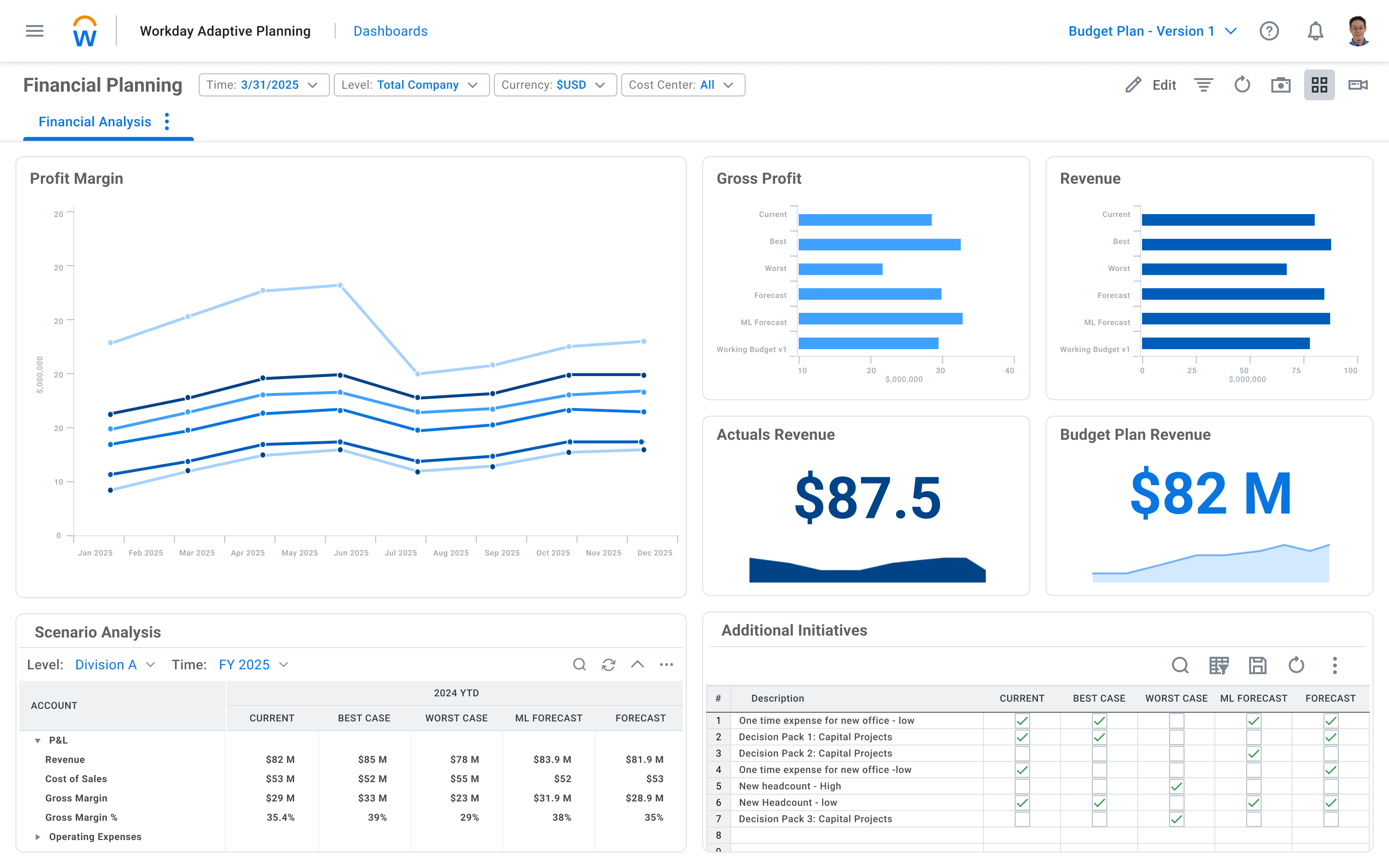
Workday Adaptive Planning streamlines planning workflows, using AI and real-time data integration to improve collaboration and provide predictive forecasts for better strategic analysis.
N/A
Pricing
Visier People
Workday Adaptive Planning
Editions & Modules
No answers on this topic
No answers on this topic
Offerings
Pricing Offerings
Visier People
Workday Adaptive Planning
Free Trial
No
Yes
Free/Freemium Version
No
No
Premium Consulting/Integration Services
No
Yes
Entry-level Setup Fee
No setup fee
Optional
Additional Details
—
—
More Pricing Information
Community Pulse
Visier People
Workday Adaptive Planning
Considered Both Products
Visier
No answer on this topic
Workday
Verified User
Chose Workday Adaptive Planning
It doesn't have the same standard fulfillment modeling as the true workforce planning products, it equals the other core HCM systems and beats them on ease of use.
A de minimis incentive was given to thank the reviewer for their time. The incentive was not used to bias or drive a particular response, nor was the incentive contingent on a positive endorsement. More Info
Visier People is well-suited for organizations that require the ability to record thorough information on analytics of the company, and to have the change of measuring training's productivity impact. The software isn't well-suited for those who tend to feature a lot of models into the software as the platform doesn't record/support most models, so some data isn't able to be recorded.
A de minimis incentive was given to thank the reviewer for their time. The incentive was not used to bias or drive a particular response, nor was the incentive contingent on a positive endorsement. More Info
It's well suited to any business where you have defined inputs, a layer of structured calculations and a defined output. In other words, any business situation! We use it in a law firm setting where it enables us to import staff plans, assign targets to each individual, thereby generating a revenue forecast linked to business capacity. From there, global assumptions determine staff and direct costs, with the user overlaying discretionary costs to arrive at a final P&L forecast. This is then summarised using the reporting and dashboarding layer to provide outputs to senior leaders for sign off.
A de minimis incentive was given to thank the reviewer for their time. The incentive was not used to bias or drive a particular response, nor was the incentive contingent on a positive endorsement. More Info
The database is very complete and detailed, thus being able to enhance a deep analysis of each user.
The Visier dashboard is extremely attractive and friendly, helping staff understand every detail of the analyzes conducted on the company's workforce.
Despite not being a great and complete solution to work with HR within this platform, however, data can be shared to exchange information between the head of each department of the company and HR staff and to speed up the analysis process and determine what to do with a low-performing employee.
It excellently determines the productivity of each employee and also determines risk by monitoring patterns and behavior.
A de minimis incentive was given to thank the reviewer for their time. The incentive was not used to bias or drive a particular response, nor was the incentive contingent on a positive endorsement. More Info
It helps create dynamic plans for finances, operations and various functional units in an organization all under one platform
It helps in scenario modeling to help analyze various business events and report by any number of business dimensions including channel, customer or product
It can be integrated with any system including ERP, BI or CRM
A de minimis incentive was given to thank the reviewer for their time. The incentive was not used to bias or drive a particular response, nor was the incentive contingent on a positive endorsement. TR verified that a representative sample of customers was invited. More Info
Visier is a people analytics tool, so all data points are tied to employees. It can be difficult to analyze data points that aren't tied to employees (e.g., certain job data) since the data is driven by people metrics.
Visier releases updates quarterly. While this cadence does provide room for updates and enhances to be implemented in the tool throughout the year, other software providers operate on a more continuous update schedule.
A de minimis incentive was given to thank the reviewer for their time. The incentive was not used to bias or drive a particular response, nor was the incentive contingent on a positive endorsement. More Info
Expense reporting aspects are repetitive and hard to fully optimize.
Finance tracking is limited to basic reports with multiple levels or drill-down...hard to fully grasp without exporting data and massaging in something else (like Excel).
A de minimis incentive was given to thank the reviewer for their time. The incentive was not used to bias or drive a particular response, nor was the incentive contingent on a positive endorsement. More Info
It is a software with great resources, it increases the possibility that the entire workforce is productive, it gives us quick answers, it is the most powerful workforce analysis software that exists so far.
A de minimis incentive was given to thank the reviewer for their time. The incentive was not used to bias or drive a particular response, nor was the incentive contingent on a positive endorsement. More Info
For one we're in way too deep to not move forward with Adaptive. We're integrated with Workday, we do a ton of reporting with Adaptive, and it's working very well for planning and forecasting. No reason to look back or change course.
Visier People makes it very easy for all end users to go in and see, pull, or dig in to their data where previously my team would have to pull or schedule a report of the data to each user. It is also very fast in updating charts/analyses when changing or adding filters, which makes the ease of use better. Last, the charts and analyses are very visually appeasing, making users want to use the platform more.
A de minimis incentive was given to thank the reviewer for their time. The incentive was not used to bias or drive a particular response, nor was the incentive contingent on a positive endorsement. More Info
It is an easy transition for Excel users, with more built-in analytical tools and no need to build formulas. It also has built-in reporting and integration with Microsoft Office products such as Excel and PowerPoint. For non-Finance users, there's an initial learning curve to get used to the tool.
A de minimis incentive was given to thank the reviewer for their time. The incentive was not used to bias or drive a particular response, nor was the incentive contingent on a positive endorsement. More Info
There haven't been any lately. The only one issue I can think of is when there was an update in Adaptive that altered our reports. Before I realized there was an issue, Adaptive reached out to let me know, so that it could be fixed.
All aspects of Adaptive Insights perform well. One area that I wish was quicker was integration. When importing data from Intacct our accounting ERP platform, it can sometimes take 4 hours for the import to process. The earlier imports are done, the quicker they complete. My estimate for a quick upload is about two hours.
Whenever we have had any questions, issues, or concerns, the support has been quick and thorough. [This] allow[s] us to be able to fully resolve any issues, or be connected with the right group quickly to attain the result we were after; be it from simple formatting to adding new detailed reporting.
A de minimis incentive was given to thank the reviewer for their time. The incentive was not used to bias or drive a particular response, nor was the incentive contingent on a positive endorsement. More Info
This was extremely helpful so that they could walk you through the model and teach you more about the complexity of various areas. It is most helpful when it is specific to your organization's model. The larger in-person trainings were helpful but they tended to be more generic and entry level. The trainings that are more tailored to your specific needs are the most helpful.
A de minimis incentive was given to thank the reviewer for their time. The incentive was not used to bias or drive a particular response, nor was the incentive contingent on a positive endorsement. More Info
They often times tended to be way too generic or entry level. They would also become sales pitches to upgrade or get new Adaptive Planning products. The questions in the training would be very niche and specific to other organizations. They were rarely helpful to the group at large.
A de minimis incentive was given to thank the reviewer for their time. The incentive was not used to bias or drive a particular response, nor was the incentive contingent on a positive endorsement. More Info
Visier can move as quickly or as slowly as the client needs. The topic-by-topic approach separates the project in clear phases and allows for focus on specific data. Depending on the size of the implementation team, implementation could move more rapidly if the subject matter experts are responsible for the individual topic data sets.
A de minimis incentive was given to thank the reviewer for their time. The incentive was not used to bias or drive a particular response, nor was the incentive contingent on a positive endorsement. More Info
Trust the expertise of very strong 3rd party implementers. Having deployed Adaptive at a separate company before, I thought I knew it all (hubris, I know). Fortunately, I began to (very quickly) trust the judgment of our Carlson implementation team, and they provided invaluable insights and best-in-class processes that have benefitted me and my team greatly.
A de minimis incentive was given to thank the reviewer for their time. The incentive was not used to bias or drive a particular response, nor was the incentive contingent on a positive endorsement. More Info
Visier People has a user-friendly interface and easy-to-use virtualization as compared to other similar tools available in the market. It also provides multiple prebuild templates for HR and workforce analytics which reduces the time and effort required for manual implementation. It can seamlessly be integrated with other ranges of HR and business systems to make it easier for organizations to centralize the workforce and HR data for analysis.
Workday became our choice because it is fully web-based and easily integrates with other systems. The learning curve for Workday was shorter than that of Dynamics. The reporting tools in Workday are more user-friendly than that of Dynamics. However Workday did not have Check Printing tools which are available in Dynamics. The organization started a project to digitize all financial transactions so it was not a priority feature. When it comes to scaling up the functionalities of Workday it was much easier than Dynamics.
A de minimis incentive was given to thank the reviewer for their time. The incentive was not used to bias or drive a particular response, nor was the incentive contingent on a positive endorsement. TR verified that a representative sample of customers was invited. More Info
A de minimis incentive was given to thank the reviewer for their time. The incentive was not used to bias or drive a particular response, nor was the incentive contingent on a positive endorsement. More Info
We went from 2 users to 70+ users over a 2 year period of time. The application scaled wonderfully. 65 of those users were non-finance users so they were able to quickly learn the software and prepare budgets quickly and efficiently. That is the power of Adaptive and its ability to scale
A de minimis incentive was given to thank the reviewer for their time. The incentive was not used to bias or drive a particular response, nor was the incentive contingent on a positive endorsement. More Info
In one case, we were able to realize a 25% reduction in turnover in a key job group by leveraging the insights we derived from Visier workforce analytics.
In one case, we were able to identify key turnover trends that would place a business' strategy at risk (due to the fact that turnover was in revenue-generating roles).
In both businesses I've used Visier, we were able to significantly reduce manual reporting (by more than 80%), enabling our data analysts to do more consultative work (vs. query generating work) with HR business partners.
A de minimis incentive was given to thank the reviewer for their time. The incentive was not used to bias or drive a particular response, nor was the incentive contingent on a positive endorsement. More Info
It's facilitated a better financial literacy and management by the non-financial managers in the company, giving them a much better ability to see what they're spending, control it, and plan better in the future.
It's hard to quantify the ease of model and version management, but we could never do what we're doing now with our current staff. It would take a small army to replicate anything close to what Adaptive pulls off using Excel, if it's even possible.
A de minimis incentive was given to thank the reviewer for their time. The incentive was not used to bias or drive a particular response, nor was the incentive contingent on a positive endorsement. More Info