Mailchimp is an email marketing and marketing automation platform. Beyond just tracking how campaigns perform, Mailchimp takes it a step further by analyzing data from over half a billion emails to show why campaigns perform, driving informed decisions.
$0
per month
Oracle Marketing
Score 7.0 out of 10
N/A
Oracle CX Marketing (formerly Oracle Marketing Cloud) is a solution designed to enable marketers to plan and execute automated marketing campaigns via email, display search, video advertising, and mobile while delivering a personalized customer experience for their prospects.
$2,000
per month
Agentforce Marketing
Score 7.7 out of 10
N/A
Marketing Cloud is a cloud-based digital marketing platform, used by marketers can segment their audience, deliver personalized messages, track campaign performance, engage leads and accounts, and optimize strategies based on real-time insights.
I have used a lot of email marketing tools over the years and Intuit Mailchimp is one that I keep going back to, it simple and easy to use, no messing around and it does what it says one tin.
The free plan of Mailchimp works well for middle and small scale businesses. It offers a rich library of email templates and powerful analytics to support the lead generation and brand awareness initiatives of the organization. Customization of templates is a piece of cake …
Constant Contact is antiquated and clunky. Pardot is a huge solution and tied to Salesforce so it’s not aimed at the same user audience. I think Mailchimp is generally just easier to use and costs less than the alternatives on the market currently.
Mailchimp was usually already in place and needed to be set up for growth. In general, I found that the lack of phone support at the lower tiers and the rigidness for opt-in rules made working with it long term not that easy.
As I mentioned earlier, Mailchimp is a great entry point for small businesses that are looking to target their customer and contact list with segmented email marketing. It is easy enough to use and the price is usually right for the return that is possible when used correctly. …
Mailchimp focuses on email and they do a good job overall compared to the competition. The platform is easy to use and makes sending emails a breeze. If you need something more robust then I would recommend Marketo as you can do anything you can imagine. However, you will need …
Mailchimp is what I inherited from my predecessor in the marketing department. It is more specialized into email marketing than Pardot or Marketo (though both have other benefits that make them really stick out for overall marketing automation), and is vaguely less expensive. Ye…
Mailchimp has fast and helpful customer service as compared to these competitors. While the feature set might be more limited, the price is significantly less. I have also found the platform to be much more intuitive.
Eloqua had long term contracts and the starter plans started as high as $2000. Also, unlike Mailchimp, it misses out on integration with Google Analytics and takes a while to fix issues with implementation.
MailChimp is fairly simple in functionality compared to competitors. Pardot was something I used for a B2B Saas company I worked for. Drip is what I used for eCommerce. Both are preferred in my current situations. I don't think I would recommend either over MailChimp for a …
Mailchimp is not for large organizations with complicated campaigns and conversion labels. It's for simple companies - I wouldn't advise communications teams to use it.
Eloqua was easier for us to develop triggered campaigns with than MailChimp. MailChimp was good for monthly newsletters that went out to the full database. Eloqua allowed us to personalize our emails and deliver the right message to the right consumer at the right time. It …
Oracle CX Marketing (formerly Oracle Marketing Cloud)'s Eloqua stacks up fairly well with these other tools, as they all have similar functions and features. Pricing and how seamlessly the platform integrates with a company's CRM are the main deciding factors. The customer …
Oracle Eloqua has the best combination of features, scalability, visibility into campaign and lead activities, and user interface of any of the marketing automation software or email service providers I've used.
While Pardot is more intuitive and less complex than Eloqua when it comes to campaign management and deploying marketing automation, if you are a larger enterprise company, you will need the API capabilities and customization options that Eloqua can provide.
I inherited Eloqua from my predecessor, I wasn't involved in decision making process of bring Eloqua onboard.
Eloqua perhaps is one of the best MAP systems out there in the market. It certainly is the best suited MAP tool for Enterprise level companies. However, it may not be …
Eloqua is more robust in my opinion. It is far more customizable and has better reporting. Pardon integrated great with Salesforce and has a great UI and has an easier learning curve than Eloqua.
Salesforce does not have a search function which can be quite frustating to find your emails and find past insights on campaigns when you do not have a perfect naming structure.
Eloqua is the true enterprise class tool compared to smaller organizations like HubSpot. We need a tool that can be approved by out stakeholders in IT, compliance etc. so the Oracle organization best suits our needs. Pardot and Marketo are always an option for the future, and …
My company is actually moving to Pardot because it integrates better with SalesForce, which our Sales teams use. I am new to Pardot so I don't know all the details on why it is a better system, but I will say that I have personally had very few issues with Eloqua and would have …
Eloqua can scale. It has more flexibility in customizations of workflows, a larger pool of partners in their ecosystem, and can handle large volume sends without breaking a sweat.
These other platforms lack the robust capabilities or ability to customize your output. These platforms are plug and play, but you can only produce within the limits of what you are allowed to. I regularly push Eloqua to do things that are not natural capabilities. I've not …
Offers robustness and scalability, especially with a mature open API. This is required for enterprises, complex technology stacks, and innovative marketing teams that want to challenge the status quo.
Verified User
Manager
Chose Oracle Marketing
I find ELQ to be the most well-rounded MAP on the market (without a lot of exposure to Marketo, which seems to be its one real opponent). In my opinion, Pardot and HubSpot offer similar, but less robust solutions that can be somewhat constricting.
Eloqua is a true enterprise level tool. It gives you what you need to get the job done, it is easy to use and you have a lot of support through communities, tutorials, documentation and events.
Eloqua is the main marketing automation platform I have used. I have done thorough evaluations of other platforms/competitors but the value of Eloqua over the competitors was clear. The only other tools I have used were individuals platforms that only do small pieces of what …
Pardot is far better, but used basic level with MailChimp. Prefer MailChimp's email design capabilities.
Verified User
Employee
Chose Salesforce Agentforce Marketing
My previous company was using MailChimp because we did not have the data volume needed for deep integrations. I would say that MailChimp’s interface is considerably more user friendly. Templates are better (and often used by Pardot if you view the source html code) and are less …
Pardot out-ranks the competition in regards to the integration with Salesforce. It is hard to beat the ability to use your already-made customer profiles and contact information in your marketing campaigns. Where it is lacking is the usability. MailChimp is a much more user …
We use Mailchimp for email campaigns that are not sales-specific, i.e., press releases. While Mailchimp is good for tracking opens, click-throughs, embedding photos, embedding videos, etc., Pardot works best when integrated both with Google Analytics as well as Salesforce. It …
I MUCH prefer Pardot to Mailchimp and Mailjet. It feels more like a professional product and behaves as such with a more advanced feature set and customizability. For instance, I have not found a good way in either of the competing products to do branded preference center …
Pardot offers equal or better performance when compared to other industry leaders. It's as user-friendly as Emma and Mailchimp and outpaces others like Blackbaud Luminate. The WYSIWYG (like all other email platforms) has some quirks to navigate around, but it's generally easy …
Mailchimp is great for simple email use. It's straightforward and great for beginners in the email space. It does not offer nearly as much in the way of complexity as Salesforce Marketing Cloud does, so is limited with what it can do. Salesforce Marketing Cloud is much more …
I think that all of the marketing platforms I have evaluated and used in the past serve different markets and purposes. Salesforce Marketing Cloud was more palatable to our team because of our existing tech stack where we had Salesforce CRM already deployed and in use. Compared …
My previous organization used Pardot and also Mailchimp. Salesforce Marketing Cloud is more powerful than both of those tools and integrates more deeply with Salesforce CRM.
I haven't chosen Marketing Cloud over Eloqua, as i stand by my opinion that MC is better for database sizes of up to a million, which for Eloqua i would say goes to multiple millions of contacts. Their database set up is just a bit more intuitive and i believe offers more, …
Salesforce Marketing Cloud offers many opportunities for personalization and supports big data integration. It features powerful tools like SQL for data and AMPscript for email creation. If someone wants to master the platform, it might require some initial learning, which I …
Eloqua had a more visual UI, where Pardot goes by a folder structure. Though I prefered the Eloqua interface, Pardot has a quicker refresh and you can see your changes instantly. Pardot seems to have far less "quirks" than Eloqua, so less customized solutions are required.
As a user of Infusionsoft and SharpSpring, I wouldn't say that Pardot is the best. Infusionsoft is better overall. Pardot is used by one client of ours. Pardot's lack of good email builder is what puts it lower on the totem pole. It is a bit stronger with reporting and …
Pardot is pretty much on the same level. We chose Pardot because it integrates directly with Salesforce. We already use Contentful for landing pages, so we weren't too worried about using Pardot's builder. I really liked the simplicity of the visual email workflows. Coming …
While Pardot's integration with Salesforce, segmentation functionality, and automation rules are much more robust than any of its competitors, the email builder lacks even compared to free versions of marketing automation software. For us, the integration and being able to …
Pardot is a player in that it is one of the older products on the forefront of email marketing. This is good and bad in that it has been established but bad in that it isn't as robust as some of the other products on the market. Adobe can be good but is new to the market and …
Pardot has a clean UI and UX and was very simple to use for the scope of our marketing team. Based on the size of our organization and team, Pardot had enough functionality for what we needed to do. However, if our company were to scale we would probably move to a more robust …
Pardot is a good tool for medium-sized and smaller sized companies. Working with larger companies I have seen more lean towards Marketo. I have also worked with e-commerce brands that have no use for a marketing automation tool that connects to Salesforce. Starting at a company …
I have used parts of the marketing cloud. While certain components of the marketing cloud are better (like social studio), the marketing automation and email marketing components of pardot are better and best suited for our business.
Verified User
Director
Chose Salesforce Agentforce Marketing
We selected Pardot for the SalesForce CRM connector, as a SalesForce CRM company we needed that first and foremost. Overall Pardot is a good e-mail platform that offers robust customization and is meagerly intuitive. MailChimp has less flexibility, but overall is an easier …
Verified User
Employee
Chose Salesforce Agentforce Marketing
Not sure, Pardot was at this company before I started.
For any E-commerce related needs, like you need to see a list of customers who have added products to cart but did not purchase, this can be done really easily, but if your e-commerce provider provides integration, then it is best suited. Most of the systems in the Market provide out-of-the-box integration. Their API is also very easy it can be integrated to any language. You can integrate it into your custom developed system and use the features, like adding customers to specific lists. Also, if your lists become really big, then their system can get a bit slow to respond via API, so you might need a strategy for how you are gonna fetch the data using API.
A duration of one and a half years is enough for us to recognize the capabilities of a tool and in my opinion, this one is just a great tool to manage marketing campaigns of even massive-sized firms. Its marketing automation tool and its way of managing campaign and the way it executes digital initiatives is enough to get an inkling of its abilities. Less favorable for the people who want to have something at a cheap price and are more dependent on the reports as its reports have nothing much in detail.
I think the product, by definition, is meant for marketing — and we use it exactly for that, for running campaigns. That’s the best-suited use case for the product. I don’t think it’s really meant to be used for anything else — that’s just not how it’s designed.
Mailchimp allows you to manage your mailing list really well. You can subscribe people, unsubscribe people manage the mailing list directly into segments, and what not.
Mailchimp has features where you can create campaigns based on your mailing lists and send out newsletters to your subscribers based on a multitude of parameters that you can setup. Such as send email daily, weekly, monthly and they also have event based mails that you can send out.
Mailchimp also has a feature where you can design your emails. The look and aesthetics are very important when sending emails to your subscribers and all those needs are addressed here.
Integration options outside of auto-syncs. I am currently having an issue trying to find an adapter to use with Eloqua to API into our data warehouse but keep the functionality on the Eloqua side.
To provide more transparency and visual details of the syncs (integrations of outside data) from any other system that is feeding Eloqua, like what is being updated or changed, better explanations of errors, drill down to newly created records.
Custom Objects - Need to have a way to create CDOs outside of just form submissions and uploading of lists, like if you needed to import a file nightly to feed that CDO data but automate the import and make sure it maps to a contact record.
Import of data from a file on SFTP - There is no way to filter or create logic to control what is being fed into Eloqua. Currently, that manipulation has to be done by the IT side first. Less flexibility.
Better auditing capabilities within the canvas. meaning, sometimes if something is changed or not working the problem may not necessarily show up in immediately, the pattern could take a while to present itself. For example, the feeders into the program. If there is a problem, I don't know that maybe contacts are not entering the program until we do reporting that month and realize there was a lull of contacts going through. Then we have a whole month of missed records or other potential data issues. When you get do large and your Eloqua machine is very robust, the harder it is to see everything
Be able to add more than 250 custom contact records. That definitely inhibits my organization in how we need to use that record.
We've had Mailchimp for about ten years, I want to say. I started with the company about four years ago, and I don't see us ever diverting to another source. It's easy for us to use, and we have all our clients already built into the database. I imagine we'll use them for as long as we have the company.
We have been able to automate so many marketing processes with Eloqua over the past 5 years that the only direction would be to adopt the latest and greatest features Eloqua adds. The alternative would be to go back to the marketing stone-age and start over again. And we would rather move forward with increased automation and efficiency.
As of right now we have not seen any other program that integrates as seamlessly into our Salesforce platform. We have barely scratched the surface of all the features and use cases. It would be irresponsible to make a move to another platform in the near future. We have not come up against any limitations that would prompt a need to switch
The interface is a bit complicated, and I need to spend some time to learn new functions and understanding how it works. I don't like working with email templates because of the limited customization options. However, functions like AI for generating emails, segmentation, and analytics still work well and are very useful.
Personally, I find it quite easy to use. But for those members of our team who have little or no testing experience, it's been a bit more difficult. There's also training required for development teams in order to have your campaigns coded and set up in the most efficient way. Our developers have been able to do basic and intermediate tests with no difficulty, and they find the interface itself quite intuitive... it's just the extremely complex tests that require a bit more understanding.
You won't find another solution that has as many features as Salesforce Marketing Cloud Interaction Studio. We all know Salesforce, we all know how big they are and it's not for nothing... Their tools do most of the things you want, need and even imagine. Using it is complicated, but the usability is infinite.
I have, in the 4+ years that I've used Mailchimp, never seen an issue that restricted the use of their software/tools. I don't know of a single time when they're system crashed or went down. I could be wrong, but I honestly haven't experienced any issues with outages, errors or unplanned downtime
Upgrades and timing of the upgrades were communicated well and planned during off hours for our work. If we did have a campaign scheduled during that time, it would kick-off after the system was back active. There were a few unplanned system down times, but it was a rare occurrence and those times were also short in duration.
I haven't noticed any slow speeds from Mailchimp or their tools. I think the landing pages load quickly and look nice. The email reports and editing operates smoothly and doesn't take time to load. Additionally, when I use Mailchimp in conjunction with Zapier + Hubspot I don't notice any drag between any of these tools
There are occasional complaints about slowness to refresh a screen or build a report. However, this is as much a factor of network access speeds as the system itself, since often the complaints occur when someone is accessing on a wireless network.
Though the make up of MA apps is not built this way today, it would be nice to see them become more real-time. The integration between Salesforce and Pardot is not a true real-time integration. If I modify something in Salesforce, those changes are not automatically reflected in Pardot immediately. There is a delay of about 15 minutes before the systems sync. This delay, although not long, is less than ideal We would love the systems to be integrated real time such that changes are propagated from one system to the other immediately.
Website tools were easy to use and understand so a novice can easily meet or exceed their client's expectations! Loved that we were able to totally customize so that the e-mail we created conveyed our client's overall messaging consistent with their branding! Client love that we can provide turnkey services to support their sales and marketing teams!
We found that we often were telling support people how the system worked. Because we were on E9 that created a lot of support issues as well since few people on the support team seemed to know how E9 worked. That was mostly okay except when we had major system issues (like SSO preventing us from logging in after an update), it became really hard to get answers that weren't vague. It was always the issues that had the highest visibility within the organization (like with Sales) that seemed to take forever to resolve and didn't have a clear escalation path. When Oracle switched Eloqua over to the Oracle support portal it just got worse
They are really responsive and more than not solve the problem or give you insight to how you can manage the solution yourself. I do find however sometimes a long delay on the more complex issues when they need to loop in other departments. but overall a good experience with support
They offer very basic classes which are required for master certification.
After having been through it, I would not consider anyone with a master certification any more qualified, unlike Salesforce.com certification which is a more difficult thing to acquire. For example, one of the classes towards certification was around social media. I would have expected examples of how to incorporate into campaigns in the product, with a demo and hands-on test. Instead, it was a powerpoint slideshow that went on way too long and covered really basic stuff like “what is Facebook, what is Twitter”
The trainers at the Pardot user conference (Elevate and Connections) were very knowledgeable and presented the material well. Again, the content was targeted to more of a new user audience, and was not really relevant for folks who had been using the product for 2+ years.
Ok, so, this sounds like it could be horrible because it was all remote, but we loved it... the Adobe training environment was easy to use, and the trainers were engaging. It was simple to switch back and forth between the meeting and the hands-on exercises in their training instances. We took the fundamentals training early in our implementation-- before the consultants came onsite-- and I know this made a big difference in our implementation, because we were able to ask informed questions throughout
Pardot's online training touches on all topics briefly and vaguely without much indepth exploration into how a final outcome could look, such as Nurturing Campaigns, Email templates, landing page templates, etc... The only true way to uncover Pardot's full capabilities is to have Front End design and coding experience. Without this key skill set, I would not recommend Pardot to another business.
It's pretty easy to get up and running! There's a slight learning curve on a few things, but once you find where everything is located, you can import your list and send your first email. It really makes our clients feel great to see how quickly they can get that first email out.
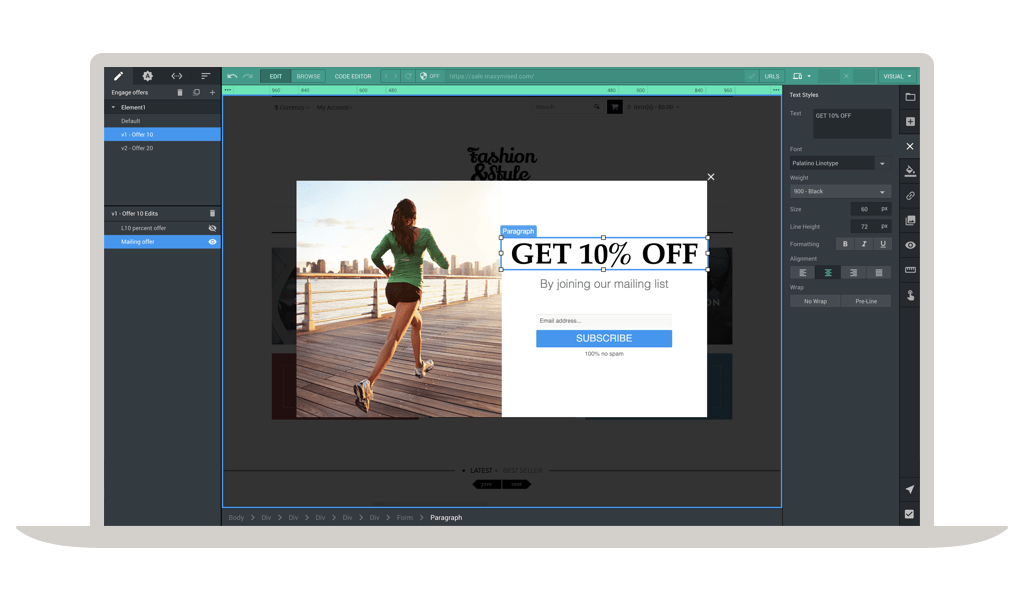
I give it a 10 because the only issue we had was a result of not following the guidance we were given. Maxymiser provided a customized implementation guide for each site where we were adding the code. On our site implementations when we followed that guide to the letter, it was extremely fast and easy and has worked very well.
From an IT perspective, once you set up the Javascript beacon and start collecting data there is a waiting game. During this time you can start labeling your site actions which can be labor intensive for a single person, but you don't really have the final end-users on the platform yet. We did a lot of training so users were experienced, but it wasn't until they had their first tasks to accomplish that they started using the system and had questions. I'd recommend setting up some immediate goals for an end-user to start segmenting for the purpose of displaying message campaigns so you can jump start end-user action.
I don't think they are comparable; we use Google Ads to put our website at the top of the list when someone googles certain words. We use meta business to manage our social media. Google aims to gain customers, while Mailchimp is used to interact with both existing and new customers.
It was quite complex to generate segments with Adobe analytics and I wasn’t personally satisfied with the overall performance of Adobe Analytics and wasn’t enough flexible in any way. So we decided to switch to something else better than Adobe Analytics and is available in the market at a cheap rate and we ended up doing our research for the most suitable tool at Oracle Infinity and we don’t regret our decision.
We use Salesforce Marketing Cloud for lead management, generating reports, tracking customer and dealer information, inputting orders, and more. I prefer HubSpot for email marketing and automation because it is easier to use and the emails are designed much better. We currently use Salesforce and HubSpot, and we are very happy to have both, as they have different pros/cons.
Mailchimp over the years I've used it has grown in leaps and bounds. They have added so many additional features than were previously available. They are truly an all-in-one marketing platform now. If you're a small operation and just want to add email to your marketing efforts, they're there for you. If you're a larger operation and want to start sending postcard advertisements, they can do that. If you'd good with that and want to kick up your marketing by going social, you can do that on their platform. They are truly able to be as small as you need, but also get quite large in whatever it is you'd like to do through their system.
Eloqua is definitely good for larger companies that have 100,000+ contacts and complex marketing workflows and data. Personalization is fairly robust with Eloqua for larger campaigns with smart content and features. Scaling across channels is also seamless - as the platform has great options for non-email channels like SMS, Direct Mail, Chat, etc.
Prior to this, we had no solution and literally were doing things on paper in a world where technology is outpacing paper. Having this process optimized has made it easier for the sales and marketing people to change information. From the training perspective, it has allowed us to see holes in where we could create additional support training, so the ROI here has been a lot more than just the optimization of a process.
One of my retail web store clients was sending out email specials and notices about once a month. After clicking the send button, we would watch Google Analytics and the current site users would light up immediately. Often, the current site visitors would pop up to 20, 30 or more after the email was sent. On a normal day, seeing 1 or 2 online users would be OK.
Pretty much in all cases, we could see an uptick in positive activity after sending out a Intuit Mailchimp email to a list.
We are able to use it to help our clients scale through testing
We have been able to measure the impact of our events and sales events so we can determine which events to continue in the future and determine future investment
Launch a new brand out of Eloqua and measure awareness
Salesforce Marketing Cloud allows us to more efficiently reach out to a higher number of prospects.
Salesforce Marketing Cloud allows us to nimbly communicate important messages in a timely fashion to facilitate conversion.
Salesforce Marketing Cloud allows us to track who is opening our messages so that we can stop sending to those not interested and focus on the most engaged audiences.