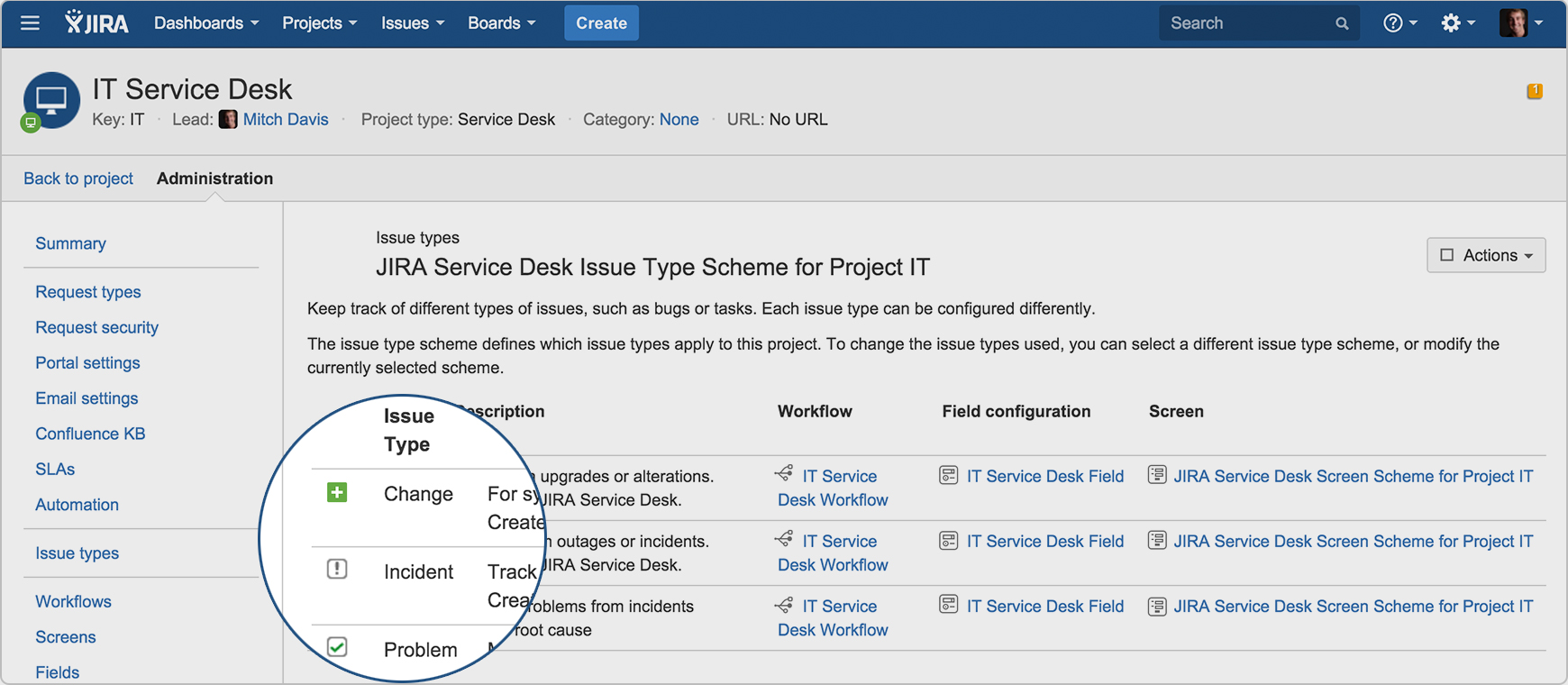
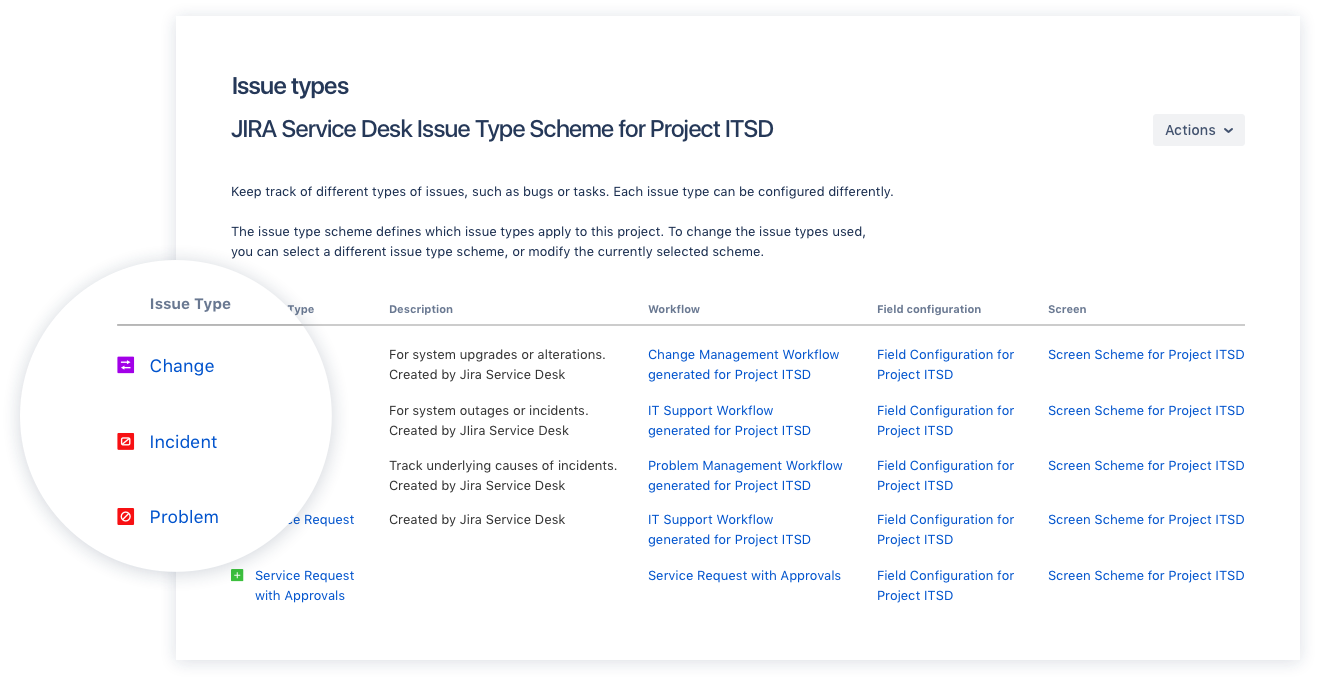
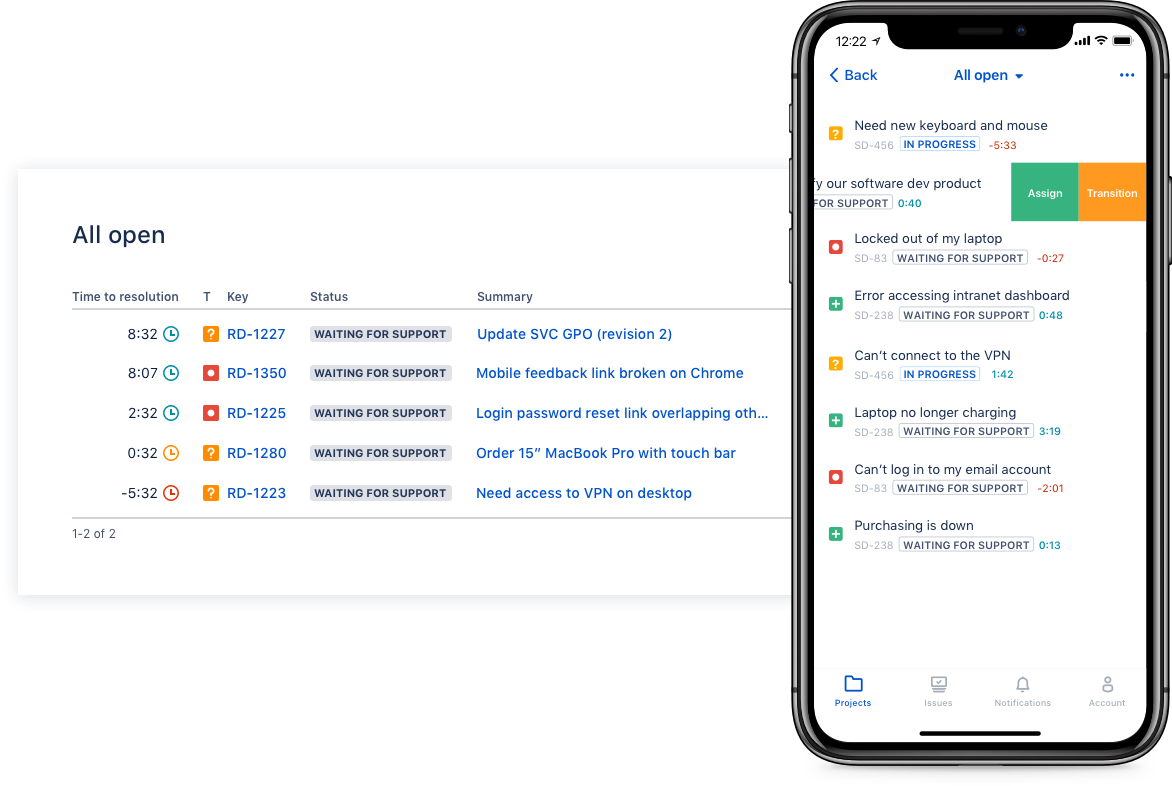
The Atlassian Service Collection, including the no longer available standalone Jira Service Management, is an integrated suite of service management applications built on Atlassian's unified Jira platform architecture. Designed to bring development, operations, internal IT, and external support teams onto a single workflow engine, the Service Collection consolidates support infrastructures to deliver service at high velocity.
$0
per month
SysAid
Score 8.9 out of 10
Mid-Size Companies (51-1,000 employees)
SysAid is an ITSM platform that enhances service delivery with AI Agents, chatbots, workflow automation, and asset management. AI Copilot categorizes tickets, provides case summaries, and offers sentiment analysis. The AI chatbot, available via chat, email, and Teams, speeds support.
N/A
Pricing
Atlassian Service Collection, with Jira Service Management
SysAid
Editions & Modules
Free
$0
per month
Standard
$20
per agent/per month
Premium
$40
per agent/per month
Enterprise
Contact sales team
No answers on this topic
Offerings
Pricing Offerings
Atlassian Service Collection
SysAid
Free Trial
Yes
Yes
Free/Freemium Version
Yes
No
Premium Consulting/Integration Services
No
No
Entry-level Setup Fee
No setup fee
Required
Additional Details
—
SysAid Copilot is available as an add-on for any plan. It bakes generative AI into every aspect of service management.
More Pricing Information
Community Pulse
Atlassian Service Collection, with Jira Service Management
JSM is more purpose-built for internal support tickets and processes. It also provides a structure to support users, unlike generalist tools like Notion. We found that there isn't really an 'all-in-one' tool that can correctly handle internal and external requests. This isn't …
We chose Jira Service Management due to its easy integrations with the rest of the Atlassian tools, as we have also invested in those. For the price, the ability to add or remove agents, and the cost being reflected in that, it was an excellent medium for us. For the …
It was the most complete package, requiring the lesser adjustments compared to the others, had the most options to tailor to our specific needs, and the price for the Cloud hosted version was fair.
Jira Service Management is quick, intuitive, & easy to use. Its a little more basic than some other software but thats the benefit. Most of the info that is required from an IT support & change management requires basic information to be inputted. Jira Service Management allows …
Jira is easier to use and holds service agents more accountable due to reporting and tracking tools that are available. It connects better with other products that other departments are using to track programming changes, etc., giving management a single pane of glass to see …
We went with this solution mainly because it was already planned to use it with the developers. Understanding the tool made us go forward with the solution as it provided everything we wanted in a project planner.
Jira is the only ticketing system we have used at my company, and it is absolutely superb. What usually was a process in the past, with lots of time to spare in between, is now updated to modern-day and makes the entire experience fluid and efficient. I know our IT department …
Jira has every necessary feature, including tracking tasks and helping teams to plan tasks. You can create user stories for tasks and also can create documentation for tasks. It can easily integrate with APIs and other service platforms. You can easily assign work to anyone who …
I didn't use any other services before this. I love this product. By the way I am using Bitbucket, too, which is also awesome, easy to manage versions.
In Jira, you can browse your own knowledge base. You can also create new widgets and filters the way you wanted it customized. I prefer JIRA over any other ticketing tool since JIRA is easy to navigate. You can create your own Dashboard. You easily can pull up the reports needed.
Jira is easier to set up and gets going faster. It is easier to customize to fit your needs and the Dashboard feature and added widgets really help you get the views you want to see. Other products are harder to set up, don't get going as quickly, and lack the dashboard …
We selected Jira Service Desk because we were already Jira users, and the price point was easy to absorb. Our experience as Jira administrators made it easy to customize Jira Service Desk to our needs.
Various intranet custom made tools, usually focused on a specific area in telco, banking, utilities, production, etc. with excellent support for general tickets and with links to company core processes
Being a past user of JIRA has helped a lot in making a decision. When I first used it, I could learn to navigate in a day's time. I knew my way through most of the functionalities. The dashboard creation was also a piece of cake. The CRM software that we used in the team was …
We use Trello along the Jira Service Desk. Jira Service Desk is universal and is better for IT and specific requests (bugs), while Trello is work better for the tasks dividing on the team level. Jira Service Desk is on a higher price range than other tools, but it worth it, …
Compared to other products I have used, like, Fresh Desk Service or Manage Engine it has more features included per user and technician (others may require a license for each type). Portal setup can be integrated to the Confluence Portal for easy access to Jira for service …
I think JIRA Service Desk is very similar to many products out there, but for users who currently use JIRA for their projects, it makes the transition much easier and users will be able to see the progress of their ticket throughout. The price is higher than many of the other …
Jira Service Desk has similar or equivalent features to heavyweight competitors as HP Service Manager, for a better price. The highlight of Jira Service Desk, in my opinion, is that you can customize a series of visual boards that are tremendously useful for an agile and …
I’m not aware of a direct competitor to Jira other than Asana which is more of a project management tool. For medium size companies and larger I recommend Jira.
Unlike the 2 other alternatives, Jira is more complete. It is a bit harder to use, but because it has more customized and better functionalities. While other software can be used for almost everything, Jira works best for tech companies that need to work on agile methodologies …
This is the first time we have used this type of platform, so I cannot really make a direct comparison. We chose this one because the price-to-quality ratio suited us quite well, and, to be honest, we are very satisfied with it. To date, it hasn't given us any problems, and …
I cannot go into details but SysAid's Ai and Automation approach seems to work best for organisation. We particularly liked the Agentic Ai and chatbot features that operate in plain English which is a great solution for our staff and our end users. We also loved the advanced …
We only had a ticketing system that lacked operational visibility. Some company locations in other countries were using Excel files to document tickets. In short, we went from a ticketing system to a complete ITSM solution with centralized administration but with users around …
I hadn't used any of these tools before, so I can't compare them to SysAid. However, I can say that we chose SysAid because of its ease of implementation, its incident management capabilities, its fully configurable AI, and the addition of software license management, which was …
SysAid has much better customization tools for workflow and the ticket form, which were very limited in the competitor product. We had greater online support, and that greatly helped us to customize much faster our environment.
I find SysAid system much better than the Spiceworks cloud version in that you can actually customize it to your company needs. Spiceworks is a great free system, but limited by lack of customizations
The value of SysAid just seemed to be much better than Kaseya. The review was relatively short with Kaseya, but I immediately liked what SysAid offered. The overall capability compared to the costs associated with SysAid made it a great choice.
SysAid is very cost-effective and flexible and integrates ITSM and asset management tools in one platform, reducing the need for separate tools. They have an intuitive interface that ensures a smooth user experience, reducing the learning curve for IT teams. SysAid offers …
Compared to BMC Remedy, SysAid offered a more modern, user-friendly, approach to IT service management. SysAid also provides a more intuitive interface, faster implementation, and built-in automation capabilities that significantly reduce administrative overhead. Tasks that …
There are many items offered on the other platforms that SysAid does not have. However, for a smaller or medium-sized business that needs a simple and easy way to get tickets flowing and allow users to help themselves, this is an excellent way to start.
ServiceNow is a very clean-looking portal and one of the primary IT asset management softwares. SysAid was originally onboarded by another project manager, but the selection came from a much lower cost than other ITSM software. In the future, interface/GUI will be a large part …
SysAid is a decent ITSM based product for the money if you want an application that for the most part can be setup and administered without a dedicated resource assigned to SysAid maintenance.
In my experience, it does not have the full functionality of either Cherwell or …
ServiceNow is lightyears ahead of SysAid. They efficiently use workflows to get everything set up in the system. One prime example is the onboarding and offboarding of employees. You can set up individual approval tasks to add/remove employees from systems. These tasks will …
Atlassian Service Collection, with Jira Service Management
SysAid
Likelihood to Recommend
Great to manage your issues in a clear and centralised way. If your development teams work with Jira, it will all naturally come together. Great way to manage the issues from end to end. - Very flexible if you have people who understands the set up and is able to configure it for your needs - Maybe not the best if you want something with very easy set up
The system is really good at helping manage first-line requests and incidents. There are workflows that can be set up on templates to give direction to the team and help ensure that all the correct procedures are followed. There are some limitations with the system when it comes to Problem and Change management, as it is very ingrained with the normal ticket system. This can lead to a "clunky" change management process.
Email integration. End-users can interact with the ticketing system exclusively through email, and admins can message exclusively within a ticket. All communications are linked directly to user accounts including SysAid admin accounts.
Ticket management is very customizable. You can add categories, statuses, action and communication automation, ticket sorting, and much more.
knowledge base links directly to tickets, so repeat issues are easy to solve.
Some of the built-in functions and workflows are surprisingly limited given the fact that you can customize a lot with JQL. These limited areas do not allow you to use JQL. For instance, the built-in notifications are lacking. They have one that is great-- "notify on critical ticket creation"-- EXCEPT that it does not allow you to notify a group or anything, only individual users.
The ticket interface is a little odd for agents. Changing the status is not a simple drop down from unassigned to open to in progress to pending, etc. There are a couple of tabs ("investigate", "pending", "workflow") where you can change the status in different ways. Maybe I am just not used to this way of doing it, but I feel like it could be simplified.
It can get complicated deleting/changing some of the out-of-the-box fields and rules, because you never know what will break workflows or other automated/built-in features.
There are still issues with how well the cloud version of SysAid performs. It can be slow at times. It can be offline every so often (very rarely).
There is a lot to learn with this solution so reaching out to their Support is crucial.
Cost. This is not the cheapest solution and cost is not an issue for us, but it might be for some companies. I think it is very reasonably priced and you get what you pay for.
Because through SYSAID is how the operation of all IT is carried out and in this way the performance indicators of the services, systems, operation, trends, workloads, project control and their deviations are known; as well as the requests for changes and requirements that are requested by both users and that is where the system improvement projects are triggered, such as change controls, which by the way are audit topics.
If you're used to other tools in the Atlassian ecosystem, you'll feel right at home with JSM. It's also a platform that technical folk can easily pick up. However, I wouldn't recommend using JSM as a company's first jumping off point into Atlassian. There are a lot of other 'newer' tools that provide sleeker ITSM systems at a similar cost.
SysAid is easy to use and configure. There are some technical components to the configuration, but their implementation of the SysAid system allows for easy self-service. There was only one time that SysAid could not provide a solution to my direct need. We quickly found a workaround. The issue was integration with Microsoft Office 365 when it was first released. The connection between SysAid and Outlook was problematic. It was not long before SysAid had resolved the issue and provided that integration.
Another of the benefits of sysaid is that it is highly available when working in on-premise environments.The only times the system is down is when a restart of the services is required to add a new feature. Apart from that, we have not had any problems.In the case of the cloud, the only condition I have seen where sysaid is not available is because the internet link is down or damaged.
In the case of system performance, I have seen that no matter the number of assets and users, Sysaid responds in the same way and at the same speed. The reports that are scheduled do not have any details because they arrive directly to your email. In the same way, when it is integrated with other systems, for example through the API or by email, we have not seen any failure due to the integration. It works very well with or without integrations.
I gave JIRA a 9 rating since for me JIRA works according to its purpose. Since there is a customer portal, our clients can leave a comment or communicate with us using the PR ticket that way it is easier for us to also request any additional information we need for our investigation.
The support is very good and fast, the attention they offer is always of a very good quality and the most important thing is that they do it in your language. Their attention is not only focused on solving problems but they also keep you informed about courses and articles to improve the use of the tool
Online Training from Atlassian was really Good to effectively deploy, manage, and utilize Jira Service Management. It really improved the overall Operational Efficiency and productivity of end users in the organization. Training gives the confidence to use Jira Service Management for all of the Product engineering, Application support, and Infrastructure engineering support team members.
My team was greatly assisted and trained well. Despite the time zone difference the trainer made every effort to be available during times that were suitable for us and the assistance and help offered was extremely appreciated by my team. A wonderful experience by the team.
Online Training was good and informative for new users adopting Jira Service Management. The Training helped to understand the product features, customization capabilities, and integration options with various tools in an enterprise organization, so the overall productivity and efficiency are improved at Blue Yonder. It also helps to timely address the incident tickets, user stories, and track and close them in a timely manner.
The training I received was very good, they gave me tasks to carry out and then they checked what I had done.It was gratifying that the instructor noticed that I had made very fast progress because I had done the implementation myself and it was very fast. At least I remember that after 5 days I had already finished almost 90% of all the implementation tasks.
In the initial stage we implement separate SysAid servers for head and branch offices. When we managed to link up our offices via point to point VPN, we manage to console them into one server. All the assets and devices on branch office were divert back to the server in head office
We chose Jira Service Management due to its easy integrations with the rest of the Atlassian tools, as we have also invested in those. For the price, the ability to add or remove agents, and the cost being reflected in that, it was an excellent medium for us. For the foreseeable future, I do not see us moving off this platform.
The value of SysAid just seemed to be much better than Kaseya. The review was relatively short with Kaseya, but I immediately liked what SysAid offered. The overall capability compared to the costs associated with SysAid made it a great choice.
Le doy esta calificación porque los módulos que contiene se pueden usar para casi cualquier departamento, tanto gestión de tickets como inventarios de equipos, hemos utilizado una versión gratuita en Ingeniería para gestionar sus tiempos en las tareas asignadas, es lo único que utilizan pero podrían usar fácilmente el módulo de inventario para su herramienta y el módulo de proyectos también
The employees are much happier with the new portal version of SysAid. There is a higher number of tickets created in the correct category as opposed to gather in the "Other" category
The IT Support group has moved away from the email option in SysAid. This has made it easier on the IT people who no longer have a huge thread of emails and just keep SysAid open.