Adobe Captivate is an elearning authoring and course design tool (or LCMS). It supports mobile HTML5 content. Captivate’s users are commonly midsized businesses to enterprises. Adobe Captivate includes some prebuilt assets as well as customizable workflows.
$33.99
per month
Litmos
Score 7.4 out of 10
N/A
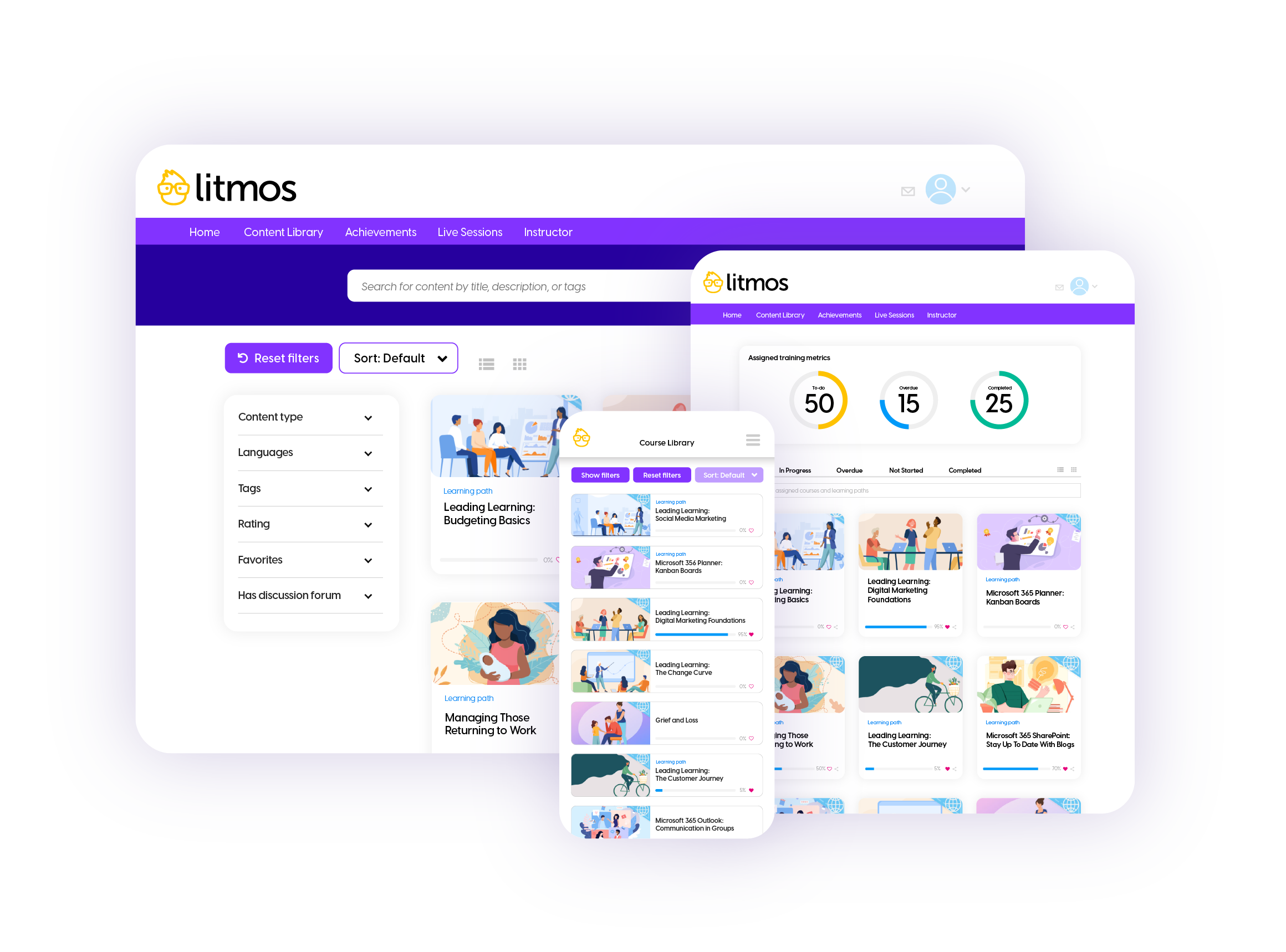
Litmos is a cloud-based Corporate LMS. Core features include a course builder, assessments and quizzes, surveys and feedback, eCommerce, virtual classrooms, certifications, course library, SCORM and TIN CAN support, reporting, and gamification tools.
All team was not satisfied with Adobe Captivate. We were facing many things like lagging while assessing content and also, and The module was not stable as it should be, that's why we all decided to switch to SAP Litmos, and we are really satisfied with the ease.
I've done business requirement gathering of LMS needs, LMS selection, and implementation at 3 companies now. Litmos and Docebo always end up in my top 3. However, Litmos has always won out for existing capabilities that, in the past, Docebo was still developing. At my current …
Litmos is easy to set up and get started using. We were able to get the system up and running quickly with only one staff member dedicated to the project. The Litmos pricing structure works best for us because of the way we structure the pricing for our training offering. …
Captivate is well suited for instruction designers who want to build attractive, personalized, interactive, energetic lessons. It's also a good choice for someone who wants to build something innovative because Captivate gives the developer so much control over so many aspects.
But if someone wanted something built quickly, generically and didn't care about holding the viewer's attention, then Captivate might be an expensive tool. That person might be more satisfied with a cheaper and easier to learn authoring tool.
For us, Litmos does what we need it to do. It houses all of our training in one place and allows us to send it out to our entire staff quickly and easily. The only area we really struggle is with eSignatures. We use this feature for memos, but instead of using the actual eSignature, we use an assessment because it gives us the ability to lock it after one attempt so that someone doesn't log back in and show that it's no longer signed.
Quickly adding in graphics, text, and interactive buttons.
Has extensive variables and branching for additional customization, beyond the competition.
Has 360 degree capability which competitors don't offer (I have not used this feature).
High degree of customization and personalization.
True responsive screen display on all devices, viewable as you are creating the training. This is different than some competitors - some just shrink the screen, but Adobe Captivate allows actually removing or moving or changing items at different screen sizes.
If you like Flash, it has Flash output, although it's going away in 2020. Personally, I think this is an outdated technology.
Many advanced capabilities. I chose this product due to the capabilities.
Comes with assets, templates, people, head shots, and full body—excellent.
Adobe Captivate is the authoring tool. It integrates with Adobe Captivate Prime - which I highly recommend if you want to truly take advantage of all of its features in reporting, administration, compliance, and social learning. (I didn't use Prime because you essentially need 100+ students to affordably use Prime.) If you look at my chart of what Captivate is capable of, I can't say that Captivate has a lot of the reporting features because they are part of Prime/SCORM, although, with Captivate's customization, you might be able to do most of them if you are up to it, but I did not.
Content Authoring: Litmos has a good content authoring tool that provides options for designing engaging and interactive courses.
Reporting: Litmos reporting tools and reporting engines are clear to understand, the come with useful features that allow for tracking completion, learning and engagement.
Course Library: Litmos has an extensive course library that we can reorganize into learning pathways to accomplish set learning objectives for our team.
Customer Support: We have seen Litmos Customer support improve over the time we have been customers. Not only are there helpful resources within the Litmos University, we also have access to skilled support from our Customer Success Manager and the Litmos Technical Team.
Clunky interface, it takes a lot of extra clicks to get places compared to other Adobe apps and competitor's eLearning software.
Would be nice if it was part of creative cloud, or at least in the group of apps you can add through Creative Cloud.
More regular and meaningful updates. Compared to flagship apps like Photoshop, Illustrator, etc. Captivate is like the read headed step child. Competitors excel at providing regular updates with clear change documentation. How are we still using Captivate 2019 in 2022?
The interface feels like it is still stuck in the 90s, would be nice if it was more modern and better in-line with flagship adobe offerings.
Variables and associated menus are a nuisance to work with vs some of the clever drop down and content-sensitive options in Articulate Storyline.
Litmos' email automation leaves a lot to be desired. When using SAML single sign on, a user can forward a reminder email to a colleague and it will include the link for _their_ training, if the recipient completes the training it report as being completed by the sender.
Litmos' functionality around assessments is terrible. It is impossible to give partial or weighted credit for a question during marking. It's impossible to undo a mistake in marking or go back to the question. Hotspot questions are not worth using. Learners entering a test again after completing but before marking is done will erase their attempt's ability to be marked. There is more that is just unacceptable here. We make tests using microsoft forms because it's easier and more accessible.
Many group admins are also learners, and will so infrequently use their admin portals, that they should not default to admin.
We have imports from our HR platform to Litmos, which is convenient. Occasionally someone gets set up twice, which is a problem with the intergration or stuff that helpdesk does. However, merging two learner records should not be a huge hassle of enumerating all of the courses and manually marking them complete. There should be a way to do this in the software.
Reporting in general leaves a great deal to be desired. There should be some more controls for xAPI/tincan modules that allow us to customize the level of tracking there. Articulate Rise uses a manifest that gives the LMS what it needs to integrate, why can't we see interaction data from the eLearning there like we could with LRS statements? If I make a storyline block or have a rise interaction, I should be able to see all the elements folks click and what they get hung up on.
Litmos should support standard Training and L&D measurement frameworks. There's no reason we shouldn't at least be able to have a dashboard for a course that includes survey data, assessments, boosts, and maybe a manual place to put in business impact KPIs. Think kirkpatrick/Phillips ROI.
We have hundreds of courses that were created in Adobe Captivate. It will take us a while to convert to Articulate. We'll need a license for another year and/or until Adobe comes out with a true update to the software.
For what we need in the very near future, Litmos does not offer us the required capability. Ideally, we are looking for an integrated LMS, coaching, mobile support and content creation platform. Litmos may have the LMS part covered but there are other platforms that do this better along with providing an integrated all-in-one service or at the very least support API integration with other vendors to meet our requirements.
Adobe Captivate does take some getting used to. There are features that are much more convoluted than they need to be, but overall it is a great product with a some excellent features. Being in a pretty small market, Adobe Captivate and Articulate Storyline dominate the space. They are not the same software, but allow for eLearning authoring. Each has their benefit and their downside, but, for me, Adobe Captivate edges out Storyline.
It's really easy to use. I just search the platform for my requirements, play a demo before downloading it, and then drag and drop it into my LMS. It couldn't be simpler. The only reason it isn't a 10 is that some courses don't have better summary descriptions or additional materials.
It is difficult to get in touch with Adobe Captivate support. With a seemingly limited number of resources, mostly outsourced, getting in contact with someone to help troubleshoot an issue is challenging. Typically wait times are long, and the desired path to resolution is to use an existing knowledge base or a self-help guide. It is certainly not a user-friendly experience.
If I could give it a negative rating I would. Worst support from any program I have had. Everything is back and forth in the support ticket. The one time I tried to chat they could not support the question. Their support page is so full of sections and products I can never find anything I need, even with a customized home page. I was hopeful that once they left SAP support might improve but it has not. I don't even know who my account executive is. Nobody has ever reached out to me. I need someone to guide me through best practices for our company and there is nobody to do that.
It was a good overview of the platform, but of course it was more of a basic overview of how to use the platform. The team provided a good training, but I would of liked a better deep dive into some of the features.
Some of the best online training I've taken from any LMS platform. It was well put together and kept me engaged the entire time. It has a good amount of HR Compliance mixed with soft skills training that the team liked. Overall, it has a robust online suite of training that any company can use.
I'm only aware of the problems Adobe Captivate had with SumTotal LMS and Upside LMS, requiring extensive contact with both internal and external support staff to fix the problems. We had no problems at all with Articulate.
We have done two implementations. The first wasn't completed by me, but the second was. I had to do a lot of data migration across from the first system into the new instance. This was really time-consuming, and it would have been great to have had an option for someone else to have completed this for us. Learning about the tool has also been up to us, and whilst the content was good, it was also high level and broad, and then getting into the specifics of our setup was really just left to us to complete on our own and have a go. We got there, but probably could have been faster with some additional support from a consultant.
I think that Articulate360 is more user-friendly and has a cleaner, more updated look. If you can edit a PDF, then you can use Articulate 360. Adobe Captivate may be more challenging for the designer, but it has more features. We chose Adobe Captivate because we want the option to create interactive learning environments. Adobe Captivate plays well with the other Adobe design products including Photoshop, Illustrator, and Premier. Additionally, Adoe Captivate is highly compatible with Cornerstone, our preferred Learning Management Systems.
I made a choice of this tool because of great review message on internet about the advantage of litmos. Also as cost is concerned I saw it to be favourable to me more than other which are Abit expensive. Litmos also have intuitive user interface which made me to fall for it.
Pretty easy to scale this LMS and can be deployed companywide in all departments for us. The team's function allows you build separate teams that can easily be assigned specific courses, so it makes it much easier to deploy
Adobe Captivate has allowed our instructors to engage students in ways we never have before.
Instructors who have used Adobe Captivate in our organization have reported higher levels of engagement with their courses and their students, theoretically leading to improved assessment of student performance.
For one of our product lines, what used to require 8-10 onboarding calls now only needs two and we are aiming to get that down to just one or potentially none. Customers can learn on demand using the courses we have constructed for them and continue their learning live with trainers.
By hosting all of our training in one place, we have made onboarding much more straightforward for employees — they can learn the product (same training we give customers) and also get their InfoSec and other training in one place.