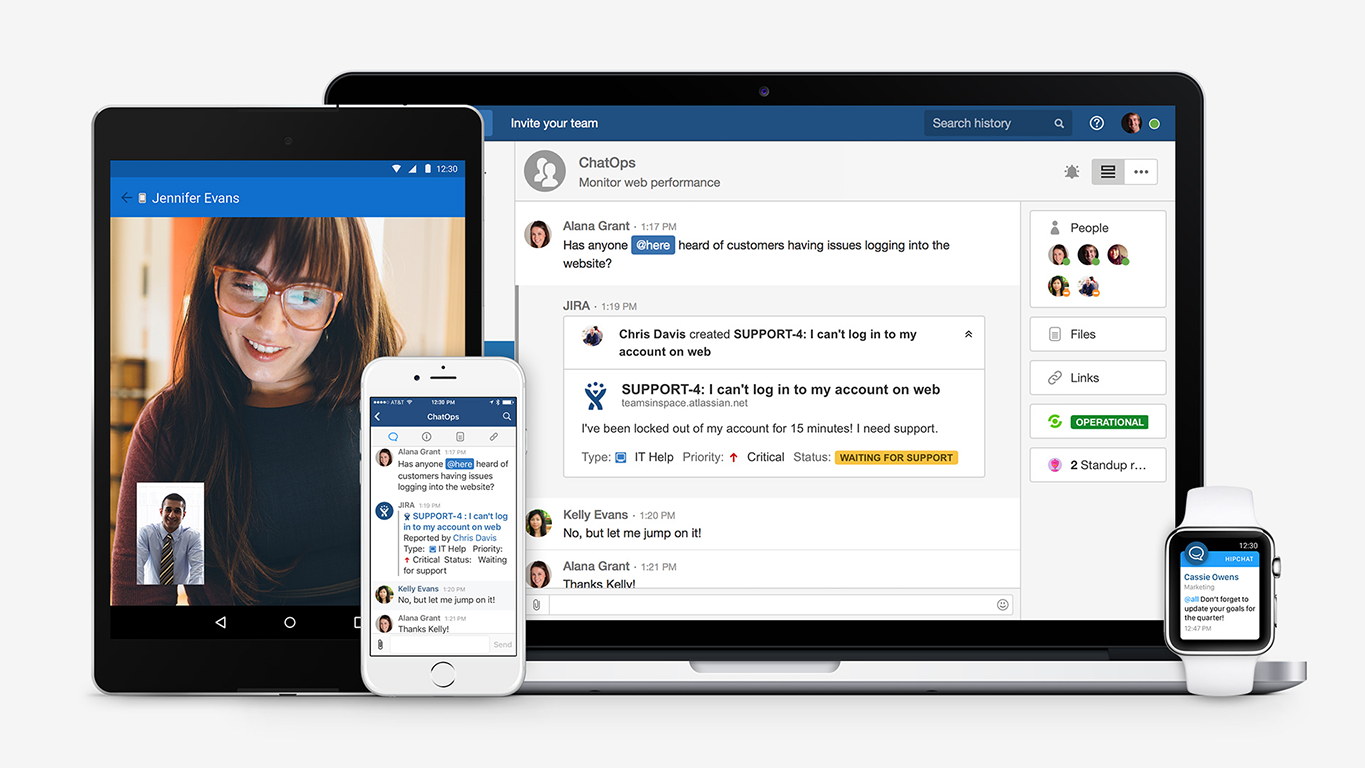
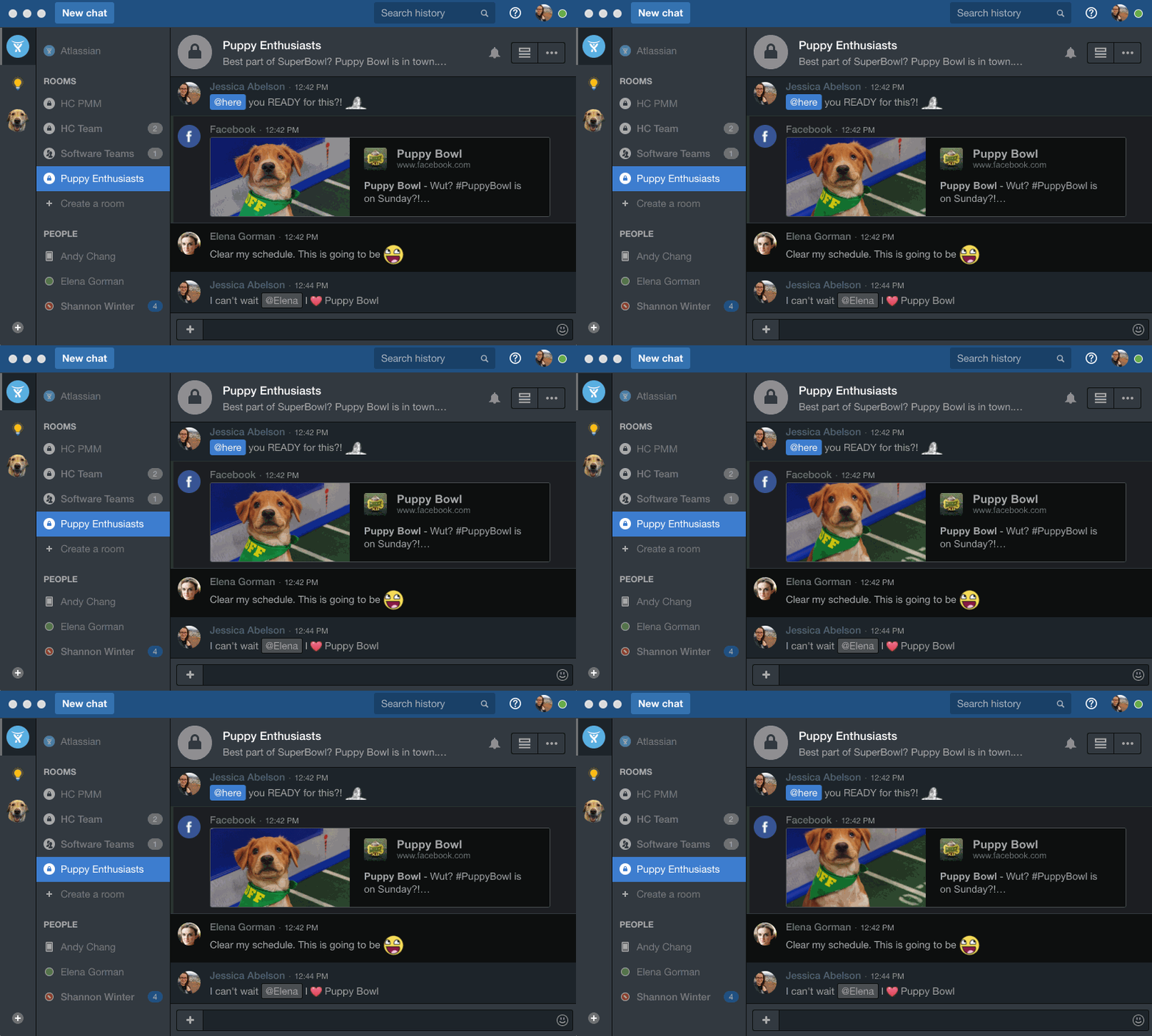
Flowdock is a collaboration tool built around a chat and team inbox interface. Flowdock is available via app or as a browser-based solution.
It was originally offered by Rally Software Development, which was acquired by CA Technologies, which was acquired by Broadcom in 2018.
N/A
HipChat (discontinued)
Score9.7 out of 10
N/A
Hipchat was discontinued by Atlassian. Users are being migrated to Slack.
N/A
Pricing
Flowdock
HipChat (discontinued)
Editions & Modules
No answers on this topic
No answers on this topic
Offerings
Pricing Offerings
Flowdock
HipChat (discontinued)
Free Trial
No
Yes
Free/Freemium Version
No
Yes
Premium Consulting/Integration Services
No
Yes
Entry-level Setup Fee
No setup fee
No setup fee
Additional Details
—
—
More Pricing Information
Community Pulse
Flowdock
HipChat (discontinued)
Considered Both Products
Broadcom
No answer on this topic
Discontinued Products
Verified User
Chose HipChat (discontinued)
HipChat might have a slight edge over Flowdock because of the larger number of integrations available in the marketplace. Otherwise Flowdock is a way better tool out of the box. It has the best solution for separating multiple conversations/threads in the same room. It's email …
A de minimis incentive was given to thank the reviewer for their time. The incentive was not used to bias or drive a particular response, nor was the incentive contingent on a positive endorsement. TR verified that a representative sample of customers was invited. More Info
Application Developer in Engineering at Getty Images (Photography, 1001-5000 employees)
Chose HipChat (discontinued)
We used hipchat because it is part of the Atlassian family of products, so integration was probably the easiest than if we went with something else. It's easy to for non-technical people to pick up and start using without much difficulty and allows flexibility in customization, …
A de minimis incentive was given to thank the reviewer for their time. The incentive was not used to bias or drive a particular response, nor was the incentive contingent on a positive endorsement. TR verified that a representative sample of customers was invited. More Info
Key User Insights
Would buy again
No answers on this topic
No answers on this topic
Delivers good value for the price
No answers on this topic
No answers on this topic
Happy with the feature set
No answers on this topic
No answers on this topic
Lived up to sales and marketing promises
No answers on this topic
No answers on this topic
Implementation went as expected
No answers on this topic
No answers on this topic
Features
Flowdock
HipChat (discontinued)
Project Management
Comparison of Project Management features of Flowdock and HipChat (discontinued)
Feature
Flowdock
4.9
2 Ratings
44% below category average
HipChat (discontinued)
7.3
106 Ratings
5% below category average
Task Management
6.72 Ratings
00 Ratings
Gantt Charts
3.01 Ratings
00 Ratings
Scheduling
4.01 Ratings
00 Ratings
Workflow Automation
2.01 Ratings
00 Ratings
Mobile Access
7.22 Ratings
7.397 Ratings
Search
5.72 Ratings
7.2103 Ratings
Visual planning tools
6.01 Ratings
00 Ratings
Communication
Comparison of Communication features of Flowdock and HipChat (discontinued)
Feature
Flowdock
3.8
2 Ratings
71% below category average
HipChat (discontinued)
7.3
132 Ratings
8% below category average
Chat
8.92 Ratings
7.7132 Ratings
Notifications
7.72 Ratings
7.7130 Ratings
Discussions
7.72 Ratings
6.5110 Ratings
Surveys
2.01 Ratings
7.834 Ratings
Internal knowledgebase
1.01 Ratings
7.043 Ratings
Integrates with GoToMeeting
1.01 Ratings
7.023 Ratings
Integrates with Gmail and Google Hangouts
1.01 Ratings
00 Ratings
Integrates with Outlook
1.01 Ratings
00 Ratings
File Sharing & Management
Comparison of File Sharing & Management features of Flowdock and HipChat (discontinued)
Flowdock is well suited for small teams and to environments that doesn't need too much reliability. I think it has some management problems that can make your life difficult if you have to manage a big amount of users. If you want just a tool communication with basic features (without using any integration or robust features) it can be suitable for you. You should try Flowdock using its free version for a small team and compare with others similar products. Flowdock delivers team chat and collaboration features, but is not necessarily the best product. Maybe some usability problems that disturb me won't be so relevant to you.
A de minimis incentive was given to thank the reviewer for their time. The incentive was not used to bias or drive a particular response, nor was the incentive contingent on a positive endorsement. More Info
A de minimis incentive was given to thank the reviewer for their time. The incentive was not used to bias or drive a particular response, nor was the incentive contingent on a positive endorsement. More Info
HipChat is very stable and reliable. I have never had issues with not being able to connect or being able to communicate with others on HipChat.
HipChat integrates quite well with other applications, such as Jira and Stash. This is a main selling point for my team. It provides a convenient feed of actions on a JIRA story or Stash pull request.
HipCat does a good job of allowing 1-1 and group chats. It is simple to start a new conversation and it is easy to hold a group conversation and keep track of who is in the room.
I like how HipChat has away/here/on mobile statuses. This makes it easy to see if a person is available to be contacted.
A de minimis incentive was given to thank the reviewer for their time. The incentive was not used to bias or drive a particular response, nor was the incentive contingent on a positive endorsement. TR verified that a representative sample of customers was invited. More Info
One thing a little bit annoying is that a lot of links to others Flowdock sections (preferences, external services, etc) will open a new window/tab. Each click may take you to a new window and you can get lost easily.
There isn't a quick access list to members of your organization to start a private chat. I took a while to find how to do that. The interface and usability could be better.
There isn't an app for Windows Phone.
Sometimes you try to load some conversation and it doesn't show anything. It is not frequently but happens sometimes.
A de minimis incentive was given to thank the reviewer for their time. The incentive was not used to bias or drive a particular response, nor was the incentive contingent on a positive endorsement. More Info
Mobile app is not very responsive on iOS. Sometimes connection to Hipchat servers is taking too long even on good networks.
Both mobile and desktop versions have no alphabetical or recent sorting for groups and chat rooms.
Video and audio calls are pretty useless, they're slow and not always work.
The whole user interface is simple but very outdated - apparently Atlassian didn't focus too much on Hipchat even though they tried in the last 2 years.
A de minimis incentive was given to thank the reviewer for their time. The incentive was not used to bias or drive a particular response, nor was the incentive contingent on a positive endorsement. More Info
I go with the flow because I'm a newer employee and Flowdock works as advertised. If it were my decision to choose a team communciator for the organization, I'd recommend we go with Slack for its robust features and ever-changing/evolving software integrations. Slack is the outright innovator in the space and will continue to hold that role for some time.
A de minimis incentive was given to thank the reviewer for their time. The incentive was not used to bias or drive a particular response, nor was the incentive contingent on a positive endorsement. More Info
The app itself had a pleasant if not generic interface. As a user experience expert and engineer I can say the interface is fairly intuitive if not bland. It does what you expect it to do and it's available on iOS and Android devices. If I recall it was generally pretty light weight in terms of installation size.
A de minimis incentive was given to thank the reviewer for their time. The incentive was not used to bias or drive a particular response, nor was the incentive contingent on a positive endorsement. More Info
HipChat support is good . Responds in timely manner when ever we have raised the request via email , phone and gives us continue update on the request .Though most of the questions are answered by HipChat FAQs , but they can still improve it and add more to the knowledge base .
A de minimis incentive was given to thank the reviewer for their time. The incentive was not used to bias or drive a particular response, nor was the incentive contingent on a positive endorsement. More Info
A de minimis incentive was given to thank the reviewer for their time. The incentive was not used to bias or drive a particular response, nor was the incentive contingent on a positive endorsement. TR verified that a representative sample of customers was invited. More Info
Private chat or channels are well implemented in both softwares and both are also very easy to setup.
Besides of some usability problemas I think Flowdock is still better than Slack in this user experience and design.
The second point is the price. Flowdock is half price of Slack ($3/month). If you are a student or a non-profit organization, you are able to get some special license.
A de minimis incentive was given to thank the reviewer for their time. The incentive was not used to bias or drive a particular response, nor was the incentive contingent on a positive endorsement. More Info
We tried a lot of chat clients before choosing HipChat. The Skype for Business UI on the Mac side was 5 years old and terrible. Mac users hated the app including our CTO. Cisco Jabber was expensive to license and maintain; Skype was open to the public which took time away due to users dealing with spam and could allow viruses and malware. HipChat being a closed product, centrally managed and available to try without an upfront investment was perfect for our environment. All our Agile teams have their own room, chat and can communicate with others quickly and easily.
A de minimis incentive was given to thank the reviewer for their time. The incentive was not used to bias or drive a particular response, nor was the incentive contingent on a positive endorsement. More Info
Actually I never shared of HipChat using with more than 25 persons in team simultaneously, but I believe it can be scaled for much largest collaboration teams. At least it works flawlessly for us, with transparent integration with Jira, and I am not see any reasons for some troubles for work at big scale.
A de minimis incentive was given to thank the reviewer for their time. The incentive was not used to bias or drive a particular response, nor was the incentive contingent on a positive endorsement. TR verified that a representative sample of customers was invited. More Info
HipChat has increased the effiency with which I am able to communicate with my coworkers, particularly those who work out of other offices. Having a light, portable messaging solution has been beneficial for checking in on small things without the need to send emails or schedule phone calls.
A de minimis incentive was given to thank the reviewer for their time. The incentive was not used to bias or drive a particular response, nor was the incentive contingent on a positive endorsement. More Info