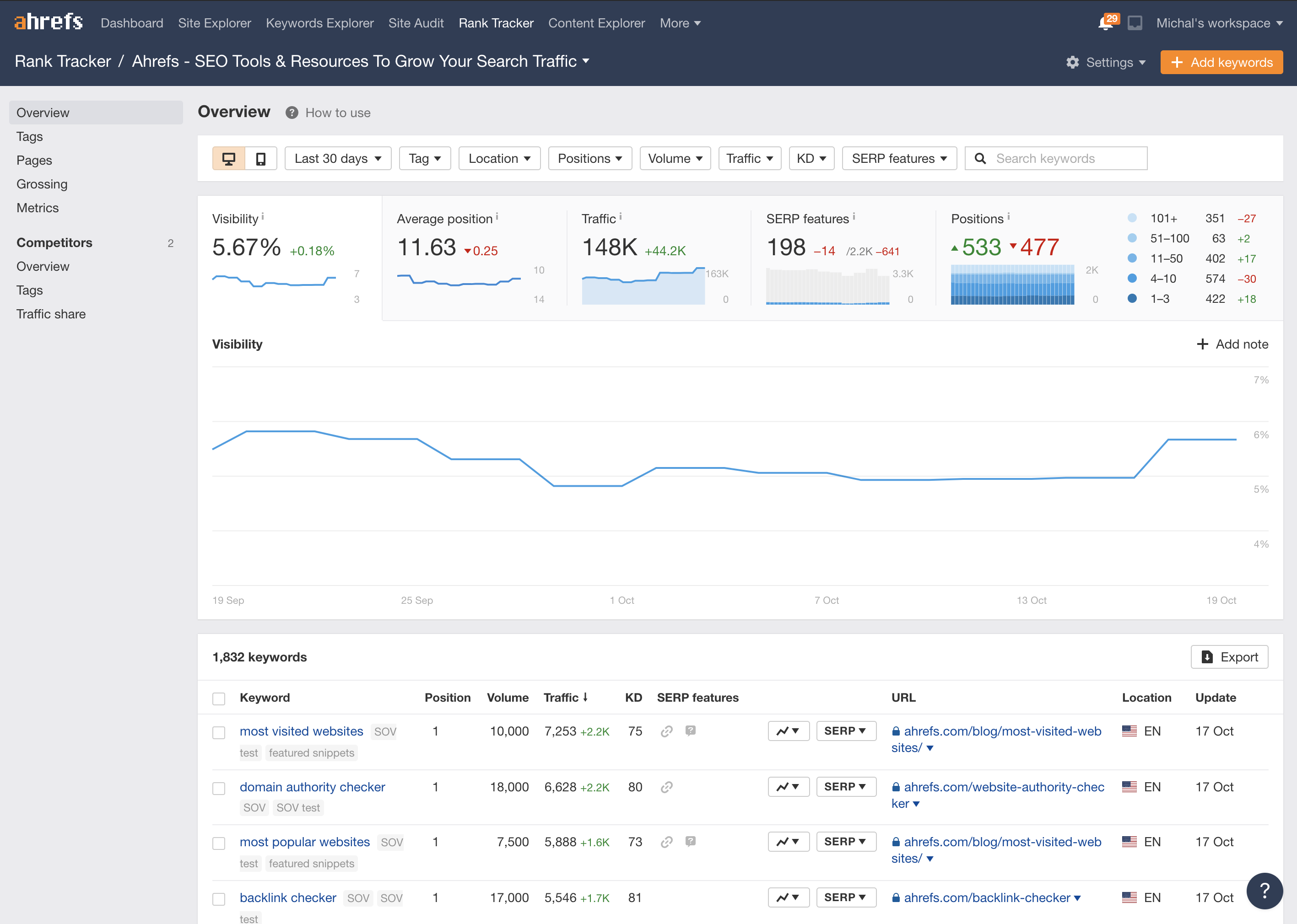
Ahrefs is an SEO tool providers. Ahrefs Site Explorer provides a suite of tools including a component for backlink & on-page SEO analysis, online brand mentions tracking, and domain comparison tool for competitor analysis, etc. They refer to themselves as “the largest index of live backlinks.”
$127
per month
Google Tag Manager
Score9.4 out of 10
N/A
From Google, the Google Tag Manager is a tag management application that facilitates creating, embedding, and updating tags across websites and mobile apps. It is a free option, vs. the company's enterprise-tier Google Tag Manager 360.
$0
Pricing
Ahrefs
Google Tag Manager
Editions & Modules
Lite
$129.00
per month
Standard
$249.00
per month
Advanced
$449.00
per month
Enterprise
$1499.00
per month
No answers on this topic
Offerings
Pricing Offerings
Ahrefs
Google Tag Manager
Free Trial
No
No
Free/Freemium Version
Yes
Yes
Premium Consulting/Integration Services
No
No
Entry-level Setup Fee
No setup fee
No setup fee
Additional Details
Discount available for annual billing.
—
More Pricing Information
Community Pulse
Ahrefs
Google Tag Manager
Considered Both Products
Ahrefs
Verified User
Chose Ahrefs
As a backlink management tool, Ahrefs Site Explorer is the best out there. Being able to look into backlinks and check for any that may be harming our sites is a process that the Ahrefs Site Explorer makes possible. While it does offer keyword tracking as well, I've found the SE…
A de minimis incentive was given to thank the reviewer for their time. The incentive was not used to bias or drive a particular response, nor was the incentive contingent on a positive endorsement. More Info
SEM Analyst in Marketing at Vizergy (Marketing & Advertising, 51-200 employees)
Chose Google Tag Manager
Google Tag Manager is a little different than the other software we've used. This not only gives us the means for tracking our websites but it also tells us if we've implemented the tag correctly and how well the website has been performing after the tag has been implemented …
A de minimis incentive was given to thank the reviewer for their time. The incentive was not used to bias or drive a particular response, nor was the incentive contingent on a positive endorsement. More Info
Ahrefs is a must have in the SEO toolbox. It is one of the leading tools in the industry for serious SEO research. It can do almost everything you need on the non-technical side of SEO. In my opinion, it is not great if you need a detailed technical tool that identifies errors and helps with fix suggestions. In that instance, I think there are better tools on the market. But - for content and keyword related tasks, I think it's must have.
A de minimis incentive was given to thank the reviewer for their time. The incentive was not used to bias or drive a particular response, nor was the incentive contingent on a positive endorsement. More Info
I have found Google Tag Manager as the go to solution for managing all of your event and conversion tags for your website. Not only does it make it easy to manage all of your tags in the one place, it is fairly intuitive to use and there is plenty of videos and help documentation online to help set up what ever you need. No scenarios come to mind at the moment on where it is less appropriate to use.
A de minimis incentive was given to thank the reviewer for their time. The incentive was not used to bias or drive a particular response, nor was the incentive contingent on a positive endorsement. More Info
I have been using this platform in my organization to develop several SEO tools to help to grow our website much.
It has all the main features which include competitor research, keyword research, website audit, content research, and rank tracking.
I have been using all these functions in the organization for several purposes. It provides complete information and complete performance details of the SEO.
It provides us the detailed keyword research with volume, CPC, and other information.
A de minimis incentive was given to thank the reviewer for their time. The incentive was not used to bias or drive a particular response, nor was the incentive contingent on a positive endorsement. More Info
Selecting elements on a site [object, class, cookie, etc] (to later fire an event, send some data, etc) is very easy with triggers. Want to add an event when someone clicks on a button? Super easy. It was many many DOM selectors and you can even add custom functions if you need to do something more specific
In general, firing events in different circumstances is very easy mixing triggers and tags. You can track almost any element of the DOM and do whatever you want with it.
Testing is a great functionality. Only you can see what's on the site and you can debug it easily by seeing which events or tags were triggered and all the DOM elements involved (and why they matched the trigger).
Working in environments (staging, production) and versioning is easy to do, deploying changes in 2 clicks.
A de minimis incentive was given to thank the reviewer for their time. The incentive was not used to bias or drive a particular response, nor was the incentive contingent on a positive endorsement. More Info
Can't export graphs: some graphs within the tool would be useful as an export. Unfortunately, exporting them is not an option.
No "blanket" reporting options: though Ahrefs is excellent for gathering and exporting intel/data, there are no blanket SEO reports provided. Exporting data is great, but simple report exporting would make it better.
A de minimis incentive was given to thank the reviewer for their time. The incentive was not used to bias or drive a particular response, nor was the incentive contingent on a positive endorsement. More Info
There are several good integrations, but there can always be more. Native tracking for call tracking solutions, analytics providers, non-Google advertisers would be top of my list.
Documentation is just dreadful. Luckily there are some awesome folks out there doing crowdsourced tutorials (shout out to Simo Ahava) but by and large the Google Tag Manager instructions are worth what you pay for them.
A de minimis incentive was given to thank the reviewer for their time. The incentive was not used to bias or drive a particular response, nor was the incentive contingent on a positive endorsement. More Info
Their index is too vast to ignore when looking at a complete backlink profile. We find links in Ahrefs that do not appear in any other link detection tool. For this reason, it's a must for our agency to use for the foreseeable future. Plus, it's very affordable considering the data you get
I haven't found another option for us to use especially one that is free. Down the road we may go a different route but for now GTM is a good option and does what we need it to do. It'd be nice to get more support or more integrations but with the free version there's only so much one can expect to get I suppose.
A de minimis incentive was given to thank the reviewer for their time. The incentive was not used to bias or drive a particular response, nor was the incentive contingent on a positive endorsement. More Info
Ahrefs is very easy to use - you can jump right in and understand most of the assets. Overall, the dashboard snapshots give a very good picture of inbound link activity. For deeper analysis of historical trends, the system can become cumbersome, making it hard to do full work without exporting and reformatting the data.
No difficult obstacle to overcome but Google Tag Manager can still be difficult for many users to deploy. Sure the basic HTML script can be deployed quite easily, but when you start to require triggers, variables, etc, it can be a little daunting.
A de minimis incentive was given to thank the reviewer for their time. The incentive was not used to bias or drive a particular response, nor was the incentive contingent on a positive endorsement. More Info
Ahrefs has always been responsive when there's been a technical issue with the site. There are usually very little problems, but if there are, they announce it on their social media accounts which keeps its customers informed. Email support is prompt and the customer service people are very helpful, knowledgable and friendly.
A de minimis incentive was given to thank the reviewer for their time. The incentive was not used to bias or drive a particular response, nor was the incentive contingent on a positive endorsement. More Info
GTM does not provide support. This is one of GTM's biggest issues but it's due to the level of customization for each website. If your team thinks they would heavily rely on the need for a support staff it is probably better to invest in a paid service with a team that can support your needs.
A de minimis incentive was given to thank the reviewer for their time. The incentive was not used to bias or drive a particular response, nor was the incentive contingent on a positive endorsement. More Info
Planning and communication will help greatly with an in-house implementation. If there are large teams, try to limit the number of people involved to 1-2 developers (back-end dev may be necessary depending on your platform), one analytics marketer and one project manager.
A de minimis incentive was given to thank the reviewer for their time. The incentive was not used to bias or drive a particular response, nor was the incentive contingent on a positive endorsement. More Info
Majestic and Ahrefs are really close in terms of tool. Ahrefs does offer competitive comparison and they do have a more up to date data base. Majestic however has a more comprehensive historical view of sites which is also extremely valuable. Majestic also offers a link velocity chart that is missing on Ahrefs. Ahrefs makes up for this with their links gained/lost calendar which Majestic is missing.
A de minimis incentive was given to thank the reviewer for their time. The incentive was not used to bias or drive a particular response, nor was the incentive contingent on a positive endorsement. More Info
We moved to GTM from a standard Google Analytics implementation. GTM is much more flexible and easier to make changes, especially as the changes relate to multiple sites and environments. While there is a learning curve when figuring out how to use GTM, I believe the change has been worth it because it helps us understand at a more fundamental level how our tracking works and gives us a lot more control over what we track and how.
A de minimis incentive was given to thank the reviewer for their time. The incentive was not used to bias or drive a particular response, nor was the incentive contingent on a positive endorsement. More Info
A de minimis incentive was given to thank the reviewer for their time. The incentive was not used to bias or drive a particular response, nor was the incentive contingent on a positive endorsement. More Info
GTM is very useful to determine if a particular element on the site is useful (i.e. is it being watched, is it being clicked, does it help customers navigate through more pages). As an SEO person, I can use this information to decide what to optimize for but also to track progress and see improvements in engagement.
With the use of Google Tag Manager, I was able to easily inject an A/B testing tool which lead to several improvements in lead generation.
A de minimis incentive was given to thank the reviewer for their time. The incentive was not used to bias or drive a particular response, nor was the incentive contingent on a positive endorsement. More Info