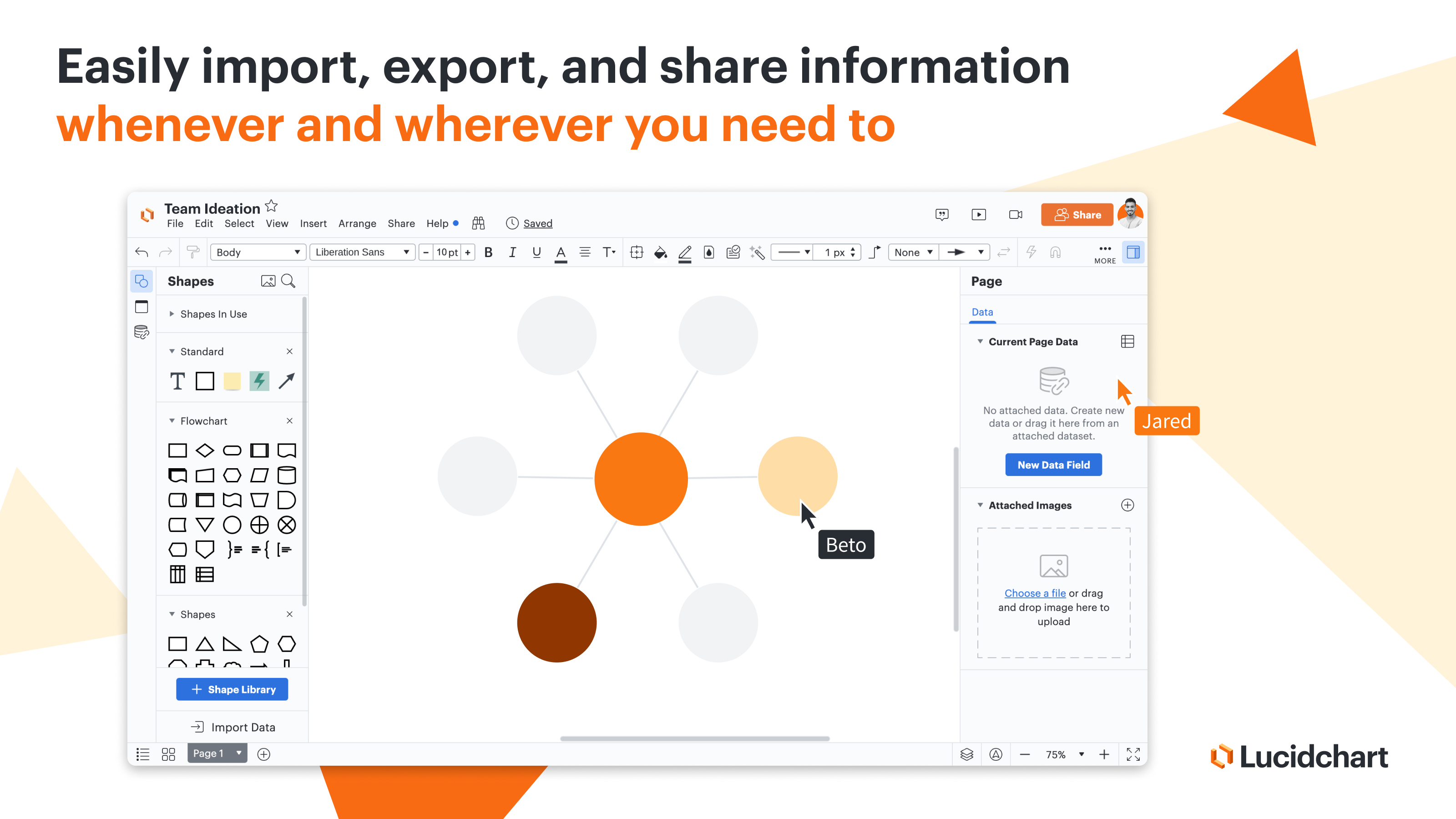
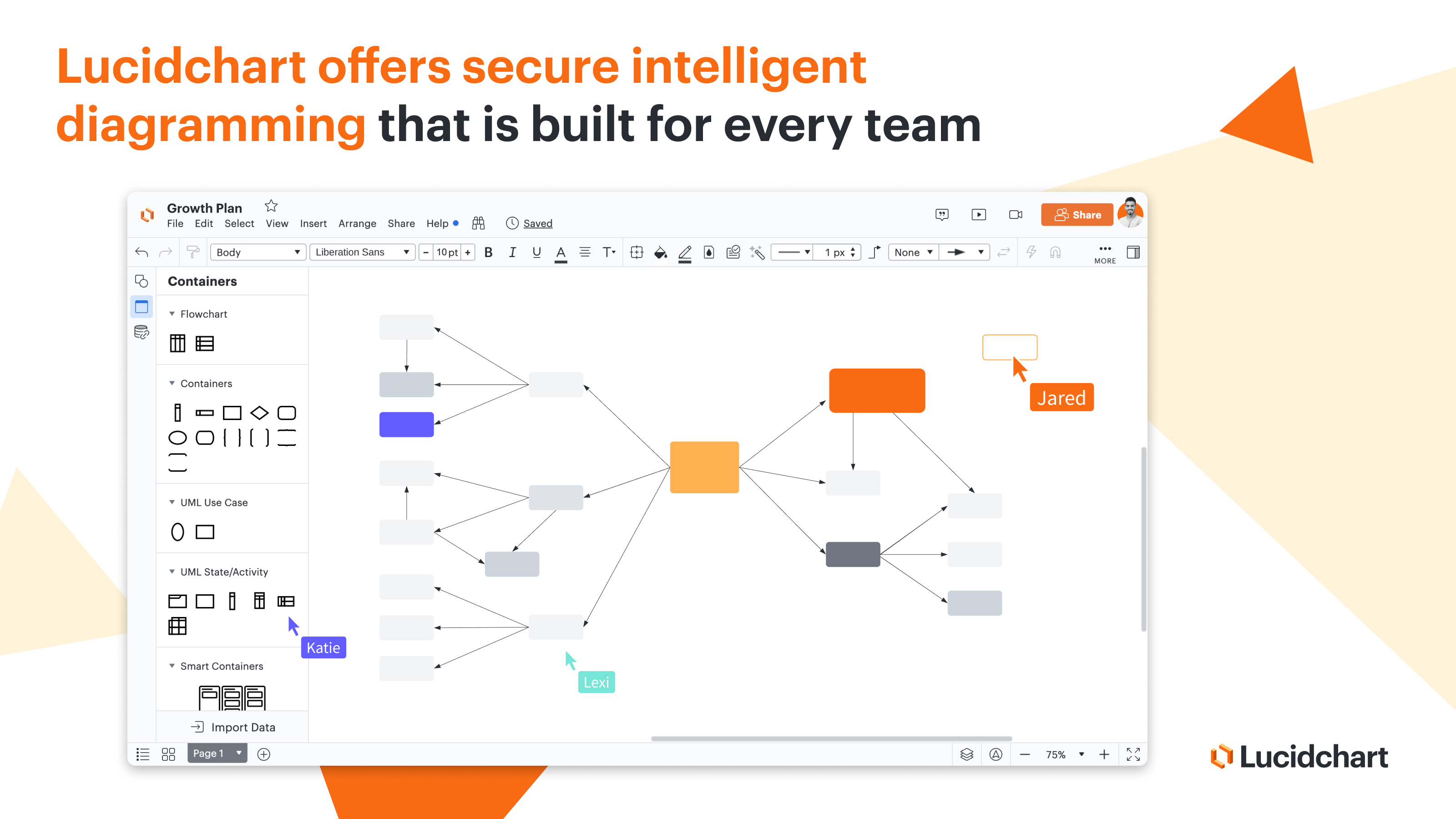
The Lucid Visual Collaboration Suite empowers teams to ideate, plan, design, build, and launch game-changing solutions from a shared infinite canvas.
$0
per month
SharePoint
Score 7.7 out of 10
N/A
Microsoft's SharePoint is an Intranet solution that enables users to share and manage content, knowledge, and applications to empower teamwork, quickly find information, and collaborate across the organization.
$5
Per User Per Month
Microsoft Teams
Score 8.1 out of 10
N/A
Microsoft Teams combines video conferencing software with team collaboration tools. The communications platform allows MS Office users to conduct conference calls and share files via SharePoint, and join or initiate a group chat.
$4.80
per month per user
Pricing
Lucid Visual Collaboration Suite
Microsoft SharePoint
Microsoft Teams
Editions & Modules
Free
$0
Individual
$9
per month per user
Team
$10
per month per user (3 user minimum)
Enterprise
.
per year
Plan 1
$5.00
Per User Per Month
Plan 2
$10.00
Per User Per Month
Office 365 E3
$20.00
Per User Per Month
Microsoft Teams Essentials
$4.80
per month per user
Microsoft Teams Enterprise
$5.25
per month (paid yearly) per user
Microsoft Teams Enterprise
$5.25
per month per user
Microsoft 365 Business Basic
$7.20
per month per user
Microsoft 365 Business Standard
$15
per month per user
Offerings
Pricing Offerings
Lucid Visual Collaboration Suite
SharePoint
Microsoft Teams
Free Trial
Yes
Yes
Yes
Free/Freemium Version
Yes
No
Yes
Premium Consulting/Integration Services
Yes
No
No
Entry-level Setup Fee
Optional
No setup fee
No setup fee
Additional Details
—
—
Discounts are available for non profit organizations.
The only application similar to Lucidchart that I have used is Microsoft Excel. Despite their connection, Excel is not as compatible with Microsoft Teams (formatting errors often arise when trying to edit Excel documents out of Teams). I think that Lucidchart and Excel are very …
I did not select Lucid Visual Collaboration Suite. That decision was taken by others in the organization. Given a choice, I am not sure I would have selected Lucid Visual Collaboration Suite. Miro was already established and, with a local client, was a better user experience in …
Much better, it doesn't get the steps in lines even a tenth as much as Visio, can use custom shapes as actual shapes rather than images, and aligns much easier. Lucid Visual Collaboration Suite is easily the best and I have tried about 4-5 programs over the last 5 years.
Miro had an advantage with the unlimited canvas until Lucidchart recently added that feature. Lucidchart seems to be better designed for creating drawings, incredibly technical or software architectural diagrams. Miro appears to be more designed for non-technical folks as a …
We used both solutions before deciding to use LucidChart. Creately works really great and is an excellent option, but their pricing was so outside of our requirements that it did not make sense to continue with our demo. Also, their salespeople did not follow up with us, they …
Miro is good for workshops and project planning but Lucidchart is more useful for architectural diagrams but it does not have stickers and fancy colors like in Miro used in workshops
In my opinion, I would say that Lucidchart provides a better experience and is easy to navigate than the product listed above. Lucidchart makes moving objects around easier and templates are easier to use in Lucidchart. The only thing I would say iObey does better is their Jira …
it is way better than visio - wish it integrated with ms teams better - It is better for cloud / collaboration - you don't have to save versions or send via email. You can send notifications or allow others access
Promapp is better for collaborating about processes and maintaing process ownership. Lucidchart is very versatile and allows us to do a lot more. I prefer Lucidspark to LucidChart for most applications, however. I wish there was a single license for the two, or at least a bundled …
When you are a Mac user like me, you don't get [Microsoft] Visio unless you work some magic and install some software that works wonders (which I actually like, but not the point right now). So Lucidchart is the remaining option, however, many think that because it is not a …
These are two different products to me, so they both do their jobs respectively. I like Lucidchart for its collaborative qualities, since multiple users can work on a project simultaneously. Microsoft 365 does not allow that option. I can also create charts and diagrams more …
draw.io was a very good diagramming software but it falls short in a few areas: templating and collaboration. Lucidchart excels at both of those areas. This allows our power users and even novice users to jump in and get diagramming with little to no setup required. We find …
Lucidchart is less expensive, cloud-based, and allows for real time collaboration. Our team mostly works out of Google Docs and Sheets so this made way more sense than moving to a per-user desktop-based product which can't do real time collaboration like Vizio. I haven't found …
As I mentioned before, we used Microsoft Visio for most of our workflow representation needs. But it was a heavy tool. [There were] a lot of unused features. Not so intuitive to use.
There is no competitor to SharePoint for an organization our size. The integration into our development environment, active directory, and other office tools just can't be matched (specifically from a contractual agreement and holistic perspective with ALL of our toolsets). Micr…
Atlassian Confluence isn't as robust with document storage but it does provide a good way to share detailed information in article or Wiki format. Microsoft SharePoint is more like a lightweight webpage creation tool while Confluence more like an enhanced notebook. Microsoft …
The reasons for selecting MS SharePoint are: SharePoint provides ease of use and web design assistance and support SharePoint helps you schedule your content for publishing. enables users to share documents with external parties and offers a better internal structure of the …
Since Microsoft SharePoint comes with the MS business office package, it is fully integrated with other office products and really works together with other MS Office products like Word, PowerPoint, Excel, Access, Publisher, etc.. in real-time, so it's really easy to maintain …
Slack is not great for document sharing, but it does integrate with SharePoint and One Drive when we need to post links. Slack is better at the chat function though, which is definitely missed from SharePoint.
I have only used Google Drive for personal reasons, not at work. SharePoint has a larger corporation safer feel to it as it uses the comfort of MS Office products for users.
Teams is the new front end for SharePoint. So far, I like the look, feel and adaptability of it better. As for Confluence, I have never been a fan of it's searching capabilities. Additionally, we've encountered users having a hard time being aware of other "spaces" within …
There are many tools in the collaborative space and SharePoint is a solid choice among them. The deep integration to Microsoft tools and O365 makes it a good choice for any company that is already invested in the Microsoft suites; better than the others in that respect.
We found that Google Docs was basically much more user-friendly that MS SharePoint, but was much more consumer-focused (which was a good thing from a usability point of view). However, its features were not robust enough for full business implementation. We all use Outlook and …
There are other tools out there that do a small portion of what SharePoint does, and in some cases, it still makes sense to use some of those, if the requirements are there. For example, the Task list in SharePoint isn't great, but it's also very old. Within Office 365, you …
It replaced our fileservers. It also replaced our former intranet server. Having SharePoint online means always having the latest version, features, and technologies. Our team that manages it all has to be up-to-date on it, but they do, and so occasionally new features are …
I personally haven't seen anything else that compares to SharePoint. There are other tools out there that do a small portion of what SharePoint does, and in some cases, it still makes sense to use some of those, if the requirements are there. For example, the Task list in …
We selected MS SharePoint due to our Office 365 subscription and the integration offered. We also use SharePoint due to the ease of updating and collaborating across multiple geographies and the large number of users on the platform.
Microsoft Teams is just a nicer front end to SharePoint for file and document management but it also has a good communication network for internal and external parties. It's easy to use on mobile device as well. It also integrates well with Microsoft Power Platform etc, meaning …
I have mainly used the Microsoft messaging tools so I can only compare between them. Overall, I like Teams better than the older versions such as Skype for Business. They did drop one or two features but I can't even remember what they were now. The ones they added are great …
I think Microsoft Teams is much more user friendly and has more features.
Verified User
Professional
Chose Microsoft Teams
While we mostly use monday.com for our CRM needs, we still use Teams for our communication needs all day every day. We couldn't function as a team without Teams! The chat and meeting setup/scheduling function is so useful and easy to use. We have found that having meetings is …
It will eventually be the replacement for Skype for Business. Microsoft has announced the end date for Skype and already new instances of Office 365 below a certain number of users don't even include Skype. Already, all they get is Teams. And it's definitely the winner for …
I prefer using Slack for text and quick video/audio calls. It is easy and has features like GIFs and other integrations built in. It's a nice one button way to communicate. We use Zoom for our more structured meetings and I use Zoom for my training sessions because I can plug …
User experience is of a higher level and integrates well into Outlook. Using the tool to facilitate user testing with participants outside the company is a breeze too.
Microsoft Team is one of Microsoft's newest applications. Looking at the evolution of the Office suite, I can only imagine what Team will become with the next updates. It's a product that fills a need and has a lot of possibilities to evolve well. I would put it right in the …
I would say they’re the same, but Microsoft Teams is a more professional app & used more often in corporate environments. I’d use Microsoft Teams over Hangouts as I’m more accustomed to it now.
Moving to Microsoft Teams from IBM Sametime chat services provided Intact a great ahead into the productivity and response times for both internal and external customers/brokers. Sametime doesn't have the capability to make voice calls from either a desktop or a mobile app …
I do not use Microsoft Teams if I can avoid it, because I can get the same type of work done in Slack, which has a much more intuitive user interface and is more modern in terms of functionality. I also use Skype for Business more regularly because it uses fewer computer …
we actually use both Webex and Microsoft teams. Internally, we mostly work with Webex, but we have multiple clients with which we need to exchange on a project basis, and they use Teams . Therefore we leverage our business licensing with Microsoft and enabled Teams for our …
Teams definitely has the upper hand over zoom and GoToMeeting. The fact that it is bundled with M365 is a huge plus not only from a cost perspective but it gives you deep integration with the other office products. This allows seamless file sharing with sharepoint and OneDrive, …
Microsoft Teams is a clear winner for robustness and for integration. It has the entire Office 365 toolkit in its corner and for an enterprise level solution, it doesn't have many peers, at least at that level of comprehensiveness. There are some peers that might compete well …
Microsoft Teams is definitely a strong contender to Slack. For small organizations with small teams, Slack has a clear advantage in term of setup and ease of use. However, for large organizations with dedicated and specialized IT Administrators the task of setting up Microsoft …
We previously had Microsoft Sharepoint available to our team but never used it because we didn't find it convenient or user-friendly. We had to spend more time trying to figure out how to best use it, and we essentially gave up. I think that's because Sharepoint is mostly just …
Teams is an evolution and shift from Skype for Business. It has many of the same functions and allows for even more features and functionality in that communications based workstream. Teams continue to use SharePoint as the storage and file+content services backend, so this …
I think Teams is ahead of the game. Its tight integration with the Microsoft suite has no rival. Having Azure as the backend provides a secure environment in the cloud with content accessible anytime anywhere. Microsoft is heavily investing in the product and constantly adding …
OneNote and SharePoint are powerful collaboration tools that I use heavily. The great thing is Teams incorporates these software packages into one instance. Your team can look at the shared OneNote; they can view and upload files in SharePointe; they can leave general notes in …
Microsoft Teams is a much better, more complete product than either Trello or Skype. We previously used Skype and it was somewhat limited as it was not fully integrated into the Microsft suite of products.
Microsoft Teams provide a good feature set that matches the commonly used enterprise collaboration tools from multiple vendors. What the Teams product lacks in VoIP support, it makes for in its web conferencing capabilities. Yammer only has a small set of collaboration …
Teams has more out of the box functionality than Slack, and Teams apps are easier for casual users to get started with. Slack integrations, Webhooks, and bots make Slack a superior messaging platform. But when comparing on the basis of an enterprise collaboration tool, Teams …
The greatest strength MS Teams has against others is that it greatly complements other Microsoft online services. In other platforms, one cannot add or share work files and open them within the interface, so others can see. As other software is focused more on the …
Prior to adopting Teams, our organization used Slack. I think Teams has made big gains in recent years and now offers essentially the same functionality and services has Slack does. While I enjoyed using Slack, I have not seen a drop off in functionality or usability since …
I personally think that Lucid Visual Collaboration Suite is the best visual collaboration software out there. I’ve used Canva, Apple Freeform, and Microsoft whiteboarding software, and none of them really measure up. If you want simple, easy, collaborative, and intuitive, then Lucid Visual Collaboration Suite is the best solution. At the same time, if you’re tight on budget, it’s probably not going to be a solution you can afford.
SharePoint Document Management excels as a central repository for storing, organising, and retrieving documents. It supports version control, metadata tagging, secure access, and integration with tools like Power Automate. At our organisation, it's used for managing contracts, policies, and supplier documents. SharePoint Workflow Automation integrates with Power Automate to streamline approvals, gather feedback, and automate recurring tasks. This reduces reliance on email chains and manual trackers.
It's amazing as a daily driver for team communication, and document search/store. Also, if you're doing a lot of LONG meetings and have trouble remembering details, the AI summarization is amazing and convenient. It just works. I'm not saying I always do this, of course, but if I need to 'skim' instead of really digging into every detail from a meeting, the AI-generated summary is generally good enough that I can get away with it.
Large number of predefined charts, diagrams, flows
A great repository of various symbols and objects
The easiness of using and manipulating objects and shapes. There is a lot of auto-editing and adjusting which the software does for you which saves a lot of your time.
Easy way of duplicating shapes.
While working with the app everything feels organic and natural. You don't get the clunky/limited feeling which happens with some other similar apps.
I have used the templates before and those are nice! I would like to see more
The ONLY complaint I can come up with is that there has been several times that my screen will lock up and i have to fully refresh it, even when it is a fairly fresh load.
Windows Explorer users have some difficulty having to constantly UPLOAD / DOWNLOAD files. Specifically on the DOWNLOAD when they are used to Drag & Drop in & out of LOCAL folders via Window's explorer.
Microsoft SharePoint supports multiple "library" types. When implementing our "image" library the search function is done via "tags" and boolean logic. This is challenging to most end users. I'd like our users to be able to search our Microsoft SharePoint image library without having to enter KEYWORD or other BOOLEAN logic.
Microsoft SharePoint can also be an internal website for each department or company wide communication tool but I believe these features are geared for much larger organizations. Since we are a SMB we really aren't using these features. So maybe something more useful to SMBs would be nice.
The webinars feature has some missing functionally such as the ability for all users to use the Q&A feature (only those with a Microsoft Teams account can use it now), the ability to upload documents for attendees to easily access and download, and the ability for presenters and organizers to easily chat amongst themselves throughout the webinar.
The "Channels" organization hierarchy could be more clear. If you have several channels set up, it can get clunky and hard to find the specific channel you are looking for.
The MS Planner tool lacks functionality and organization. You cannot assign more than one person to a task and it's confusing when you try to share tasks with people - it would be nice if they were automatically added to someone's calendar.
It's integral to our business. It's already included with most of the Office 365 licensing we buy, so the cost is effectively zero. It stores our files, it is the foundation for custom applications, and Microsoft only continues to enhance its functionality and its connections to other Microsoft tools. SharePoint just keeps getting better and better.
Microsoft Teams is included with our Office 365 subscription and we have no intention of migrating off of Office 365 and Microsoft products. Since Microsoft Teams is included for free with our Office 365 subscription, and since we enjoy all the features, benefits, and functionality, there is no question that our team will continue to use the product
The usability of Lucid Visual Collaboration Suite is bar none and incomparable to any other tool used in the past. There is such a vast offering that covers all the needs of any user in industries far and wide. It is no doubt that this is a firm recommendation for anyone and everyone to utilize this tool for all their needs.
No usability issues reported. Individual teams also have allocated areas which replace legacy shared drives on local LANs. Access to Sharepoint resources is fully integrated with corporate Active Directory with additional two-factor authentication required for administrative users. Users have access to Microsoft Services Hub which allows you to create, manage, and track support requests while staying current on Microsoft technologies with access to select self-paced learning paths
If you have the full Microsoft Office suite, it works really well because it's integrated well within its ecosystem, but if not, it can be annoying because it tries to open a shared file in the web versions of the file equivalents. The web version is also a bit slow, and the login is very difficult to handle if you have multiple Microsoft or Outlook accounts.
I would rate the overall support for Lucidchart as a 9. The support provided is generally robust and responsive. Their help center, tutorials, and webinars offer extensive resources for users. The ticket-based support system is effective, providing timely resolutions to most issues. Moreover, they actively gather user feedback, demonstrating a commitment to continuous improvement
The overall support provided by Microsoft for Microsoft Teams has been quite good but there is still some room for improvements. Microsoft needs to proactively work on fixing the open bugs in order to provide a seamless experience to the users. But over the service and experience provided by the Microsoft team have been quite satisfactory.
The face to face training I received was on SharePoint Administration. It was rushed as there was a lot of information to cover and the application of the labs weren't that great either. I like to be able to relate what I am learning to what I am currently doing.
I like to learn at my own pace and online training allows for that. Additionally, you can skip through pieces of content that you already know or are already comfortable with. Microsoft actually offers great videos on their website for basic fundamental SharePoint Training. I have used these training videos in some of my own training sessions with end users.
Lucidchart is well beyond Microsoft Visio and is constantly improving. Visio is pretty much stagnant and hasn't been improved for several years, Lucid is constantly adding new functionality like AI powered functions and tools. We have no reason to pay for Visio licenses when Lucid can provide so much more for less.
The reasons for selecting MS SharePoint are: SharePoint provides ease of use and web design assistance and support SharePoint helps you schedule your content for publishing. enables users to share documents with external parties and offers a better internal structure of the content and better indexing and searching capabilities.
Microsoft Teams offers a much more integrated experience between their chat and video call function compared to Google Chat and Slack. Both other tools are much better for internal communications are they have simpler UI without other features. Whereas Microsoft Teams can be used for more critical conversations, particularly between external companies, and has been very useful in sales conversations which is what we chose it for when speaking to companies that work exclusively through Microsoft.
Honestly, this tool is worth every penny. Yes, it's not free and you pay for the quality of services and the license. But the ROI and the benefits are all there. Also, the renewal, negotiation, and contract terms are all very well explained by our Microsoft account manager, and she's a charm.
I used Skype for Business to take calls, hold conferences, and provide remote assistance to users. Microsoft Teams, on the other hand, is superior to Skype for Business in my opinion. My job entails a lot of screen sharing.
It sure has. It has saved me a lot of time. Think of all the time I could have wasted trying to learn a program that does the same thing, whereas Lucidchart just does it with ease, learn as you go, and be a boss at it.
Lucidchart has increased productivity. My diagrams have helped co-workers find connectivity and helped them troubleshoot devices. This has saved time and increased productivity.
Personally, I would say that by using Microsoft Teams, it upped my collaboration with my colleagues by around 50% or around more than half of what I usually did prior to using it.
I had 100% show rate and attendance on all of my meetings in the past 6 months.
If I may add, I also have been chattier & collaborative towards my colleagues in past 3 months particularly the month of December when we had huge traffic at work. I would estimate this behavior to have been increased by around 60% than what I usually incur during normal operating days.