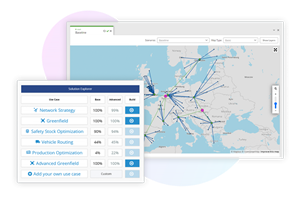
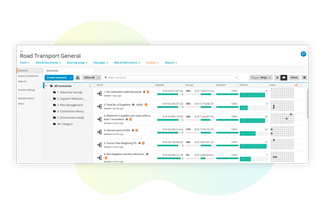
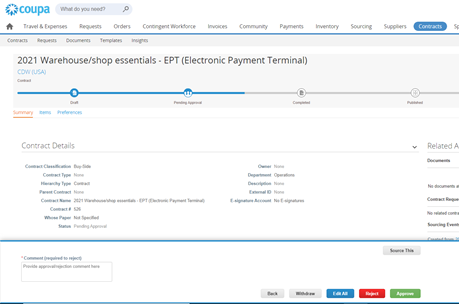
Coupa’s cloud-native Business Spend Management
(BSM) platform provides end-to-end processes
that helps drive collaboration
across for every business leader from supply chain, procurement,
finance, treasury, compliance, and IT and supply chain
leaders to help their companies to get the visibility and control they need to
spend smarter, mitigate risk, and improve
resilience. A
unified platform approach frees up IT from complex integrations to help
leaders deliver on these goals.
$549
per year
SAP Fieldglass
Score8.2 out of 10
N/A
A Vendor Management System (VMS) used to find, engage, and manage a global external workforce – including temporary workers, freelancers, contractors, consultants, and service workers.
Assistant Manager - R & D in Engineering at Havells India Limited (Consumer Electronics, 10,001+ employees)
Chose SAP Fieldglass
SAP Fieldglass offers extensive capabilities for managing contingent workforce, statement of work (SOW) projects, and services procurement. It seamlessly integrates with other SAP products (e.g. SAP SuccessFactors, SAP Ariba) and external systems, providing a unified ecosystem …
A de minimis incentive was given to thank the reviewer for their time. The incentive was not used to bias or drive a particular response, nor was the incentive contingent on a positive endorsement. TR verified that a representative sample of customers was invited. More Info
Senior Recruitment Executive in Human Resources at Mindlance Staffing (Staffing & Recruiting, 1001-5000 employees)
Chose SAP Fieldglass
Because of the user friendly experience that SAP Fieldglass provide, this keep SAP Fieldglass always ahead of them. The ease of all the process is the key how SAP Fieldglass stacks up against the other similar products like I mentioned in the above tab. There are other reasons …
A de minimis incentive was given to thank the reviewer for their time. The incentive was not used to bias or drive a particular response, nor was the incentive contingent on a positive endorsement. More Info
A de minimis incentive was given to thank the reviewer for their time. The incentive was not used to bias or drive a particular response, nor was the incentive contingent on a positive endorsement. More Info
Suitable: Simple indirect procurement. Low cost; short cycle implementation. Less Suitable: Complex procurement scenario requiring serious vendor collaboration. End-to-end integration. Direct Material Procurement, especially when planning, quality inspection, and other miscellaneous activities are involved, requires handling various special statuses and updates to meet industry- or country-specific requirements.
A de minimis incentive was given to thank the reviewer for their time. The incentive was not used to bias or drive a particular response, nor was the incentive contingent on a positive endorsement. More Info
A well-suited case could be : a) It's valuable during audits (both internal and external ) as it documents history and clear records. Scope of Improvement could be: a) It might not be suitable where the external workforce is relatively smaller, as it could be a costly affair for them.
A de minimis incentive was given to thank the reviewer for their time. The incentive was not used to bias or drive a particular response, nor was the incentive contingent on a positive endorsement. More Info
Coupa is easy to use, however, we had to teach our end users about procurement. They are not used to conducting an RFP, onboarding a supplier, or preparing a PO. This is the change management that our employees had to be prepared to understand. The Shelby Group helped us with the implementation.
The hardest part was the integration between NetSuite and Coupa. We wanted to have a dynamic tight integration between the two solutions. If we adjusted the chart of accounts or added a new supplier we wanted it to be able to done in both systems and be available immediately in both systems. We used a partner called SuiteSkies to accomplish this dynamic integration.
We’ve been able to manage the implementation and maintenance with a very lean IT group.
A de minimis incentive was given to thank the reviewer for their time. The incentive was not used to bias or drive a particular response, nor was the incentive contingent on a positive endorsement. More Info
A de minimis incentive was given to thank the reviewer for their time. The incentive was not used to bias or drive a particular response, nor was the incentive contingent on a positive endorsement. TR verified that a representative sample of customers was invited. More Info
Support Team - A little slow in responding. I think the tool is so configurable that they struggle with figuring out what is causing certain issues that are being submitted on the portal.
I'd love for the Sourcing Module to be able to support larger events. There seems to be a limit on the number of lines each event can support and as a growing retailer, our store count dictates we have room to grow and that each store is represented in the bid process.
Would like to see the ability to issue multiple POs for a single item to multiple locations. The tool may do this but I know I can't and it may be due to how we interface with our ERP.
A de minimis incentive was given to thank the reviewer for their time. The incentive was not used to bias or drive a particular response, nor was the incentive contingent on a positive endorsement. More Info
Some of the accounting dropdowns/combinations are clunky and not easy to use in conjunction with each other
User profiles are not synched with Ariba- sometimes missing information in Ariba would cause invoices to fail/get stuck. Would be helpful to have a hard stop in SAP Fieldglass to prevent such issues
Additional expertise across resources would be helpful. As noted, support itself is responsive and willing. However, we would continue to go through our original implementation contact for knowledge and immediate help.
A de minimis incentive was given to thank the reviewer for their time. The incentive was not used to bias or drive a particular response, nor was the incentive contingent on a positive endorsement. More Info
A de minimis incentive was given to thank the reviewer for their time. The incentive was not used to bias or drive a particular response, nor was the incentive contingent on a positive endorsement. More Info
Usage of the web interface it’s easy and user friendly. iOS app it’s quickly and simple, with just a foto it’s possible to store the invoice and system automatically recognize the expenses. Good integration with credit card company to and excellent functionality to assign the credit card expenses to relative invoice.
A de minimis incentive was given to thank the reviewer for their time. The incentive was not used to bias or drive a particular response, nor was the incentive contingent on a positive endorsement. TR verified that a representative sample of customers was invited. More Info
-Could be easy or hard to use depending on corporate policies and compliance. At times, errors and cryptical message associated with them could drive users mad.
A de minimis incentive was given to thank the reviewer for their time. The incentive was not used to bias or drive a particular response, nor was the incentive contingent on a positive endorsement. More Info
Web interface and iOS app are so simple and user friendly. The functionality that recognizes the expenses working very well. The integration with a credit card company it’s a an excellent functionality that simplify a lot the expenses management
A de minimis incentive was given to thank the reviewer for their time. The incentive was not used to bias or drive a particular response, nor was the incentive contingent on a positive endorsement. TR verified that a representative sample of customers was invited. More Info
-Support is generally speaking OK (not great). The user community is quite active, and the response time is acceptable. I would certainly hope there's more user-generated content (like in SAP, Oracle, and Linux, etc.), but I suppose Coupa is still not large enough, and the incentives are not yet there.
A de minimis incentive was given to thank the reviewer for their time. The incentive was not used to bias or drive a particular response, nor was the incentive contingent on a positive endorsement. More Info
A de minimis incentive was given to thank the reviewer for their time. The incentive was not used to bias or drive a particular response, nor was the incentive contingent on a positive endorsement. TR verified that a representative sample of customers was invited. More Info
A de minimis incentive was given to thank the reviewer for their time. The incentive was not used to bias or drive a particular response, nor was the incentive contingent on a positive endorsement. More Info
Concur was a lot easier and more user friendly for employees doing expense reports on their phone. That is not the case with Coupa. You must use your laptop to do expenses and our managers don't always have enough time to do that while out in the field working. This has caused some issues.
A de minimis incentive was given to thank the reviewer for their time. The incentive was not used to bias or drive a particular response, nor was the incentive contingent on a positive endorsement. More Info
SAP Fieldglass offers extensive capabilities for managing contingent workforce, statement of work (SOW) projects, and services procurement. It seamlessly integrates with other SAP products (e.g. SAP SuccessFactors, SAP Ariba) and external systems, providing a unified ecosystem for enterprises using SAP’s suite of solutions. It is highly scalable, suitable for large enterprises with complex workforce management needs.
A de minimis incentive was given to thank the reviewer for their time. The incentive was not used to bias or drive a particular response, nor was the incentive contingent on a positive endorsement. TR verified that a representative sample of customers was invited. More Info
A de minimis incentive was given to thank the reviewer for their time. The incentive was not used to bias or drive a particular response, nor was the incentive contingent on a positive endorsement. More Info
I would have to say Fieldglass has made a positive impact, only in that having access to it has opened up some client relationships we didn't have before. I am a vendor to clients using Fieldglass, so I can't really report on the financial successes they may have had by implementing it.
The negative side to Fieldglass, or any VMS, really, from an agency perspective is that it cuts out manager contact. That has a negative impact, both to the agency and the hiring manager. No longer can the managers really explain what they need, and no longer can an agency understand the req deeply. We have to work off of a scrubbed job description which is generally pretty vanilla.
A de minimis incentive was given to thank the reviewer for their time. The incentive was not used to bias or drive a particular response, nor was the incentive contingent on a positive endorsement. More Info