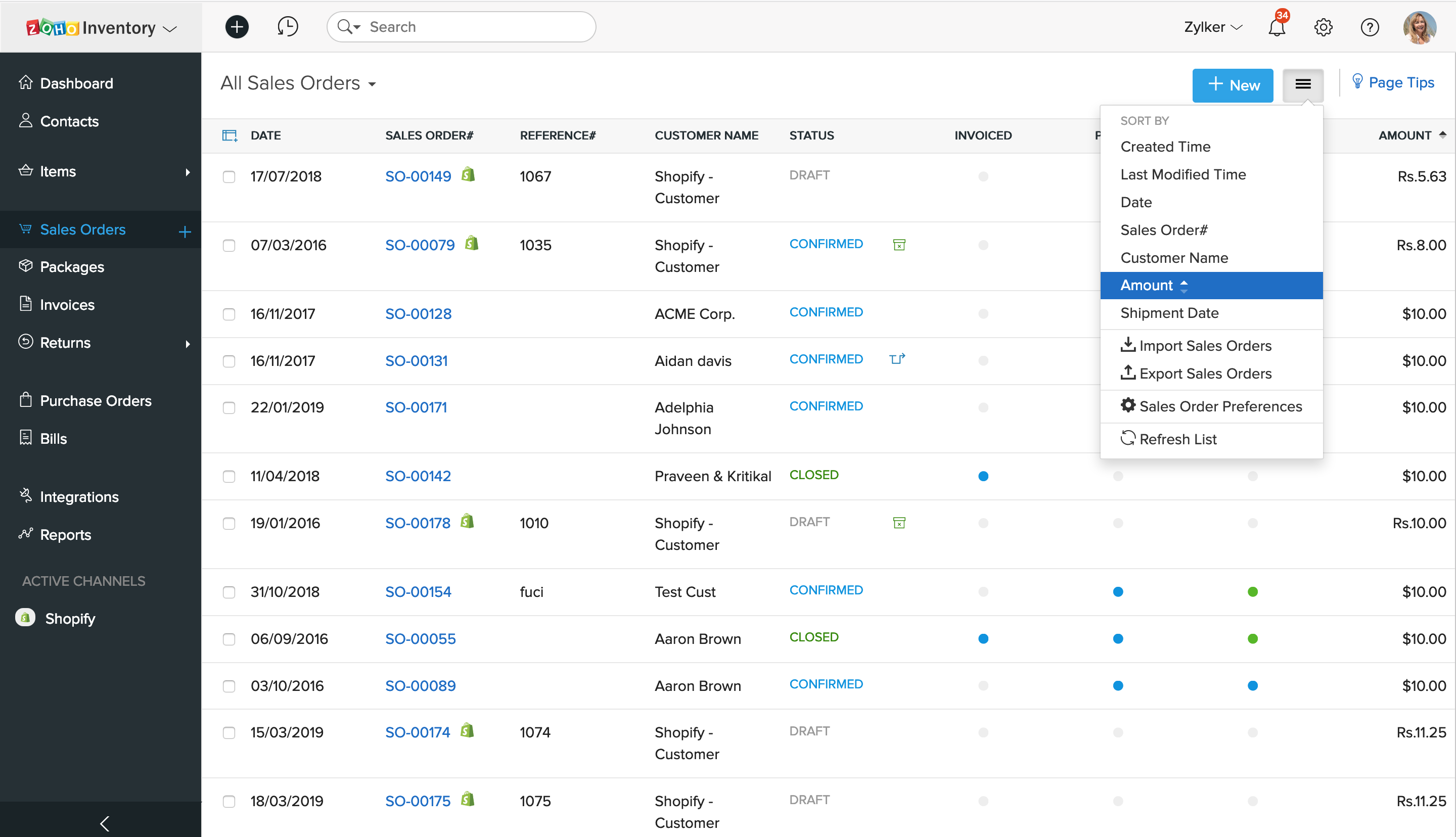
QuickBooks Desktop Enterprise is a widely-used accounting package designed for small to mid-sized businesses. It is the top of the QuickBooks line. Pricing starts at $3,000 for five users, and goes up depending on the number of additional users. They also offer an Advanced Inventory module for $999 / year.
$1,703
per year per user
Zoho Inventory
Score9 out of 10
N/A
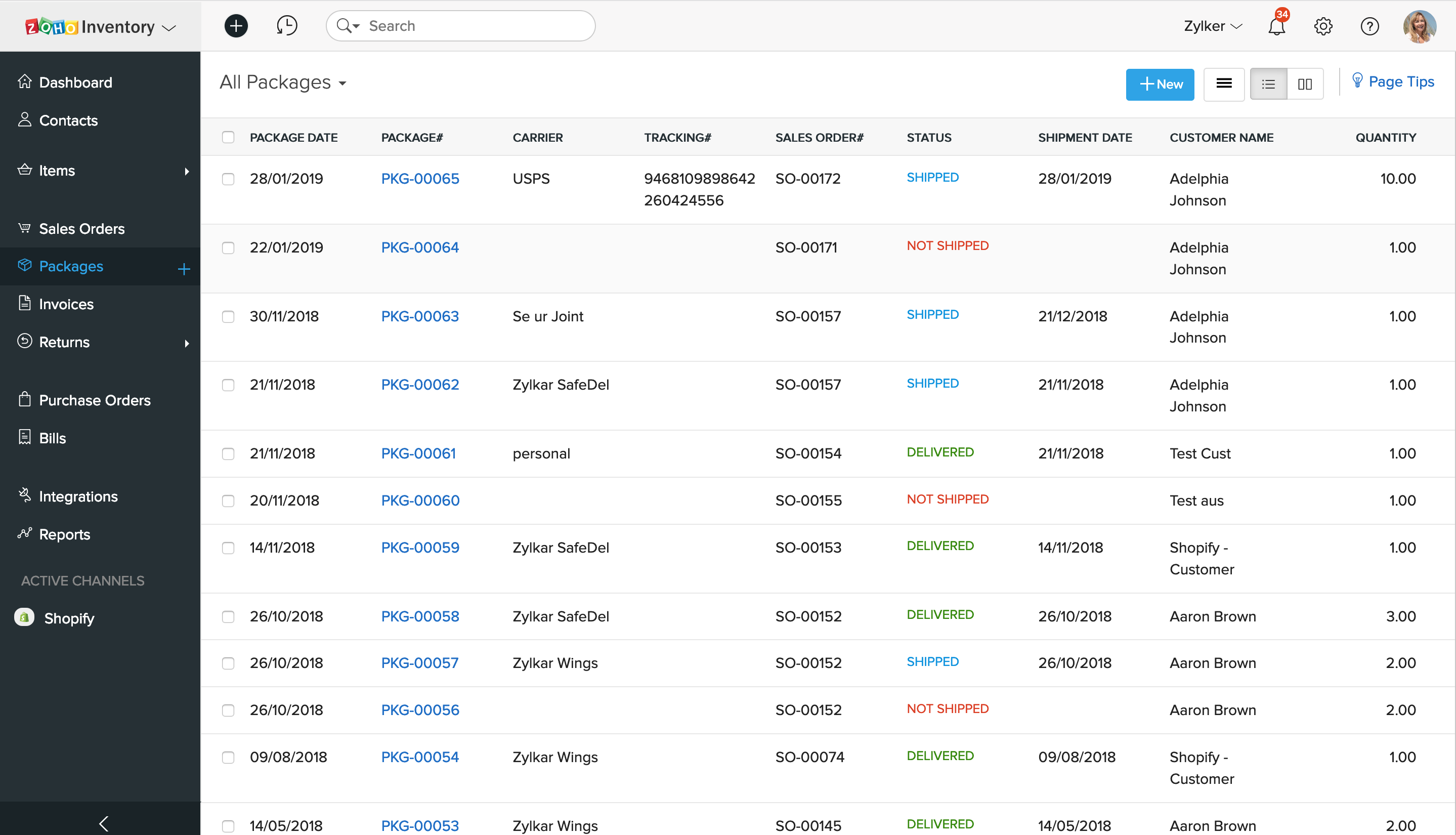
Zoho Inventory is a cloud-based inventory management solution designed for small to midsize businesses. It features inventory management modules including reporting and analysis, and lot traceability. It features mobile compatible apps for Android and iOS devices. Zoho Inventory offers additional capabilities such as built-in shipment estimating, and tracking and delivery confirmation features that allow users to invoice, ship and track products. The solution allows users to create…
$39
per organization / month billed annually ($49.00 billed monthly)
Pricing
QuickBooks Desktop Enterprise
Zoho Inventory
Editions & Modules
Diamond
$447
per month per user
Diamond with Remote Access
$513
per month per user
Gold
2,210.00
per year per user
Platinum
2,717.00
per year per user
Gold with Remote Access
3,000.00
per year per user
Platinum with Remote Access
3,504.00
per year per user
BASIC
$39.00
per organization / month billed annually ($49.00 billed monthly)
STANDARD
$79.00
per organization / month billed annually ($99.00 billed monthly)
STANDARD
$199.00
per organization / month billed annually ($249.00 billed monthly)
The inventory management is better than QuickBooks however you give up an awful lot to get that benefit. The reporting in QuickBooks is far superior. The reporting in Inventory is terrible with every few options to customize the reports. For example, pulling in a …
A de minimis incentive was given to thank the reviewer for their time. The incentive was not used to bias or drive a particular response, nor was the incentive contingent on a positive endorsement. More Info
QuickBooks Enterprise is great for managing our inventory, purchases and income as we receive it. We use it to help budget and plan our monthly purchases, as well as keep each location on track when it comes to their expenses. It's also used for payroll and timekeeping at each store.
A de minimis incentive was given to thank the reviewer for their time. The incentive was not used to bias or drive a particular response, nor was the incentive contingent on a positive endorsement. More Info
It's a basic system which does some things well but the things it does well are the basic things you would expect! Many other features that are a little beyond basic are just not available or you can get 90% of the way there but get stuck on the final 10% so you need to hire a developer who can try to get you through the last bit. An inventory management system with no bin locations pretty much sums it up. The reporting system is terrible. To get any real use you need to integrate it with Zoho Analytics but the problem there is it only syncs every 3 hours. The integrated shipping process is extremely cumbersome
A de minimis incentive was given to thank the reviewer for their time. The incentive was not used to bias or drive a particular response, nor was the incentive contingent on a positive endorsement. More Info
Updating as each transaction is posted means, in the event of a crash, power failure, whatever; all the posted transactions are securely in the data file and can be pulled up on another computer, if the computer being used crashes.
Reporting is generally user friendly, in that one can see the desired results by setting a few parameters for the report.
A de minimis incentive was given to thank the reviewer for their time. The incentive was not used to bias or drive a particular response, nor was the incentive contingent on a positive endorsement. TR verified that a representative sample of customers was invited. More Info
A de minimis incentive was given to thank the reviewer for their time. The incentive was not used to bias or drive a particular response, nor was the incentive contingent on a positive endorsement. More Info
Wish we had the ability to track gallons. We are a truck stop and need to know how many gallons we buy and sell.
Matching up credits in Pay Bills can be challenging, especially if you make a mistake.
Wish in some of the reporting that it would automatically total some columns.
Downloading from the bank wish it would tell you the last time you downloaded and the dates you put in so you don't download the same information twice.
A de minimis incentive was given to thank the reviewer for their time. The incentive was not used to bias or drive a particular response, nor was the incentive contingent on a positive endorsement. TR verified that a representative sample of customers was invited. More Info
Templates within Zoho Inventory are very weak. You can't customize many including package slips, shipment docs, etc...
When an order has multiple packages, it's next to impossible to find the item you are looking for. Scenario, a large order has many packages and a customer has cancelled one of the items. You must click through every package to find the item, edit the package and remove it before you can cancel the item.
The reports within Inventory are extremely basic and many of them are useless
The packing slip module is useless as it does not print out bin locations
It's an inventory management system but it does not have bin locations
The backorder system is useless. If you "backorder" something then the whole order is locked until the backorder arrives in. Scenario.... a client orders 20 items, 1 is on backorder. You "backorder" that one item but want to ship the other 19... not possible. The order gets completely locked.
You can't print out RMA requests. There is just no option to do it, you have to do a screen shot
Integration with Amazon or other 3rd party e-commerce providers is troublesome.
A de minimis incentive was given to thank the reviewer for their time. The incentive was not used to bias or drive a particular response, nor was the incentive contingent on a positive endorsement. More Info
While QuickBooks Desktop Enterprise has been an amazing tool for many years, it seems it is getting phased out for QuickBooks Online. Intuit is decreasing the level of support it offers for QuickBooks Desktop in lieu of stronger support for QuickBooks Online. Although the desktop version is robust and helpful, it seems QBO is the way of the future for bookkeeping with QuickBooks.
A de minimis incentive was given to thank the reviewer for their time. The incentive was not used to bias or drive a particular response, nor was the incentive contingent on a positive endorsement. More Info
It is relatively easy to customise but the problem is sometimes it is not easy to see where this customisation is available. Also the integrations with external systems can prove problematic both during installation and ongoing development and maintenance. It's great for small companies with a simple inventory or even larger organisations with smaller product lines. And it is reasonably priced if you ar eprepared to put the time in.
A de minimis incentive was given to thank the reviewer for their time. The incentive was not used to bias or drive a particular response, nor was the incentive contingent on a positive endorsement. More Info
QuickBooks provides all staff immediate access to the data in whatever form each person wants it. The balancing on entries prevents incorrect data entry on payables/receivables. Reports are easy to customize and save for future use. The records are easy to audit.
A de minimis incentive was given to thank the reviewer for their time. The incentive was not used to bias or drive a particular response, nor was the incentive contingent on a positive endorsement. TR verified that a representative sample of customers was invited. More Info
Rating: 7 out of 10 We rate QuickBooks Desktop Enterprise's availability a 7 out of 10. For the most part, the software is dependable and available when we need it. When hosted on a properly managed local server or through a reputable third-party cloud provider, uptime is generally consistent, and routine day-to-day operations run smoothly. However, availability challenges do arise, particularly when accessing QuickBooks remotely or during periods of high system demand. Because it's a desktop-based solution, availability is highly dependent on our internal IT infrastructure. If our network goes down, a server needs maintenance, or if there’s an issue with a remote desktop connection, access to QuickBooks can be temporarily disrupted. These outages aren’t necessarily caused by QuickBooks itself, but they do impact our experience with availability. Additionally, we’ve occasionally experienced application errors, especially after updates or when working with large company files. While Intuit support is usually helpful in resolving these issues, they can still lead to frustrating delays—especially during critical periods like month-end closing or grant reporting deadlines. Planned maintenance, while infrequent, also affects availability, especially when using a hosted environment. Coordination with IT or hosting providers is sometimes needed to minimize downtime. Overall, QuickBooks Desktop Enterprise is a reliable tool, but its dependence on local infrastructure introduces more potential points of failure compared to cloud-native solutions. Enhancements in cloud-based access or hybrid models could significantly improve both accessibility and uptime. That said, with strong internal IT support or a reliable cloud hosting provider, the availability can easily rise to an 8 or 9.
A de minimis incentive was given to thank the reviewer for their time. The incentive was not used to bias or drive a particular response, nor was the incentive contingent on a positive endorsement. TR verified that a representative sample of customers was invited. More Info
I rate QuickBooks Desktop Enterprise's performance a 5 out of 10, mainly because while it’s functional for most routine tasks, it can lag significantly when handling complex operations, large data files, or during multi-user sessions. As our organization has grown, we’ve noticed that report generation—especially for customized or multi-dimensional reports—can be slow, sometimes taking several minutes to load or refresh. This impacts productivity, particularly during key financial cycles like audits, monthly closings, or grant reporting. Performance degradation is especially noticeable when multiple users are active in the system at the same time. Even with a solid server setup, there’s often a drop in responsiveness when more than a handful of users are generating reports or entering transactions concurrently. We’ve also experienced some slowdowns in third-party integrations, particularly when syncing with Vena Solutions or exporting data for use in external tools. While the integrations are valuable, they occasionally stall or require workarounds, adding friction to our workflows. In short, QuickBooks Desktop Enterprise delivers the basics well, but its performance limitations become more apparent in high-volume or complex use cases. It would benefit from better optimization for large datasets and faster processing for advanced reporting. Upgrades in system architecture—such as deeper support for cloud hosting or more efficient data handling—could significantly improve the user experience and move this rating closer to an 8.
A de minimis incentive was given to thank the reviewer for their time. The incentive was not used to bias or drive a particular response, nor was the incentive contingent on a positive endorsement. TR verified that a representative sample of customers was invited. More Info
It takes a long time to get through to customer support. And sometimes you have to explain the situation multiple times before the rep actually understands the issue, but that's usually because the issue is complex and out of the ordinary. However, the rep is always patient, and will take as much time and effort as necessary to resolve whatever issue you're having. It's nice that they can "take over" your computer rather than having to talk you through the solution over the phone.
A de minimis incentive was given to thank the reviewer for their time. The incentive was not used to bias or drive a particular response, nor was the incentive contingent on a positive endorsement. More Info
It is a very easy system to learn, so with the help it was even easier. QB is a good solid system, but it lacks some of the complexity other systems have. with QB you need to get additional modules to get the same functionality that other systems offer standard
A de minimis incentive was given to thank the reviewer for their time. The incentive was not used to bias or drive a particular response, nor was the incentive contingent on a positive endorsement. More Info
easy to learn system, specially with some kind of support. Just like with any other system, things get lot easier if you have guidance to lead you in your search for answers. having said that, QB is very easy to use and very easy to teach. you wont spend much time memorizing where to click.
A de minimis incentive was given to thank the reviewer for their time. The incentive was not used to bias or drive a particular response, nor was the incentive contingent on a positive endorsement. More Info
If you're loading QuickBooks Enterprise Solutions onto a computer that you're going to directly log into, you should be able to do it yourself. If you are going to connect to a server through a network or remote connection, you should probably have a professional IT person set it up for you.
A de minimis incentive was given to thank the reviewer for their time. The incentive was not used to bias or drive a particular response, nor was the incentive contingent on a positive endorsement. More Info
We have selected this product as it is affordoable in terms of pricing and features too. Our clients is geeting lots of benefits by using this product. By using QuickBooks desktop client also manage the information realted to financials and also get the clear picture for the future by using the accounting information from this product.
A de minimis incentive was given to thank the reviewer for their time. The incentive was not used to bias or drive a particular response, nor was the incentive contingent on a positive endorsement. TR verified that a representative sample of customers was invited. More Info
The inventory management is better than QuickBooks however you give up an awful lot to get that benefit. The reporting in QuickBooks is far superior. The reporting in Inventory is terrible with every few options to customize the reports. For example, pulling in a salesperson report that factors in returns is not possible. You can't pull a report to see what items need to be picked for all open orders.
A de minimis incentive was given to thank the reviewer for their time. The incentive was not used to bias or drive a particular response, nor was the incentive contingent on a positive endorsement. More Info
I would rate QuickBooks Desktop Enterprise a 7 out of 10 for overall scalability. The product offers solid scalability features, particularly for small to mid-sized organizations like ours that are growing and need reliable multi-user access, enhanced data capacity, and cross-departmental functionality. It handles increasing transaction volumes and user growth quite well, especially with its support for up to 40 users and the ability to manage large lists (customers, vendors, accounts, etc.)—a significant improvement over QuickBooks Pro or Premier. Its role-based permissions system also allows us to assign tailored access by department or user level, which is essential for maintaining control and security across teams like finance, HR, and program management. Additionally, features like advanced reporting, inventory management, and class tracking have helped us better manage multiple programs or sites within one system. That said, the scalability still has some limits. For example, deploying the software across multiple physical locations or for remote teams requires additional IT infrastructure—such as hosting it on a third-party cloud server or setting up a VPN—which introduces cost and complexity. Also, while QuickBooks Desktop Enterprise can technically handle a high volume of data, performance can decline as the file size grows over time unless regular maintenance and optimization are done. In summary, QuickBooks Desktop Enterprise scales well within its designed range, particularly for growing nonprofits and NGOs. However, organizations with distributed teams or very large, complex operations may eventually find the system’s desktop-based architecture less agile compared to cloud-native ERP platforms. With enhancements to cloud integration and remote accessibility, this rating could easily increase.
A de minimis incentive was given to thank the reviewer for their time. The incentive was not used to bias or drive a particular response, nor was the incentive contingent on a positive endorsement. TR verified that a representative sample of customers was invited. More Info
Good value for the price. The initial setup was quick and easy.
When properly set up and processes are followed it's decent at managing inventory which is something we had problems with. Have to have a dedicated employee to builds.
Rolling up costs in multi-level BOM's is a project each time we have to review costs, it's very time consuming to manually update all assemblies.
A de minimis incentive was given to thank the reviewer for their time. The incentive was not used to bias or drive a particular response, nor was the incentive contingent on a positive endorsement. More Info
A de minimis incentive was given to thank the reviewer for their time. The incentive was not used to bias or drive a particular response, nor was the incentive contingent on a positive endorsement. More Info