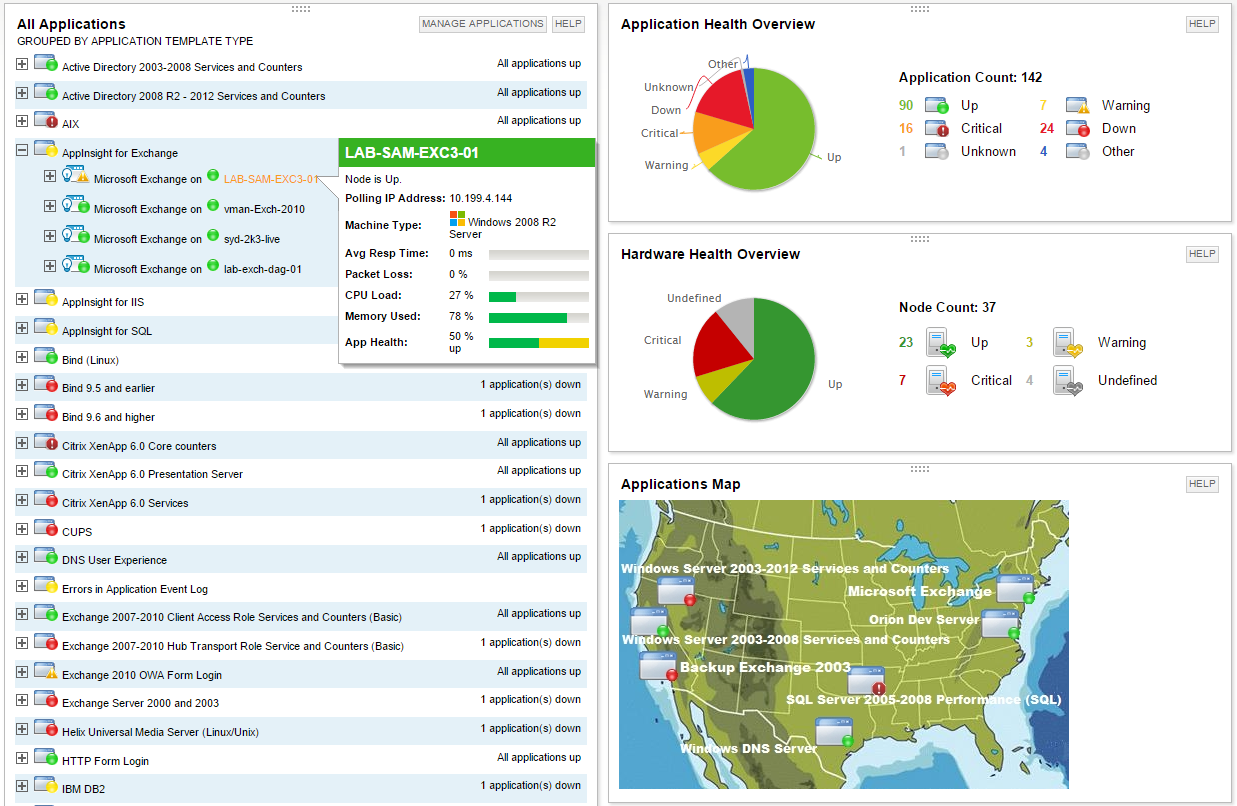
SolarWinds Server & Application Monitor (SAM) delivers application and server monitoring capabilities. SAM allows for self-service for easy setup, 1200+ monitoring templates, and customization options, as well as integrate with other SolarWinds products.
N/A
Zabbix
Score 8.6 out of 10
N/A
Zabbix is an open-source network performance monitoring software. It includes prebuilt official and community-developed templates for integrating with networks, applications, and endpoints, and can automate some monitoring processes.
N/A
Pricing
SolarWinds Server & Application Monitor
Zabbix
Editions & Modules
No answers on this topic
No answers on this topic
Offerings
Pricing Offerings
SolarWinds Server & Application Monitor
Zabbix
Free Trial
Yes
No
Free/Freemium Version
No
No
Premium Consulting/Integration Services
No
No
Entry-level Setup Fee
No setup fee
No setup fee
Additional Details
SAM pricing starts at $2,995.
—
More Pricing Information
Community Pulse
SolarWinds Server & Application Monitor
Zabbix
Ask people about this product
Oswald Schmidt• 2nd
Legacy Response Consultant at Pagac - Flatley
Skilled at Licensed Concrete Soap
Haven Koelpin• 2nd
District Markets Director at Johns, Bruen and Haag
Skilled at Rustic Granite Tuna
Nash Pfannerstill• 2nd
Regional Implementation Planner at Langosh Inc
Skilled at Refined Metal Tuna
See helpful people who have experience with this product
The last time we did a monitoring and performance shootout was years ago. While I can say we picked SolarWinds' Orion suite over WhatsUp Gold, Zabbix, and several others, it would be unfair to list the shortcomings of each for our needs, because they might not be valid anymore.
Zabbix gives limited value. Even though the SAM is paid, we (Management) would agree to pay for it because of the value it brings in. The comparison was very positive towards SAM. It could be with Dashboards, In-built templates, Forecast, Monitoring, Alerts.
The monitoring capabilities of both SCOM and Zabbix was OK, the licensing and configuration complexity for SCOM was huge. The Zabbix system was very good on the non-windows side, and limited on the Windows side. SAM, when utilized with the different modules that we own, …
The nature of monitoring applications is to alert, offer ways to keep a production environment up and running, and limit/reduce interruptions. We have Zabbix and Nagios Network Analyzer in place, which help uptime and other critical infrastructure stay in operation. Metrics …
I have tried and researched many products including Cacti, Zabbix, Dynatrace, as far as I have read the best crafted product among them is SolarWinds. [Already], SolarWinds company is the most successful company that has proven itself in issues such as monitoring and logging.
SolarWinds is cost-effective, we have a great solution provider that helps us with tool integrations and maintenance, the integration capability and extensive documentation also help a lot in the ability to use it in various monitoring models and scripts.
Nagios and Rancid are used internally by a company that was acquired last year. They're a big open source group.
Other groups also use HostMonitor, Big Brother, and a couple of home grown tools that don't really stack up. Those groups don't want to change the way they do …
SolarWinds is just easier to set up and manage out of the box. I don't want to waste time configuring a solution when that solution is meant to be monitoring my environment.
SAM is infinitely easier to set up. I don't have to build out low-level agents to gather the information I want. SAM makes it as easy as checking some boxes in the UI. The UI is much easier to understand and set up. SAM comes with easy integration of LDAP to help manage users.
Application and network monitoring are great, but we need an externally based site monitor (like site 24x7 that we use currently) to be available through the Orion web console.
Monitoring solutions are usually tricky to install, confgure and maintain. SAM is easy in all of those aspects. It is not super hard to configure or set up and day-to-day operation is simple as well. It is also nice that it is back by a company with a very good support staff if …
SolarWinds SAM dominates OpenSource solutions. It is straightforward and easy to understand. Built-in application templates make setting up monitors a snap!
SAM's biggest advantage by far is EASY OF SETUP and USE. This is the one reason I went with SolarWinds...it blows the others away when it come to the simplicity. But it's simplicity paired with power.
In the past, when rolling out tools like Nagios, I feel like I needed to …
For monitoring applications that run on Windows hosts on VMware or HyperV virtualization, SolarWindows offers a nice, vertical view of both the loads and the resources. In such an environment, this makes life really good! But if you have something else -- for example, Linux hosts -- you're on your own to some extent. That is, the things it does well, it does very well -- but everything else is much less polished.
Zabbix is very well suited for infrastructure monitoring i.e. the underlying host servers, basically, compute nodes. However, it has limited FM & PM capabilities for the workloads, i.e., the virtual machines (VMs). Zabbix has an easy-to-use GUI which can be explored easily & provides good filtering of the data.
Collecting hardware data - CPU, Memory, Network, and Disk Metrics are collected and reported on.
Flexible design - It is very easy to build out even very large environments via the templating system. You can also start where you are - network monitoring, server monitoring, etc. and then build it out from there as time and resources permit.
Provides a "plugin architecture" (via XML templates) to allow end users to extend it to monitor all kinds of equipment, software, or other metrics that are not already added into the software already.
Very complete documentation. Almost every aspect of Zabbix has been documented and reported on.
Cost - Zabbix is FOSS software and always free. Support is reasonably priced and readily available.
Provides basic monitoring/visibility. Visibility into detailed/fine-grained issues best suited for more specialized/expensive solutions.
Licensing per monitored application rapidly uses up purchased license count.
More out-of-the-box templates or easier setup of monitoring less-common applications would make the solution more appealing given the target audience of the product.
In a busy Zabbix environment, it can easily overwhelm the underlying database. Plan on having SSDs and a significant server infrastructure to keep up with more than a hundred hosts.
Building out Zabbix metrics that suit your environment can be very time consuming. When choosing a monitoring platform like Zabbix, expect a steep learning curve and to invest significant resources to make the tool valuable.
This is less important than it has been in the past, but current versions of Zabbix still do not handle IPMI checks of hardware very well. We needed to write our own wrapper for IPMI checks rather than using the built in IPMI poller.
We are heavily invested in Solarwinds products for a reason. They are generally easy to setup and run with, requiring only some interfacing with support or help articles on rare occasions. They do what we bought them to do and we can't ask for more.
It is free. It didn't cost anything to implement (other than my time and the cost incurred for it) and it is filling a badly needed gap in our IT infrastructure. Support is available if we have issues and can be done annually or paid for on a per incident basis as needed. Expansion, updates, and all other future lifecycle activities are likewise free of cost, so as long as someone is able to implement/maintain the software (and the OSS project is maintained) then I imagine the company will never leave it.
SolarWinds Server & Application Monitor is quite easy to use and super versatile. It allows you to do just about anything you can through premade templates or through scripting. You can use an agent on the servers if you want to, or you can monitor through WMI or SNMP credentials. You can customize thresholds for alerting quickly, and you can configure alerts to be as complex or as simple as you want.
The graphical interface and the performance of the database leave a little to be desired, they could be better explored.Some functionality and screens do not work well depending on the browser used. The integrations never had any problems or caused crashes in other systems.
I think there was only a couple times I had to open a support case for SAM and one time they got multiple engineers on the phone to get a better idea what I was trying to monitor and was able to point me in the best direction to monitor that system.
The setup is the most time-consuming portion of using zabbix. It takes a lot of effort to shape it into a usable format and even then it can get very messy. It's not exactly intuitive and as mentioned the UI seems a bit antiquated. If I was to roll out a monitoring solution from scratch, I'd probably look for alternatives which are easier to use and maintain.
We are a mainly Windows environment, so it would be useful if we could have used Active Directory to deploy agents. As of version 4.2, Zabbix has announced a new agent MSI file to allow exactly that. Unfortunately, we didn't have that option. Also, for Linux and MAC deployments, there is no simple way to deploy that. Using remote scripts you may be able to create something, but most places will opt for either SNMP (agentless) or manual installation of agents to add to Zabbix. A way of deploying agents via discovery would go a long way to helping in the adoption of the tool.
It has been a while since we first purchased SolarWinds, but I looked over several other products that I can't remember now. Many other products tried to scan the network to find computers but given that our computers are located in various places across campus with other computers in our buildings that are not ours that type of network scanning was not what we needed. Other services have extra services that we had no need of and I liked the ability to add custom fields in SolarWinds so we can track the information on each computer that we need to know.
We're using the Solarwinds suite as our global monitoring standard, but it is very complex and its licensing model makes it difficult to monitor a wide range of technologies. So, we're using Zabbix as a complement on our monitoring process. Zabbix is a way more flexible and has free integrations to a wide range of technologies. It is also more 'user friendly' and easy to manage.
Less time spent investigating causes of issues. We are alerted straight away and can find the root cause of the issue in less time.
We have been able to ditch all our previous individual monitoring solutions, none of which integrated with each other for a single solution which fully integrates with each of the different modules to provide a single portal for monitoring and alerting.
Zabbix simply makes it easier to identify, and subsequently resolve problems quickly
Zabbix gives one web page to look at to see a list of all on-going issue in a single place
Zabbix can automate response to alerts. For example, Zabbix allows you the customization to take a monitored server out of production rotation if it is identified as unhealthy