Salesforce' Agentforce Sales (formerly Salesforce Sales Cloud) is the company's flagship CRM platform. The AI CRM for Sales features data built right in.
$25
per month
Workday Adaptive Planning
Score 7.7 out of 10
Mid-Size Companies (51-1,000 employees)
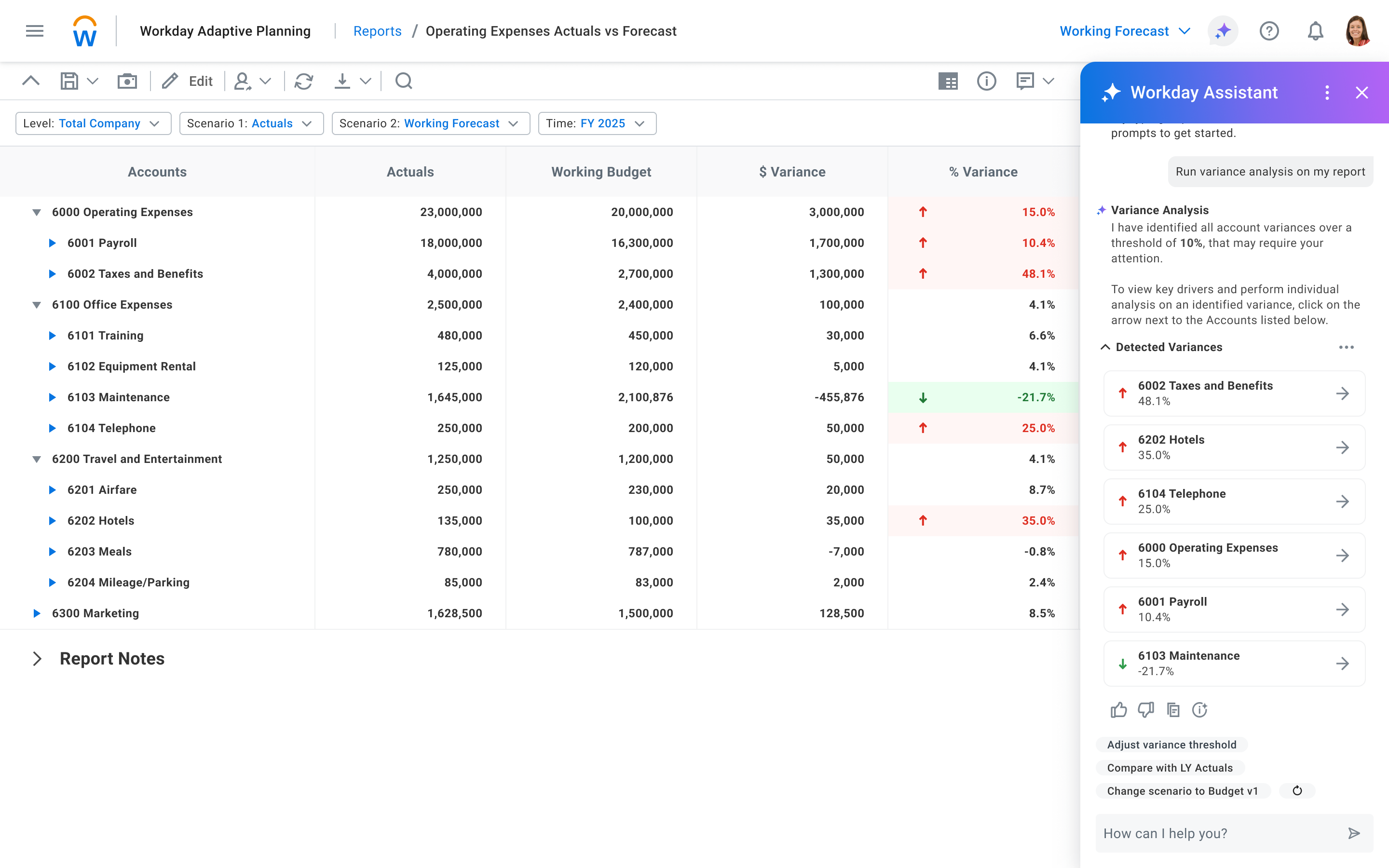
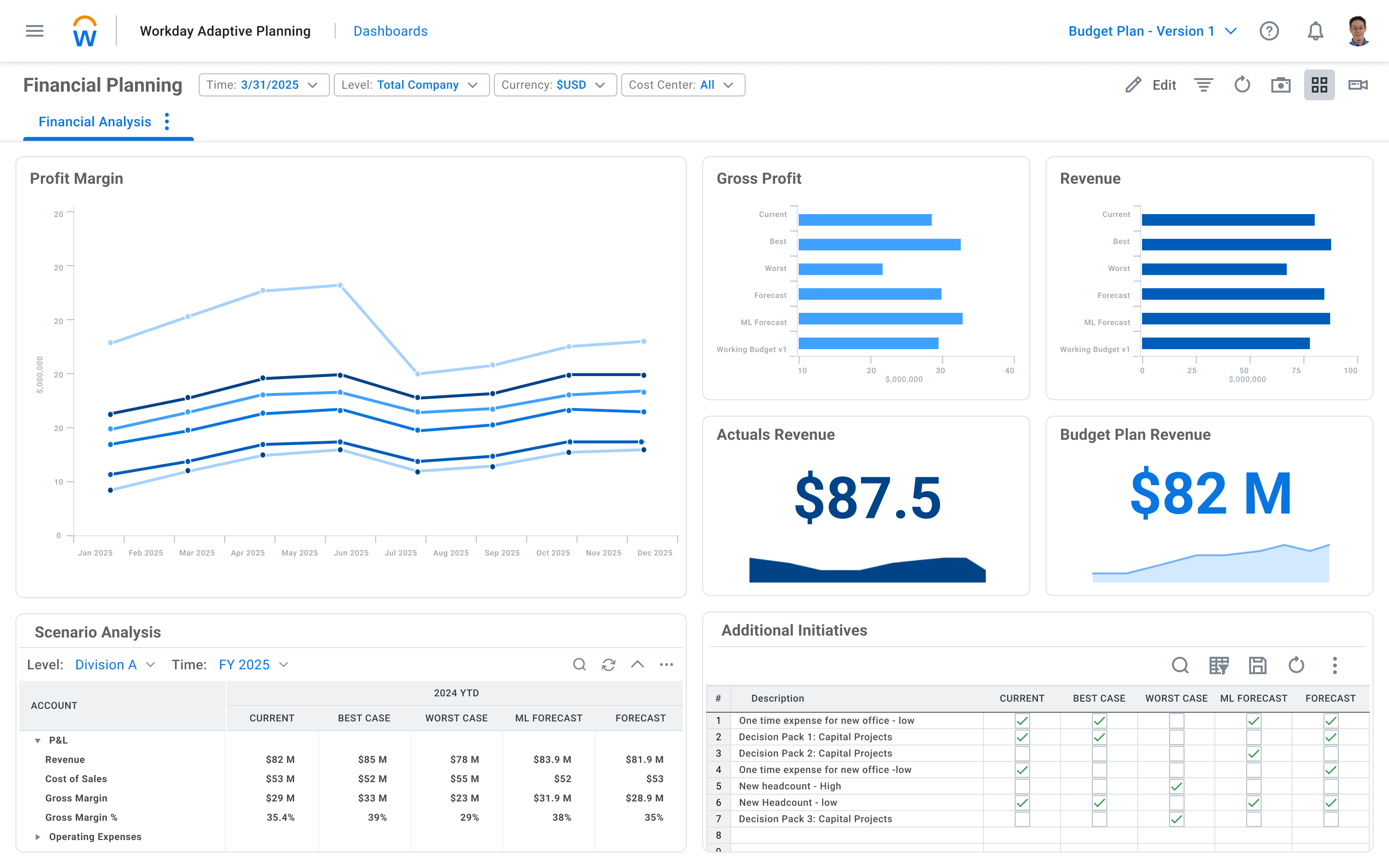
Workday Adaptive Planning streamlines planning workflows, using AI and real-time data integration to improve collaboration and provide predictive forecasts for better strategic analysis.
Workday became our choice because it is fully web-based and easily integrates with other systems. The learning curve for Workday was shorter than that of Dynamics. The reporting tools in Workday are more user-friendly than that of Dynamics. However Workday did not have Check …
We did some analysis of Anaplan, but it seemed they were built for much bigger companies. It did not seem like we could implement and maintain Anaplan without significant IT support, which was one of the main goals of the project. Anaplan did seem like it could have more …
Adaptive is much more flexible and powerful for our needs. It provides a wealth of reporting tools and capabilities that Cognos simply didn't or couldn't provide. The ability to have a team of one completely implement and manage the solution for a company is not unreasonable …
Adaptive planning was selected for a different use case of financial planning and management reporting to which is lives up to expectations. We are pleased with Workday's commitment to expand the product offering as the demands of the business continue to grow.
Verified User
Analyst
Chose Workday Adaptive Planning
I have not used any other products like Adaptive Suite. I have only ever used Excel templates and models with VBA and models.
I have used TM1 and Hyperion in the past and I find Adaptive to be cleaner, more flexible, quicker, and more powerful. It is extremely user friendly and intuitive which means the ramp time for a new employee to feel comfortable and competent with the tool is comparably short. …
Adaptive is flexible and super fast compared to these widely used tools. Also, much easier to maintain singular vision for the team with a single source.
Adaptive Insights is more user friendly, I love the fact that it updates in real time, without having to "roll up" your data to see the results. The reporting is easy to use and understand and the cost is much better when compared with big hitters such as Hyperion and Oracle. I …
Features
Salesforce Agentforce Sales
Workday Adaptive Planning
Sales Force Automation
Comparison of Sales Force Automation features of Product A and Product B
Salesforce Agentforce Sales
8.2
269 Ratings
4% above category average
Workday Adaptive Planning
-
Ratings
Customer data management / contact management
8.7269 Ratings
00 Ratings
Workflow management
8.5258 Ratings
00 Ratings
Territory management
7.6211 Ratings
00 Ratings
Opportunity management
9.0259 Ratings
00 Ratings
Integration with email client (e.g., Outlook or Gmail)
7.8244 Ratings
00 Ratings
Contract management
8.0215 Ratings
00 Ratings
Quote & order management
7.6198 Ratings
00 Ratings
Interaction tracking
8.9229 Ratings
00 Ratings
Channel / partner relationship management
8.0190 Ratings
00 Ratings
Customer Service & Support
Comparison of Customer Service & Support features of Product A and Product B
Salesforce Agentforce Sales
7.8
104 Ratings
1% above category average
Workday Adaptive Planning
-
Ratings
Case management
8.3102 Ratings
00 Ratings
Call center management
7.782 Ratings
00 Ratings
Help desk management
7.386 Ratings
00 Ratings
Marketing Automation
Comparison of Marketing Automation features of Product A and Product B
Salesforce Agentforce Sales
8.0
244 Ratings
3% above category average
Workday Adaptive Planning
-
Ratings
Lead management
8.0239 Ratings
00 Ratings
Email marketing
8.0206 Ratings
00 Ratings
CRM Project Management
Comparison of CRM Project Management features of Product A and Product B
Salesforce Agentforce Sales
8.1
248 Ratings
5% above category average
Workday Adaptive Planning
-
Ratings
Task management
8.4236 Ratings
00 Ratings
Billing and invoicing management
7.278 Ratings
00 Ratings
Reporting
8.7201 Ratings
00 Ratings
CRM Reporting & Analytics
Comparison of CRM Reporting & Analytics features of Product A and Product B
Salesforce Agentforce Sales
8.3
260 Ratings
7% above category average
Workday Adaptive Planning
-
Ratings
Forecasting
7.9228 Ratings
00 Ratings
Pipeline visualization
8.4247 Ratings
00 Ratings
Customizable reports
8.7257 Ratings
00 Ratings
Customization
Comparison of Customization features of Product A and Product B
Salesforce Agentforce Sales
8.5
252 Ratings
10% above category average
Workday Adaptive Planning
-
Ratings
Custom fields
9.0249 Ratings
00 Ratings
Custom objects
8.7239 Ratings
00 Ratings
Scripting environment
7.8176 Ratings
00 Ratings
API for custom integration
8.5209 Ratings
00 Ratings
Security
Comparison of Security features of Product A and Product B
Salesforce Agentforce Sales
9.0
283 Ratings
7% above category average
Workday Adaptive Planning
-
Ratings
Single sign-on capability
9.0221 Ratings
00 Ratings
Role-based user permissions
8.9255 Ratings
00 Ratings
Social CRM
Comparison of Social CRM features of Product A and Product B
Salesforce Agentforce Sales
7.9
160 Ratings
5% above category average
Workday Adaptive Planning
-
Ratings
Social data
8.1158 Ratings
00 Ratings
Social engagement
7.6156 Ratings
00 Ratings
Integrations with 3rd-party Software
Comparison of Integrations with 3rd-party Software features of Product A and Product B
Salesforce Agentforce Sales
8.0
217 Ratings
6% above category average
Workday Adaptive Planning
-
Ratings
Marketing automation
8.0213 Ratings
00 Ratings
Compensation management
7.9146 Ratings
00 Ratings
Platform
Comparison of Platform features of Product A and Product B
Salesforce Agentforce Sales
8.2
232 Ratings
7% above category average
Workday Adaptive Planning
-
Ratings
Mobile access
8.2232 Ratings
00 Ratings
BI Standard Reporting
Comparison of BI Standard Reporting features of Product A and Product B
Salesforce Agentforce Sales
-
Ratings
Workday Adaptive Planning
9.3
1 Ratings
19% above category average
Pixel Perfect reports
00 Ratings
9.01 Ratings
Customizable dashboards
00 Ratings
10.01 Ratings
Report Formatting Templates
00 Ratings
9.01 Ratings
Ad-hoc Reporting
Comparison of Ad-hoc Reporting features of Product A and Product B
Salesforce Agentforce Sales
-
Ratings
Workday Adaptive Planning
8.0
1 Ratings
3% above category average
Drill-down analysis
00 Ratings
9.01 Ratings
Formatting capabilities
00 Ratings
7.01 Ratings
Integration with R or other statistical packages
00 Ratings
8.01 Ratings
Report sharing and collaboration
00 Ratings
8.01 Ratings
Report Output and Scheduling
Comparison of Report Output and Scheduling features of Product A and Product B
Salesforce Agentforce Sales
-
Ratings
Workday Adaptive Planning
8.0
1 Ratings
0% below category average
Publish to PDF
00 Ratings
8.01 Ratings
Report Versioning
00 Ratings
8.01 Ratings
Report Delivery Scheduling
00 Ratings
8.01 Ratings
Data Discovery and Visualization
Comparison of Data Discovery and Visualization features of Product A and Product B
Obviously, for any business, there are two main areas to focus on — the sales path and the service path. Sales Cloud wouldn’t be suited for a company that’s primarily into support services. For those kinds of companies, Salesforce has a different product — Service Cloud. So, for anyone in the support or service space, Sales Cloud isn’t the right fit.
We're a mid-size organization working with a shoestring budget and an IT skeleton crew...not much room to dedicate resources to a platform like this fully. Having it SaaS based is helpful for system management through their Helpdesk system, and a single platform also helps streamline the knowledge needed by our developers when integrating other business aspects to Workday.
The customizations - We have an organization that operates differently from most companies, so we’ve had to implement quite a few customizations — and Salesforce allows us to do that quite quickly. Most of the time, delays come from dependencies on other internal parties rather than the system itself.
From my perspective as a consultant, one of the biggest advantages is that everything is in Salesforce — all the details, all in one place. The ability to customize it easily is a big plus; there’s really a lot you can do with it.
It helps create dynamic plans for finances, operations and various functional units in an organization all under one platform
It helps in scenario modeling to help analyze various business events and report by any number of business dimensions including channel, customer or product
It can be integrated with any system including ERP, BI or CRM
We still need to include the production part. We started using Salesforce to sell the seeds — our inventory is in SAP — and from there we handle sales and track the process of planting, harvesting, selling, and then collecting payments. But we don’t yet manage the earlier production processes, like production planning. We handle allocation, but not full production planning, and that’s an area where we still have room for improvement.
Dashboards are not the best for graphs/charts. However, I have heard of companies using the dashboards for forecasting/budgeting. I would like to see Workday Adaptive Planning demonstrate this part of the feature.
Better security or locks to prevent deleting Actuals data - you are literally one click away from doing this.
On the web-based reports, better functionality when needing to reverse the sign in calculations - right now it is only available for revenue vs. expenses.
There are days when I wish we hadn't switched, but I know that if we put in the time, we will get to where we want to be with the software and that it has many more capabilities than anything else we looked at. However, the amount of time and onboarding we need to do is also far greater than we realized/were told when we originally bought the product. They told us we should hire onboarding support, but at the end, after we had already reached our budget maximum for this, so it's been slower than we had hoped.
For one we're in way too deep to not move forward with Adaptive. We're integrated with Workday, we do a ton of reporting with Adaptive, and it's working very well for planning and forecasting. No reason to look back or change course.
Because I think it could be easier. We have different standards today since we’re used to interacting with consumer apps like Starbucks, where all you do is scan your card. Then, when you use Sales Cloud, there are still a lot of manual inputs. So my mission with AI is really about figuring out how to make that easier.
It is overwhelming at first, but once you really get to know it, you realize it is fairly simple and customizable, and then it has a lot more limitations than you first thought. Realizing those limitations and finding workarounds is when you know you've mastered the software.
Salesforce is always available securely from any internet-capable device anywhere in the world, UNLESS you choose to set security measures so that ONLY trusted IP ranges may access the system at certain times of the day. It's all about choice and flexibility with Salesforce products.
There haven't been any lately. The only one issue I can think of is when there was an update in Adaptive that altered our reports. Before I realized there was an issue, Adaptive reached out to let me know, so that it could be fixed.
Salesforce performance in general is excellent. "The cloud infrastructure beneath Force.com has been fine-tuned over the past 10 years. It powers nearly 100,000+ businesses running more than 185,000 applications that 3 million users count on every day." Points per Salesforce - 1) Multitenant kernel - With a multitenant platform, each business that uses the app doesn’t have its own copy. Instead, all businesses share a single copy and then customize it for their specific needs. 2) ISO 27001 certified security - You can’t compromise when it comes to enterprise-level security. Force.com is road-tested and trusted by nearly 100,000+ companies, including many of the world’s most security-conscious organizations, such as banks and health care providers. 3) Proven reliability - All Force.com apps run on world-class data centers with backup, failover, and disaster-recovery facilities. Force.com has had a proven 99.9 percent uptime record for years. 4) Proven, real-time scalability - Force.com is used by many of the world's largest enterprises, including Cisco, Japan Post Network, and Symantec. Applications can automatically scale from a few users to millions of page views, as needed. 5) Real-time query optimizer - You need fast access to your data. The Force.com query optimizer delivers under 300ms response time, at a massive scale. 6) Real-time transparent system status - You can always see real-time system performance, availability, and security information at trust.salesforce.com. 7) Real-time upgrades - Unlike traditional software platforms, our upgrades never break your customizations, code, or integrations. We upgrade the platform for you 3 to 4 times each year. As a result, you’re always on the latest version, with access to the latest features, performance, and security enhancements. 8) Real-time sandbox environments - With a single click, you can create copies of your applications, configuration, and data in separate environments for development, testing, and training. 9) Three global production data centers and disaster recovery - Force.com runs on three geographically dispersed, mirrored data centers with built-in replication, disaster recovery, a redundant network backbone, and no single points of failure
All aspects of Adaptive Insights perform well. One area that I wish was quicker was integration. When importing data from Intacct our accounting ERP platform, it can sometimes take 4 hours for the import to process. The earlier imports are done, the quicker they complete. My estimate for a quick upload is about two hours.
The overall support has been good. More and more features are being released quite frequently. Very small features are also making big difference in how the tool can be adapted and used better. If there is anything we need or are stuck, the support team sets up a call and helps in resolving the issue/provides workarounds.
Whenever we have had any questions, issues, or concerns, the support has been quick and thorough. [This] allow[s] us to be able to fully resolve any issues, or be connected with the right group quickly to attain the result we were after; be it from simple formatting to adding new detailed reporting.
I attended two training sessions. I would rate them a 4 as an advanced user. It was very basic – great for someone new – would give 8+ for new person.
I had 3 years of experience at the time. I skipped basic and went onto advanced and still not helpful. A lot of it was best practices that didn’t feel relevant for our business
This was extremely helpful so that they could walk you through the model and teach you more about the complexity of various areas. It is most helpful when it is specific to your organization's model. The larger in-person trainings were helpful but they tended to be more generic and entry level. The trainings that are more tailored to your specific needs are the most helpful.
I have gone through multiple. The content that’s delivered is quite basic – I wish they had more advanced training.
We are grandfathered into premium support plus training. We get unlimited access to instructor led and online training for free. We have taken advantage of this
They often times tended to be way too generic or entry level. They would also become sales pitches to upgrade or get new Adaptive Planning products. The questions in the training would be very niche and specific to other organizations. They were rarely helpful to the group at large.
Just from an organizational standpoint - we standardized our data prior to moving to Salesforce. But we essentially standardized it wrong. That's created a big disgusting mess for us know that I'll have to deal with as the Admin. Be sure you think through use cases prior to doing something like that - seek outside opinions on how the data will work best, especially depending on what else you're going to integrate with Salesforce.
Trust the expertise of very strong 3rd party implementers. Having deployed Adaptive at a separate company before, I thought I knew it all (hubris, I know). Fortunately, I began to (very quickly) trust the judgment of our Carlson implementation team, and they provided invaluable insights and best-in-class processes that have benefitted me and my team greatly.
So I've evaluated, implemented Microsoft Dynamics in the past. I've used Oracle CRM solutions. I've used Daylight, which is a very niche CRM system the last couple of years. And I've evaluated a variety from Legacy Microsoft Ones to Zoho and Sugar when making implementation decisions at other companies. But usually I've gone with Salesforce. I'd say it's better than most. The only one that I generally prefer, and last time I chose an implementation from scratch, I did Microsoft Dynamics. And the reason is for small mid-size organization, Microsoft Dynamics, if you already have Microsoft Office products, it's much better integrated to all of the Excel, Word, OneNote, Outlook email than what you get from Salesforce. And so that's the only one that if someone's a Microsoft organization and small sized company, it'll save a lot of integration things, a lot of security, a lot of login and access and IT management by just sticking within the Microsoft ecosystem. But outside of that, if you don't use Microsoft or if you're a large organization or have other needs that you want, Salesforce I'd say is better than all of the other CRM offerings out there. It's the easiest to use and the most robust and the most vendors and products for the ecosystem.
Workday became our choice because it is fully web-based and easily integrates with other systems. The learning curve for Workday was shorter than that of Dynamics. The reporting tools in Workday are more user-friendly than that of Dynamics. However Workday did not have Check Printing tools which are available in Dynamics. The organization started a project to digitize all financial transactions so it was not a priority feature. When it comes to scaling up the functionalities of Workday it was much easier than Dynamics.
Salesforce is the most widely used CRM system. Professionalism tends to increase when things go wrong for market leaders. Salesforce considers us as users because they own the market. Having all of our data in one place and all of our teams working within Salesforce. Anyone who uses Salesforce is impacted by it, even if they don't.
It's very scalable as it has a ton of features (but you do need an admin who understands how to leverage these features). Because of the various features, we've also needed to host onboarding sessions with our users so that they can familiarize themselves with the platform, which isn't always super user-friendly or intuitive.
We went from 2 users to 70+ users over a 2 year period of time. The application scaled wonderfully. 65 of those users were non-finance users so they were able to quickly learn the software and prepare budgets quickly and efficiently. That is the power of Adaptive and its ability to scale
Using Salesforce.com has made my daily routines more efficient and simplified the manual tasks I had to perform independently. I can now access data from any device, online or offline, and provide better guidance to my team about the forecasts provided by the built-in artificial intelligence (AI). A chat with a Salesforce support specialist would be great. The knowledge base has a community forum where Salesforce users can ask questions and learn more about the product.
It allows me to keep a close eye on all of my performance metrics through the Dashboard Reporting, ie what my sales pipeline looks like, how much it's changed in the last 60 days, new opportunities created in the last 7 days, # of emails sent for the week, etc. The ease of the design and output make it really easy to check my progress throughout the day to find where I have holes and am falling short on my personal and work goals. It's resulted in greater transparency with my Mgmt Team and shorter 1-on-1 mtgs with my boss as he can see exactly where I am at all times (to be fair, I'm a senior sales rep, so he pretty much lets me do my job completely unfettered), but it does prove that I am continually producing which recently resulted in a raise I didn't even ask for.
The SF repository is so detailed that I don't have to spend tons of time finding frequently used websites attached to a client or see what all interactions with the company look like. Even though I don't use SF for my bulk emails and email sequences, SF provides me with an email to use in the bcc of these emails which links everything back to SF. I find that extremely helpful. This really impacts my efficiency and I can honestly say that once I started using all the functionality of data management, it saved me about 20% of my time/week that I could then allocate towards other revenue-generating tasks like prospecting and account management. The more time I have for those, the better. My year-over-year on accounts 1 year and older just grew by 17% this last year.
It's facilitated a better financial literacy and management by the non-financial managers in the company, giving them a much better ability to see what they're spending, control it, and plan better in the future.
It's hard to quantify the ease of model and version management, but we could never do what we're doing now with our current staff. It would take a small army to replicate anything close to what Adaptive pulls off using Excel, if it's even possible.