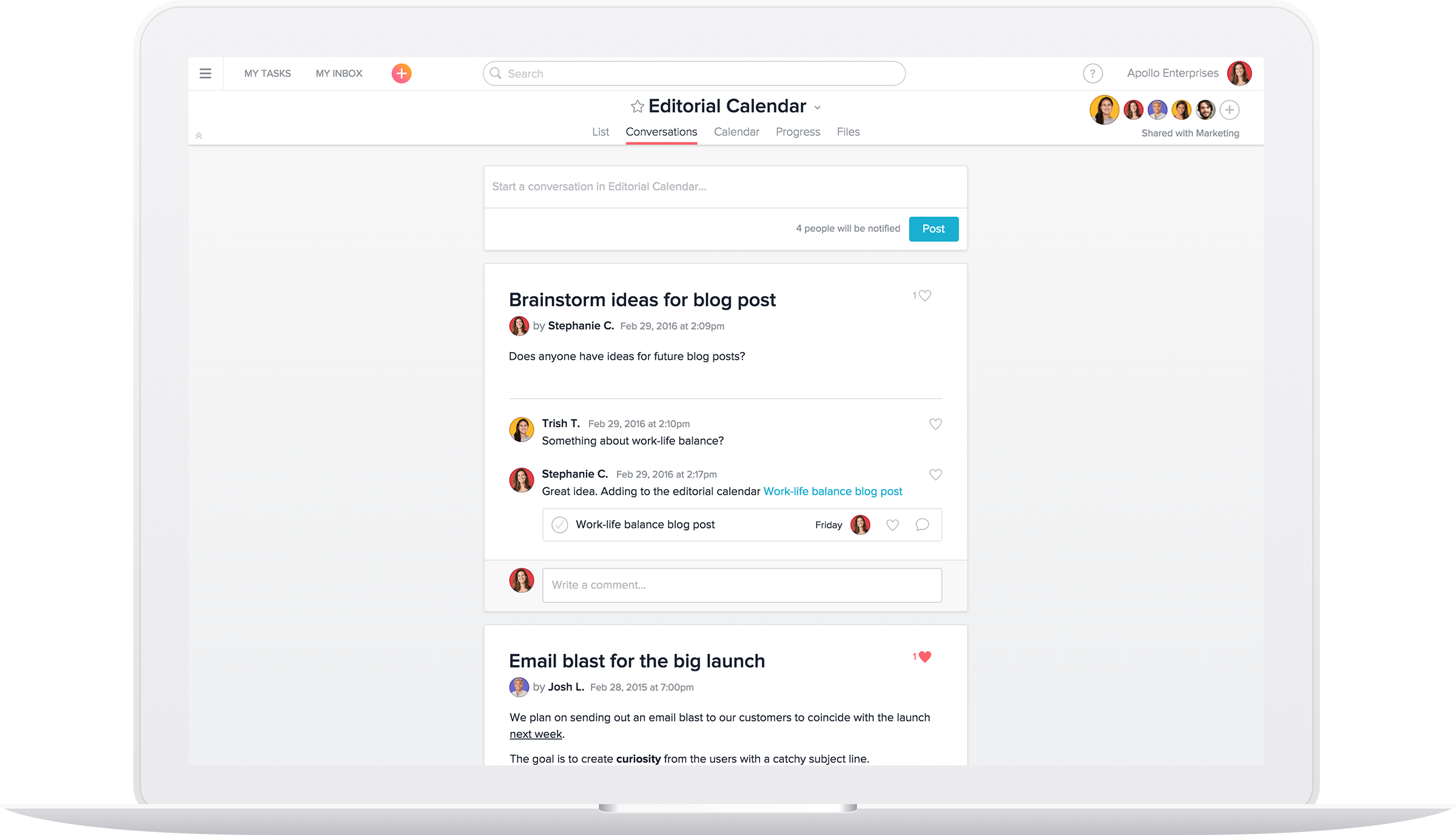
Asana is a web and mobile project management app. With tasks, projects, conversations, and dashboards, Asana lets an entire team know who's doing what by when, enabling workload balancing. Users can also add integrations for GANTT charts, time tracking and more.
$13.49
per month per user
Slack
Score 9.0 out of 10
N/A
Slack is a group messaging or team collaboration app that aims to simplify communication for businesses. Features include open discussions, private groups, and direct messaging, as well as deep contextual search and message archiving, and file sharing. Slack integrates with a number of other tools, such as MailChimp, Dropbox, and Google Drive. Slack was acquired by Salesforce in December 2020.
The product is free to use, and also has paid plans with more features and greater controls.
The…
$8.75
per month per user
Pricing
Asana
Slack
Editions & Modules
Starter
$13.49
per month per user
Advanced
$30.49
per month per user
Enterprise
Contact Sales
Personal
Free
Free
$0
Pro
$7.25*
per month per user
Business+
$12.50*
per month per user
Enterprise
Contact Sales
Offerings
Pricing Offerings
Asana
Slack
Free Trial
Yes
Yes
Free/Freemium Version
Yes
Yes
Premium Consulting/Integration Services
Yes
No
Entry-level Setup Fee
Optional
No setup fee
Additional Details
A discount is offered for annual billing.
*Per active user, per month, when paying once a year.
Pro is $8.75 USD per active user when paying month to month. Business+ is $15.00 USD per active user when paying month to month.
More Pricing Information
Community Pulse
Asana
Slack
Considered Both Products
Asana
Verified User
Account Manager
Chose Asana
I'd choose Asana as a solution in case I need to deal with project management and working with other people. In case I need to also have private conversations with anyone involved in a project, I'd prefer Slack. And in case I'd like just a task management tool without too …
Against Jira it offers a more modern experience with less complex user interfaces. The admin and setup experience is also way faster with less (or no) legacy complexity.
Against other modern players like Linear and Basecamp it offers way more integrations so we can pull in data …
We have a lot of different software available and different teams are using different products. I think Asana is comparable to many of the other software that we use. It was slightly less intuitive than I would have expected, but it did help keep everyone updated on the project …
Asana is a top-tier project management software that helps us organize and track projects from start to finish. It allows us to apply tasks/to-dos to multiple projects without duplication, divide complex projects into smaller tasks, and track project progress. It also helps us …
Verified User
Manager
Chose Asana
I believe that Asana is more professional than Trello. I used Trello a long time ago, but it looked more suitable for a student project rather than for a professional team or business environment. I believe it has great features to help companies in different stages and of …
Asana is cross-platformed and is easy and quickly reachable via a web browser.
It has permissions, filters, reports, tags, comments, etc. All these features allow tracking day-by-day activities of the team as well as weekly/ monthly milestones and reporting.
I have used many tools for project management but Asana is the tool that has fulfilled my all requirements and given me satisfying and reliable services at a good price. I easily manage all projects and track them in
advanced ways. [I] highly suggest [this] tool, I assure you …
I have been using Smartsheet for a similar project management usage with a customer of ours. Asana is way better than Smartsheet with a much better user interface and experience.
We are evaluating Forecast as another project management option. The benefit of Asana is that is it usable on mobile whereas Forecast is not. Asana is also more affordable, making it easy to add teammates and clients. Since Asana does not manage resources/time allocation like …
Basecamp is more for individual work tasks and it fails to provide an overall bigger picture of how the project is going as a whole. I like Asana much better because it gives visual cues to let you know whether you're going to hit a deadline or if there are bottlenecks in the …
Personally, I didn't have a say in this as I had not started at the company when the team decided on Asana. That said, I have used monday.com, and we also have JIRA, which is used by our dev team, and us occasionally if we need to. JIRA has too many bells and whistles and is …
We tried Trello, Wunderlist, and Producteev, but at the time, none of them had the feature set that Asana offers. The main requirement we had was the ability to create projects and subtasks with individual due dates and assignments. Asana was the only one that allowed us to …
Asana has a task list, Trello doesn't. Asana has different views, Trello only has one. The Asana mobile app is amazingly easy to use. Trello can be confusing for some people. Trello is free for unlimited users, Asana requires payment for more users and integrations. Trello also …
Asana is so much better than Wrike. Wrike has a lot more customizability, but it's too much. Asana keeps things very simple and can include a litany of integrations to help me get the most out of my needs. Wrike, from what I remember, also uses more resources from my computer. …
Asana shines as a project management tool. It far exceeds other comparable programs as it has and is constantly adding new features for its free and premium users. The program is consistently adapting to market needs, keeping it viable as a project tool that can be utilized by …
There were a combination of factors that led us to decide on Asana, including ease of use and external system integrations, but primarily we could use it across geographically distributed offices successfully and incorporate a variety of end user work flows based on global …
We “beta” tested several softwares across our company. Asana was a great fit for our small corporate team. But when we rolled it out company wide, it didn’t stick. We eventually ended up using Airtable - which has worked out well for us.
Lead Graphic Design Specialist/ Social Media Marketer
Chose Asana
Asana and Monday are similar in that they are both task tracking softwares however I feel that Asana is a bit too simple for our team as opposed to Monday. Asana is great for a small to medium sized team, we are looking for a software that we can use across multiple departments …
Honestly, the two listed are a bit different and are used for a lot of different reasons, but Asana has a very streamlined focus on project management, where as Dropbox and Google Dropbox has a lot of different uses that could include project management.
Slack helps me with integration with the above selected and I get notified with updates from them. Better UI for chat compared to Asana and Google Workspace. Closed environment due to workspace.
The level of complexity for Power users is unparalleled in Asana. The only advantage Google Chat has is its linkage with Gmail, another indispensable tool. Google's meetings are better and connectivity-related issues are fewer. Microsoft Teams too is similar to Google Chat is …
Asana makes project management easy but not the communications. When you're working with remote or global teams, it's necessary to have options in an app to channel work and communicate efficiently.
Slack is a much better product, in my opinion! It’s much easier to use than other products, even though it may be similar enough. I would rather use it than any other product like Slack. Our team loves it and it integrates well with other apps like Asana or gmail.
Asana is better at due dates and tasks for items. Slack is better for internal communication and "check-ins." I also haven't been able to schedule messages in Asana or do Gantt charts in Slack. Wish the two were integrated!
The other platforms have valuable features (like progress kanbans and storage for big files) but none of them work on their own. Slack is the central hub that we use for all communications, discussions, and meetings.
Slack excels at versatility and ease-of-use. Everyone knows …
To me, there is no competition between Slack and Microsoft Teams. In my opinion, Slack crushes MS Teams in every regard and is a pleasure to use. I think MS Teams on the surface looks like it has a comparable feature set, but when you actually USE the app, there's no question: …
Slack is far better. It has better features. It’s easier to use and the pricing is usually better. It is far more superior in terms of usability on boarding sophistication of the features and user experience. it makes it very easy to scale and the pricing is very good. I would …
Slack is like an advanced version of any tool that I've ever used in the past. It's super simple and clean and makes chatting and organizing tasks, projects and content super easy. I think every company should be using Slack if they want to truly have their team be the most …
Microsoft Teams is one of the other tools that I've evaluated in a professional context. Compared to Slack, it feels a bit clunkier and bland. Slack feels vibrant and full of personality that can vary from workplace to workplace. Teams is also a far more expensive solution to …
Slack is better in all aspects such as I can join channels related to my specific role, projects, or interests. I can communicate with colleagues, share updates, and ask questions. I can attach documents, images, or code snippets to conversations. I can contribute to ongoing …
Slack’s cross-platform accessibility—whether on desktop, mobile, or via API—makes it highly adaptable for various teams, ensuring it's a comprehensive solution for modern collaboration needs. All these factors contribute to its top-tier usability, making it a favorite for …
For internal/team communications, Slack is by far the best app I've worked with. The channel system is very simple yet very intuitive. As a result, the app is extremely easy to get familiar with and use daily, even for members of our team who are not very tech-savvy. Slack is …
- MS teams Vs Slack - Slack athread View is incredible - API integration helps with our product - Multiple Domains Login is seemless - Google Chat Vs Slack - google is too messy. Great for chatting and productivity as individual tools. But as integrated productivity …
Slack is great for communicating with our remote team across the country. It keeps our teams connected when working on multiple projects and initiatives. Slack has more connectivity options than Google Meet, making it a valuable tool. Since we use other products, integration is …
This product is much more user-friendly than Teams. I feel that it has many more useful features. My team uses this product daily and we have been very happy with the results.
Verified User
Analyst
Chose Slack
Slack is very good compared to many other tools and I feel that it is much better and user-friendly than other platforms that I have used. slack is good with communicating and a majority of our projects come out with great success and very few options for room for improvement
Slack is way more organized than WhatsApp and for sure a best solution for companies looking for a platform that they can rely to never lose sensitive information.
Slack was so simple to start using--super easy integrations with Jira, Sharepoint/OneDrive, and our PM tools--that it was a no-brainer. The video was glitchy, especially for any users who had iffy upload speeds (which isn't Slack's fault entirely, but they did not have as many …
Slack and Microsoft Teams offered me very similar characteristics, both offered me a wide communication with which I could have a consistent interaction with my entire work team, they also offered me the possibility of making video calls with my coworkers, however, the reason …
The usability of Asana is broad since it's available in a variety of platforms that are widely used nowadays. I think that it would be great for people who are constantly on the move and switching devices, since it has allowed me to work from my phone, too. I also think that Asana has proven itself to handle a large quantity of work
Slack is ideal for Scrum and agile teams that need continuous communication during sprint planning, daily stand-ups, backlog refinement, testing, and retrospectives. Slack is well-suited for maintaining team knowledge through searchable conversations and dedicated channels, where experienced team members help onboard new QA analysts.
Through it, we were able to communicate and cooperate with the rest of the team to complete the work in the required manner and at the appropriate time.
Customer issues: Threads feature allows us to group a particular issue in a single thread and discuss within that thread. I can use the thread link to embed in JIRA ticket for tracking progress in JIRA (which is our details engineering tracking system).
Ability to add folder to Slack channel helps keep important information, documents easily accessible. e.g., we use this to keep a "ramp up" folder that can be used by any new joiner.
Global search is effective when I forget which group a particular message was in.
Would love a better integration with GitHub. For example, notifications when your PR is updated, when review is requested, @-mention in comments, etc.
Improved "Later" tab, for example the ability to create to-do lists or making the "Later" tab into a more powerful to-do list (annotate items with notes)
More powerful integrations, e.g. Google Calendar could render a calendar view within Slack, rather than sending the daily schedule
To be more transparent, I give 10 because Slack serves our collaboration needs. It provide us a good platform for team communication relaying important update within the company, it has even mobile app where you can install in your phone to monitor any updates within that team that needs your immediate attention and intervention.
It is very user-friendly. Takes a new employee an hour to start figuring out how the system works. That's an important factor. You don't want to encounter the issue where employees need a week to understand how the system works. For example, JIRA, I tried using it for a week and I still don't understand the complicated layout. Asana has a simple interface. Once you see it, you get it type of program.
Slack has good usability. Devs that are not familiar with the platform are able to jump into conversations and start sharing code and links within just minutes. Non developers are also able to understand the layout such as the Project Managers that are keeping the projects on track. We have not seen any tickets where employees are having trouble understanding Slack.
Yes, the app works 24/7. I don't even recall having any period that we could not use since the implementation. Even the maintenance periods are barely noticeable and our work is not impacted by it when it happens.
Slack is a soft app, we don't have many issues with it. I recall one or two people complaining about something during our usage period, but I didn't have a bad experience. When the app is slow, usually the problem is with my computer or my internet. The app works just fine.
I haven't had to use their support so I can't rate it. The fact that I haven't needed them reflects the ease of use of the product. I would recommend that any new users schedule a complete demo of the product to ensure that they are using it to it's fullest (there's a lot of useful features).
Whenever I've had to troubleshoot an issue with Slack (which, to be honest, has not happened very often), their online documentation has been easy to locate, easy to understand, and effective in resolving my issue. Slack's ever-growing popularity also means that there's a large community of practice out there that can be depended upon.
Asana is a top-tier project management software that helps us organize and track projects from start to finish. It allows us to apply tasks/to-dos to multiple projects without duplication, divide complex projects into smaller tasks, and track project progress. It also helps us organize work on Kanban boards or linear lists. It stands out from the crowd in a big way compared to the competition.
I like Slack better than ClickUp, because I would spend 30-60 minutes a day updating my ClickUp tasks. The way ClickUp was used was very micromanaging. I billed by the hour, so I was willing to put in the time to alert the boss what tasks I was working on.
One of my jobs used Hive - I mostly just ran it in the background in case anyone messaged me. I did not use it often.
Slack has been incredibly helpful in connecting various tech apps and ecosystems, creating a more streamlined and responsive process.
Slack has made it significantly easier to communicate with our team members across multiple time zones, creating a more engaging environment for our all-remote team.